Really. The point of doing any moral action is to solve a problem that is hurting someone. The point of ethics is to help us fix things.
Does arguing with your racist family make the world a better place? I super doubt it! If people could be argued out of racism then I think by now there wouldn’t be any racists.
That makes arguing with your racist family not the domain of ethics. That doesn’t mean you shouldn’t do it – if it makes you happy, or lets you stand up for someone else in the room, or makes for a great post on the internet later, you can totally do it even though it won’t help. But you don’t have an obligation to do things unless they make the world better. And if arguing with your racist relatives will make you miserable, change their mind not one bit, and help no one – well, then, not only does that not make the world better, it actively makes the world worse, since worlds where you are miserable are bad. It is morally important that you not be miserable.
If you have family members you’ve successfully had productive conversations about tough issues with in the past, a good way to approach them would be to find a time when you can talk one-on-one (rather than confronting them during a holiday when everyone is tense, stressed, and crowded). If you don’t have family members who you’ve successfully had productive conversations about tough issues with, then I’d focus your energy and your desire to do good in the world on convincing easier targets.
As someone with racist, homophobic, xenophobic family:
I think that a lot of The Discourse has forgotten that in the case of progressives who actually have these family members, we often have no choice in whether or not to deal with them, and we know we are never going to change them. Oftentimes this is accompanied by people pulling rank in the family and lots of “oh, nevermind him, he’s old.” This is actually going to be worse for most of the younger people on Tumblr than the older people who’ve been on their own and have been able to choose which family members they associate with.
I’ve been seeing a lot of threat posts lately and honestly? Fuck that shit.
People could have made nice posts but no – y’all gotta go and give people anxiety.
No-one needs to reblog bupkis.
There are certain stories told around the campfire that transcend
from whispered words to pure legend. There are also tales retold in the
veterinary sphere, obscuring confidential client details of course,
which seem unbelievable at first but certainly happened somewhere, some
time.
This is one of them.
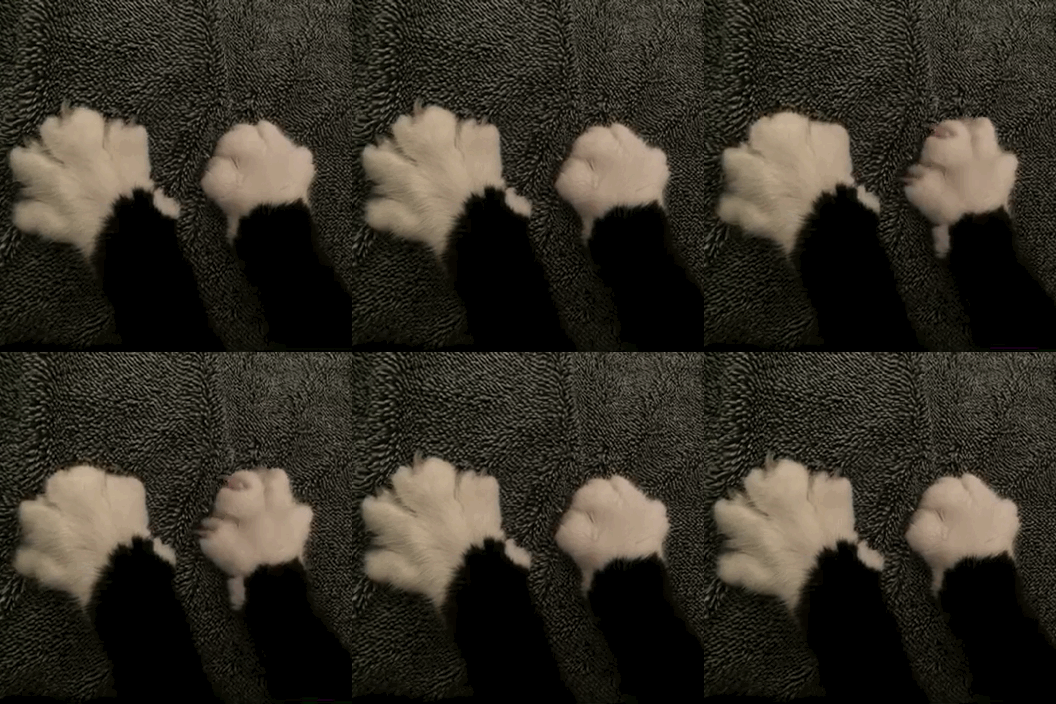
Once upon a time, a young family had a black and white cat named Sox. They had absolutely been planing to desex and microchip Sox, but life unfortunately got busy and Sox went missing before they could get this done.
After a week of searching, they very luckily found Sox at the pound. Sox was desexed and microchipped before being released, and they gladly took their cat home.
I used to think my daddy was a black man With script enough to buy the company store But now he goes to town with empty pockets And his face is white as a February snow
I was born and raised at the mouth of hazard holler The coal cars rolled and rumbled past my door But now they stand in a rusty row all empty Because the L&N don’t stop here anymore
The line here where Jean says she “used to think my daddy was a black man” because he was covered in coal dust might sound like some sort of racist blackface-type reference today, but the implications to the line in the context in which she originally sang it make it really incredibly progressive. Jean Ritchie is a white woman in Eastern Kentucky comparing her father to a black man- comparing the plight of exploited Appalachians with the even greater plight of Black Americans- in the year 1965. This line would have been extremely controversial at the time and place, not as a racist line, but as an explicitly anti-racist line signaling solidarity between poor whites and black people.
Many younger Appalachians in the 1960′s were swept up in the rising left-wing protests and student movements of the time (it still shows today, with a significant number of retired hippies residing in various pockets around Appalachia today). There was a rekindled spark of class consciousness among young Appalachians at the time that led many towards explicitly anti-racist progressive politics. Some most notably founded the Young Patriots Organization that allied with the Black Panthers and joined Fred Hampton’s Rainbow Coalition; around the same time, other young Appalachians played a significant role in MLK’s Poor People’s Movement. Jean Ritchie, in her 40′s at the time, was one of these Appalachians: she wrote songs about poverty and environmentalism while performing alongside leftist folk icons like Woody Guthrie and Pete Seeger. Ritchie had to release this and other political songs under a pseudonym (Than Hall, after her maternal grandfather, Johnathan Hall) to avoid upsetting her apolitical mother, and because she “felt that they would be better received in those days if they came from a man.”
We need to get around to realizing that genetic modification isnt contamination, or carcinogenic chemicals, or sludge, or evil godless mutations. They aren’t horrifying and they’re grown natural just like everything else.
But, I can’t help but note the irony in saying, “all citrus fruits are GMO hybrids,” while accusing other people of not knowing what they are talking about, because hybrids are not GMOs. Also, “the potato” isn’t genetically-modified: a handful of patented cultivars of potato are. There are thousands more non-GM cultivars and landraces at the International Potato Center in Peru, for example, some of which are resistant to late blight.
Many people (and I include myself in this category) are critical of certain genetic engineering projects as they relate to agriculture because we are concerned with:
the ecological impacts of things like genetic bottlenecks and genetic drift;
insecticidal resistance and improper use of pest refuges;
an increased dependence on monocultures of a narrow range of cereal crops;
the global depletion of agricultural diversity, and loss of sustainable indigenous food sources;
the increased cost of GM seed, and intellectual property/licensing costs for said seed driving the consolidation of smallholder farms into corporate hands;
software-like ‘user agreements’ with seed preventing transparent, peer-reviewed science from happening in evaluating these crops;
the lack of accessibility of genetic engineering techniques and equipment;
the ownership of most of the world’s seed supply between 3-10 multinationals
and, the moral implications of patenting biological organisms.
I know there are some weird and terrible anti-vaccer types drawn to the anti-GMO brigade, but fighting misinformation with more misinformation isn’t helpful. There are a huge number of political, ecological, and legal concerns to be sussed out in this relatively-new field of science, and it’s not helping the debate to add to it without understanding some of the basic concepts being debated.




 Urocyon's Jaunts 2.0
You must be logged in to post a comment.