People have no idea what I do to try and help the planet. They have no clue the lengths I go to to live in an environmentally friendly house and to minimize my impact on the earth.
I even wrote a god damn article about environmental activism vs performative activism in the Zero Waste movement, and gave examples on how to live a more eco-friendly life.
It’s ugh, it’s whatever. People are going to complain no matter what. At least I’ll be hydrated while they do it.
Are y’all five and can’t drink from a glass without a straw?
I have profound nerve damage in my face and throat that prevents proper muscle function. I also have cfs and other muscle problems. I recently discovered that using straws helps to alleviate some of the pain and difficulty out of being able to drink fluids, because it puts less strain on certain muscles. This means that for the first time in over two years, I have been able to finish a glass of water without choking. So no, not five. Just very fortunate to be alive.
The use of plastic straws by disabled people became a moral detriment suitable for public shaming before lack of accessibility became a moral detriment suitable for public shaming.
My disabled YouTuber friend now gets harassed when she uses a plastic bending straw (an accessibility tool, something she NEEDS in order to drink, no alternative currently works) in her videos.
Reminder right here: no matter how someone looks, their disability will not always be apparent to you.
But when my disabled friend is denied emergency evacuation plans out of a building because the elevators get shut off and she uses a wheelchair, does the building owner get shamed or harassed? No.
Those are the power dynamics at play here.
Imagine if ableds cared about accessibility as much as they care about banning plastic straws.
“Imagine if ableds cared about accessibility as much as they care about banning plastic straws.”
Virtual Eye Pod, 2018. As part of their on-going research into self-driving vehicles Jaguar Land Rover are employing self-driving pods that have large ‘virtual eyes’ to interact with other road users. The intelligent pods run autonomously on a fabricated street scene in Coventry, while the behaviour of pedestrians is analysed as they wait to cross the road. Research suggests that 63% of pedestrians worry about how safe it is to cross the road with the advent of autonomous vehicles. The ‘eye pods’ have been designed to help work out how much information self-driving cars should share with users or pedestrians to ensure that people trust the technology.
I think something more … robotic … could convey the same information without falling into the Uncanny Valley like these do.
[Image description: a photoset of a large, truck-like autonomous vehicle at the crosswalk of what looks like an underground garage or tunnel. The vehicle is painted white, orange, and black. On the front of the vehicle, just above the windshield, are mounted two, round, cartoonish, eyes. The first, second, and third pictures in the set show a woman with long blonde hair approach, and cross, the crosswalk; the vehicle’s eyes move to follow her. Description ends]
People using wheelchairs, trying to navigate crowds of other people, have a similar problem: being ignored, having people walk into our paths without warning, etc.. My aide has said that’s because people using wheelchairs are below the sight lines of most ambulatory people, so what should I expect?
But, funnily enough, ambulatory adults seem to have no problem at all making room for ambulatory children. My suspicion is that most normates put wheelchair users in the same mental category as robot cars: they forget that we are autonomous beings, capable of movement (and heavier than they realize, and not able to react to changes as quickly as they can).
So, awhile back (a search of my Dreamwidth Journal reveals it was just about nine years ago), I got the idea for mounting some sort of “puppet” with a moveable head, mounted at the eye line of the worse offenders in crowds (about 5 feet / 1.6 meters–typically an adult, able-bodied, male – surprise, surprise) that would turn in the direction I’m moving my chair… almost exactly like these “Eye Pod” vehicles.
In any case, as the person with the strongest vested interest in
crowd control, having this falling into the Uncanny Valley is exactly what I want my puppet to do, if it makes people go: “…Oh… erg,” and back up half a step as I approach.
My simplest idea is a to have the head be an emoji-like face – something the brain registers as “human” almost instantly.
My most elaborate idea is to have it be a fully automated dragon puppet, “perched” on the back of my chair, with a flexible neck, roaring sound effect, and a mouth that opens when it roars – to reveal long teeth, and glowing red lights in its mouth. Maybe even movable wings, so I could dope slap those fools who are being particularly obnoxious (ridiculously unrealistic and impractical … But a girl can dream).
laws about minimum wage should apply to disabled people
laws about minimum wage should apply to incarcerated people
everyone deserves a fair living wage for their labor
wait, they don’t???
Not even close. Disabled folks can be paid as little as $1 an hour in some cases at whats called “subminimum wage.” Prisoners are sometimes forced to work without pay at all.
Hi, I am an attorney in the disability field. Many disabled folks make well under $1 an hour in what are called “sheltered workshops”. There are only three states right now that require people with disabilities to be paid at least minimum wage, and they are Alaska, New Hampshire, and Maryland. Goodwill is a major offender, but there are many, many others.
Also minimum wage actually needs to actually be a fair living wage.
Another especially horrific thing about this:
Sometimes voc rehab counselors will… strategically avoid saying much about a sheltered workshop not having opportunities for advancement.
So people will assume that their low pay and dull tasks are temporary and that they can earn promotions or raises, when actually those things are pretty much nonexistent.
So you get people being like “I’ve done this for 20 years, why have I never gotten promoted?”
“Did these people [in academia who claim that they are not exposed to disabled people] realize that when they encountered the work of Rosa Luxemburg (who limped), Antonio Gramsci (a crippled, dwarfed hunchback), John Milton (blind), Alexander Pope (dwarfed hunchback), George Gordon Brown (club foot), [Jorge] Luis Borges, James Joyce, and James Thurber (all blind), Harriet Martineau (deaf), Toulouse-Lautrec (spinal deformity), Frida Kahlo (osteomyelitis), Virginia Woolf (lupus), they were meeting people with disabilities? Do filmgoers realize when they watch the films of James Ford, Raoul Walsh, André de Toth, Nicholas Ray, Tay Garnett and William Wyler that these directors were all physically impaired? Why is it when one looks these figures in dictionaries of biography or encyclopedias that their physical disabilities are usually not mentioned – unless the disability is seen as related to creativity, as in the case of the blind bard Milton or the deaf Beethoven? There is an ableist notion at work here that anyone who creates a canonical work must be physically able. Likewise, why do we not know that Helen Keller was a socialist, a member of the Wobblies, the International Workers of the World, and an advocate of free love? We assume that our ‘official’ mascots of disability are nothing else but their disability.”
— Lennard J. Davis, Enforcing Normalcy: Disability, Deafness, and the Body (via irwonder)
(This is a draft for an article I’m submitting (by request) to a Canadian Student Christian Movement website. I recently posted a version of it on Facebook and thought some of you might like to read it. The title isn’t great or original, and I’m looking for a more clever pun. Hmu.
For the last couple of months, there’s been talk of a ban on plastic straws, or even all single-use plastics. The impetus was simple: plastic waste was a real cause of suffering and death for marine animals, and a threat to the general sustainability of life on earth. It’s production is a major factor in carbon emissions. No one was arguing that point. But there was a group speaking out against the ban that is often overlooked in these kinds of discussions. With the power of social media, they’ve made themselves heard: disabled people.
You see, when you have limited or no control over the muscles in your mouth or hands (or you don’t have the latter), drinking can be a hassle. Virtually the only way to drink unaided from a cup can be a bendable straw, which are currently made from plastic. Re-usable metal straws or compostable bamboo straws will benefit some people, but for others, their pointiness can be a hazard. Plastic straws are cheap and readily available everywhere, meaning that it is one of those accessibility concerns that rarely take a second thought. A ban on plastic straws would change that. And people with palsy, spinal damage and Parkinson’s disease were not shutting up about it. Amazingly the responses, if they came at all, were not always understanding.
I’ve seen commentors on friend’s FB pages say things like ‘I’m not going to kill the planet for the convenience of some disabled people’ and I’m sure that’s not an uncommon sentiment. This ignores of course that a) drinking unaided is not a convenience but a source of dignity and a material need for most of us. And b) while the impact of plastic straws is bad and easy to personalize, they are hardly ‘what’s killing the planet’. 46% of the famous ‘Trash Island’ is composed of fishing nets. But so far, the fishing industry hasn’t had to deal with a ban.
This is just the first time the concerns of disabled people have gained serious traction in a debate about saving the Earth. The pattern is typical though: a lot of environmentalism puts the burden of saving the planet disproportionately on the poor and disabled.This is not usually the result of malice, but rather ignorance (although persistent and, as in the example above, sometimes willful). Environmentally sustainable products are often more expensive and require more human power, time and effort to use. Resources the rich and abled simply have more of.
Interestingly, the poor and disabled rarely get credit for all the environmentally destructive behavior they can not engage in if they wanted to. Biking to work or not taking a plane on vacation is only considered an admirable sacrifice for the environment if you have the option of doing those things. But if you can’t do those things, but you also need a plastic straw to drink? Or you can barely afford food, let alone sustainably produced items? Or you don’t have the free time, money or hand-eye coordination to forgo any other convenient, cheap, ‘wasteful’ products? Then a lot of environmentalists will blame you, personally, for the destruction of the earth.
On balance, carbon footprint and negative impact on the environment correlate with wealth. Rich people are not only usually more wasteful than poor people (because they can afford to be, and live in places where the effects of that waste are not as noticable), they also by definition have more control over the industries and regulations that truly govern the amount of pollution, overconsumption and waste that ruin the environment. This is how places like Europe can enjoy a higher standard of luxury while still having stricter environmental and labor regulation than other places: we’ve outsourced the social and environmental costs to Asia, Africa and South America.
Food waste is a political problem. Carbon emissions are a political problem. Child labor is a political problem. These are not personal moral problems that you can disinvest from and be done with it, judging everyone else.
The market will not ever solve these problems. They are a result of the market: they are byproducts of policies that are very profitable to rich and powerful people who can avoid these negative consequences. The market will only succeed in hiding the issue. Usually by relocating to a poorer place and some good marketing. The true solution will only come from a sense that we, as a global community need to reorganize the way we produce and distribute goods and services.
Small tasks are things like changing the rules about food waste so that corporations can’t just deliberately throw food away if they could just as easily have given it to starving people. Possibly setting up a distribution system to make that happen. Maybe disincentivize overproduction by farmers by changing subsidies. Making companies that use forced or inhumane labor practices criminally liable.
Larger things are like: how to transition to an economy that is not based on fossil fuels while minimizing the opportunity for massive poverty and violence. What are the alternative ways to produce energy and plastics? If there aren’t any feasible options, who has to sacrifice what? If we let the market decide, we already know the answer. And it will not be everyone equally.
The inevitability that our current way of life is going to become impossible means that we have to think of new ways of life, not just as individuals, but as a society. It would be really nice if it did not rely on everybody spending more money, and doing more stuff by hand. Not all of us have money. Not all of us have hands.
(for the record: I have both. That is not the point.)
Damage to the environment and unethical business standards are systemic and in the hands of very few people at top and large global businesses. At the individual level the impact we have is minimal but that does not mean that our choices do not matter.
I choose to buy cruelty free, ecologically friendly produced products and recycle. I do my best to keep food waste low and avoid excess packaging.
But I understand that these things are not easy for everyone to do. In fact what I do is limited by time, money and my mental health. The only way we can help reverse the damage we have done to the earth is to play our part as best as we can and understand that not everyone can do everything in the same way.
Flexible straws as an accessible element for those who require them is a tiny drop in the bucket compared to all the other things we can and should be doing to help the environment. And perhaps someone can find a way to make straws out of a fast biodegradable material with the same properties of current bendy straws? Rather than hurting members of our community we need to be focusing on the future with an eye on adaptability and innovation.
So if you don’t need a straw, refuse it. Otherwise leave those who do alone and go about your day conscious of your ecological impact and don’t forget that the biggest problem is a few filthy rich people and some giant corporations.
A while back a ton of people saw a video of a turtle with a straw stuck up its nose. I was one of them. It was very sad.
So when places started proposing we ban plastic straws, I was like…
“Yeah! Fuck straws!”
But then the disabled community spoke up and tried to inform everyone that plastic bendy straws are essential for people with various health issues. Without them, people might end up having to make the choice of whether or not they can consume liquids in public. And that really sucks.
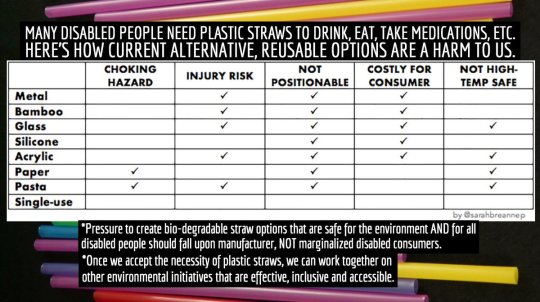
This community put a lot of thought and research into this and was unable to find another material that could be a suitable replacement in every circumstance.
They proposed a system where you could just ask for straws rather than places giving them out all willy-nilly. This would still reduce the use of plastic straws significantly without screwing disabled folks.
I assessed this new information and…
I CHANGED MY DAMN MIND.
*gasp* “The Frogman is a flip-flopper!”
Naively, I figured most people who consumed this new information would do the same.
But it ended up being a mixed bag of mostly sullen disappointment.
As I read the comments on various articles I noticed a weird phenomenon where people magically transformed into materials scientists.
Disabled groups thought long and hard about this. These groups did some great in-depth research. And all these groups pretty much came to a unanimous consensus that there are currently no satisfactory alternative solutions. They also found that plastic straws are actually a drop in the bucket of our waste issues. Furthermore, the “straws on demand” solution would make that drop pretty frickin’ tiny. The overall risk to turtle noses would go way down.
Despite seeing these conclusions thoroughly presented to them, people would think about the issue for about 30 seconds and be like…
“Okay, but what about paper straws? What about reusable straws? What about this? What about that? I have a metal straw that works great! Surely that will do!”
These internet dunderheads actually believed their 30-second brainstorm would come up with a sufficient solution that has not been thought of yet.
As if the entire disabled community is going to be like, “We did all of this research, spent all of this time looking for alternatives, committed all of these resources to spread our conclusions, BUT WE NEVER KNEW ABOUT PAPER STRAWS! Thank you, kind stranger! You have single-handedly solved this dilemma!”
I just have trouble wrapping my head around the kind of ego one must have to think they could solve an issue like this with an internet comment.
What makes it worse is some of these “what about” comments would be replies to actual disabled people. These sudden experts in the science of materials would start suggesting straw alternatives. And these disabled folks, who are probably exhausted and at their wit’s end, must decide if they should give these individuals explanations of why these genius suggestions won’t work for them.
“I know you aren’t feeling well, but can you do all of the research for me so I don’t have to spend 2 minutes googling shit?”
And when you try to tell these people they are being ableist and kinda shitty, they act like a wounded animal. Suddenly they are the victim. THEY WERE JUST TRYING TO HELP! Not trusting people who live with these problems is the height of privilege. And forcing them to make their experiences relateable while remaining calm and polite is exhausting.
Then someone made this amazing chart that couldn’t possibly make it any easier to comprehend.
And people were still responding to it with…
“OKAY, BUT WHAT ABOUT…?”
In conclusion…
IT’S OKAY TO CHANGE YOUR DAMN MIND.
Also…
YOU’RE NOT AS SMART AS YOU THINK YOU ARE.
(Unless you actually are a materials scientist and you are developing an alternative as we speak.)


 Urocyon's Jaunts 2.0
You must be logged in to post a comment.