* * * This post may trigger paranoia or delusions about surveillance, so it’s totally okay to skip it if it will set anything off. * * *
I just ran across a Youtube channel where the parent of a young adult (YA) with schizophrenia (or it could be schizo-affective disorder? YA is 18-ish) posted surveillance footage from inside YA’s bedroom. YA was either in a hallucination or a delusion where they were doing some kind of martial arts moves and holding their shoes like weapons. It looked very similar to somebody playing pretend, but I’m sure YA was in combat with somebody real to them.
The parent says YA is medicated, but they still sometimes hear voices and often talks about going on adventures with a team that battles aliens or solves mysteries.
The parent says they have a nanny cam monitoring YA’s bedroom for YA’s safety, but I don’t know if YA is aware of the cameras or that the footage of their behavior is being posted for the world to see. (I’m avoiding linking because I don’t want to expose YA any further.)
The parent who posted the video is struggling with mental health issues themselves (depression) and has to keep a household with more than one disabled person afloat, one of which is their spouse (debilitating migraines). Their kids, including YA, are all autistic with comorbidities that complicate their needs. I think YA is the oldest, but I could be wrong.
The parent sounds like they try very hard to understand issues like autism and mental illness, but I feel like them posting YA’s adventure to be a serious breach of trust and privacy.
I don’t have schizophrenia or schizzoaffective disorder myself, but I’ve heard a frequent paranoid delusion you can have is that you’re being monitored by somebody for a million different reasons.
My question:
Does recording and posting videos of YA’s behavior during hallucinations / delusions (potentially) without their knowledge / consent risk intensifying symptoms or triggering new ones?
I try not to get overly frustrated when people make suggestions re: my health because I know a lot of the time people are genuinely caring and trying to help. Sometimes the things people have told me about have been truly helpful and I’m extremely grateful for that.
But when your idea of “help” is to suggest something so basic as “take an allergy med”, what that actually tells me is that you don’t believe me when I tell you I’m already doing everything I can to survive my body going off the rails and into this downward plummet, and think I’m just not trying hard enough.
The conversation I’ve just had was this:
“Have you tried taking zrytec? I hear it works really well for allergies.”
“Oh hi, and yes. I take zrytec and 3 other meds, carry an EPI pen and wear a face mask, and sadly I still get sick. Thank you though, for trying.”
“Weird. Maybe you should talk to a doctor? They might be able to determine what you’re reacting to.”
“Yes, I’ve done that. They prescribed the meds, the Epi pen, and the use of the face mask.”
“Well, are you sure you’re taking the zrytec right?”
“Yes.”
“Cause you really shouldn’t still be that bad if you’re taking it right.”
“I am sure I am taking my meds right, thank you. If I wasn’t there’s every chance I’d be dead. Please stop asking me that.”
“Wow. Rude much? I was only trying to help.”
Except no, you weren’t. You were trying to be RIGHT cause there’s no way the sick person could actually be taking care of themselves and still struggle, right? There’s no way you can eat right, exercise and meditate, and still get sick, right? It must be something I’M doing to deserve this and if only you could figure it out you’d get to be a saviour. So you suggest the simplest, most common sense thing and adamantly repeat that if you are doing this, then that cannot be happening. It’s a lie. It must be, cause otherwise that would mean some things just happen to people without rhyme, reason or mercy. And one day that person could be you. No, no, that can’t be true. It’s you, you’re at fault. Are you sure you’re taking your meds right? Sure, really, really sure?
Yes. I’m god damn sure.
Also, I’m not here to be a personal learning curve for you on how not to be shitty to sick people.
I’m not a simulation with endless patience and resources to spoon feed you on why sick people deserve to be listened to when we say we are already doing everything within our power not to get any sicker, and nor do I need to disclose my full medical history to you, in order for you to judge whether I’m worthy of being listened to or not.
You are not being nice, you are not being helpful. You are in fact being very rude, and I owe you nothing.
Maybe I’m wrong, but there’s something that feels uniquely American about the mindset that if you’re chronically sick, there must be some reason you deserve it. You must be doing something wrong. You must be not properly taking care of yourself somehow. Or you’re just plain immoral in some way.
It’s so wrong. Maybe I’m wrong and this mindset is common outside the U.S., but somehow I doubt it, at least to our level. Because here in the U.S. medical care isn’t considered a right. Here people argue that they shouldn’t give their precious tax dollars to take care of “some people unwilling to take care of themselves” but don’t blink about funding war after war…
I’m originally from the UK and I can tell you it’s not unique to the US. Even when I had free healthcare I was made to feel like I was to blame for getting sick. Worse, I was a drain on precious resources that could have been used for “actually sick people”.
violence against people who are in psychiatric institutions is not lesser or somehow more deserved if the people who are in institutions “deserve” to be there or “belong” there
aka people who hear voices and and communicate with angels and demons and God and ufos and who don’t feed or clothe themselves don’t deserve ANY form of abuse even the tiniest, slightest, faintest fraction more than someone who was “really sane” and ended up in an institution “by mistake”
furthermore, the ability to institutionalize and abuse “innocent” people wouldn’t exist if the ability to institutionalize and abuse “actually crazy” people didn’t exist
but my bottom line is being “crazy” does not make you worthy or deserving of abuse in any way
It’s a self-perpetuating hole. Employers don’t want to hire disabled people in places where they’ll be interacting with “The Public,”* because it’ll make their customers “uncomfortable.”
And because people aren’t used to seeing us in their day-to-day lives, when they do see us, they get uncomfortable.
And then employers can point to that, and say: “See? We told you so!”
And then, there was this thing that was happening in late summer 2017, where YouTube was demonetizing YouTubers who made videos about Disability (maybe they still are), because it wasn’t “advertiser-friendly” (The fact that it barely made a ripple of response compared to the push-back over LGBTQ+ is rather telling, too).
Here’s a good video about that, from Jessica Kellgren-Fozard (She’s simultaneously signing in BSL and speaking English, and there are also closed captions):
And it’s not just YouTube/Social media, either. When was the last time you saw a disabled person in a fast food commercial, or a commercial for dish soap, or an office supply store? Or as an extra in a crowd scene on TV, or the movies (without turning out to be a secret plot point, just before the climax)?
And, yeah, yeah… not all disabilities are visible. But it’s awfully “convenient” for producers if the only Disability Representation we get is the invisible kind.
This has gotten a spike of fresh notes, lately, so it’s been showing up in my dash notifications. And that’s brought up a further thought:
I remember when I was kid (back in the 1970s) going to a meeting/protest to rally for more representation of disabled people in television commercials (like: why don’t you ever see someone in a wheelchair, washing the dishes? or someone with Down’s syndrome eating at a fast food place?). And the push back from the companies was generally: “But we don’t want people to think that our product will cause disability!”
But then, a bit later, say – early 80s (maybe it was 1981 – the International Year of Disabled Persons)you would see advertisers occasionally include a kid in a wheelchair in a breakfast cereal commercial, or something. But it was always a cartoon/animated commercial (not flesh and blood), and it was always aimed at kids – not adults. ‘Cause, you know: kids have to be taught not to bully each other, and be tolerant (meanwhile, the actual power dynamics they see all around them teach them the exact opposite).
The problem is: this ghettoizes disability as a “Children’s Issue,” when disabled people are routinely infantalized as it is.
I’ll add that occasionally you see a disabled person, an actual, non-animated one, in an ad today… but it is invariably a small child, and almost invariably a small child with Down’s Syndrome. I think I saw an article about a model with Down’s who was not a small child, but again. Disability has more than one form, and I’m willing to bet Down’s Syndrome got made the (ahem) “poster child” for disabilities because of the reputation people with Down’s have for being sweet-natured and thus easy to pity/feel good that “they are achieving so much!”. It’s rather disgusting now that I’m thinking about it. At the same time, I’d rather think about it and work to change things than live in ignorance.
Also: Down’s Syndrome is easily recognizable as a disability, thanks to the common facial features that go with it (so the brand can tick off the “socially inclusive” and “morally upright” boxes), but unlike people in wheelchairs or with missing limbs, their bodies are not the “wrong shape.”
Meanwhile, actual people with Down’s Syndrome are still routinely bullied…
Stop commenting on people’s mobility aids. I don’t care if they look too young to use it. I don’t care if they don’t look like they really need it. I don’t care if they’re not using it like you’d expect them to. You know nothing about their body or why they use it. Them using their mobility aids in public is not bothering anyone. Leave them alone.
On Facebook I recently claimed that it is commonly said: “We should treat addiction the way we treat other mental disorders.” I strongly suspect this is a prevalent claim among liberals who casually support drug policy reform but who know very little about mental health or societal ableism.
And I have responded: “We should not treat addiction the way we treat other mental disorders– because we already treat other mental disorders very badly. Rather, we should treat addiction, and all other mental disorders, much better than we currently do.”
However, in reply, one of my friends has suggested that maybe very few people actually believe that “We should treat addiction the way we currently treat other mental disorders,” and that nearly everyone who supports drug policy reform also thinks we need to treat all mental disorders much better. She thinks I might be attacking a strawman.
So, who is right? Is “We should treat addiction the way we treat other mental disorders” not a common claim? Are there notlots of liberals who are ignorant of the fact that our society treats all mental disorders horribly?
Speaking as a liberal here: I think a lot of liberals are ignorant of the fact that our society treats mental disorders horribly, but it’s not in a “the way things are is okay” way, it’s in a “I don’t know how things are and I think that things are much better than they currently are.”
Most NT people don’t have experience with the psych system beyond maybe “I have a friend who has depression, she’s on meds and doing a lot better”. They think that IRL psych care is … well, like any other kind of doctor-ing, in an idealised TV kind of way. You go in, people who care about you and want to help talk to you about your mother or the way you feel sad all the time, you cry a lot, they give you meds and everything turns around in a montage of coffee cups and jogging into the sunset. They think abusive psychiatrists are overwrought caricatures made up for ghost stories and that widespread institutional psych abuse hasn’t happened since the ‘50s.
Concrete example: I watch a youtuber who reviews old video games. He recently reviewed a very bad, corny, and ableist game about a psychiatrist gaslighting her patients. One of the main plot points of the game is that the protagonist cannot get rid of this psychiatrist- every time he goes to the agency she works for, they tell him “oh, she can’t be doing this, she’s very experienced, I’m sure she knows what she’s doing”.The youtuber in question laughed this off as being unrealistic. And I kind of cringed, because that is the defining experience of dealing with long-term mental health care.
The liberals you’re talking about are falling into a failure mode, yeah, but it isn’t because they think the current mental health system is adequate; it’s that they think that we have a better system in place than the one that actually exists. They are trying to say “treat addicts like people, with respect and compassion; don’t treat them like criminals”. And they think that mental patients are treated with respect and compassion, because they haven’t seen evidence to the contrary. I think that if they did know, they would not be saying “treat addiction like any other mental illness”.
Our Associate Director of Advocacy and Development, Reid, wrote about service animals and invisible disability for Rooted in Rights!
“There are times when I don’t take my service dog with me. Some days I will wake up feeling well enough to go through my standard routine (work, errands, etc.) by myself. Other times, I know I will have a human companion with me to help me through the day, who can fill a similar role as my dog.
But sometimes, the reason I don’t bring my service dog out with me is that I fear the reactions of others…
When faced with questions about my disabilities or the purpose of my service dog, there is always a risk that I will be accused of “faking” my need for a service dog. These accusations alone can be enough to send me into a meltdown on a bad day. It is a real option I have to weigh: do I try to go out on my own, knowing that it will take me a tremendous amount of effort without my service dog, or do I bring my service dog and risk the ignorant comments of strangers making my mental state even worse?”
Don’t be that person, y’all. Just a note that just because someone doesn’t need the service dog 24/7, or every day in public, that doesn’t mean their disabilities aren’t real.
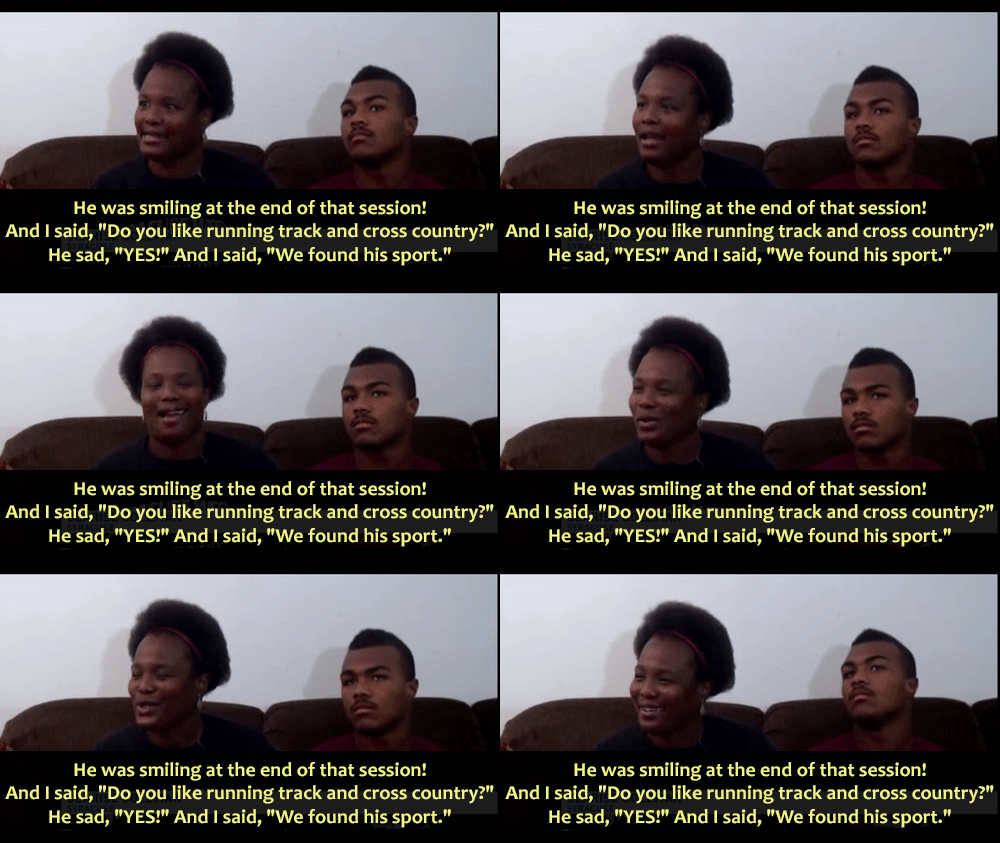
For more than two years, Clarise Coleman faithfully attended every track practice and every cross-country meet for her son, Chase.
A few weeks ago, Chase, who is a nearly nonverbal autistic child, was running in a meet in Rochester, New York, with his team from Corcoran High School – was assaulted by a stranger in the middle of a race.
Coleman was waiting for him at a part of the course where runners would come down a hill but he didn’t appear and she went looking for him. She was shouting his name and then she started to meet people who pointed in the direction of her son. One of them said:
“I see a grown man, who is quite tall and fairly heavy … exit the vehicle and give this young man a shove that puts him back 10 feet and flat on his butt. Like, just shoved him across the road. The kid didn’t seem to be doing anything but standing there, obviously had nothing in his hands and weighed all of 130 pounds. This guy was easily twice that.”
This tall white guy was a 57-year-old man named Martin MacDonald who told the police that the reason he attacked the Black kid was he thought Chase was going to mug his wife and take her purse.
“My son is a minor. [MacDonald is] a grown man,” Coleman said she told police. “He put his hands on my son. Of course I want to press charges.”
However the police was deaf and on Oct. 21, Rochester City Court Judge Caroline Morrison sent a letter to the Colemans that shocked them:
She had denied their warrant application, and MacDonald would not be charged for second-degree harassment.
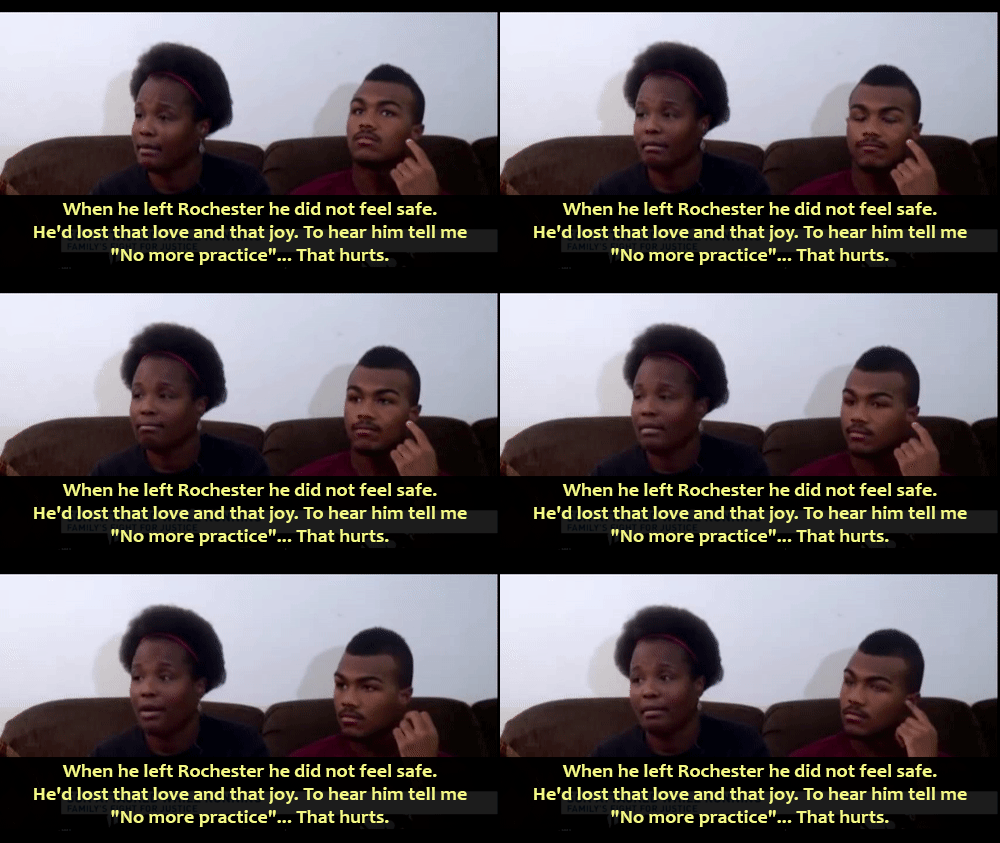
Now the autistic Black boy refused to go to practices and skipped running in his last meet of the season. He turned his running uniform in to his coach, who gently encouraged him to change his mind. Chase refused.
“We just keep telling him, ‘You didn’t do anything wrong. Chase is good. There are mean people and there are nice people and this person was just a mean person,’ ” Coleman said. “We just keep apologizing to him that happened. Especially me. I kept apologizing to him that I couldn’t keep him safe.”
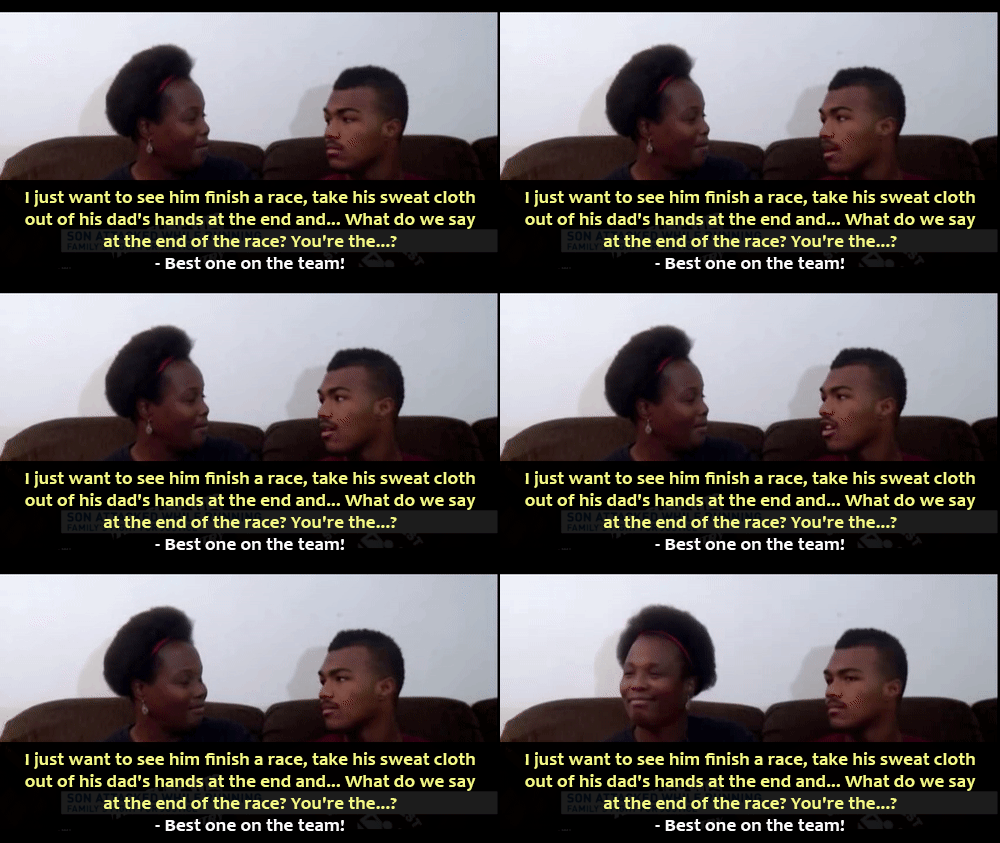
The attack deeply traumatized him and he lost one of the few things that gave him a sense of pride and belonging.
Please, make a shout out to this outrageous accident! The white man still didn’t receive any punishment for ruining life of the Black boy. THIS IS HELL!
#StayWoke #BlackChildrenMatter #WhitePrivilege
Every reblog that includes Martin MacDonald in it is another web page to help make sure that when you google Martin MacDonald’s name, it’s in connection with child abuse and racism.
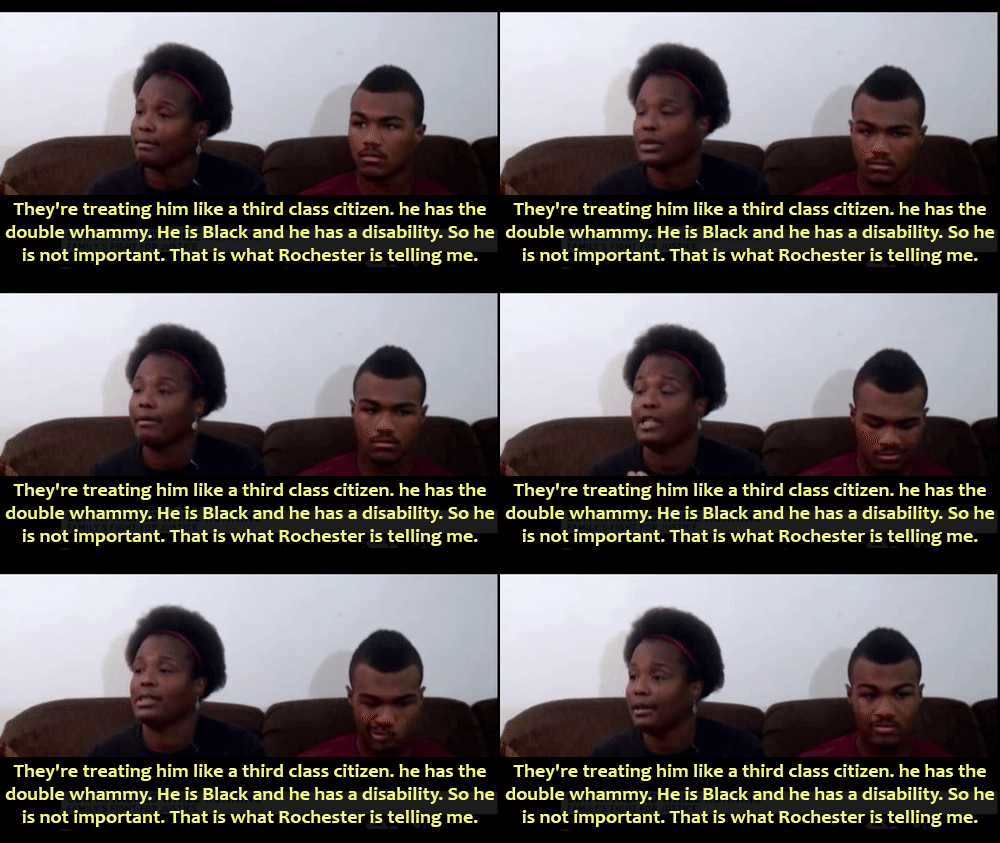
He did get charged with second degree assault. There’s a lot of focus in the article on MacDonald saying he wouldn’t have done it if he’d known Chase had autism, which implies that he’d be justified in shoving a 15 year black kid without autism. which is really gross.
Part of what always gets to me about the “but some autistic people can’t communicate” crowd is what seems to be an implicit assumption that I don’t understand the depth of some people’s communication difficulties because I don’t really know anybody with those kinds of communication challenges, or else I wouldn’t believe what I do?
And I do, you guys. I know them in person, for real.
And I believe in their rights to have their communication in whatever form it does occur taken seriously.
This is not a belief that’s antithetical to people with profound communication disabilities existing.
I remember one time I went for a psych evaluation, and the doctor was utterly sure I had severe depression and anxiety… Right up until she figured out I was multiply disabled and my answers to those questions were firmly based in reality, and statistics backed up my concerns to the point that it was a little unreasonable that I wasn’t more worried about it.
Which is to say, here’s your reminder that certain kinds of psych testing are explicitly inapplicable to physically disabled and chronically ill people, and if you have an invisible disability, it’s worth reminding your shrink.


 Urocyon's Jaunts 2.0
You must be logged in to post a comment.