Spanish newspaper El Confidencial reported that Amazon met with police officials after the strike was announced. It wanted local officers “to force employees to go to their respective jobs and ensure their performance was identical to that of a normal working day.”
Amazon’s request “dumbfounded” police, according to El Confidencial. “The request was categorically rejected by the police, who maintained that controlling labour productivity doesn’t fall within its powers,” a police source said.
Law enforcement officials reportedly emphasized to Amazon that Spanish law protects workers’ right to strike. They told the company that police would be present at the strike but would limit themselves to keeping the peace.
Oh it actually gets so muchh worse. I just read the Spanish article that reported this and apparently:
1) This is not the first time Amazon approached the Spanish police for this (previously in July and March). They were always denied.
2) In response, Amazon hired a private security company to smuggle a bunch of people into the protest to take images “for future reprisal”.
3) They lied to the media when questioned about this insane attempt to strong-arm the police.
Fuck Bezos, seriously. I mean, the idea of Amazon is great, but how the fuck did we get to this point?
Do not buy into that bullshit about us getting a “raise”. It’s not a raise. Not when workers who have been there 2+ years who made $13 when they started and now make $14 are only getting that $15 like every other new employee is. We should be getting payed $16 but we aren’t.
They already took away our ability to earn payed days off. Yup that’s right. Thru points earned thru productivity we could earn a payed day off if we had a certain amount of points.
Now they take away our monthly bonuses too that we earned thru attendance and productivity.
AND they took away our stocks because of this so-called “raise”.
All they did was move the money elsewhere. Actually, I haven’t done the calculations yet but I bet we LOST money from our pay.
That “raise” is bullshit. Fuck Jeff Bezos and fuck Amazon.
they took the money out of the workers left pocket and put it in their right
As someone who used to work for amazon and still has friends who do, this is facts. Spread this like wildfire cause it’s actual bullshit!!!!
We have done the math. With bonuses that double during November and December taken away, and stocks having to be purchased (that they haven’t even figured out the system for as far as I know), veteran workers lose about 3k a year.
Not looking forward to it, but I had better go ahead soon and try to retrieve some packages from a neighbor I don’t know that I’ve every talked to before 😕
Amazon not only split an order up into multiple packages for no obvious reason, they came while I was asleep and left them all at a neighbor’s. Glad they found somebody home at that time, but still. Wish the delivery person had just put them over the back gate again, since it hasn’t been rainy today or anything.
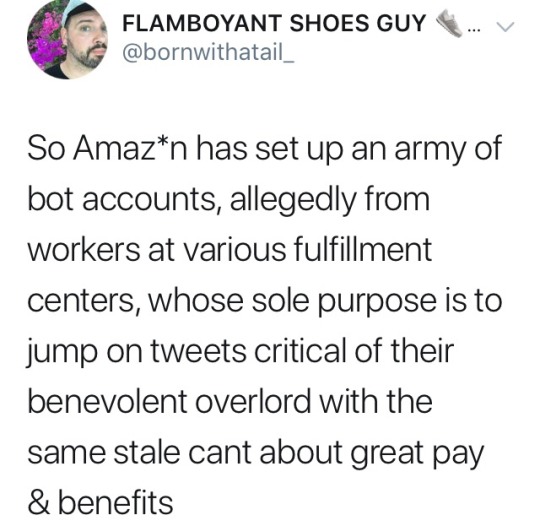
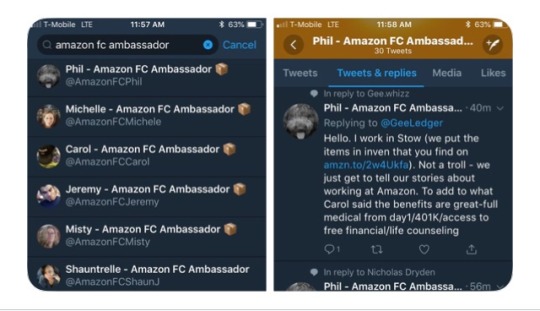
They’re not bots! …they’re sockpuppets. Astroturfing sockpuppets.
They’re paid to tweet. So, this is just a new way for Amazon to run ads that can’t be blocked by ad filters.
They all started this month, and so far, Amazon hasn’t answered questions about them (like how many there are, or what qualifies a person to have an Ambassador account). They’ll probably issue takedown notices to anyone who makes a parody account using the same logo on their main page, but so far, they haven’t done anything about people adding “Amazon FC Ambassador” to their user name.
The linked article says they’re paid – but at least on of the AFCA’s says they’re not being paid.
One of the warehouse workers interviewed, Shannon Allen has been living in her car at the warehouse parking lot for months after her injuries. Donate to her GoFundMe here
‘With a net worth of around $140bn, Amazon founder and CEO Jeff Bezos is now the richest person in the world. That distinction has come at the expense
of Amazon’s workers. In order for those workers to begin sharing in the
vast wealth their labor has afforded Bezos and other Amazon executives,
they need a union.
Since Amazon’s founding
in 1994, the company has successfully suppressed all efforts by its
employees to unionize and improve working conditions. A few years ago,
maintenance and repair technicians at Amazon filed a petition with the
National Labor Relations Board announcing their intention to form what
would have been Amazon’s first union. Amazon immediately hired a law firm to suppress the organizing effort.
In 2000, after an arm of the Communication Workers of America attempted to organize
customer service employees, Amazon responded by shutting down the call
center where they worked. (The company claimed, unpersuasively, that the
firings weren’t related.)
The same year, the New York Times reported
that Amazon’s internal website for managers included instructions on
detecting and busting unionizing efforts. In 2016, the Times exposed
a manager at an Amazon warehouse in Delaware who made up an anti-union
story to scare employees off organizing. According to the Times, several
employees appeared to have been fired for advocating a union.
While Amazon has been diligently working to shut down any prospect of
its workers unionizing, investigative journalists and activists have
uncovered widespread abuses of workers. Ambulances were calledto
British Amazon warehouses 600 times in three years. James Bloodworth, a
writer who went undercover at an Amazon warehouse in Staffordshire,
England, discovered that workers there routinely urinated in water bottles to avoid being punished for taking breaks from work.
Similar conditions have been reported in the United States. In a 2011 essay
for the Atlantic, writer Vanessa Veselka shared her experiences working
at an Amazon warehouse outside Seattle. She described how employees
were forced to work in robotic, fast-paced conditions. Veselka was
eventually fired from her temp position at the warehouse after she
attempted to organize a union.
More recently, warehouse workers told
Business Insider about time-crunched employees using trash bins to go to
the bathroom. Employees also described a work atmosphere predicated on
fear of missing productivity targets, and said that employees spent most
of their lunch breaks waiting in line for onerous security screenings.
Former Amazon workers have alsosaid they are pressured to under-report warehouse injuries.
Amazon workers are not paid wages that reflect these strenuous
working conditions. In at least four states, the company is one of the top 20 employers of people dependent on food stamps. In a 2017 corporate filing, Amazon reported
that the median salary of its employees is $28,446, or roughly $13.68
an hour for full-time employees. Jeff Bezos makes more than that every nine seconds.
…Amazon’s tendency to locate its warehouses in rural areas
alsomakes it more difficult for workers to leave Amazon to find higher
paying work – though Amazon still has one of the highest employee
turnover rates in corporate America. According to PayScale,
Amazon’s employee-turnover rates are the second worst of all Fortune
500 companies. In addition, a large portion of the company’s employees
are temporary; the company regularly hires 120,000 seasonal employees to handle extra workloads during the holidays.
Those who do stay on as full-time employees are pushed to their
physical limits – making it all the more difficult for workers to find
time and energy to organize for collective rights.
In Europe, Amazon workers have found more success. In March, Amazon
workers at a warehouse in San Fernando de Henares, Spain, received union
support as they organized their first strike, joining similar strikes in Germany and Italy. In Italy, after strikes and protests, Amazon recently agreed to end unfair scheduling practices.
Though Amazon has suppressed union efforts in the US, campaigners in
Seattle recently made a heroic effort to push back on the campaign’s
bullying. Last month, local leaders and activists there successfully
lobbied the Seattle city council to pass a
“head tax” on Seattle corporations grossing more than $20m in revenue.
Advocates in favor of the tax argued that Amazon, which paid no federal taxes
in 2017, should contribute to funding city services; such tax revenue
could be used for affordable housing and homeless services. Amazon responded
to the tax by threatening to scale back its business in Seattle. As a
testament to the political power Amazon wields, the Seattle city council repealed the tax with no replacement just a month after the same council members unanimously passed it.
The lesson from that episode seems to be that only unions, not local legislation, can really hold Amazon accountable to its workers…
The
reality is that the decline of America’s traditional retail industry has
left a void that corporate titans like Amazon will continue to exploit –
unless employees, unions and Amazon customers work together to raise
wages and improve working conditions.
a lot of people are talking about how it’s pointless to boycott Amazon during the strike bc Amazon has so many subsidiaries that it seems impossible to avoid them all for a week.
but the strike is about warehouse workers for Amazon.com (and amazon.es, amazon.fr, etc.) specifically.
if you can avoid whole foods and audible etc. during the strike, go for it!! but the really essential piece is that you do not purchase anything from the Amazon website for the duration of the strike. it’s okay to be specific here.
it is better to do something than nothing, and in this case, no one is even expecting a boycott of all the subsidiaries – the part that will be most traceable to the strike will be the drop in purchases from Amazon.com anyway.
Do not visit Amazon until 17 July 2018 or until the strike ends, whichever happens last.
‘The retailer, which last year made more than £6bn of revenues in
Britain, has a disciplinary system under which points are accrued for
illness. Workers are issued a penalty point for each episode of
sickness.
Workers are told that more than one point will result
in a “series of counselling and disciplinary meetings” and between four
and six points can result in dismissal.
In one case, a woman who spent three days in hospital with a kidney
infection was docked two points, reduced to one on appeal, despite
providing a hospital note.
The system has been revealed in an investigation by The Sunday Times at Amazon’s sorting depot in Dunfermline, Scotland.
The
undercover reporter was paid £7.35 per hour by an agency that supplies
workers to Amazon, but was left with less than the minimum wage after
paying £10 for the agency’s bus which took her to the site 40 miles from
her home in Glasgow.
It emerged this weekend that some low-paid
workers are camping out in woodland near the sorting depot to avoid
paying the bus costs and ensure they are left with more than the minimum
wage…
The reporter obtained a job with PMP Recruitment, one of the two main
agencies that hires and supervises workers at the Dunfermline depot.
The investigation found:
Workers being threatened with dismissal
if they accrued too many points for illness, late attendance or
absence, or for making too many errors or failing to hit productivity
targets.
A claim from a worker in Amazon’s on-site first-aid
clinic that workers were under pressure to hit targets and were
suffering injuries in the rush to collect products
Workers were
expected to cover more than 10 miles a day in the warehouse collecting
items, but water dispensers to ensure they avoided dehydration were
regularly empty
The reporter was told she had to sign an
opt-out of the working time directive, which limits weekly hours to 48,
in order to get a job.
The reporter was employed as a “temporary
warehouse operative” at Amazon’s vast plant in Fife. She worked in the
“picking” department, which involved retrieving items from across
several floors of the sprawling warehouse, according to orders displayed
on a handheld scanner she was given. She worked at least 10 hours a
day, with an unpaid 30-minute lunch break and two 15-minute paid breaks….
Under the system
set out in the Amazon temporary associate handbook, half a point is
issued to recruits who are late to work or late back from a break; one
point for “one period of sickness”; and three points for “no call, no
show”. The undercover reporter was told that anyone who was more than 30
seconds late in arriving at work or returning after a break would be
subject to the half-point penalty.
Workers were also told that if
they made more than one error a week in collecting items or failed to
hit productivity targets they could be subject to a disciplinary
process, which could result in dismissal.’
A really common strike tactic in the pre-internet days was form a
picket line. Basically, the striking workers would hold up signs
explaining their strike and surround their place of work with a line of
people all chanting and marching. This not only got the public
interested in the strike, but it also physically blocked people from
entering the business they were striking against.
When
workers strike, businesses sometimes hire “scabs”, or workers willing to
step in and replace the strikers to make the strike meaningless. A
picket line would mean that even if the business got a full complement
of scabs, they would still take a huge hit financially during the
strike.
“Never cross a picket line” is something union and
other pro-labour parents used to teach their children, and it meant both
“never be a scab” and also “never patronize a business currently under strike.”
Amazon will likely
hire scabs during a widespread strike to pick up at least some of the
slack. But this time, workers can’t use a physical picket line to block
access, because Amazon is an online business. But it’s still important
to make sure the company isn’t able to bring in a lot of profits during
the strike – hence the calls for boycott online.
Amazon knows they need their employees. They just think they can get away with abusing them. The boycott and the strike are not to convince them to think anything, it’s to make it so unprofitable to continue that they have no choice but to concede to the strikers’ demands.


 Urocyon's Jaunts 2.0
You must be logged in to post a comment.