The dog has an issue where his esophagus doesn’t work right; it doesn’t get food in there right because it’s all stretched out and stuff. So what dog owners (and cat owners and I guarantee you the cat ones look goofier) do is make a highchair and feed them upright so gravity can be a hero. It’s also really cute.
The disorder is called Megaesophagus.
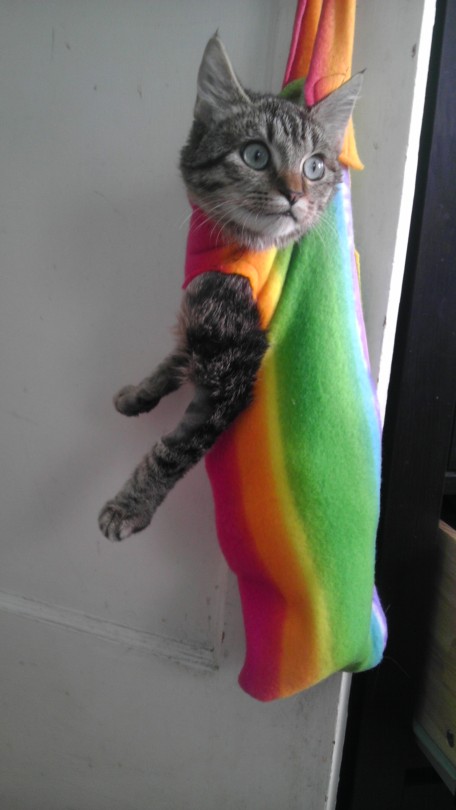
Here is a cat with the same disorder in his eatin’ sock.
EATIN’ SOCK
ALWAYS REBLOG THE EATIN’ SOCK
EATIN’ SOCK IM CRYING
take note! this is how you coo over disabled animals without expressing pity or that they’re inspirational, which are stereotypical attitudes that may carry over to your view of disabled humans. the eatin’ sock is a hilarious disability thing that doesn’t rely on any unkind sentiment.
The Museum of English Rural Life (Reading, UK) : get educated about the British countryside and learn more about this and other absolute units, including the GIANT TEAPOT
(do you like carts? do you love carts? are you absolutely frickin stoked about carts? then oh boy do @unirdg-collections have what you need)
When my husband went to work at the north, I felt very lonely. So the evenings, I started to play guitar and sing outside. Little by little my music attracted all the cats from our neighborhood. They were captivated by my music. I thank the Virgin of Zapopan for this big company I have now.
The five underpasses and two overpasses that cross Colorado 9 south
of Kremmling have reduced wildlife related crashes by almost 90 percent,
Lisa Schwantes communications manager for CDOT said Thursday.
There are more than 30 passages, which vary in construction, across
the state of Colorado, only two of them cross over the highway.
“They’re extremely important,” Jeff Peterson, wildlife program
manager for CDOT, said. “When you get into conflicts with wildlife that
raises the issue.”
Statistics obtained by CDOT show that from 2006 to 2016 on U.S. 160,
in the area between Durango and Bayfield, there were 472 car-animal
collisions, a large number of them involving mule deer…
The most familiar color-changing reptiles are Old World chameleons, so it’s not surprising that shade-switching Carolina or Green Anoles have earned the moniker “American Chameleons”.
These small lizards, not closely related to real chameleons at all, change color between brown and green depending on their mood and habitat. Three different kinds of pigment cells—blue, yellow, and brown—control the Anole’s color. Quirks of genetics occasionally produce Anoles missing the blue or yellow pigment, resulting in rare yellow or blue individuals.
Male Anoles use an extendible throat flap, called a dewlap, to communicate with each other, either to threaten rivals or impress mates. Excited males turn their green up to eleven, flash their red dewlaps, and raise cranial crests on the backs of their heads, escalating their displays to fierce battles if posturing isn’t enough to drive away the competition.
The new population could double the known numbers of these oddball creatures
by Briget Katz
The red handfishis a funny little critter that uses its fins to scuttle along the rocky seafloor. Dwelling exclusively in the waters off Tasmania, it is also one of the rarest fish in the world. So researchers were excited to find an entirely new population of red handfish hiding amidst Tasmania’s reefs. As Calla Wahlquist reports for the Guardian, the discovery may double the number of known red handfish.
Previously, scientists were aware of only one red handfish population of between 20 and 40 individuals, which swim along a stretch of reef in the Frederick Henry Bay. But a member of the public recently reported seeing a little handfish in a nearby area. So seven divers from the University of Tasmania’s Institute for Marine and Antarctic Studies and the citizen science project Reef Life Survey set out to try and find these elusive marine creatures…




 Urocyon's Jaunts 2.0
You must be logged in to post a comment.