This evolutionary experiment has been going on for thousands of years.
And the efforts of small-scale farmers, a recent study suggests,
generate the bulk of corn’s genetic diversity in North America. In the
face of more aggressive weather threats researchers say the finding
comes at a critical time. “This takes things a step further,” says
Daniel Piñero, a plant population geneticist at the National Autonomous
University of Mexico. “Family farmers are not only preserving the
[genetic] diversity of maize,” or corn, Piñero says—they are
contributing more of it.
In the study Mauricio Bellon, a social scientist who works for Mexico’s
National Commission for the Knowledge and Use of Biodiversity, and his
colleagues used government numbers from the 2010 rainy season—the last
year a national census was done. The team narrowed in on the
municipalities with maize yields of up to three metric tons per
hectare—in other words, where people still grow their own food and
cultivate native varieties. The researchers then estimated the area
where corn hybrids are produced at a commercial scale…
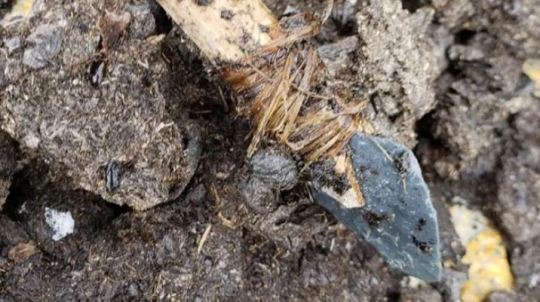
At first, Jennifer Herkes didn’t realize what had been found — she thought it was a piece of an atlatl dart.
“I thought, ‘Oh yeah, that’s neat,’” she recalled.
Then she saw it wasn’t just a piece — it was the whole spear.
“My heart rate started increasing, and I got goose bumps all over. I’d never seen anything like that before, it was amazing,” said Herkes, who is the heritage manager for the Carcross/Tagish First Nation in Yukon.
“The feathers, the sinew, the sap they would have used as, like, a glue to attach the stone point to the wood shaft — all of it is completely intact.“
Herkes believes it’s the first full atatl spear ever found in Yukon. It’s believed to be at least 1,000 years old. Read more.
Holy bonkers.
If you’ve never seen them, the term atlatl dart may be misleading. It’s a giant arrow, five feet long and at least an inch thick. The atlatl itself is essentially a stick that you use to extend your reach and thus increase the speed you can throw stuff, and you just use it to launch this bigass spear. Hunters all over the world used them for thousands of years to kill large and dangerous animals.
Today, historians and hunters are rediscovering this nifty weapon, and many indigenous peoples are studying it and using it to reconnect with their past.
The discovery of an ancient burial or ceremonial site in the upriver region of the Churunga Valley, in far south Peru, received little attention in the turbulent world of 1943. Decades later, it would take two generations of Andean scholars to painstakingly piece together the puzzling story of this discovery, which included the largest and most spectacular find of Precolumbian Peruvian feather work to date.
Protected from decay by being rolled, placed into large ceramic jars, and buried in the arid soil, the cache included an estimated ninety-six panels, each densely covered with tens of thousands of small glossy macaw body feathers, primarily from the blue and yellow macaw (Ara ararauna). Although these panels were found in the dry western foothills of the Andes, the birds’ home is the Amazonian rainforest, far to the east. The effort required to secure such a mind-bogglingly large supply of either feathers or live birds suggests that colorful feathers were highly valued.
The panels are of roughly similar dimensions, and the majority feature alternating rectangles of blue and yellow feathers, which came from the macaw’s dorsal and ventral sides, respectively. The panels have a woven heading tape, and most also include braided cords that hang from the narrow sides. Although the cords suggest that these works were meant to be secured to some kind of structure, their actual function remains frustratingly illusive.
Christine Giuntini, Conservator, 2016
References Bird, Junius B. 1958. Art of Ancient Peru: Selected Works from the Collection. Checklist with commentary of an exhibition at the Museum of Primitive Art, Feb 19–May 18, 1958. New York: Museum of Primitive Art. (unpaginated)
King, Heidi. 2013. “The Wari Feathered Panels from Corral Redondo, Churunga Valley: A Re-examination of Context.” Ñawpa Pacha, Journal of Andean Archaeology 33 (1): 23–42.
View from the Moon Pyramid to the Road of the Dead in the ancient Teotihuacán Pyramids in Mexico.Tais Policanti
This story was originally published in Spanish by HuffPost Mexico. A version of it has been adapted and republished here in English with permission from HuffPost Mexico.
Millions of tourists visit the ruins of Teotihuacán every year. They climb the pyramids, walk the Avenue of the Dead, and learn about the spectacular artifacts recovered from the ancient Mesoamerican city. Looking across the vast and remarkably well-preserved stone complex, built by hand by a pre-Aztec civilization, many likely assume that only a powerful despotic king—directing hordes of slave or serf laborers—could have orchestrated the construction of such a carefully planned city. Indeed, this is what archaeologists once believed. If tourists make the effort to visit some of the excavated residential compounds outside the main archaeological zone, however, they may start to understand why such assumptions about Teotihuacán society are changing. For these structures lie at the heart of our shifting perspective of the ancient city: namely, that it was far more egalitarian than we had previously imagined possible.
I began my archaeological career in the 1970s as an undergraduate examining artifacts at Teotihuacán. That first trip to Mexico cemented my love not only for the archaeology, but also for Mexican life and culture. In the decades since, I moved on to excavating Aztec-period sites in the provinces of that civilization’s empire. In 2015, when I was appointed director of Arizona State University’s archaeological lab in San Juan Teotihuacán, I got to return to my first love among Mexican sites, armed with new ideas about ancient cities and urban life. But after just a few years of work, I began to see Teotihuacán in a very different light.
Compared with the Aztec sites I have studied, Teotihuacán seems very strange, and not just because of its huge size (100,000 people, living in an area of close to 20 square kilometers). For one, it’s the only pre-modern Mexican city completely planned with a grid layout. For another, its residents lived in a form of housing—apartmentlike multifamily compounds with white lime-plaster floors, ornamented roofs, and porches—remarkably spacious and luxurious for the ancient world. These complexes are key to the conclusion of many researchers, including myself, that the city’s residents lived far more economically equal lives than any other known Mesoamerican society.
These new insights into Teotihuacán have come thanks to extensive fieldwork on the site. This includes decades of study from archaeologists excavating the pyramids and apartment compounds, who have helped to more fully reconstruct the architecture of the long-abandoned city and unearthed artifacts that are giving us clues about the lives of the people who inhabited it. It also includes work from anthropologists like René Millon and George Cowgill, who mapped the entire city and took more than 5,000 collections of artifacts from the surface of the ground. These materials are now stored in the lab I direct, where they are being studied by archaeologists.
Mesoamerican ballplayers wore protective gear called hachas, palmas, and yokes to protect their hips and abdomens from the impact of the game’s solid rubber ball (see MMA 1978.412.15 and 1978.412.16). In painting and sculpture, the yoke is shown worn around the player’s hips, the palma or hacha attached at the front. Those used during active play were most likely made of wood or some other light material; stone versions such as this one were worn, if at all, during ballgame-related rituals, or placed on display. Given the distinctive design of each hacha, both those worn and those carved in stone may have served to identify teams or individuals.
Hachas also vary greatly in form and size, so much so that they qualify as a group only in contrast to the taller and thinner palmas. The Metropolitan’s own collection includes hachas in the form of human or animal heads, full figures, even one representing a pair of human hands. The name hacharefers to the axe-like form of many (hacha is Spanish for axe), including the example seen here. In these, the back is slightly wider than the front where the sides converge in a sharp point. Facial features and any other details are carved on low relief, each side a mirror image of the other.
In other ways this stone hacha is unusual in both its subject and composition. In order to conform to the classic hacha shape, the artist has rendered the face, body and tail fin in consecutive, ascending registers of low relief. This creative solution to the problem of representing a horizontal subject within the confines of the vertical hacha format does not preclude a closely observed, detailed rendering of the subject, however. The artist has carefully rendered each scale individually, with increased depth of relief from front to back, mimicking how fish fins overlap in nature. The rounded form of the cheeks, slightly open mouth, and flared gills suggest the respiration and movement of the fish as it passes through the water.
In jarring contrast to this naturalistic image is the fish’s unusual profile. The inclusion of what looks like a very human nose suggests a composite being of the supernatural realm. The belief in a watery underworld inhabited by deities was widespread throughout Mesoamerica. At the Classic Veracruz city of El Tajín, scenes of ballgame-related rituals both on earth and in the underworld are carved on the walls of one of its many ball courts. In one, a man wearing a fish helmet sits in a water-filled temple, surrounded by supernatural figures. The unusual blending of fish and human elements on this hacha may reflect the widespread Mesoamerican belief that the ball court was a conduit, the game and its rituals a way of connecting humans to the deities dwelling in that realm.
Patricia Joan Sarro, 2017
Published references
Art of Oceania, Africa, and the Americas from the Museum of Primitive Art. New York: The Metropolitan Museum of Art, 1969, fig. 584.
Resources and additional reading
Ceremonial Sculpture of Veracruz. New York: Long Island University, 1987. Earley, Caitlin C. “The Mesoamerican Ballgame.” In The Hilbrunn Timeline of Art History. New York: The Metropolitan Museum of Art, 2000–. http://www.metmuseum.org/toah/hd/mball/hd_mball.htm (June 2017)
Koontz, Rex. Lightning Gods and Feathered Serpent: The Public Sculpture of El Tajín. Austin: University of Texas Press, 2009.
Leyenaar, Ted J.J. Ulama, Jeu de Balle des Olmeques aux Azteques – Ballgame, from the Olmecs to the Aztecs. Lausanne: Musée Olympique, 1997.
The Metropolitan Museum of Art. Vol. 12, The Pacific Islands, Africa, and the Americas
Scott, John F. “Dressed to Kill: Stone Regalia of the Mesoamerican Ballgame”. In The Sport of Life and Death, The Mesoamerican Ballgame, E. Michael Whittington, ed., pp. 50–63 New York: Thames and Hudson, 2001.
Shook, Edwin M. and Elayne Marquis. Secrets in Stone: Yokes, Hachas and Palmas from Southern Mesoamerica. Philadelphia: American Philosophical Society, 1996.
Von Winning, Hasso and Nelly Gutiérrez Solana. La Iconographía de la Cerámica de Río Blanco, Veracruz. Mexico City: UNAM Instituto de Investigaciones Estéticas, 1996.
Wide-mouthed bowls or plates are believed to have been used as presentation or serving vessels. Those raised on four bulbous feet are identified with the Maya lowlands of Mexico and Guatemala in the earliest centuries A.D. and include a rather showy type surfaced with an arresting, bright orange-red slip, as seen here. The surface is continuous, even, and smooth in color; the shape is clean lined and well balanced. This type of vessel represents a considerable display of proficiency in the art and technique of the potter and was valued as a precious object at the time of manufacture. Other ceramics of specialized shape and size were finished with the same orange-red surface color. Perhaps suites of similarly hued ceramic containers were particularly meaningful together. This example has dark gray firing-clouds on the bottom of the feet, the only change in color from smooth orange-red on the vessel.



 Urocyon's Jaunts 2.0
You must be logged in to post a comment.