Do you ever lean or position yourself in therapy to make eye contact or see a client that is not looking at you or have turned away from you? And do you ever ask them to atleast look in your direction? Why or why not?

neurodiversitysci:

therapy101:

it really depends on the context and the client, for me. I work with some clients who have difficulty making eye contact and engaging in other pro-social behavior. If they want to change those things, then one of the best things I can do to help them is to have them practice with me in session. In that context, I have asked a client to look at me, and help them find a way to do so comfortably. In other contexts I wouldn’t do that. I might ask about lack of eye contact, to see where it’s coming from. At the same time I’ve worked in some clinical settings where the position of our chairs makes it harder to have easy, consistent eye contact, so in those settings I was more flexible when people chose to look straight ahead rather than at me. 

______

If you enjoyed this post, consider making a pledge at Patreon to support Therapy101 and access to information about psychology and mental health.

I think it’s important to pay attention to eye contact when teaching, because it can tell you a lot. Often, when there’s a lot to process cognitively or emotionally, people will look away, whether neurotypical or neurodivergent. If I were a therapist, I would treat looking away as a clue that the client was making more effort. Maybe they’re dealing with stronger emotions, or fighting an urge to suppress them, or feeling uncomfortable talking about them, or having difficulty finding the words to talk about them, or angry at me but feeling guilty saying so… (these are all reasons I’ve looked away and I’ve seen other people do many of these, too).

Of course, autism or other disabilities can affect the exact meaning of dropping eye contact, and you need to compare it to a baseline of how much the person normally makes eye contact before you can accurately interpret.

If I were a therapist, SLP, or someone else who offered advice on communication, I would point out when a client drops eye contact, and ask them if they’re aware of it. Behavior like this is often done unconsciously, and telling clients about it can help them become more aware of how they’re feeling and communicating in the moment. Pointing out emotional reactions and nonverbal behavior is a common, and effective, therapeutic technique. You use the way a client interacts with you as a window into how they might interact with people in other areas of their lives.

I would not encourage a client to make more eye contact unless the client specifically asked me to teach them to do so. I don’t want to distract them and make them uncomfortable. 

In addition to variables like seating, I would take into account clients’ cultures of origin, too. Many cultures use less eye contact than middle class Americans do, and it may be seen as less friendly and more aggressive.

If you’re neurodivergent and don’t make a lot of eye contact, does that seem respectful? What would you do if trying to help someone who doesn’t make much eye contact?

I would also explicitly add “middle-class Americans from the dominant culture” and/or “from the a similar cultural background to the professional’s” there.

Speaking as someone likely to be read as more generally middle-class American, who is coming from a culture within the US where my neurodivergent eye contact patterns never really stood out as unacceptably odd.

Overall, well said.

In general, it’s probably better not to assume that you understand what another person’s unexpected eye contact and body language patterns are intended to communicate. Maybe especially if your interpretations of that do conflict with what they are saying.That may well be down to any of a variety of factors leading to miscommunication, and not so much the other person being deceptive and/or showing poor insight.

(Partly based on experience dealing with faulty assumptions like that, yes.)

neo-sigma:

renegon-paragade:

bigfootismyonlyfriend:

hot take but girls with ADHD don’t ‘present differently’, it’s just that misogyny punishes girls and people read as girls a lot more severely for their ADHD symptoms so most girls become way more proficient at masking their symptoms so end up being left undiagnosed and then just develop depression, anxiety, trauma and burnout over not being able to meet standards that are difficult if not impossible for people with ADHD and being harshly reprimanded for it

This goes for autism too! Also some of the ways people present for both are considered ways that girls should act or brushed off as just some silly but normal girl thing (examples off the top of my head: going nonverbal or walking on tip-toes). That’s why when guys act the same way they get diagnosed, because they are “acting weird” aka “girly”

Similarly, autism can make it so a lot of girls don’t present as feminine, so they get criticised for behaviors that autistic boys might get away with.

Exactly the same behavior from members of various groups (assigned gender, race, ethnic group, class background, take your pick) can be interpreted very, very differently according to cultural expectations. Along with which explanations are even considered for that behavior, based on assumptions and stereotyping.

The increasing emphasis on “Group X just inevitably present differently!”–or “inevitably employ masking in exactly the same predictable ways”, for that matter–doesn’t really help with sorting out the bias factors. Kinda the reverse. That can too easily turn prescriptive in the same ways, especially if it’s used to dance around the question of professional bias.

krismichelle429:

dobdob:

ttfkagb:

Oldest depiction of female form shows that modern archaeologists are pornsick misogynists : Reclusive Leftist

female-only:

plansfornigel:

Image and video hosting by TinyPic

Female figurine from the Hohle Fels cave near Stuttgart, about 35,000 years old. Interpreted as a pornographic pin-up.

“The Earliest Pornography” says Science Now, describing the 35,000 year old ivory figurine that’s been dug up in a cave near Stuttgart. The tiny statuette is of a female with exaggerated breasts and vulva. According to Paul Mellars, one of the archaeologist twits who commented on the find for Nature, this makes the figurine “pornographic.” Nature is even titling its article, “Prehistoric Pin Up.” It’s the Venus of Willendorf double standard all over again. Ancient figures of naked pregnant women are interpreted by smirking male archaeologists as pornography, while equally sexualized images of men are assumed to depict gods or shamans. Or even hunters or warriors. Funny, huh?

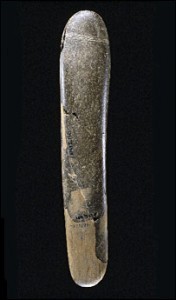
Consider: phallic images from the Paleolithic are at least 28,000 years old. Neolithic cultures all over the world seemed to have a thing for sculptures with enormous erect phalluses. Ancient civilizations were awash in images of male genitalia, from the Indian lingam to the Egyptian benben to the Greek herm. The Romans even painted phalluses on their doors and wore phallic charms around their necks.

Image and video hosting by TinyPic

Ithyphallic figure from Lascaux, about 17,000 years old. Interpreted as a shaman.

But nobody ever interprets this ancient phallic imagery as pornography. Instead, it’s understood to indicate reverence for male sexual potency. No one, for example, has ever suggested that the Lascaux cave dude was a pin-up; he’s assumed to be a shaman. The ithyphallic figurines from the Neolithic — and there are many — are interpreted as gods. And everyone knows that the phalluses of ancient India and Egypt and Greece and Rome represented awesome divine powers of fertility and protection. Yet an ancient figurine of a nude woman — a life-giving woman, with her vulva ready to bring forth a new human being, and her milk-filled breasts ready to nourish that being — is interpreted as pornography. Just something for a man to whack off to. It’s not as if there’s no other context in which to interpret the figure. After all, the European Paleolithic is chock full of pregnant-looking female statuettes that are quite similar to this one. By the time we get to the Neolithic, the naked pregnant female is enthroned with lions at her feet, and it’s clear that people are worshipping some kind of female god.

Yet in the Science Now article, the archaeologist who found the figurine is talking about pornographic pin-ups: “I showed it to a male colleague, and his response was, ‘Nothing’s changed in 40,000 years.’” That sentence needs to be bronzed and hung up on a plaque somewhere, because you couldn’t ask for a better demonstration of the classic fallacy of reading the present into the past. The archaeologist assumes the artist who created the figurine was male; why? He assumes the motive was lust; why? Because that’s all he knows. To his mind, the image of a naked woman with big breasts and exposed vulva can only mean one thing: porn! Porn made by men, for men! And so he assumes, without questioning his assumptions, that the image must have meant the same thing 35,000 years ago. No other mental categories for “naked woman” are available to him. His mind is a closed box. This has been the central flaw of anthropology for as long there’s been anthropology. And even before: the English invaders of North America thought the Iroquois chiefs had concubines who accompanied them everywhere, because they had no other mental categories to account for well-dressed, important-looking women sitting in a council house. It’s the same fallacy that bedevils archaeologists who dig up male skeletons with fancy beads and conclude that the society was male dominant (because powerful people wear jewelry!), and at another site dig up female skeletons with fancy beads and conclude that this society, too, was male dominant (because women have to dress up as sex objects and trophy wives!). Male dominance is all they can imagine. And so no matter what they dig up, they interpret it to fit their mental model. It’s the fallacy that also drives evolutionary psychology, the central premise of which is that human beings in the African Pleistocene had exactly the same values, beliefs, prejudices, power struggles, goals, and needs as the middle-class white professors and students in a graduate psychology lab in modern-day Santa Barbara, California. And that these same factors are universal and unchanged and true for all time.

Image and video hosting by TinyPic

Hohle Fels phallus, about 28,000 years old. Interpreted as a symbolic object and …flint knapper. Yes.

That’s not science; it’s circular, self-serving propaganda. This little figurine from Hohle Fels, for example, is going to be used as “proof” that pornography is ancient and natural. I guarantee it. Having been interpreted by pornsick male archaeologists as pornography because that’s all they know, the statuette will now be trotted out by every every psycho and male supremacist on the planet as “proof” that pornography is eternal, that male dominance is how it’s supposed to be, and that feminists are crazy so shut the fuck up. Look for it in Steven Pinker’s next book. ***

P.S. My own completely speculative guess on the figurine is that it might be connected to childbirth rituals. Notice the engraved marks and slashes; that’s a motif that continues for thousands of years on these little female figurines. No one knows what they mean, but they meant something. They’re not just random cut marks. Someone put a great deal of work into this sculpture. Given that childbirth was incredibly risky for Paleolithic women, they must have prayed their hearts out for help and protection in that time. I can imagine an elder female shaman or artist carving this potent little figure, and propping it up somewhere as a focus for those prayers.

On the other hand, it is possible that it has nothing to do with childbearing or sexual behavior at all. The breasts and vulva may simply indicate who the figure is: the female god. Think of how Christ is always depicted with a beard, which is a male sexual characteristic, even though Christ isn’t about male sexuality. The beard is just a marker. Or, given the figurine’s exaggerated breasts, it may have something to do with sustenance: milk, food, nourishment.

The notion that some dude carved this thing to whack off to — when he was surrounded by women who probably weren’t wearing much in the way of clothes anyway — is laughable.

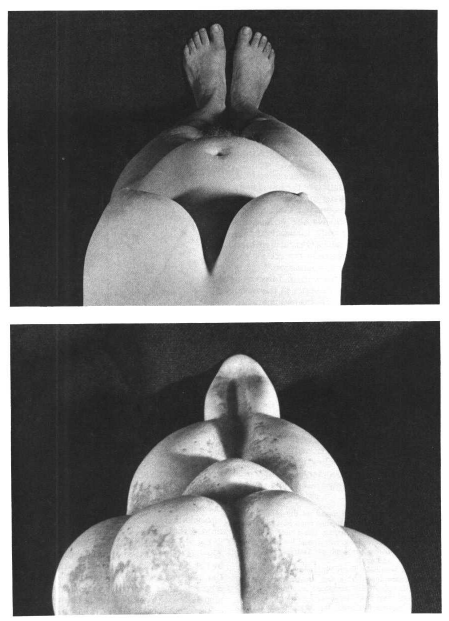
There was a post doing the rounds on tumblr a while back that I wish I could find, but most of it seemed to be taken from this study by LeRoy McDermott, Comparing Modern Bodies with Prehistoric Artifacts.

When looked at from above, as a woman observes herself, the breasts of PKG-style figurines assume the natural proportions of the average modern woman of childbearing age. For example, the dimensions of the breasts of the off-illustrated Venus of Willendorf are comparable to those of a 26-year-old mother-to-be with a 34C bust (see fig. 5). When foreshortened from above, even the apparent hypertrophic dimensions of the Venus of Lespugue and the best-preserved figurine from Dolní Vestonice enter into a reasonably normal, albeit buxom, range.

image

McDermott goes on to theorise that the reason most of these hyper-female statues are missing a head and hands is that the head, obviously, can’t be viewed by the sculptor without access to a reflection of some kind. As the hands are in a constant state of motion making the figurine, it would also be difficult to have a fixed reference to work from.

The whole thing reminds me of that oft-quoted Sandi Toksvig article:

When I was a student at Cambridge I remember an anthropology professor holding up a picture of a bone with 28 incisions carved in it. “This is often considered to be man’s first attempt at a calendar” she explained. She paused as we dutifully wrote this down. “My question to you is this – what man needs to mark 28 days? I would suggest to you that this is woman’s first attempt at a calendar.”

It was a moment that changed my life. In that second I stopped to question almost everything I had been taught about the past. How often had I overlooked women’s contributions? How often had I sped past them as I learned of male achievement and men’s place in the history books?

Working (loosely) in an archeological field for this past year has made me realise how much is taken for granted about ancient culture and to what degree we patch up the remnants of the past with modern values and notions of gender and sexuality. On a daily basis I’m asked – when in character – who my husband is, whether I’m a cook, why I’m holding a spear and carry a dagger and slingshot as part of my kit. These notions of a woman’s place are so ingrained that the children on school trips to the hill fort frequently can’t believe it when I tell them our Chieftain is a woman. Even if the only Iron Age Briton they can name is Boudica, they have a hard time getting their head around it.

I know I’ve reblogged this before, but I just can’t help myself. It’s way too cool.

chavisory:

myceliorum:

chavisory:

Part of what always gets to me about the “but some autistic people can’t communicate” crowd is what seems to be an implicit assumption that I don’t understand the depth of some people’s communication difficulties because I don’t really know anybody with those kinds of communication challenges, or else I wouldn’t believe what I do?

And I do, you guys.  I know them in person, for real.

And I believe in their rights to have their communication in whatever form it does occur taken seriously.

This is not a belief that’s antithetical to people with profound communication disabilities existing.

I just wanted to reply to this to clarify something: I hope you didn’t get that from anything I said to you. Because I didn’t mean any of that to apply to you, just to be perfectly clear.

Because when I replied to you before with all that the extreme amount of information about the topic, I was not at all meaning to contradict anything you said. I was only trying to add to it that there is unfortunately a group of people who really do think that said people don’t exist. And who are also unfortunately easily confused with you or with me or with a lot of other people. Because they say things that sound a little similar to things we say, but they mean something entirely different. And I think the distinction is lost on a lot of the “there are some people who can’t communicate” people.

So I wasn’t in any way trying to say you didn’t know people, didn’t know of people, anything like that. I was only trying to tell other people who might be reading, that there is this unfortunate group of autistic people who honestly believe that communication issues are extremely simple if they exist at all. And who do actually berate strangers for things they couldn’t possibly know about a stranger.

And unfortunately I think some of the confusion of them with us is honest enough. And that if they’ve encountered people like that, they could just read that into what we are saying. But I also think some of it may be dishonest some of the time. Like I think sometimes what they’re doing, is they’re deliberately blurring the lines so that they don’t have to think about what we actually have to say.

When it’s honest, I think it’s that thing where where people just don’t read that carefully. And if they see two things that look vaguely similar, and they have certain biases already, they’ll see what they expect to see. But when it’s dishonest, it’s more than that.

Also if the formatting on this post is completely borked it’s because my Tumblr client seems to be completely borked so if these paragraphs are out of order it’s because I literally can’t figure out where they are because they’re on top of each other.

Oh no, not at all….this was an afterthought not only towards the specific anon who inspired my rant of a couple days ago, but to a pattern from, especially (for some reason), siblings of non-speaking/non-verbal autistic people who I see yelling at people.  Not at you.

Like, there is often this undercurrent of what seems like an assumption in the anger of people who feel the need to let me know that their autistic family member really can’t communicate at all that I just don’t know people with real and significant communication disabilities.

And I have absolutely seen autistic people claiming that autism itself is never disabling, that autism alone cannot cause lack of speech, or that autism can’t cause certain speech and language issues that they’ve seen parents describe that I know it can because I’ve seen other autistic people (including you) report them or because I experience them.

So to some extent I understand that anon’s frustration, because I do know the rhetoric she’s talking about it and I resent it, too.  I have a pretty sharply limited daily capacity for speech.  I know people in real life for whom no conventional form of AAC seems to work particularly well.  (One uses RPM, and has had a lot of success with it, and it’s STILL a hugely effortful, draining, time-consuming process that she can’t do very much of all at once.)

I see it being the case both that:

a.)  There are too many people who assume that someone who doesn’t speak doesn’t have the capacity to communicate and there are too many people who may be able to use AAC or learn to type but have never even been given the opportunity, let alone taught.  And

b.)  There are people whose communication disabilities are such that we don’t have any readily available, easy solutions yet.

With both of those things leading me to the conclusion that it’s too dangerous to declare virtually anyone simply incapable of communication, because we both don’t provide tools to enough people who probably could use them, and don’t understand enough about autism or about truly complicated and intense communication disabilities.

grison-in-labs:

jumpingjacktrash:

curlicuecal:

jumpingjacktrash:

kmclaude:

queerpyracy:

queerpyracy:

baffling how much of this site is just conservative protestantism with a gay hat

you know what i’m in just enough of a bad mood that i’m ready to nail my grievances to the church door so let’s fucking go

  • black and white morality wherein anyone who doesn’t believe/think/live exactly as I do is a dirty sinner Problematic and probably a predatory monster
  • everyone is a sinner Problematic but true believers people who activist the right way according to my worldview are still better than everyone else, and I will act in accordance to this belief in my own superiority to let everyone else know I’m better than them because I found Jesus am the most woke
  • casual and fucking omnipresent equations of womanhood with softness/goodness/purity/nurturing to remind every woman who isn’t/doesn’t want to be any of those things that they’re doing it wrong
  • aggressive desexualization (particularly of women’s sexuality, to the point where it may as well not exist at all) accompanied by pastels [not a criticism directed ace ppl having a right to sex-free content and spaces but specifically targeted at a wider problem resulting from the previous point]
  • YOU’RE VALID AND JESUS LOVES YOU and neither of these platitudes achieves a goddamn thing
  • historical context is for people who care about nuance and we don’t have time for either (see: black and white morality)
  • lots of slogans and quotes and nice little soundbites to memorize but does anybody actually study the source material with a critical eye to make their own informed analysis
  • the answer is no
  • I’ve been to bible study groups don’t @ me I know what the fuck I’m talking about
  • Good Christians™ Nice Gays™

    don’t fraternize with/let themselves be influenced by non-Christians those terrible queers

  • all the media one consumes must be ideologically pure or it will surely harm the children
  • it is Our Sacred Duty to protect the children from Everything, thus ensuring their innocence/purity/etc until such time as they are idk probably 25 years old
  • literally just “think of the children” moral panic y’all can fuckin miss me with that
  • people who don’t conform to the dominant thinking WILL be excommunicated/driven from the social group, and any wrong treatment they suffer will be seen as a justified consequence of their wrong thinking
  • I Saw Goody Proctor With The Devil And She Had A Bad Steven Universe Headcanon

Thank you for breaking it down like that because so many of us have been saying it but to see a play by play breakdown comparison is just…Thank you.

  • sipping tea and judging people as a group bonding activity

oh, man, speaking as a queer Christian who gets regular tumblr flashbacks to my childhood in the Bible Belt, YES

-belief that small snippets of text can be analyzed out context to understand the whole work/ judge the whole person
-Desire for moral choices to be easy/ black-and-white leads to belief that it is possible to find a one-size-fits all answer to every situation
-Literal, rather than literary analysis, with weird fixation on etymological roots that have nothing to do with source material
-Belief that there is “one true interpretation” that is self-evident and will be understood by everyone encountering the same material regardless of background
-Overwhelming, internalized sense of culpability for other people’s actions/integrity/souls
-Overwhelming, internalized sense of personal guilt
-Pressure to evangelize aggressively
-Tendency to value broad ideals before individual needs
-Hostility towards coexistence/tolerance/neutrality
-Hostility towards lack of consensus in viewpoint
-Knowledge as contamination
-Guilt/contamination by proximity
-Fixation on the sexual as uniquely dirty/sinful
-Belief in “thought crimes”
-Argumentation via appeal to higher authority/feelings of revulsion rather than internal, verbalizeable logic
-“conversations” that are actually stealth soapboxes because one side isn’t actually interested in listening
-“polite requests” that are actually commands because “no” is not considered an acceptable answer
-in-group language
-virtue-signaling and hostility towards the outgroup
-gatekeeping
-communities strongly built around the idea of being the world’s underdog
-appropriation of other people’s persecution/victimization
-treating the concept of oppression like a trophy
-glorification/fetishization of victimhood

reblogging again for good addition

*sips morning tea* Yep. 

And look, I’m a fucking ex-Catholic, and this is shit we used to make fun of y’all for (when, of course, we weren’t stealing the exact same shit from Protestants in a effort to fit the fuck in with you loons). It’s not like Catholicism is free from fucked-up shit and toxic communities, I should note–hi, indulgences, for one, hi, over-reliance on authority and hierarchical structures–but the emphasis on good works instead of good thoughts is something I took away with me when I was learning my shit in CCD and it’s something that screams out to me both when I see it in conservatives and on Tumblr. 

Some of this shit is general to abusive systems, and some of it is general to Christian thought (such as fixation on the sexual). But an awful lot of it, especially the focus on virtue-signaling, impeccably correct beliefs, and panic about the morality of one’s thoughts rather than one’s deeds, is straight out of conservative Protestant thinking specifically–and I’m saying that as someone who is intimately familiar with a different, if no less flawed, conservative Christian tradition. That shit permeates American culture in general, so it’s not surprising to see it here on in a community of Anglophone LGBTQ+ folks, since Americans have force of numbers among Anglophones.

But there is something beautifully ironic about LGBTQ+ folks on Tumblr picking up the same broken, toxic beliefs most common to exactly the kind of vicious conservative evangelical/Protestant/fundamentalist culture that found its genesis in demonizing us, attacking us, and trying to drive us out of mainstream American culture. Y’all think you can dismantle the master’s house with his tools? Kiddos, you’re not even there yet. What you’re doing is trying, in theory, to dismantle that house by aping the overseers as best you can–and I don’t even think you’re really aiming to take the house apart. I think you just want to be top dog in the kennel, and you haven’t worked out that we’ve all got thumbs and that that kennel door doesn’t lock as securely as you think. 

Nothing new about that, of course. You see it in every marginalized group going round, people making that mistake. But damn, it’s enough to make a cynical woman laugh to herself over her morning cup of tea. 

Physician, know thy own queer history

star-anise:

I’ve come to suspect that a lot of LGBTQ+ discourse these days is conservative Protestantism with a gay hat because it’s pushed by people who literally are conservative gay Protestants whose worldview hasn’t been broadened beyond “now you can have 2.5 kids in a house in the suburbs… with a spouse of the same gender.”

My girlfriend Marna has been a queer activist since the late 80s. She’s told me about the incredible deliberation and debates LGBTQ+ activists had, in the late 90s and early 00s as the community began to see past the AIDS crisis and immediate goals of “surviving a plague” and “burying our dead.” There were a lot of things we wanted to achieve, but we had to decide how to allocate our scarce reserves of money, labour, publicity, and public goodwiil. Those were the discussions that decided the next big goals we’d pursue were same-sex marriage equality and legal recognition of medical gender transition.

From hearing her tell it, it seems like it was actually a wrenching decision, because it absolutely left a lot of people in the dust. A lot of people, her included, had broad agendas based on sexual freedom and the rights of people to do whatever they wanted with their bodies and consenting partners—and they agreed to put their broader concerns aside and drill down, very specifically, onto the rights of cis gays and lesbians to marry, and the ability to legally change your sex and gender.

As a political tactic it was terrifically effective. In less than two decades, public opinion in many countries has totally reversed on gay marriage, and we’ve won some truly enormous legal landmarks. Gender transition has entered public consciousness and the first landmark battles allowing people to define their own gender have been won. Marriage equality means that husbands and wives are protected from being banned from their dying spouse’s bedside, being forcibly separated from their children, or not being recognized as an important part of their spouse’s life.

The LGBTQ+ community knew they were taking a gamble, focusing so exclusively on marriage equality, and trans activists knew that they wouldn’t be able to achieve anything else until they’d gotten basic medical transition recognized. By and large, prioritizing things this way paid off. But they knew going in that there would be costs—and we’re reaping them.

Activists of 20 years ago chose to sideline and diminish efforts to blur and abolish the gender binary. Efforts to promote alternative family structures, including polyamorous families and non-sexual bonds between non-related adults. Efforts to fight the Christian cultural message that sex is dirty, sinful, bad, and in need of containment. Efforts to promote sexual pleasure as a positive good.

Those efforts have been going on for the last 20 years, but they’re marginalized—activists who had to decide where their finite time, money, publicity, and social capital went literally sat in committee meetings and said, “Marriage equality is our top priority. Legal gender transition is our top priority. Everything else will have to wait.”

This happened especially because sex education, sex positivity, and youth outreach were incredibly dangerous areas. Our enemies have been saying for years that all LGBTQ+ people are pedophiles, perverts, seeking to corrupt and recruit children to our cause; anyone trying to teach children basic facts about how to avoid disease, what’s happening to their own bodies, or what possibilities they have for identity and orientation, risks having their name, career, and life ruined. As a sex educator in the 90s, Marna had to tell teenagers, “I can’t answer your questions about safe sex now. Come back when you turn 18.”

So kids who grew up being told that girls and boys are different and ought to lead different lives, and sex is dangerous and sinful and gross, and you definitely shouldn’t want sex UNTIL you get married to your One True Love, only had that message tweaked a little bit. Now you can cross the floor from the Girl Side to the Boy Side or vice-versa. Now your One True Love doesn’t have to be a different gender from you. But those kids could survive with the rest of their worldview relatively intact. And I think that’s what we’re seeing in fandom, with an emphasis on “pure” OTP ships, on only including LGBT+ identities that use crisp, clear gender binaries and result in nuclear family life. The rest of those cultural messages about sex and love remain: men’s and women’s worlds are and should be different, “impure” sex degrades and defiles you, sexual urges that do not contribute to your One True Love and family life should be repressed, shamed, or destroyed, and sexual thoughts are every bit as bad as acting on them.

This isn’t because kids today are bad or stupid. It’s because as a community, we had to decide where our effort was going, and now we need to pay down the debt we’ve racked up over years of prioritizing marriage equality and legal trans recognition over sex positivity, sex education, and deconstructing gender.

TERFs, SWERFs, exclusionists, and transmedicalists have stolen a march over liberal queers because they’re doing the work to educate youth. While liberal queers have been staging protests and lobbying politicians, half a dozen of my undergraduate professors were radical feminists. Communities of exclusionists and anti-sex activists have honed their expertise at engaging teenagers with their ideas and theories. They’re the ones writing the FAQs, answering the asks, and doing the groundwork of saying, “Here is a basic framework of sexual ethics for you to follow.”

If we want to win back the culture wars, we have to step up our own efforts. Go back to the sex educators and gender activists whose good work has been ignored or underfunded for all this time and support them. Let major LGBTQ+ activist organizations know that their work so far is very nice, but it’s time to renew our focus on youth outreach and mentoring young activists. Brainstorm a way to help angry, isolated, disenfranchised young people form communities based around positive action and a sense of belonging. Get into mentorship or education yourself. Help us pivot as a community, to reach out to the kids who have obviously been underserved.

People doing the good work who need our support:

San Francisco Sex Information
Sex & U
Scarleteen
Sexplanations
Making Queer History

We won a few battles. That’s nice. But now it doesn’t serve us to whine that they’re not all won. We’ve still got work to do.

(@star-anise: Patreon | Paypal)

star-anise:

ofinfinitespace:

star-anise:

ofinfinitespace:

star-anise:

doomhamster:

star-anise:

Some Person replied to your post “When I was younger and more abled, I was so fucking on board with the…”

Let’s not kid ourselves by revising traditional storytelling. Traditional stories (Western stories, anyways) depict females as props, at best they become secondary characters. Mostly, though, they are passive and rewards to be won, by males. Yes, of course there are some elements that can be rescued, like the females never allowing the villain to take away their kindness. But it is not empowering. 

Traditional Western stories never depicted women as progagonists, or having agency? Women in traditional Western stories (who were not villains) were always unfailingly kind? What the SHIT?

CAN PEOPLE NOT ACTUALLY CONVERSANT WITH PREMODERN EUROPEAN LITERATURE AND ORAL TRADITIONS PLEASE GET THE FUCK OFF MY POST

…has Some Person ever fucking read a storybook?

Hint: the Brothers Grimm and their ilk did not revise stories to make the heroines MORE empowered. And yet somehow we have quite a few stories with women as heroes, even within the most narrow definitions of the Western canon.

I realize part of the point is that agency isn’t as simple as having the ability to enact violence, but in Finette Cendron (1697) by Mme d’Aulnoy, Finette is imprisoned by an ogress and about to be eaten with her sisters. She persuades the ogress that they will do wonderful things for her, including dress her hair and paint her face to make her beautiful. The ogress agrees, and when Finette goes to do her hair, she cuts the ogress’s head off with the enormous scissors provided.

“Unfailingly kind” my ass.

Meanwhile there are entire books about women’s agency in medieval romances.

So like CAN PEOPLE JUST NOT. It is, in fact, possible that I know misogyny was not a recent invention.

@star-anise: if you ever need someone to stand on a mountain and shout: “The story of history is not a straight from conservative to progressive” I’ve got a mega-phone and a bone to pick. 

I especially do not get how a certain type of feminist is literally willing to believe that EVERY woman, from the invention of agriculture until the last two generations, was UNEQUIVOCALLY and IRREDEEMABLY oppressed and unable to do a single goddamn thing to resist that.

And call this attitude “feminist”.

AMEN. 

And also that they some how believe that’s a more useful narrative for recruitment than, let’s look at the ways women have been ingenious and resourceful and ADAPTED TO THEIR TIMES in order to subvert patriarchy and make livable lives for themselves. 

I wrote my senior undergrad thesis on Quaker female preachers from 1650 – 1830, a chunk of time when women’s position in the world – particularly publicly – was very much moving backward. In 1650, ecstatic experience was very much a grounds for public speech by women (in the US/England at least), whereas by 1830 motherhood was really the only grounds for authority that a woman could invoke to preach public. Even among Quakers who were relatively relaxed about this sort of thing. 

But I swear to God, the entire process was basically standing up in front of the history department and shouting NOT ALL TIMES ARE THE 19th CENTURY. 

The grip that the Victorians have on our historical narratives is hysterical and and also scary/sad.

Victorians invented the idea that Medievals believed in a flat earth (when the only time the flat earth appears in medieval literature it’s to signify that the person who believes in it is a complete numbskull) and now there are literal FLAT EARTH SOCIETIES.

The Victorians got us to the present day, but at what cost.

Before Europe: The Christian West in the Annals of Medieval Islam

aninishib:

historicity-was-already-taken:

Love this! This is post-modern historiography done beautifully! Not rejection of narrative and contextualization abilities, but reframing of narratives in a challenge to Euro-centric constructs and modes of thought!

Sorry for saying “post-modernism” lol. And like, the other jargon. I’m just having a Moment.

“Is it possible, then, to write a history of Europe using only Arabic sources?”

Wow, this is really interesting!

Before Europe: The Christian West in the Annals of Medieval Islam

do you have any recs in regards to the commons/debunking the tragedy of the comms? (I am already reading caliban and the witch.) im attempting to write an essay exploring animal neutral territories and how commons are ecologically/socially beneficial for all

kropotkhristian:

kropotkhristian:

Yes! Anything by the economist Elinor Ostrom, who won the Nobel Prize in Economics, is a good starting place. She came up with a list of “rules” that would make the commons work, and big surprise, it actually just sounds like anarcho-communism.

I also feel like I should sum up some of the response to the “tragedy of the commons” so that people who don’t end up reading more can have a ready response to it.

The “Tragedy of the commons” assumes a profit motive from the beginning. It assumes that, given a common resource, everybody will seek to both produce and take as much as possible for themselves from the common resource in order to maximize profit. It does not even consider production for need as a possibility. A common example of the “tragedy” would be if a group of people were given a common field for cows to graze in, each individual would seek to maximize their own cow herd. This would deplete the grazing field and result in nobody having a field to graze in. This is the “tragedy.”

However, why should people seek to maximize their own cow herd, if they don’t plan on producing for anything beyond need? Does a family need more than two or three cows for milking? What if the community had agreed on a certain number, and there would be local community repercussions if somebody stepped out of line? Ostrom brings up many of these responses and proves that self-governing commons systems work better than either state-sponsored commons or private ownership.

So if you ever hear somebody bring up the “tragedy of the commons” again, you can actually just point out that the whole thing assumes that we are working in a capitalist system, and that people will respond to the commons in a capitalist way. We are trying to dismantle capitalism, so the “tragedy of the commons” can’t possibly apply to what we are attempting to build.