It seems like there is a big, popular understanding about where you’ll find wild “Siamese fighting fish” aka “betta fish” in Thailand.
Apparently, the common North American (and European?) idea is that you’ll find beta fish in places like this:
I can understand this misconception, especially if you’ve never experienced what our monsoon seasons are like, nor have ever seen a rice field before… among many other things. The fact is, you’ll never see betta fish in such tiny bodies of water. I have seen tadpoles in small puddles like these… and, in shallow gutters/”khlongs”, I have even found little guppies and fresh water crabs. But try as I might (and I have really tried), I have not once found a single betta fish in these kinds of environments.
Betta fish naturally occur in these kinds of environments:
Yes, the water can be shallow (knee-deep), but the territory is often wide, vast, and dense with soft, vertical growing foliage. The water is not stagnant like in a puddle, nor is it barren with wide open space. In this environment, a wild betta fish has many hiding opportunities.
I can only assume that betta fish do not naturally occur in small puddles (be it in the jungle or otherwise), or within Khlongs/gutters–because it is not an optimal environment for them and they cannot survive it. Please note that I do not, nor have ever raised betta fish. I have only looked to admire them in the wild and these are my observations.
As someone who raises a variety of wild/’exotic’ animals, I have found it critical to the animals health and behavior–to recreate their natural environment as closely as possible, while omitting natural dangers from the set-up. Doing so will allow your animal to exhibit its full range of natural behaviors, and exist optimally. For you, this means being able to watch your animal preform behaviors and show off colors you might never have had the chance to see, otherwise. I my opinion, this is much more rewarding than spending time, energy, and emotions into trying to defend a tiny, barren, and stagnant fishbowl set up.
this is literally no way to treat any animal, and it’s completely avoidable.
.5ppm+ ammonia is inexcusable – this betta was literally burning alive every second he was in that water – and it’s entirely from lack of care. not to mention his fins are literally rotting off and he is completely emaciated – this fish was not being fed.
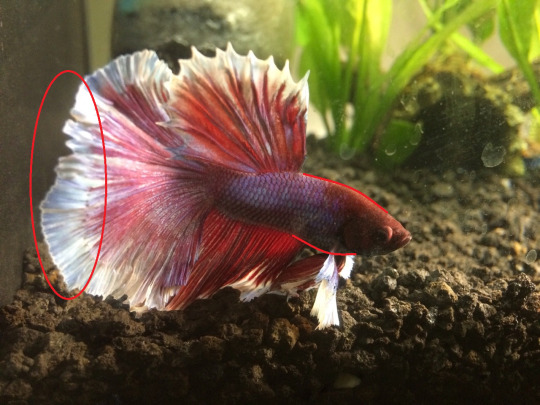
for example, here is my completely healthy male dumbo eared betta, arwen:
his back has a nice curve outward to it, meaning he is a healthy weight. his stomach has a gentle swell, meaning he was fed recently and an appropriate amount for his size. he doesn’t have fin rot, meaning his fins are not blackening and necrotic – literally rotting away.
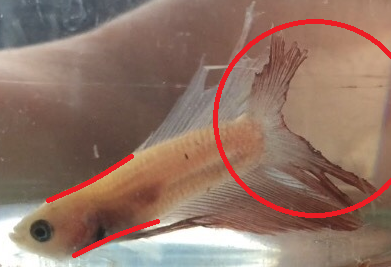
for comparison, here is the doubletail male i got today:
both his back and stomach are sunken in – this betta is both emaciated and hasn’t eaten in several days at least. his fins are necrotic and rotting away – he is quite literally decaying while still alive. he is also VERY pale – meaning he is stressed and sick. (NOTE: the healthy betta used as an example isn’t a double tail – which means exactly what it sounds like. he only has one tail while the betta i got today has two)
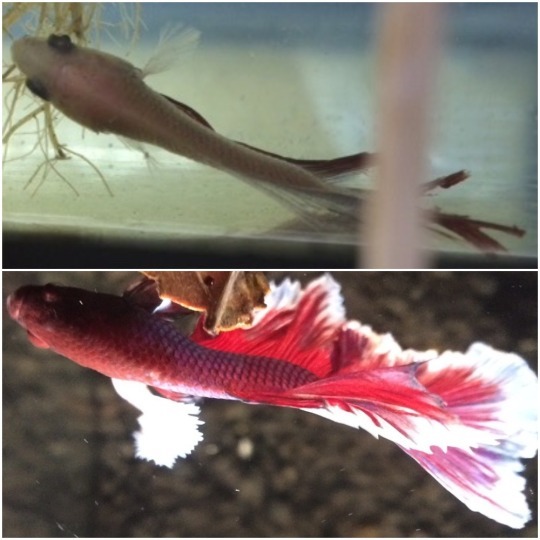
this is a comparison between the two from above:
it was difficult to take a picture of arwen from above because a healthy betta is very unlikely to sit still when your hands are hovering above them – my betta would be excited and dancing around for food, because they are conditioned to associate my hands above them with eating. in general, a healthy betta isn’t going to sit still for a picture. aside from that, i think it’s very apparent the difference between the two. arwen’s body is all gentle, healthy curves. his head isn’t large in proportion to his body and it doesn’t look weirdly disjointed from the rest of his body.
i’d normally post this to my fish blog, but i think it’s extremely important for people to really SEE this cruelty for what it is and understand just how easy it would be to provide proper care.
i don’t suggest anyone “rescue” a betta from petsmart or any other store- especially walmart. that being said, i just couldn’t leave him, he was belly up and i knew if i didnt take him no one else would – not like it would have mattered because i got him at closing and i know he wouldnt have survived the night had i not taken him. i also saw an opportunity for education – because i have 10k followers on this blog.
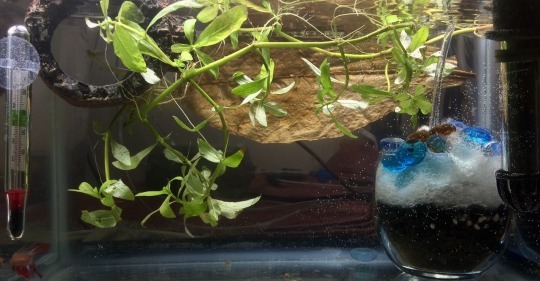
this is his new home. a clean, warm environment dosed with aquarium salt and stressguard(a fish antiseptic). i will have to monitor him closely for a while, change out his water daily and dose him with more antiseptic and aquarium salt.
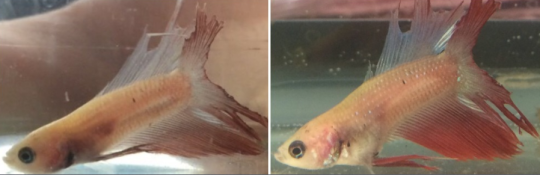
this is the difference in just 5 hours
please, properly care for your animals, and dont support companies that don’t.
I used to raise these guys. To see them kept badly and thoughtlessly is heartbreaking. And to see even one rescued from treatment like that is very, very good.
Four months, a heated, filtered, planted 5.5 tank, a lot of blood worms and regular water checks later:
i’m crying. he’s as beautiful as a summer’s night sky, when the sun is about to set over the horizon , and the last reflections of blue and pink dance off of fluffy white clouds.
Oh my goodness, even if he stayed ugly, this story warms my heart so much. Aww…




 Urocyon's Jaunts 2.0
You must be logged in to post a comment.