What is feminism? In this short, accessible primer, bell hooks explores the nature of feminism and its positive promise to eliminate sexism, sexist exploitation, and oppression. With her characteristic clarity and directness, hooks encourages readers to see how feminism can touch and change their lives–to see that feminism is for everybody.
A groundbreaking work of feminist history and theory analyzing the complex relations between various forms of oppression. Ain’t I a Woman examines the impact of sexism on black women during slavery, the historic devaluation of black womanhood, black male sexism, racism within the recent women’s movement, and black women’s involvement with feminism.
In Teaching to Transgress, bell hooks–writer, teacher, and insurgent black intellectual–writes about a new kind of education, educations as the practice of freedom. Teaching students to “transgress” against racial, sexual, and class boundaries in order to achieve the gift of freedom is, for hooks, the teacher’s most important goal.
Bell hooks speaks to the heart of education today: how can we rethink teaching practices in the age of multiculturalism? What do we do about teachers who do not want to teach, and students who do not want to learn? How should we deal with racism and sexism in the classroom?
Full of passion and politics, Teaching to Transgress combines practical knowledge of the classroom with a deeply felt connection to the world of emotions and feelings. This is the rare book about teachers and students that dares to raise critical questions about eros and rage, grief and reconciliation, and the future of teaching itself.
A sweeping examination of the core issues of sexual politics, bell hooks’ new book Feminist Theory: from margin to center argues that the contemporary feminist movement must establish a new direction for the 1980s. Continuing the debates surrounding her controversial first book, Ain’t I A Woman, bell hooks suggests that feminists have not succeeded in creating a mass movement against sexist oppression because the very foundation of women’s liberation has, until now, not accounted for the complexity and diversity of female experience. In order to fulfill its revolutionary potential, feminist theory must begin by consciously transforming its own definition to encompass the lives and ideas of women on the margin. Hooks’ work is a challenge to the women’s movement and will have profound impact on all whose lives have been touched by feminism and its insights.
One of our country’s premier cultural and social critics, bell hooks has always maintained that eradicating racism and eradicating sexism must go hand in hand. But whereas many women have been recognized for their writing on gender politics, the female voice has been all but locked out of the public discourse on race.
Killing Rage speaks to this imbalance. These twenty-three essays are written from a black and feminist perspective, and they tackle the bitter difficulties of racism by envisioning a world without it. They address a spectrum of topics having to do with race and racism in the United States: psychological trauma among African Americans; friendship between black women and white women; anti-Semitism and racism; and internalized racism in movies and the media. And in the title essay, hooks writes about the “killing rage"—the fierce anger of black people stung by repeated instances of everyday racism—finding in that rage a healing source of love and strength and a catalyst for positive change.
bell hooks writes about the meaning of feminist consciousness in daily life and about self-recovery, about overcoming white and male supremacy, and about intimate relationships, exploring the point where the public and private meet.
According to the Washington Post, no one who cares about contemporary African-American cultures can ignore bell hooks’ electrifying feminist explorations. Targeting cultural icons as diverse as Madonna and Spike Lee, Outlaw Culture presents a collection of essays that pulls no punches. As hooks herself notes, interrogations of popular culture can be a ‘powerful site for intervention, challenge and change’. And intervene, challenge and change is what hooks does best.
Addressing questions of race, gender, and class in this work, hooks discusses the complex balance that allows us to teach, value, and learn from works written by racist and sexist authors. Highlighting the importance of reading, she insists on the primacy of free speech, a democratic education of literacy. Throughout these essays, she celebrates the transformative power of critical thinking. This is provocative, powerful, and joyful intellectual work. It is a must read for anyone who is at all interested in education today.
Although it may not be the goal of filmmaker, most of us learn something when we watch movies. They make us think. They make us feel. Occasionally they have the power to transform lives. In Reel to Real, Bell Hooks talks back to films she has watched as a way to engage the pedagogy of cinema – how film teaches its audience. Bell Hooks comes to film not as a film critic but as a cultural critic, fascinated by the issues movies raise – the way cinema depicts race, sex, and class. Reel to Real brings together Hooks’s classic essays (on Paris is Burning or Spike Lee’s She’s Gotta Have it) with her newer work on such films as Girl 6, Pulp Fiction, Crooklyn, and Waiting to Exhale, and her thoughts on the world of independent cinema. Her conversations with filmmakers Charles Burnett, Julie Dash, and Arthur Jaffa are linked with critical essays to show how cinema can function subversively, even as it maintains the status quo.
In these twelve essays, bell hooks digs ever deeper into the personal and political consequences of contemporary representations of race and ethnicity within a white supremacist culture.
When women get together and talk about men, the news is almost always bad news,” writes bell hooks. “If the topic gets specific and the focus is on black men, the news is even worse.”
In this powerful new book, bell hooks arrests our attention from the first page. Her title–We Real Cool; her subject–the way in which both white society and weak black leaders are failing black men and youth. Her subject is taboo: “this is a culture that does not love black males: ” “they are not loved by white men, white women, black women, girls or boys. And especially, black men do not love themselves. How could they? How could they be expected to love, surrounded by so much envy, desire, and hate?
Drawing on both her roots in Kentucky and her adventures with Manhattan Coop boards, Where We Stand is a successful black woman’s reflection–personal, straight forward, and rigorously honest–on how our dilemmas of class and race are intertwined, and how we can find ways to think beyond them.
In Sisters of the Yam, hooks examines how the emotional health of black women is wounded by daily assaults of racism and sexism. Exploring such central life issues as work, beauty, trauma, addiction, eroticism and estrangement from nature, hooks shares numerous strategies for self-recovery and healing. She also shows how black women can empower themselves and effectively struggle against racism, sexism and consumer capitalism.
On that note, everyone should go read When the Grey Beetles Took Over Baghdad by Mona Yahia. It’s about an Iraqi Jewish girl growing up in Baghdad after the tasqit (when 90% of the Jewish population left) and struggling to find her identity while constantly being told by each successive regime that she does not belong in the only home she has ever known. It’s an excellent book and I have a mini quest to get everyone on the face of the earth to read it.
I would also suggest The Best Place on Earth by Ayelet Tsabari, the other book I wrote my paper on. It’s a collection of short stories about Mizrahi Jews in (and sometimes out) of Israel and their struggles with identity and belonging in the face of marginalization.
Both of these books are so good, they made me want to scream from the top of mountains. They’re both #ownvoices as well. Mona Yahia is an Iraqi Jewish woman who was born in 1954 in Baghdad (tasqit: 1950-51) and Ayelet Tsabari is a Mizrahi Jewish woman of Yemeni descent who was born and raised in Israel, though she lives in Canada now.
TLDR: When the Grey Beetles Took Over Baghdad and The Best Place on Earth are my two favorite books by Jewish women of color. Please read them.
Basically, there are about two options when it comes to Very Long Books, depending on the dimension of you bookshelf.
1) Push it as far back as possible into the shelf. The spine end is heavier than the leaves, so you want to make the center of gravity closer to the spine end. Make sure it’s well supported on either side with either other books or bookends.
2) Shelve it spine-down; all other rules apply regarding support.
However, the best way to shelve a long hardcover book?
Don’t.
Store it flat and fully supported, on a table or shelf.
Shelving a book that doesn’t fit on the shelf is asking for damage, either through natural warping or accidental bumping.
Thank you so much! This is actually super-helpful!
I can’t do coffee table or open storage with this many naughty cats around, and a lot of my shelves are the cheap kind that kid of bow in the middle over time, but I am pretty sure I can find a level place to lay it flat with only big flat books I barely use on or under it to prevent wear and tear.
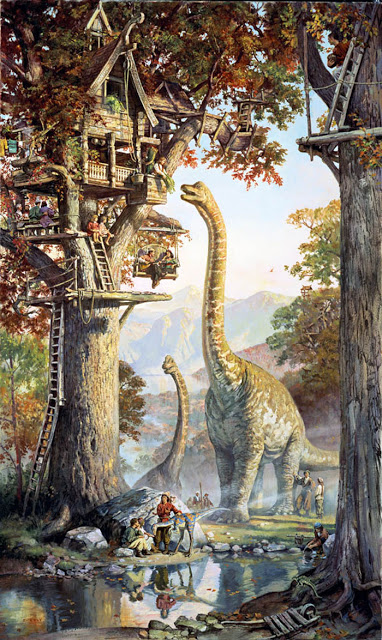
Dinotopia is a fictional utopia created by author and illustrator James Gurney. It is the setting for the book series with which it shares its name. Dinotopia is an isolated island inhabited by shipwrecked humans and sentient dinosaurus who have learned to coexist peacefully as a single symbiotic society. The first book has “appeared in 18 languages in more than 30 countries and sold two million copies.”Dinotopia: A Land Apart from Time and Dinotopia: The World Beneath both won Hugo awards for best original artwork.
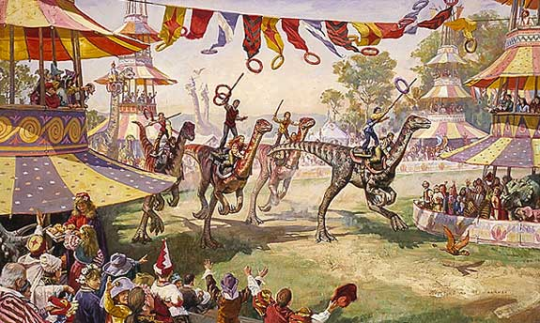
God these images still send this ENTIRE thrill through me. They just evoke that feeling of being a child with a book too large for you, staying for so long on a single picture that you feel like you could turn around in it.
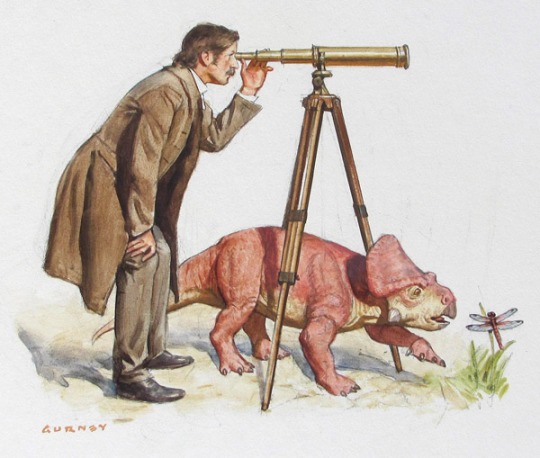
Gurney consistently produces a world that feels completely reasonable and real. The color, the light, the relationships between fore- and background,
the fact that it seems like a real world, where people are engaging in perfectly reasonable cultural activities…
The natural gestures, implying the personalities and relationships of characters in a single image…
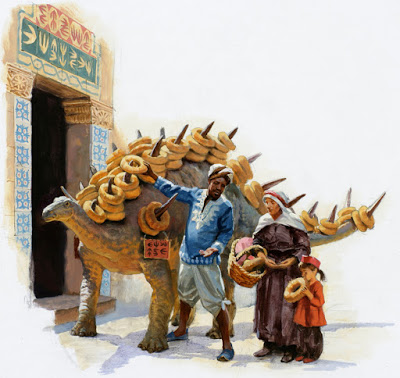
And it’s quite creative. I mean, look at this pair of bagel sellers. WHAT A GREAT WAY TO SELL BAGELS?
I had to use a macro lens to capture these miniature books–they are super tiny!
“Old King Cole” and “Three Blind Mice” were both published by Gleniffer Press in Paisley, Scotland and stand at just 1 mm tall! In 1985 they were the smallest printed books and smallest letterpress printed books in the world, and they hold the Guinness Book of World Records for that year.
a young adult novel series where a girl hides her gender to become a knight but in the end it turns out theyre all women pretending to be men so the rest of the books are just abt lesbianism and swords
It’s good that people are getting aware of this book again, real good, but lemme give y’all some historical context: Buzz Windrip is a caricature of Woodrow Wilson and a lot of the book is lampooning the Wilson presidency.
Y’know how we keep tryna tell y’all that Trump is not the disease, he’s just a symptom? Well, the title of this book is actually a bit of black comedy, because it totally did happen here.











 Urocyon's Jaunts 2.0
You must be logged in to post a comment.