[A] reason commonly cited for supporting Bolsonaro is Brazilians’ frustration with corruption, which, for the last 5 years has been nearly exclusively associated in the national and international media with the PT. Like the issue of violence, this does not hold up to a minimal level of scrutiny. President Dilma Rousseff was never involved in personal enrichment through corruption. In fact, she herself is a victim of corruption. Impeached for committing a non-impeachable offense, a budgetary infraction that was systematically committed by all leaders of all levels of Brazilian government and legalized one week after she was removed from office, it has subsequently come out that congressmen were bribed to vote in favor of her impeachment.
Luiz Inácio Lula da Silva, who was the one man generally believed powerful enough to block the privatization of Brazil’s massive offshore petroleum reserves, was arrested on charges that he committed “indeterminate acts of corruption” related to an apartment the courts were unable to prove he ever owned and thrown in jail before his appeals process played out, in a move which Glen Greenwald says was obviously done to keep him for running for president this year. Likewise, Fernando Haddad was a victim of corruption when US-backed judge and prosecutor Sergio Moro illegally leaked plea bargain testimony to the press during election season, alleging that it implicates him in a corruption scandal despite the fact that the testimony had already been thrown out by the public prosecutor’s office.
Jair Bolsonaro, on the other hand, spent 25 years affiliated with the most corrupt political party in Brazil, the Partido Progressista (PP), led by the most corrupt politician in Brazilian history, Paulo Maluf, who is on Interpol’s most wanted list and can not leave Brazil or will be arrested. Furthermore Bolsonaro is already inviting corrupt politicians to help run his government. These names include:
1) Alberto Fraga, Congressman from the DEM party and gun industry pitchman who Bolsonaro invited to lead his bloc in Congress. Three weeks before the first round elections, in September, 2018, Fraga was sentenced to 4 years of semi-open imprisonment after being caught on tape charging and receiving bribes from a bus company;
3) Congressman Pauderny Avelino from the DEM party, who was convicted in 2016 of paying cronies millions of dollars above market rate in rents for buildings and used school furniture when he was education minister in Manaus; and
4) Paulo Guedes, a University of Chicago educated monetarist economist and former attache [military officer] to Augusto Pinochet. Bolsonaro has invited him to be his Economic Minister, even though he is currently being investigated by the public prosecutors office, who want to know how he managed to pocket R$1 Billion in six years while managing pension funds.
[The] election was neither fair nor free. It was the result of a massive fraudulent campaign backed by the US government, Brazilian military and the judiciary to guarantee that the privatizations of the world’s largest offshore petroleum reserves implemented by the coup government of Michel Temer are not reversed, and that the US military has access to Brazilian bases for another possible future petroleum grab in Venezuela. The following events had a much bigger effect on Bolsonaro’s victory than violence and corruption:
1) A joint US/Brazil operation imprisoned leading candidate Luiz Inácio Lula da Silva, who promised to reverse petroleum privatizations and re-allocate state oil profits to public health and education. He was jailed before his appeals process was finished on trumped up charges with no material evidence, based on a single plea bargain testimony made by a convicted criminal in exchange for sentence reduction and partial asset retention;
2) Lula announced he would run for President anyway, as was his right according to Brazilian and international law. The electoral court allowed 1400 candidates with similar legal issues to run, but they made an exception for Lula. Still leading in all election polls from behind bars, with more support than all other candidates combined and double the support of Bolsonaro, the one man easily capable of defeating fascism was barred from running;
3) The UN Human Rights Committee issued a ruling ordering the Brazilian government to allow Lula to run for office. Brazil is a signatory to the UN Protocol on Civil and Political Rights and, according to MP 311/2009, UNHRC rulings are legally binding. The Supreme Electoral Courtbroke Brazilian law and disobeyed the UN when it refused to let Lula run;
4) In a country where TV crews regularly enter prisons to interview drug traffickers and mass murderers, the courts bared Lula from speaking to Journalists, illegally prohibiting him for communicating to the public why they should vote against fascism in the elections;
5) 3.3 million voters, most of whom were poor and Northeastern – essentially the demographic that most supports the PT party – were purged from the voter rolls two weeks before the elections; and
6) After Bolsonaro support surged in the first round election, Folha de São Paulo revealed that his campaign was using an illegal slush fund created by hundreds of businessmen paying up to $4 Million USD each, to hire tech firms to illegally acquire personal data from users of the WhatsApp social media app. According to the article, this was used to create thousands of demographicly targeted groups of 256 uses each and bombard them with lies and slander against the PT party. These lies were not primarily based on fear mongering about violence and corruption, but on slander that the PT party is run by sexual perverts who want to make everyone’s children gay. After Supreme Electoral Court President Rosa Weber received death threats from Bolsonaro supporters and held a meeting with Bolsonaro supporter General Sergio Etchegoyen, she decided to hold off investigations until after the final round of the elections.
International capital and the US government now have exactly what they want in Brazil. All natural resources will be opened to exploitation from foreign capital. The US military will be able to use the Alcantara rocket launching base as a take off point for forays into Venezuela. Brazil’s participation in the BRICS is dead in the water and US Petroleum companies will be swimming in Brazilian oil. Regardless of the level of participation by the US and its institutions, these events fit a pattern of US interventions in Latin America over the past 100 years.
If we are truly interested in defeating fascism it is important to move beyond cliches and work to identify the real actors at play, so that their power can be countered. In order to do this, we have to move beyond the idea that Brazil operates in a geopolitical vacuum and that the return to neofascism, which was previously installed with ample US government support from 1964-1985, can be explained by oversimplified generalizations on public opinion.
LGBT BRAZILIANS TAKE CARE WITH DATING APPS AND GRINDR, THEY WILL BE USED TO TARGET VICTIMS PLEASE SIGNAL BOOST
ALSO!!!!!!!!!!!!
In Whatsapp (the most used messaging app in Brazil), if you receive a contact from a “juridical support group for LGBT+ people who are being harassed” called “REAJA”, DO NOT INTERACT!!!!!!! Apparently, this is not a real support group but it’s a trap that are targeting LGBT+ people to physically harm them. They people behind “REAJA” have very malicious intentions.
Be careful and stay safe!!!!!!!
the REAJA thing is a bunch of real things and also fake facts put together in a messy way, creating confusion. its not actually a secret gay extermination group like some messages spread on whatsapp claim it is. https://www.boatos.org/politica/grupo-reaja-lgbt-armadilha-gays.html (this link is in portuguese, i dont think theres anything abt this in english)
however, still be careful if you get contacted by things of that sort because there are people out there who have openly expressed their desire to harm lgbt+ people and other minorities. stay alert.
Brazil did it. Brazil elected a neo-facist, racist, homophobic asshole to govern our country and the consequences about it it’s already happening.
In less than 24h since he’s been elected it’s been hell of fucking earth in Brazil. Countless people have been reported dead all over the country, mainly LGBTQ+. Countless. People parading around cities with their fucking guns (it’s pretty much illegal in Brazil but this asshole is trying to change our law to allow guns, he’s even encouraging parents to give their kids a gun ????), shooting it into the sky in sign of victory. Did you know that one of those bullets killed a child? Yeah. One killed an old lady too. There’s been report of them invading a indigenous village and attacked them. They’ve been saying they are going to kill every single “slut”, “fag”, “dyke”, poor people, Nordestino (people that lives in Nordeste, a region in Brazil, that is mainly against this government), black and homeless people. Aka in the last 24h Brazil felt what is like to live in the fucking Purge.
There’s already people recruiting “good citizens” to erradicate Brazil of “fags and dykes, because now that their master’s been elected, there’s nothing protecting them, they’re not even people.” I kid you not. They’ve created group chats in popular apps to talk about mass shooting the LGBTQ+ community in Brazil. Yesterday there were people waiting outside a queer club to beat anyone that went outside.
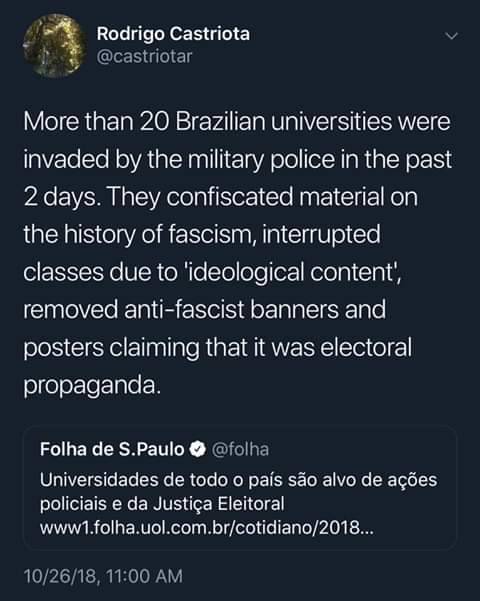
Our police enforcement already started to invade college campuses and schools to destroy history books because they think our teachers are indoctrinating us in favor of communism. These history books tells about our 1964 military dictatorship (something we’re very afraid of happening again and we’re pretty sure is gonna happen with this demon in charge). They are trying to say that we choose to elect a military government back then, when in fact was a fucking coup. They’re also trying to get rid of philosophy classes and social studies because they think it only teach us to become communists as well. Basically, they’re all very ignorant and violents and they’re trying to fuck with the only fucking hope we have to our future: education.
You won’t probably hear many of the things I’m saying because I’ve been reading it on social media, and everything we (the opposition) say on social media is basically reported as “fake news” by his voters. But yeah, I can’t count how many videos I’ve saw today of women getting beaten and threatened. Of how many stories I’ve read of people walking the streets and cars pullover poiting guns at them and threaten them. Of people posting pictures of their “victory bbq” with guns spread in their tables close to their fucking meat. Of how many times I’ve cried since his pronouncement, thinking about how I’ve never felt so unsafe in my entire life. Of how I’ll have to be cautious about everything from now on, if I don’t want to become another casualty.
If you don’t believe what I’m saying, read about what foreign news are talking about us:
So it seems… the Western side of the Atlantic is descending into a fascist nightmare… what’s… what’s going on on the other side?
Also descending into a fascist nightmare, but more politely and under the guise of “economical” problems (brexit and the european refugee crisis says hello)
so i dont like to use this to project my voice at all but i live in brazil and we just elected an actual fascist to the presidency. if you are outside the country, please educate yourself on what is happening here…im sorry im just too distressed to collect links but brasilwire has some good reading on it. and to my fellow brazilians: tamo junto. a luta continua, sempre.
i know it seems silly to many of you who just come here for aesthetics but i need people to please be aware that brazil is full of real people, terrified of the return of the brutal anticommunist dictatorship that the fascist bolsonaro has promised. please…dont take this lightly.
brazilians, if you are crowdfunding to leave the country please message me and i will boost your campaigns on my various sideblogs.
Guys, please please please keep Brazil in your prayers and keep an eye on us.
Today we had the elections and the candidate who’s winning is extremely sexist, homophobic, white supremacist that supports dictatorships and that everything should be solved with guns (he’s also a former member of military).
He has said that women aren’t fit to work bc they can get pregnant, that the reason he had a female child was because he was “weak” when making the baby, that “gayness” is a product of parents not beating their children enough, that the biggest mistake of the horrible dictatorship our country lived in the 60’s was torturing instead of killing, etc.
So far, his hateful speeches have sparked a massive hateful following of people who idolize him and there have been numerous cases of these people doing terrible things in his name. For instance, groups of people chanting on the streets that he will kill gays (a slur was used), people taking pictures using guns in the voting cabin, hacking a fb group of women against this man, his supporters shot and killed a dog for “disrupting” their event and more.
The mainly white male following has spread inummerous fake news about other candidates and are convinced that nazism was a leftist movement and use this info to demonize the main contender, who’s a leftist. This caused the german embassy to release a statement informing them that it was (obviously) actually a right wing movement. Not surprisingly, as radical right wingers, they do not believe it. That, coupled with his VP talk of “race whitening” doesn’t shock anyone here.
The elections will soon be over and he’s winning with a 20% gap. I am completely desolate. I don’t know what to do, how life’s gonna be for me and my friends. I’ve never been more scared in my life. My country is recognized all over the world for its freedom, but we’re about to enter very very dark times.
Please, don’t forget us.
He has now won the election.
Yesterday a black boy my age was killed in a protest and today people are celebrating this “win” setting fireworks on the streets.
Jair Bolsonaro, a fascist, pro military dictatorship, racist, misogynist, and homophobe, has been elected Brazilian president. My heart goes out to all Brazilians who are in danger and living in fear right now because of him and his horrid followers.
I’m crying right now. It’s been really a terrible evening here. The future is more uncertain than ever and I wish it was overreaction bit it’s not. Their violence already started and tonight was no exception. We’ve been adopting this sentence now that we lost (WE LOST A LOT MORE THAN OUR CANDIDATE) that says “ninguém solta a mão de ninguém” (no one lets go of the other’s hand or something like that). It’s a good premisse. Thanks for your thoughts. Since it’s a world wave of hate, we are in this togeter.
RIO DE JANEIRO — Brazil on Sunday became the latest country to drift toward the far right, electing a strident populist as president in the nation’s most radical political change since democracy was restored more than 30 years ago.
The new president, Jair Bolsonaro, has exalted the country’s military dictatorship, advocated torture and threatened to destroy, jail or drive into exile his political opponents.
He won by tapping into a deep well of resentment at the status quo in Brazil — a country whiplashed by rising crime and two years of political and economic turmoil — and by presenting himself as the alternative.
“We have everything need to become a great nation,” Mr. Bolsonaro said Sunday night shortly after the race was called in a video broadcast on his Facebook account. “Together we will change the destiny of Brazil.”
He appeared eager to dispel concerns that he would govern despotically, saying his government would be a “defender of the Constitution, democracy and liberty.”
Mr. Bolsonaro, who will take the helm of Latin America’s biggest nation, is farther to the right than any president in the region, where voters have recently embraced more conservative leaders in Argentina, Chile, Peru, Paraguay and Colombia. He joins a number of far-right politicians who have risen to power around world, including Italy’s deputy prime minister, Matteo Salvini, and Prime Minister Viktor Orbán of Hungary.
“This is a really radical shift,” said Scott Mainwaring, a professor at Harvard University’s Kennedy School of Government who specializes in Brazil. “I can’t think of a more extremist leader in the history of democratic elections in Latin America who has been elected.”
With 98 percent of votes counted, Mr. Bolsonaro was ahead with 55 percent, guaranteeing him a win over Fernando Haddad of the leftist Workers’ Party, who had 45 percent.
Hundreds of supporters gathered outside Mr. Bolsonaro’s seaside home in Rio de Janeiro, jumping and hugging each other when the results were announced. As golden fireworks lit up the sky, they chanted “mito,” or legend, paying homage to their president-elect.
Reeling from the deepest recession in the country’s history, a corruption scandal that tarnished politicians across the ideological spectrum, and a record-high number of homicides last year, Brazilians picked a candidate who not only rejected the political establishment but at times also seemed to reject the most basic democratic tenets.
Mr. Bolsonaro’s victory caps a bitter contest that divided families, tore friendships apart and ignited concerns about the resilience of Brazil’s young democracy.
Many Brazilians see authoritarian tendencies in Mr. Bolsonaro, who plans to appoint military leaders to top posts and said he would not accept the result if he were to lose. He has threatened to stack the Supreme Court by increasing the number of judges to 21 from 11 and to deal with political foes by giving them the choice of extermination orexile.
Mr. Bolsonaro, 63, a former Army captain who has been a member of Congress for nearly three decades, beat a crowded field of presidential contenders, several of whom entered the race with bigger war chests, less baggage, and the backing of powerful political parties.
Part of the reason for his victory was the collapse of the left. Many cried foul after former President Luiz Inácio da Silva, the longtime front-runner in the race, was ruled ineligible to run after he was imprisoned in April to start serving a 12-year sentence for corruption and money laundering.
His Workers’ Party had won the last four presidential elections, and Mr. da Silva, a former metalworker, retained a devoted following among poor and working class Brazilians who felt represented by him personally and had benefited from his party’s social inclusion policies.
But many more Brazilians showed through their votes that they’d had enough of the Workers’ Party, which steered the country from 2003 to 2016 through a boom-and-bust cycle that ended in an economic morass and the impeachment of his successor, President Dilma Rousseff.
Despite his influence, Mr. da Silva was not able to pull off the last-minute transfer of votes to the candidate chosen to replace him on the ballot, the bookish and urbane — but less charismatic — Fernando Haddad.
And for those Brazilians who saw the political establishment they inherited from the Workers’ Party as venal, Mr. Bolsonaro was an enthralling candidate.
He accomplished little in his long legislative career, but his roster of offensive remarks — he said that he’d rather his son die than be gay and that women don’t deserve the same pay as men — was interpreted by many as bracing honesty and evidence of his willingness to shatter the status quo.
“The way he’s run his campaign is very clever,” said Matias Spektor, a professor of international relations at Fundação Getulio Vargas University. “He has managed to align himself with the institutions that Brazilians still believe in: religion, family and armed forces.”
Mr. Bolsonaro, the patriarch of a family from Rio de Janeiro that includes three sons who are also lawmakers, ran an insurgent campaign that defied the political playbook that brought his predecessors to power.
A year ago, Mr. Bolsonaro’s bid was widely regarded by political veterans in Brasília as fanciful in a nation renowned for the cordiality and warmth of its people. Some of the candidate’s remarks were so offensive the country’s attorney general earlier this year charged him with inciting hatred toward black, gay and indigenous people. In a country where most of the population is not white, this alone might have seemed to disqualify him.
Yet, the vitriol and outrage Mr. Bolsonaro brought to the campaign trail as he traveled around the country largely mirrored Brazilians’ dystopian mood.
Nearly 13 million people are unemployed. The homicide rate is among the highest in the world — last year, 63,880 people were killed. And Mr. da Silva, the former president many had idolized, had left office with an approval rating of 87 percent only to become the most prominent scalp taken by a corruption scandal that has ensnared dozens of the country’s political and business leaders.
Part of Mr. Bolsonaro’s appeal lay in the extreme solutions he proposed to assuage the population’s anger and fear of violence.
He vowed to give the police forces in Brazil — some of the most lethal in the world — expanded authority to kill suspected criminals, saying with trademark bluntness that a “good criminal is a dead criminal.” He also promised to lower the age of criminal responsibility, impose stiffer sentences for violent crimes and ease Brazil’s gun ownership restrictions so civilians could better protect themselves.
“Violence must be reduced because otherwise we are headed toward total chaos,” said Roberto Levi, 36, a police officer in Rio de Janeiro who voted for Mr. Bolsonaro.
Over the past two years, while many of Brazil’s traditional political parties and powerful kingmakers were busy defending themselves against corruption allegations stemming from the investigation known as Lava Jato, Mr. Bolsonaro flew around the country, drumming up support, particularly among young men, and in comparatively wealthier and whiter parts of the country.
While rivals spent small fortunes on marketing firms, video editors and consultants, Mr. Bolsonaro relied primarily on Facebook, Twitter, YouTube and the instant messaging service WhatsApp to communicate with voters and expand his base.
Opponents enjoyed far more advertising time on television and radio — which is allotted by party size — and rolled out slickly edited campaign materials. But Mr. Bolsonaro’s campaign drowned them out with a bare-bones, scrappy communications strategy. He and his sons broadcast shaky, poorly-lit videos on Facebook and Instagram in which Mr. Bolsonaro cracked jokes, took aim at adversaries and bemoaned the state of Brazil.
On WhatsApp, supporters created hundreds of groups to share memes, videos and messages that often contained falsehoods and misleading content that cast Mr. Bolsonaro in a positive light and disparaged his rivals.
One dominant message, spread widely via WhatsApp, asserted with no evidence that Mr. Bolsonaro’s opponents encouraged schoolchildren to become gay or reconsider their gender identity by employing sex education materials referred to as “gay kits.”
“I like what Bolsonaro stands for,” said Cintia Puerta, 55, an architect in São Paulo said Sunday after casting her vote. “My sister works in a school so I know they are teaching “gay kits” to children, teaching them about sexuality at age five and six. They’re indoctrinating children in the school.”
Mr. Bolsonaro’s presidential ambition nearly ended on Sept. 6 when a man sliced a knife into his stomach during a campaign rally, slashing several organs and his intestines.
After that, Mr. Bolsonaro declined to participate in debates and did few probing interviews, leaving significant gaps in the electorate’s understanding of his position on pivotal issues, including pension reform and the privatization of state enterprises.
In the wake of the attack, Mr. Bolsonaro’s standing in the polls rose steadily after languishing in the low 20-percent range for weeks. Last-minute endorsements from the influential evangelical lobby and agribusiness leaders gave him a boost.
After the first round of voting, in which Mr. Bolsonaro received just shy of the 50 percent required to win outright, some political analysts expected he would moderate his rhetoric in order to appeal to centrist or undecided voters.
They were wrong.
Last Sunday, he issued a threat to members of the Workers’ Party that critics called downright fascist.
“Those red good-for-nothings will be banished from the homeland,” he said during an address, delivered via a video link up, to thousands of supporters gathered in São Paulo. “It will be a cleanup the likes of which has never been seen in Brazilian history.”
For the Workers’ Party, Sunday’s presidential defeat leaves a political movement that won accolades from much of population for affirmative action and inequality-reducing policies significantly weakened and effectively leaderless.
Party luminaries hoped that the former president, Mr. da Silva, a lion of Latin America’s left know by his nickname of “Lula,” would return to the presidential palace. Even after Mr. da Silva was jailed, party leaders said that “an election without Lula is fraud.”
When courts made clear Mr. da Silva would not be allowed to run, and the Workers’ Party nominated Mr. Haddad, a former education minister and mayor of São Paulo, the campaign’s slogan was “Haddad is Lula.”
During his campaign, Mr. Haddad visited Mr. da Silva in prison multiple times, and did little to take responsibility for the party’s mistakes. This lack of atonement pushed many hesitant Brazilians toward Mr. Bolsonaro, said Mr. Mainwaring, the Harvard professor.
“The Workers’ Party strategy was centered too much around Lula and too little around thinking about the future of the country and about winning this election,” he said. “An important part of the Brazilian electorate would have voted for the P.T. if it had drawn a line in the sand and renounced the corruption of the past.”



 Urocyon's Jaunts 2.0
You must be logged in to post a comment.