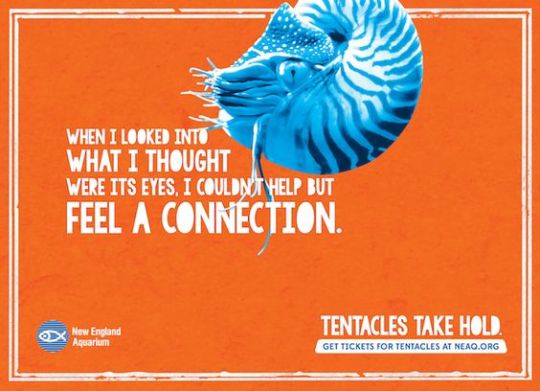
friends, you don’t understand. This ad campaign was goddamn HUGE. They bought out the entirety of multiple train stations in Boston with these. There are so many more, and they’re all this same beautiful combination of questionable/amazing.
No bigger than a thumb, the Hawaiian bobtail squid needs all the help it
can get to survive. Researchers have long known that this cephalopod, Euprymna scolopes,
houses bioluminescent bacteria in a special light organ just for that
purpose. The light helps camouflage the squid from predators below, and
the squid has specific proteins to aim this spotlight.
Now, researchers have discovered that the bobtail hosts other bacterial
guests as well—and may depend on them to keep squid eggs safe. Many
octopuses watch over their eggs as they develop. Not the bobtail squid,
which leaves its eggs unattended on coral reefs. Yet it does have a
small gland in its reproductive tract whose function has been a mystery
for almost a century. Curious about this gland, microbiologists isolated DNA from it, identifying about a dozen types of microbes.
These microbes are deposited in the jelly encasing the squid’s eggs.
Now, the researchers have treated bobtail squid eggs with antibiotic and
left them in seawater. In just 11 days, the eggs became coated with a
“fuzz” of fungi and suffocated, they reported this week at the Frontiers
in Phylogenetics meeting at the National Museum of Natural History here.
Just when we thought octopuses couldn’t be any weirder, it turns out that they and their cephalopod brethren evolve differently from nearly every other organism on the planet.
In a surprising twist, scientists have discovered that octopuses,
along with some squid and cuttlefish species, routinely edit their RNA
(ribonucleic acid) sequences to adapt to their environment.
This is weird because that’s really not how adaptations usually
happen in multicellular animals. When an organism changes in some
fundamental way, it typically starts with a genetic mutation – a change
to the DNA.
Really interesting short read for those interested in evolution.
stupid non-cephalopodes: evolve through a relatively stable updating of genetic matrices
grand cephalopod savants: biohacking into the nature mainframe and leaving eldritch comments in the engine’s source. what the fuck is a “stable release”




 Urocyon's Jaunts 2.0
You must be logged in to post a comment.