i feel like the role colonialism plays in “deindustrialization” of colonized areas (eg; India went from 25% of global industrial output in 1750 to only 2% in 1900 ) is an important concept and one that contradicts myths that you see not only in colonial apologia but even some kinds of misguided anti-colonialism set up on myths of idealized pasts
Lotsa people asking for references so I’ll just put that stuff here
This passage from the textbook “The Process of Economic Development" by James Cypher is good at giving a very basic rundown of how this worked in places like colonial India. Here is another paper that gets much more detailed about the general process. In the specific example of India you have a region going from being the single largest textile manufacturer in the 18th century to essentially having its textile industry killed off by the end of the 19th. Indian textiles had a heavy presence in European markets initially and while the decline was certainly related to the advent of machine factories it was not caused by it and predates it by some years
By the end of the 17th century, Indian calicos were a major force in European markets (Landes,
1998, p. 154). For example, the share of Indian textiles in total English trade with southern Europe was more than 20 percent in the 1720s,
but this share fell to about 6 percent in the 1780s and less than 4 percent in the 1840s (Inikori, 2002, p. 517). India was losing its world
market share in textiles during the 18th century, long before the industrial revolution.
Economic policies by the British helped with this process. High tariffs were put in place in the UK on Indian textile goods while within India the importation of British goods was done without any tariffs thus making British manufactured goods cheaper in India while Indian manufactured goods were made more expensive in Britain. This was occurring even when the textile industry in both areas was still largely “cottage” (ie without machine factories) and the rise in industrial machinery in the UK was partially (not solely) caused by the specific desire to make the balance of trade favor the economy of the imperial center over that of colonies
Peripherally related but:
I once saw some folks in the R*tional*st corner of tumblr having a conversation about how to end the disputes over land in North America between Settlers and Natives.
It was a mess and a trainwreck at best, as you’d expect when a buncha settlers sit down and discuss between themselves how they can finally shed the pretense of colonial guilt. Their idea was to pay back the monetary value of the land in its entirety, as reparations to every living descendent. (I’m not sure they had an unfucked conception of who would be entitled under this scheme.)
ONLY the land, not incluing not factoring in any “improvements” or anything that had been built since. Because, they insisted, that’s all that was unjustly taken that could ever be paid back with money. There are so many issues with that line of reasoning and I’m not even gonna begin to unpack all of them – the relevant thing for this discussion was the presumption that there were no pre-existing infrastructures, or large-scale deliberate alterations to the landscape. That there were no houses, cities, or farms. No mining of economically-important minerals, no alterations to the landscape to make it more productive, in short no civilization or anything that might’ve improved the use-value or the property value of the land.
And like, we know that’s not true. I could get into the way that history and archaeology put the lie to that assumption, with new discoveries coming in all the time to bolster or illuminate a number of different cases – but instead, I’m just going to show you a picture:
This is Wyam, AKA Celilo Falls. Until 1957, it straddled the Columbia River that seperates Oregon from Washington. It’s nearly impossible to overstate how important it was, not just because of the rich fishing grounds (so rich that seals and sea lions would swim hundreds of miles inland just to get at the salmon runs), nor for the fishing platforms that enabled fishermen to get so many of them – but also, for the many villages nearby, which had been continuously occupied for over 15,000 years, and were a trading hub for people bringing goods from as far away as Alaska, the desert Southwest, and the Great Plains. The rocks there were covered in art, some of it dating back to its earliest habitation. Lewis and Clark showed up in 1805 and were astounded at the population density. Even after disease, conquest, genocide and settlement, it was an important population center for many of the Chinookan and Sahaptin-speaking societies that lived there.
Try to picture 15,000 years of continuous history. Try to picture art from the first human beings to live there, side-by-side with that made by their descendents 15,000 years later. Writing was invented in Mesopotamia about 5000 years ago. It was only 7000 years ago that people speaking Proto-Indo European showed up in the places we think of as Europe today.
For over twice that span of time, Wyam was a major destination for people from thousands of miles away, and until 1957, their descendents were still living there. It is, in fact, the oldest continuously-inhabited place on the entire continent.
Until 1957, when the Army Corps of Engineers finished working on the Dalles Dam, and flooded the entire area.
Ten years earlier, the United States government decided that building the dam and flooding the site wouldn’t contravene their treaties with the Native nations there. They subsequently had a Supreme Court case that ended with a $26.8 million dollar settlement, divided among the tribal governments.
Fat lot of good that money’s done. Poverty, suicide, and food insecurity rates are still incredibly high on the reservations nearby.
My point is: destroying native infrastructure – whether for settlement or extraction of resources – is a vital component of how colonialism operates.
“The Trump administration cannot ignore the law, nor the reality of tribes’ existence as sovereign nations that predate the United States. Treaties cannot be sponged away. The government’s legal duty to provide medical care to tribes, determined by treaties, Congress, Executive Orders, and the Supreme Court of the United States, cannot be summarily dismissed. These actions maynot only be illegal, but threaten the survival of natives today, whose ancestors were extinguished by the millions in the genocide of Indigenous that began with the landing of Christopher Columbus in 1492. We deserve to live.”
The Burnum Burnum Declaration England, 26th January, 1988
I, Burnum Burnum, being a nobleman of ancient Australia do hereby take posession of England on behalf of the Aboriginal people. In claiming this colonial outpost, we wish no harm to you natives, but assure you that we are here to bring you good manners, refinement and an opportunity to make a Koompartoo – ‘a fresh start’. Henceforth, an Aboriginal face shall appear on your coins and stamps to signify our sovreignty over this domain. For the more advanced, bring the complex language of the Pitjantjajara; we will teach you how to have a spiritual relationship with the Earth and show you how to get bush tucker.
We do not intend to souvenir, pickle and preserve the heads of your 2000 of your people, nor to publicly display the skeletal remains of your Royal Highness, as was done to our Queen Truganninni for 80 years. Neither do we intend to poison your water holes, lace your flour with strychnine or introduce you to highly toxic drugs. Based on our 50,000 year heritage, we acknowledge the need to preserve the Caucasian race as of interest to antiquity, although we may be inclined to conduct experiments by measuring the size of your skulls for levels of intelligence. We pledge not to sterilise your women, nor to separate your children from their families. We give an absolute undertaking that you shall not be placed onto the mentality of government handouts for the next five generations but you will enjoy the full benefits of Aboriginal equality. At the end of two hundred years, we will make a treaty to validate occupation by peaceful means and not by conquest.
Finally, we solemnly promise not to make a quarry of England and export your valuable minerals back to the old country Australia, and we vow never to destroy three-quarters of your trees, but to encourage Earth Repair Action to unite people, communities, religions and nations in a common, productive, peaceful purpose.
Transcription of tweets from twitter user red3blog:
We really should be teaching more white people that slavery absolutely WAS a choice for slaveowners. All too often, we act like it was a way of life or a force of nature and not a CHOICE made by people who felt entitled to regard other people as their property.
Slaveowners made a choice ever[sic] single day to treat other human beings like their property. Plenty of people in their own time knew this was wrong, but they did it anyway. Teach THAT.
things i am going to teach my children later: the “pick one favourite” syndrome embedded in our culture is stupid and useless
it starts at fucking pre-school, in those little get-to-know-me books, and it never ends. favourite colour? mother tongue? favourite character? best friend? favourite sport? song? movie? book? series? band? toy? no you can only pick one
and i am deeply convinced that this is intrinsically linked to one of the things that annoys me the most, which is that in our society, it’s considered a sign of maturity to prioritise one thing, and often specifically one person, above everything else. i mean, priorities are definitely important, but you are also absolutely allowed to equally enjoy/love/feel connected to different things without constructing some kind of hierarchy where one of them always wins out
“you can only like one gender, you can only be one (of the two “biological” – ha) genders, you can only have one partner, you must have one best friend, you must have one favourite activity (preferably your job, bc that makes you a functional member of society) because clearly if you love multiple things, you must love them less than if you spent all that love on one thing”
this rhetoric creates so much guilt and jealousy – as if love is a finite concept.
(incidentally it is also possible to genuinely love something without it being one of the things you love the most, and that doesn’t make that love any less valid, but that’s another discussion)
It is if the forms only allow one language as answer on a planet where some people are raised fluent in more than one language and others grow up with the language of their parents suppressed to the point their technical mother tongue is the language they are least fluent in.
Trade languages and colonial-remnant official languages exist. Sometimes the language someone speaks at home isn’t the most useful language for official communication, which is what that kind of question is usually after, because quite often the language used where most people are natively bilingual at home isn’t the one someone would be using in public official situations to start with.
For example, being functionally bilingual or trilingual was so common in Roman-era Judea and Galilee (especially Galilee) that there was an established system forming of which names were replaced with which other names to deal with grammatical and pronunciation problems during language shifting. Paul’s name switch wasn’t a conversion thing, it was a sign he was using trade-language Greek as his primary language after being Saul when he was primarily speaking Aramaic – but he would have been fluent from childhood in both along with all his neighbors. We don’t notice things like that now when switching to and from English because English doesn’t decline names, so the significance is lost. (And Americans additionally also have a Pick One Name system that has trouble even dealing with culturally established common nicknames being used as someone’s primary use name once things hit the legal system.)
India has a similar multilingual situation now thanks to colonial Britain. Someone’s ‘mother tongue’ will most likely be a regional dialect of one of a few languages, but everyone in the country uses English for official purposes. ‘What is your mother tongue’ will tell you where someone grew up, but they’ll still most likely be fluent enough in English to function in official situations. And then they use ANOTHER language for poetry and art, which is why Bollywood movies aren’t in English but can be understood across the entire country.
I know someone who is German, has a doctorate in English, and teaches another language at the college-level in America. If he’s honest on a form about what his ‘mother tongue’ actually is because they only give him space for a single answer and presume he’s less than functionally fluent in any other language he might speak, someone is going to go looking for a translator he does not need, it’s going to take forever because German is not a common language where he lives, AND he’s going to be ticked off when he realizes what the delay is.
‘Mother tongue’ is only a simple one-answer question when everyone is presumed to have a single language they grew up fluent in.
Gaelic hasnt been lost. It’s never died or been brought back. There’s an unbroken line of native speakers going back to the beginning of the language. That doesn’t seem like a ‘lost’ language to me. Furthermore I’m not sure what ‘artificial life-support’ means in this context. Gaelic is given funding for schools because there’s still native speakers of the language. It’s no more artificial than money being given to schools for English language lessons.
If anything is ‘artificial’ its the imposition of a foreign language
(English) into a Gaelic majority zone and native speakers having to
fight for decades to be able to be taught in their own language. Native speakers being forced to learn English to exist within their own regions because a central government would not allow services to be given in a people’s own language.
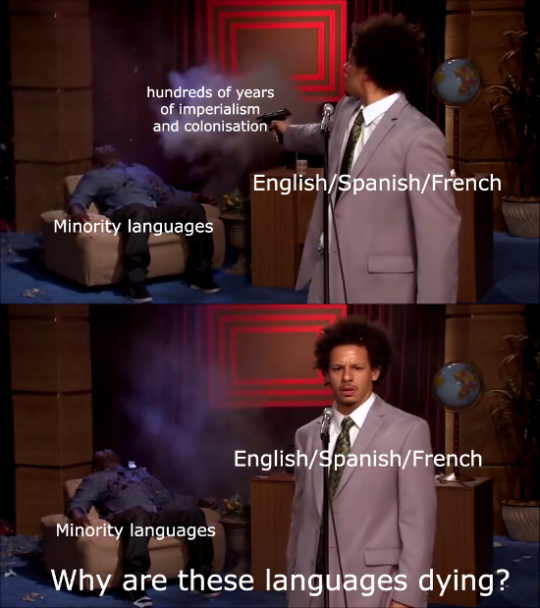
But then the clock only goes back so far with people who wish that minority languages would just die. There’s nothing artificial about shooting someone but suddenly it becomes an ‘artificial’ act to maybe phone an ambulance?
“There’s nothing artificial about shooting someone but suddenly it becomes an ‘artificial’ act to maybe phone an ambulance?” — THIS RIGHT HERE
Also just gonna point out here:
In the UK, the languages Gaelige, Gaelic, Cymraeg and Kernewek (that’s Irish, Scottish, Welsh and Cornish respectively) didn’t just “die out.” There was a concerted effort by the English to kill them off.
For example, in Wales, if a child was heard speaking Welsh in a classroom, they’d be given a “Welsh Not”, a wooden plaque engraved with “WN” to hang around their neck. They’d pass it onto the next child heard speaking Welsh, and whoever had the Welsh Not at the end of the day was punished – usually with a beating.
Kernewek was revived after a long hard struggle by the Cornish folk, and is now being taught again, but a lot about it has been lost because everyone who grew up speaking it has died.
And languages are never revived “just because.” The language of a place can offer so much insight into its history, so if you’re content to let a language die then you’re content to let history die.
People talk about “dead” languages as if they dwindle away gradually, naturally coming to an end and evolving into something else, but that’s rarely the case. Languages like Cymraeg and Gaelige and especially Kernewek didn’t have the chance to die with dignity, they were literally beaten out of my parents and grandparents.
Is it any wonder every other country hate the English? We invade their country, steal their history, claim pieces of their history as ours or flat out re-write it, and kill every part of their culture that we can.
It’s a miracle that any of the Celtic languages survived, so even if you don’t see the point in keeping them alive, the actual natives of each country we’ve fucked over are clinging onto what heritage they have left through the only thing they can: their language.
Hey OP, póg mo thóin!
*snerk* xD
I would like to point all of these “just let it die” assholes directly at Hebrew.
The language was effectively dead. It had been murdered and forced-assimilated away.
But there was this dude named Ben Yehuda.
And he said “no.”
“The language of my people for four thousand years or more,” he said, “should not stop existing because of a bunch of assholes.” (Okay, this is a dramatic retelling. He probably didn’t actually say assholes.)
So he started an official movement to recreate Hebrew as closely as possible to how it had been spoken about a thousand years prior.
Today, ancient Hebrew is spoken by millions of Jews around the world weekly in our prayers and Torah readings, and modern Hebrew is the official language of eight and a half million people–many of them having been born speaking it as a first language. Many people in the first group also speak at least some modern Hebrew–and it’s possible you do, too! A lot of loan words from Hebrew and Yiddish have made their way into English (like klutz, mensch, and kibitz).
That’s hardly “on life support.” Hebrew is growing, living, and thriving because of the Enlightenment efforts of the 1800s. The same COULD be done for languages like Welsh, Navajo, and Basque if the larger powers that be said “this is important” rather than forcing a giant bastion of culture–the language in which a people lived, loved, thought, told stories, and explained their world–to die.
there is a distinct difference between language that has died because it stopped meeting the needs of the people using it and language that has been deliberately killed by oppressors
I remember reading a linguist’s thoughts on this a while back. They noted that languages are not only an important cultural heritage, but also an important historical artifact that offers a look into the unique perspective of a culture. The things that we name and how we name them reflect our values and priorities. For example, Inuktitut is said to have several different words for snow that categorize them by various metrics. This reflects a need for communication regarding what the snow was like, which naturally would be important to a people who deal with snow on a near constant basis. There are nine different ways to say “you’re welcome” in Native Hawaiian, each responding to a different level of gratitude. You don’t respond the same way to “thanks for giving me a donut” as you do to “thanks for saving my life.” This reflects a culture of accountability and honor.
The study and preservation of indigenous languages worldwide is vital to the enrichment of our global culture. You don’t have to be fluent in multiple languages to be able to understand the perspective that is offered by nurturing this tradition. Our ability to communicate is one of our greatest gifts – what a waste it would be to throw that away simply because providing institutions of cultural heritage is too inconvenient.
^^^^ also ^^^ to the person pointing out that the non-English archipelagan languages were deliberately suppressed, they didn’t “lose” a “fight”, attempts were made to erase cultures, it is a thing the English ruling classes have always done literally everywhere they had any power
Gaelic hasnt been lost. It’s never died or been brought back. There’s an unbroken line of native speakers going back to the beginning of the language. That doesn’t seem like a ‘lost’ language to me. Furthermore I’m not sure what ‘artificial life-support’ means in this context. Gaelic is given funding for schools because there’s still native speakers of the language. It’s no more artificial than money being given to schools for English language lessons.
If anything is ‘artificial’ its the imposition of a foreign language
(English) into a Gaelic majority zone and native speakers having to
fight for decades to be able to be taught in their own language. Native speakers being forced to learn English to exist within their own regions because a central government would not allow services to be given in a people’s own language.
But then the clock only goes back so far with people who wish that minority languages would just die. There’s nothing artificial about shooting someone but suddenly it becomes an ‘artificial’ act to maybe phone an ambulance?
“There’s nothing artificial about shooting someone but suddenly it becomes an ‘artificial’ act to maybe phone an ambulance?” — THIS RIGHT HERE
Also just gonna point out here:
In the UK, the languages Gaelige, Gaelic, Cymraeg and Kernewek (that’s Irish, Scottish, Welsh and Cornish respectively) didn’t just “die out.” There was a concerted effort by the English to kill them off.
For example, in Wales, if a child was heard speaking Welsh in a classroom, they’d be given a “Welsh Not”, a wooden plaque engraved with “WN” to hang around their neck. They’d pass it onto the next child heard speaking Welsh, and whoever had the Welsh Not at the end of the day was punished – usually with a beating.
Kernewek was revived after a long hard struggle by the Cornish folk, and is now being taught again, but a lot about it has been lost because everyone who grew up speaking it has died.
And languages are never revived “just because.” The language of a place can offer so much insight into its history, so if you’re content to let a language die then you’re content to let history die.
People talk about “dead” languages as if they dwindle away gradually, naturally coming to an end and evolving into something else, but that’s rarely the case. Languages like Cymraeg and Gaelige and especially Kernewek didn’t have the chance to die with dignity, they were literally beaten out of my parents and grandparents.
Is it any wonder every other country hate the English? We invade their country, steal their history, claim pieces of their history as ours or flat out re-write it, and kill every part of their culture that we can.
It’s a miracle that any of the Celtic languages survived, so even if you don’t see the point in keeping them alive, the actual natives of each country we’ve fucked over are clinging onto what heritage they have left through the only thing they can: their language.
Hey OP, póg mo thóin!
*snerk* xD
I would like to point all of these “just let it die” assholes directly at Hebrew.
The language was effectively dead. It had been murdered and forced-assimilated away.
But there was this dude named Ben Yehuda.
And he said “no.”
“The language of my people for four thousand years or more,” he said, “should not stop existing because of a bunch of assholes.” (Okay, this is a dramatic retelling. He probably didn’t actually say assholes.)
So he started an official movement to recreate Hebrew as closely as possible to how it had been spoken about a thousand years prior.
Today, ancient Hebrew is spoken by millions of Jews around the world weekly in our prayers and Torah readings, and modern Hebrew is the official language of eight and a half million people–many of them having been born speaking it as a first language. Many people in the first group also speak at least some modern Hebrew–and it’s possible you do, too! A lot of loan words from Hebrew and Yiddish have made their way into English (like klutz, mensch, and kibitz).
That’s hardly “on life support.” Hebrew is growing, living, and thriving because of the Enlightenment efforts of the 1800s. The same COULD be done for languages like Welsh, Navajo, and Basque if the larger powers that be said “this is important” rather than forcing a giant bastion of culture–the language in which a people lived, loved, thought, told stories, and explained their world–to die.
there is a distinct difference between language that has died because it stopped meeting the needs of the people using it and language that has been deliberately killed by oppressors
I remember reading a linguist’s thoughts on this a while back. They noted that languages are not only an important cultural heritage, but also an important historical artifact that offers a look into the unique perspective of a culture. The things that we name and how we name them reflect our values and priorities. For example, Inuktitut is said to have several different words for snow that categorize them by various metrics. This reflects a need for communication regarding what the snow was like, which naturally would be important to a people who deal with snow on a near constant basis. There are nine different ways to say “you’re welcome” in Native Hawaiian, each responding to a different level of gratitude. You don’t respond the same way to “thanks for giving me a donut” as you do to “thanks for saving my life.” This reflects a culture of accountability and honor.
The study and preservation of indigenous languages worldwide is vital to the enrichment of our global culture. You don’t have to be fluent in multiple languages to be able to understand the perspective that is offered by nurturing this tradition. Our ability to communicate is one of our greatest gifts – what a waste it would be to throw that away simply because providing institutions of cultural heritage is too inconvenient.
By far the best part of Assassin’s Creed III is the fact that you can chase down the founding fathers and just harangue them, just bully those slaveowning nerds and shove them around a bit.
Here we see the guy on the $1 bill kneeling and crying because a stronger boy pushed him
George Washington didn’t own slaves. He inherited slaves but set them free because he saw slavery as inhuman.
George Washington inherited some of his slaves from Martha’s first marriage, but owned over 100 of his own by the end of his life. He did not give any indication during his life that he saw slavery as inhuman and, in fact, was pretty enthusiastic about the practice of holding humans prisoner and putting them to work in a forced labor camp.
When he needed new slaves, he known to ask for “Six or more n*****s… males… well-grown lads… healthy, and none of them addicted to running away.” (Letter from George Washington to John Francis Mercer, November 6 1786)
There was also his practice of dealing with “misbehaving” or “unruly” slaves was to ship them off to an even more brutal plantation in the Caribbean in exchange for various luxury foods and drinks. Like in 1766, when he sent an “unruly” slave named Tom to the West Indies in exchange for barrels of molasses and rum, or then again in 1791 when he shipped of an unnamed “misbehaving fellow” in exchange for “one pipe and quarter cask of wine.”
Now, you’re partially right on one thing. He did set his slaves free. In his will. You know, when he was dead and therefore done exploiting them. Couldn’t be bothered to do it while he was alive and stood to lose something from, you know, releasing the inmates of his forced labor camp, but he did technically allow SOME OF them to go free when he was no longer alive to enjoy the fruits of their labor.
You might be thinking of Ben Franklin, who actually did set his slaves free and take up the cause of abolition because he thought the institution of slavery was abhorrent, but this was also something that made him incredibly unpopular, especially with enthusiastic slaveowners like Washington and Jefferson.
Oh, and in reference to your tags. Temple University, class of 2014. Bachelor’s in History. During my years there, I specialized in American history and specifically built my curriculum to cover race relations in detail. The subject area of my capstone class was the American Revolution. If you’re going to accuse someone of skimping on research and not paying attention in history class, maybe don’t pick someone who just came off of five years of history class culminating in a final intensive course on this exact subject when you couldn’t even be bothered to google it.
they literally have the slave quarters on display at Mt Vernon…
George Washington didn’t own slaves he just ~inherited~ them!!
???? What?
Also, at least as relevant to that game featuring Connor/Ratohnhake:ton? George Washington’s War on Native America. In which he personally tried to wipe out the Iroquois League.
Though, those are not totally separate issues. As quoted from another source through the link (bolding added):
He insisted in killing as many Indians as possible without taking into account age or sex. The survivors were to be given as agricultural slaves to the colonists who deserved them “Destroying not only the men but the settlements and the plantations is very important. All sown fields must be destroyed and new plantations and harvests must be prevented. What lead can not do will be done by hunger and winter.”
George’s own words. So obviously opposed to the idea of slavery… 😩


 Urocyon's Jaunts 2.0
You must be logged in to post a comment.