When I go in, I literally pray, “PLEASE let this be something obvious and easy to diagnose.” Because if it’s not, I’m going to get injected with psych drugs I don’t need, have my other medications discontinued in favor of this month’s preferred drug, be told that I don’t really hurt, and have my file annotated with “drug seeking.” Seriously, I’d rather have a heart attack than a severe, but non-life-threatening, pain when I go to the ER. The heart attack they will find quickly and treat effectively – because they can ignore everything I say and still treat it. But they will ignore everything I say if what I say is essential to diagnose the real problem. Just once, I’d like to go to an ER – or have my disabled friends go to an ER – and be believed from the start when we say we hurt and need help. Just once.
I’m not so sure about the heart attack, especially while AFAB. (And diabetic, and expecting to need to fight to avoid getting put on contraindicated statins again soon–with the idea of reducing the elevated risk of heart attacks…)
But, excellent post overall. I didn’t want to go totally overboard quoting, but the whole thing is well worth a read.
This week, the Office for National Statistics has added ready-made mashed potato to the UK’s official shopping basket, which it uses to measure inflation, and people are up in arms. Who buys a pre-chopped onion that costs three times as much as a whole one? How lazy do you have to be to choose a frozen omelette over a couple of eggs?
These kinds of convenience foods are an easy target. But for the 13.3 million people in Britain with disabilities – and those living with arthritis, chronic illness, recovering from injury or surgery, or undergoing cancer treatment – convenience foods aren’t just convenient: they are a lifeline.
This is an issue close to my heart. I’m a professional cook, but I also have a chronic pain condition, and there are occasions when I can’t even hold a knife. In times like those, I’m never going to opt for the impenetrable whole butternut squash over one that has already been diced for me.
The footrest/leg lift assembly on my motor wheelchair just snapped off, and is now dragging on the floor.
I
called the wheelchair/medical supply place (the only one within two
hours’ drive from here, since their only rival went out of business last
November), and the soonest they can get anyone to take care of it is a
week from today…. They have two mechanics on staff, and one of them is
on jury duty.
The only advice the woman on the phone could tell me is just improvise something as best I can until then.
But really, this is what happens when a) you try to meet the needs of
the Disabled through capitalism, and b) the Disabled are a class that
are considered commercially unworthy.
In contrast, look at all
the options available to you if your car breaks down, or even your
kitchen sink backs up. There’s more than one service provider in town,
and each one has more than two qualified employees…
Meanwhile, I
get charged an extra $75 before the person even comes out here, because
I did not buy the chair from them… I bought it from their competitor,
who went bankrupt. So it’s not even like I have a choice.
Is there anything we can do out here in Tumblrland to help?
Not that I can think of… except sending good vibes, in the chance that it’ll actually protect me from any follow-on things going wrong.
I mean, we could all brainstorm ways to dismantle the medical-industrial-complex… But I don’t think that will change much between now and next Wednesday…
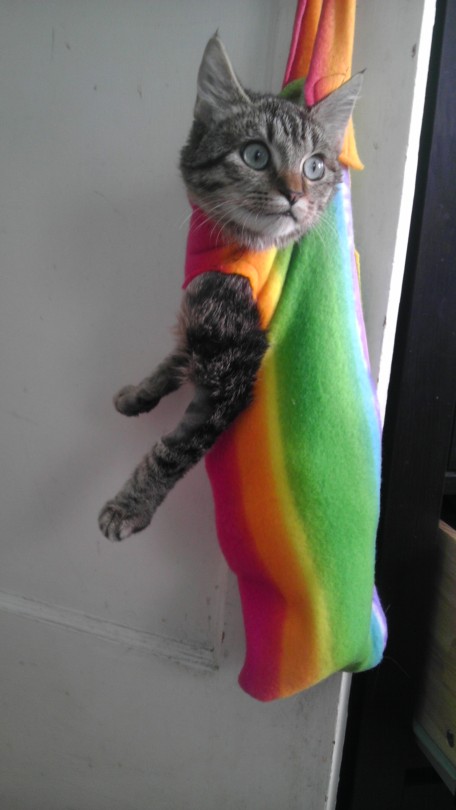
The dog has an issue where his esophagus doesn’t work right; it doesn’t get food in there right because it’s all stretched out and stuff. So what dog owners (and cat owners and I guarantee you the cat ones look goofier) do is make a highchair and feed them upright so gravity can be a hero. It’s also really cute.
The disorder is called Megaesophagus.
Here is a cat with the same disorder in his eatin’ sock.
EATIN’ SOCK
ALWAYS REBLOG THE EATIN’ SOCK
EATIN’ SOCK IM CRYING
take note! this is how you coo over disabled animals without expressing pity or that they’re inspirational, which are stereotypical attitudes that may carry over to your view of disabled humans. the eatin’ sock is a hilarious disability thing that doesn’t rely on any unkind sentiment.
But I can’t help but wonder if only privileged people can afford to take a position of social media puritanism. For many, particularly people from marginalised groups, social media is a lifeline – a bridge to a new community, a route to employment, a way to tackle isolation.
“We stand with those who want answers and effective policy solutions…But false and harmful claims and attacks on ‘mental illness’…further discrimination against individuals with mental health disabilities. It is time for us to do better. ”
Mobility aids, you know em, you’ve seen em. Wheelchairs, crutches, canes, buggies ect. They are great inventions to help people get around with better mobility, hence mobility aids.
Thing I wanna talk about though, is this awful problem that non disabled people have, stemming from the press pushing articles about people faking disabilities to get benefits. This has to be the most toxic thing that disabled people have to deal with on the daily and I need to talk about this, cause its not ok.
So some people (myself included) have disabilities that occasionally require the use of a mobility aid, like crutches or a cane. Some people use mobility aids all the time but can go without them if needs be (an example of somebody using a wheelchair who can stand and walk, but only for very short times). These people get looked down on so badly by judgey non disabled people and its awful to be there and there is no need for it because of this misguided belief that they’re just faking it
I had a bit of a rough time around Christmas. I had a fall, and with some serious back luck, fell on by back and a bottle in my back was in the worst spot, so it jarred my nerves and put me in a lot of pain. I also ran out of my painkillers, so was without for a good few weeks. I have a cane I will use if I need the support, but I hate using it and honestly the idea of having to use it again really hit me so hard, Like I cried cause I was so worried about what people would think.
I was lucky. at uni everyone knows about my leg and they were all ok and supportive about it. It really helped a lot, but it really hit me that I shouldn’t feel this way. Cause my leg problems are intermittent, when I have my bad days I keep having the feeling of “I’m just not disabled enough” and that’s never ok. I don’t take any benefits at all, cause the government made it so i cant apply, but still, I gotta grapple with that awful thought of “Am I disabled enough to use this”. The answer should always be yes. My doctor says I should use crutches on bad days, and that should be good enough but Im always so worried about other people claiming that im “faking” it cause i’m pretty active when my leg isnt bad. It still hurts but I can deal with it.
Im rambling, but my point is that there are people who need to use mobility aids occasionally, but not all the time, and people shouldn’t look down on them, call them liars or fakers or make them have to “prove” their disability constantly. We really need a change on how people view disabled people, especially ones with Hidden Disabilities because i’m noticing a nasty shift where people need to police disabled people constantly to “catch them out”. That needs to stop, its not ok.
I dunno how much sense this made, but yeah. I don’t like the way that things are going, where disabled people are losing benefits constantly, and people want to police disabled people so they need to prove their disability constantly. We need a change, a governmnet who cares more about disabled people, and the press to fuck off with their hatred of anyone who is disabled.
Sorry for the long rant
TL;DR, Some people dont need mobility aids constantly, and that doesnt make them any less disabled. Treat them with as much respect as anyone else
…There are aspects of being autistic, for me, that I doubt it’s possible for society to accommodate perfectly. That, even if society did a substantially better job at accommodating autistic people, being autistic would still markedly affect how I live, and will always leave me expending more effort than the non-autistic people around me just to get by…
…I will always be disabled. I don’t see that not being the case within my lifetime. There are, without a doubt, important roles for government, education, technology, and medicine to play in mitigating disability, but I will always be disabled in ways that even perfect acceptance and accommodation probably cannot erase.
So, neurodiversity critics need to understand that we who support neurodiversity aren’t confused about the fact of your child or loved one being really, truly disabled. We know there are non-speaking autistic people, epileptic autistic people, self-injuring autistic people. We know this because many of us are non-speaking, epileptic, and self-injuring autistic people.
Those of us who can communicate on the Internet believe that what we are saying about our own needs applies to the rights and needs of other disabled people, including the children and loved ones of neurodiversity detractors. So when we talk about the rights, acceptance, and accommodation that autistic people deserve, we are not the ones who think those things are only for people like us.
…We neurodiversity supporters believe that what someone can do matters. We believe that the way someone can communicate matters…
…We can help make a future that has room for people like your child in it, complete with the rights, the access, and the supports they need to live their fullest life. We think that that is doable. We think that that is right.
Yes, autistic lives are different. Yes, they are often hard. No, they will not look like the lives of non-disabled people.
We just don’t think that that makes disabled lives wrong.
Joseph Shapiro and an investigative team at NPR have just released an in-depth series on disability and sexual assault that took nearly a year of work. “Abused and Betrayed” unfolds in a series of features exploring various aspects of the sexual assault epidemic in the developmental disability community — from exclusion in sexual education to rape in institutions.
Part of me is glad that this series exists. Shapiro has a long history of involvement in disability reporting and culture — his book No Pity is a must-read — and sexual abuse in disability communities is an issue that rarely receives public attention.
But, to my knowledge, no one who worked on this investigation is disabled, which is extremely disappointing. The lack of visibility for disabled reporters is a serious failure for newsroom diversity that has real consequences — we can tell stories nondisabled people can’t, and consider issues nondisabled reporters and editors tend to miss.
In “She Can’t Tell Us What’s Wrong,” (warning: this article is very graphic) the team looked at cases where communication issues hinder disabled people’s ability to report abuse. In many cases, this also presents challenges for sex education and personal empowerment. A disabled person may not realize that abusive behavior is, in fact, abusive, with some reports of abuse relying on witnesses who observe something going wrong.
That was certainly the case when a staff member at an institution walked into a patient’s room and saw a member of the staff “with his pants down.”*
In rape reporting, there are certain conventions people follow. Many publications will not use rape survivors’ last names, for example, and may at times change the first name as well. They may take other steps to shield a survivor’s identity out of respect for the fact that rape is an intensely personal, violating crime. A special duty of care is required in places where the ability to consent may be compromised.
And so I was startled when NPR opted to redact this rape survivor’s last name, but then provide extremely specific identifying details about her. Her sister is named in full, and the feature includes numerous photographs. The name of the institution is also included, and so is identifying information about the specific room the victim lives in. The detailed reporting on her case suggests that, while she knows some sign language, she lacks the ability to communicate explicit consent to have her story told in such detail.
While the rape survivor welcomed the NPR crew, it’s not clear whether she fully understood what they were doing, or the ramifications. Did she know that an intimate and traumatizing incident in her life would be broadcast nationwide? Would she have consented if she understood that? This decision was made for her by her sister, in a familiar patronizing pattern.
The piece also explored the case of a woman whose sexual assault was revealed when she tested positive for a sexually transmitted infection. Again, NPR shows her photograph, names her family, discloses the specific infection she was diagnosed with, names and shows her aides. Again, her capacity for consent was not explored, and the voices of her family members are centered in her story.
Infantilization and desexualization are troubling themes throughout the series; one family member compares an adult victim to a “child,” expressing shock that she would be targeted for sexual assault. The nondisabled public is horrified at the thought of sexual abuse that involves adults who are “like children,” as though this is somehow “worse” than sexual abuse in general. Turning disabled people into metaphorical children doesn’t stop abuse, though; if anything, it increases vulnerability to assault.
Readers and listeners come away with a strong sense that disabled people aren’t sexual and don’t have agency. Their family members, meanwhile, are given considerable authority — and the series doesn’t delve into the history of caregiver abuse committed by family members.
This kind of storytelling troubles me because it taps into a long, dark history of focusing on the voices of parents and family members while excluding disabled people from their own narratives. Commentary from disabled people was reserved for the end of the series, in a single set of first-person interviews. This is one result of allowing nondisabled people to dominate the media landscape; they tell stories about us without us rather than centering disabled voices.
When the idea that family should be the voices in the conversation is normalized, it makes it much harder to push back on abuse of power. One would expect a series about abuse to empower people, not reiterate the social structures that contribute to abuse. It is very uncomfortable to admit that nondisabled people and reporters should be stepping back to provide room for disabled voices in storytelling. But it is a conversation we need to have.
These sexual assault survivors have difficulty communicating their stories in a way that’s accessible to nondisabled people. But does that mean their stories should be told for them in such graphic detail? Reporting like this often justifies such sharing on the grounds that this is the only way to get listeners, viewers, or readers to “pay attention” — by humanizing an epidemic of sexual assault that would otherwise be dry statistics or vague nonspecifics. Does that justification make it okay?
Like many disabled people, I’ve had my stories told for me, without my consent, “for the greater good.” The sense of profound personal violation that results does not make up for the supposed social benefit.
As a journalist, this is an issue I think about: Would this action bother me, if I was on the receiving end? Or has someone who’s been in a similar position told me it was violating and upsetting? Because if so, that’s an indicator that I need to find another way to tell the story.
There’s a way to report on this serious epidemic in our community that respects privacy and autonomy, as for example in a later installment in the series where victim privacy is respected. Why couldn’t the same have been done across the board?


 Urocyon's Jaunts 2.0
You must be logged in to post a comment.