Do you ever think about the fact that the US has created and legitimized a system of institutionalized inequality by funding schools through property taxes? That basically a child’s education is only as good as the value of the property in their neighborhood. Funny how education is so often viewed as an equalizing factor when there is nothing equal about it.
I really don’t care if I’ve already reblogged this
Because this needs to be reblogged….
I remember learning this for the first time as an adult. I had grown up thinking education was the great playing field leveler. So I was so furious to find out how very much it wasn’t anything of the kind.
This is a big part of why you’ll often see rich white people fussing about school district lines, because they hate the idea that their money is going towards the education of poor children.
This is where I wish more schools would adapt the student driven IEP model in middle and high school. It’s coming for New York in the most recently updated special education policies and I can’t wait. I’m willing to give suggestions on that. But more on that in another post.
At the university level, as the student, it is 100% your responsibility to advocate for yourself. Your parents aren’t legally allowed to be involved (due to privacy laws) and the disability office cannot get too involved for the same reason. I’ll get to what the disability office can and cannot legally do in a separate post.
So you did your intake meeting. You know what your accommodations are. What next? Well you need to meet with your professors to discuss accommodations. This can go multiple ways:
•They insist you meet in their office
•You wait for the class to drain out and you talk to them after class if they are available.
Then their response usually falls somewhere between:
•Incredibly helpful, asking on a regular basis how they can best assist your learning according to your accommodations so you get the most out of their class (I don’t know how I managed three of these professors this semester).
•Indifferent, they’ll follow the accommodations and not much else. If it isn’t specifically written in the accommodations, they might not do it.
•Intentionally obstructive, trying to get in your way. Ableist as hell. Don’t believe students who need accommodations belong at universities. Has the false belief that accommodations affect academic integrity (they legally aren’t allowed to do that). I’ll be covering that in a separate post.
Usually a disability services office that goes out of their way is on a campus that has mostly incredibly helpful to helpful professors. Can you get an intentionally obstructive professor in this scenario? It’s theoretically possible (remember the best professors are constantly checking themselves for bias) but unlikely as it’s likely university policy to be accountable for all student learning. The reverse is also likely.
Anyway, so you have your time for when you are going to speak to your professors. What do you say? First, you introduce yourself. Tell them why you wish to speak to them (or remind them of you schedule an appointment over email). Then tell them what accommodations from the disability office you were given and how it will affect their specific class. So I’m going to use my accommodations from this semester and my hybrid class as an example of applying the accommodations to the class:
•Time and a half on tests [Blackboard quizzes require Time and a half, which only needs to be set once]
•Small group test taking in alternate location [Will be taking final exam at disability office]
•Requires computer for written exams/essays etc.
[N/A, quizzes already on computer, all papers typed and submitted electronically]
•Requires computer for taking notes in class
[During on campus classes, I need to have my laptop to take notes on]
•Requires audio note taking software
[It’s easier for me to record audio then only type the absolutely important things vs trying to type everything and getting frustrated. My laptop mic is pretty good plus there are settings I can adjust and I have a USB mic just in case.]
•Requires books and large texts in alternate format (ebook/audio)
[I can’t process long bits of text. It’s easier for me to have text to speech/audible read to me while I read along. I have a way to convert longer PDFs into ones that screen readers can handle but if I look confused on what went on in the reading, it’s because the conversion went array.]
Each class is different, so I tailor my responses to how the accommodations apply to that class. This must be done in the first week if everything is going to go smoothly. If your disability services office is good, they’ll email your accommodation letter to you and your professor every semester so everyone gets it and no one can claim ignorance.
“[T]he interests of the oppressors lie in “changing the consciousness of the oppressed, not the situation which oppresses them,” for the more the oppressed can be led to adapt to that situation, the more easily they can be dominated.” — Paulo Freire
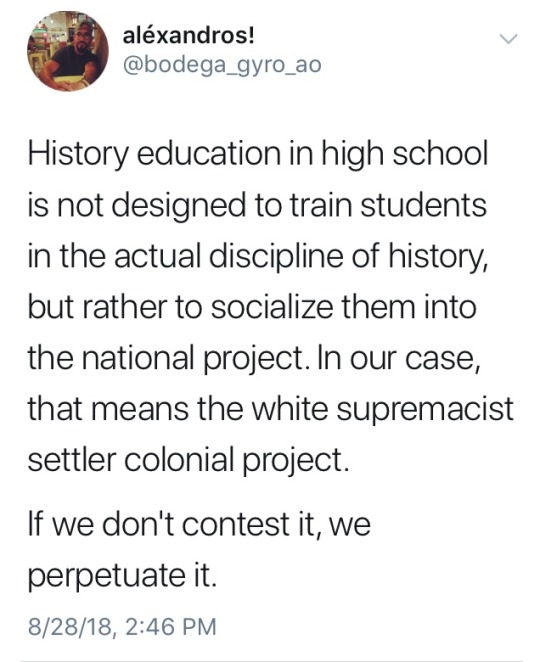
The history we were taught in school has trained us to center the accomplishments and humanity of white people, especially wealthy white men. When the accomplishments of the Other is touched on only briefly in passing, we internalize the idea that such people are less important; that their stories are mildly interesting sidebars at best, and not part of the main arc of History.
I don’t believe that most teachers do this on purpose, but I do think there are a lot of teachers who fail to examine critically and question the history they themselves were taught, or the curriculum their school uses, which can lead them to unwittingly perpetuate harmful narratives and extremely lopsided history.
Every time you are presented with a historical narrative, or remember a historical “fact” you learned in school, stop and ask yourself, “is that really what happened? How do we know?” Then look up and confirm the information with a reliable source (preferably multiple original eye-witness accounts), if you can.
If you’re not sure where to start, try googling “factual account of [historical event]” and seeing what websites and book recommendations come up. For books, read the negative reviews, and see what people’s complaints are. If reviewers complain about factual inaccuracy, steer clear. Young adult books are often a good source of basic information, broken down in ways that are easy to understand.
For Americans, I recommend starting by looking up factually accurate accounts of the Plymouth colony and the first Thanksgiving, since that is one of the most heavily mythologized pieces of American history. The story you think you know is probably the sanitized and simplified children’s picture-book version invented in the 19th century to promote American unity during and after the Civil War.
What do you actually know about what the Pilgrims believed, why they were persecuted in England, and what they hoped to accomplish in the “New World”?
What do you know about the life and background of Squanto (Tisquantum) or William Bradford or Miles Standish?
What did the Pilgrims think about the Indigenous Americans, and vice versa?
What were relations like between the colonists and the natives after the First Thanksgiving?
How and why did the national holiday of Thanksgiving come about?
The true history of the world is sometimes sad, sometimes horrifying, but always fascinating and worth the effort of finding it out.
The way we were educated also tells us to center individuals rather than groups, which is a way of reinforcing capitalist ideals, even though no individual in history existed separate from groups and support structures. This is what allows people to claim they rose to power/prominence from their ‘own hard work’ and causes people who have not risen to power/prominence to be blamed for the fact that they have not. (Regardless of whether they’re capable of it, but especially regardless of whether they want to.)
It also centers Important Events, when it’s important to not that all events had many factors leading up to them and had many impacts beyond whatever people find important to list out. Most historical changes can be traced to a whole slew of events that may be considered ‘more important’ or ‘less important’ for a variety of reasons, and can be used in different ways to create different narratives of how history went. Changes happen over time, not instantly, and won’t just keep going without further input.
Another thing a lot of emphasis is put on is war and revolution. A lot of things have happened in history that don’t involve fighting though, and there’s a lot to learn from histories of farming, social movements, weather and natural disasters, myths and stories, art, or anything else you can think of. War definitely has an impact on society, but so does everything else, and plenty of revolutions happened without any bloodshed at all, or even people noticing any drastic changes, which is probably where house cats come from.
Technology is also an interesting and educational thing to look into, but also something depicted as a) instantly inciting change, b) monotonically increasing, c) universally good with no negative impacts, d) the only/most important marker of an ‘advanced civilization’, and e) whatever will make post-Enlightenment Western culture look like the best and smartest culture in a way that’s unique to them and makes it difficult to prove other cultures had/have cool technology.
So even when ideas about history can be backed up by facts, it’s important to be careful to read between the lines and figure out what story they’re telling, and especially who that story benefits.
Another thing I’m not adding to the educator post, but is relevant:
We need to deal with the homophobia, transphobia, and racism toward students and staff in our schools.
This crap is unacceptable. I talked to HR about a classroom teacher I was a long term sub for. He regularly belittled his students for being LGBTQ kids.
He used a lot of ‘dogwhistle’ racism that the Black, Latino, and Native American kids picked up. Multiple students said they were afraid of him.
I was told that he resigned. People like him should not be teachers.
He was working with vulnerable kids and was doing this crap. Don’t be this guy. Also: I’m not closeted at workplaces if I know I’m going to be treated all right. I stayed in the closet here. I was notified that he would not be rehired.
I’m a queer of color. I’m a school employee. I didn’t realize I’d be a refuge for students. I AM. I’m a magnet for kids looking for a positive adult in their lives.
Do you know how important that is? We need staff that reflect our student population. I went to these schools. I grew up in the district. I get where some of them come from. That’s A BIG DEAL.
Don’t be the teacher, school, or school district that drive away great staff because you tolerate ridiculous crap like racism/homophobia/transphobia. Even if you don’t ‘‘get’‘ your students of color or your queer students or your queer students of color, make an effort. If you don’t understand, it’s OK to say “I don’t understand, but I’ll do my best to support you.”
Same deal with your staff. “Hey, I don’t understand (insert issue here), but I’m happy to learn about it.”
Long story short: Don’t be that guy.
Friendly reminder: Your after school gardening enrichment teacher is a queer woman of color. And I’m AWESOME. 😀
Regarding Don’t Be That Guy in the above thing:
Don’t misgender your trans students. It’s not that hard to use their pronouns.
They/Them? Awesome.
She/Her? Cool beans
He/Him? Neato
Other pronouns? Also neat!
They want to be addressed as Mx. (last name)? Go for it!
They want to use a different name from their given name? Right on!
It takes 0 time to make these quick changes. Also: Your students will trust you!
One of my coworkers is given gendered activities to work with. She says Boys Here, Girls Here, and Everyone Else Here. Some kids join the 3rd team because their friends are on it. It’s not seen as a big deal.
My mom cried as a first year teacher when she realized many of her students were food insecure. She put a snack pantry in her class and has had one ever since.
My sister cried with anger as a first year teacher because of how few of her students grew up without being exposed to violence, poverty, and neglect.
My dad didn’t cry as a first year teacher, but was convinced he was the worst teacher ever for 4 years straight. (He wasn’t)
My aunt was exhausted for the first year because her students were convinced she’d only be at their school for one year and then move to a better paying school district like all of their other new teachers. She spent the entire time teaching, actively gaining trust, and calming anxieties.
Some of these things are not technically school related, but have an impact on students in the classroom. As new teachers, my relatives got varying levels of support. New teachers need better support.
3 quit at my old job because they didn’t feel like they were getting the pay or support that was appropriate for what they were doing in the classroom. All of the teachers I have encountered pay for many of their own supplies. Many take time before or after school to check up on students they feel are at risk.
There are teachers that have students live with them or end up fostering students. My mom fostered 2 students and had another 2 live with us.
What many teachers do on the job isn’t as supported as it could be. They aren’t paid like they should.
Did I mention that a lot of the first year teachers I have worked with qualify for SNAP benefits and/or WIC? 😦
This post has 2k notes.
Re: Why Teachers Provide Snacks (at my work)
ALL of the teachers I work with at my school provide snacks to students.
We’re a Title I school. This means almost all of our students are food insecure. It’s unreasonable to expect food insecure families to provide their own snacks to school.
ALL of the teachers and many of our other staff members provide snacks for their classrooms or offices. Our counselor has snacks in her office. Our health room assistant has snacks in her office. Our principal has snacks in his office. Our vice principal has snacks in her office. The office professionals have small snacks available as well.
Our new teachers usually can’t afford to do this, so veteran teachers and support staff often chip in.
When students DON’T have access to snacks, they get tired. Our students can’t focus. Students get irritable. They’re feeling the effects of hunger and cannot focus on their work. We see escalated behaviors because kids are hungry.
Providing food not only prevents some problems from happening, but it’s The Right Thing To Do.
Many of our students’ Only Guaranteed Meals are at school. School meals are not designed to provide a child’s only source of nutrition. The caloric value of school lunches isn’t enough. So—Kids get snacks with lunch. Kids get multiple ‘breaks’ (which they think are ‘‘regular breaks’‘) for snacks.
Anyone who wants a small snack will get one.
We have a Friday Weekend Bag Program, but many families HATE THOSE. Those snack bags come from the Thurston County Food Bank. They only contain shelf stable food since many of our families don’t have a reliable way to cook things. Most of the families decline the bags because the Instant Noodles, Dry Granola Bars, and Vegetable Soup aren’t what they’d eat anyway.
__
A lot of the kids DO want fruit/vegetables. (Downside is if they can’t store those at home). We have some kids who try to hoard milk. <—a problem since many kids don’t have access to reliable refrigeration at home! Our milk ‘‘collecting’‘ kids ALL don’t have reliable refrigeration since they’re in living situations that don’t have refrigerators or freezers.
We provide snacks for the kids because we need to.
My Personal Project this coming school year is connecting My School with local nonprofit Fairshare Food Share Resource. It’s a group of volunteers who harvest small amounts of fruit and vegetables and give them away. They’re for smaller home gardeners who aren’t up for sending items directly to our food bank system due to time/health issues/etc.
The Thurston County Food Bank is expanding our school garden this year. I’m hoping that the garden will eventually be a nice Community You Pick for our students and the surrounding neighborhood.
The last big ol’ update had links. I’ll add links to this because food insecurity TICKS ME OFF. It shouldn’t be a thing. We’re fightingfood insecurity at my elementary school.
“Schools have always been the front line in the battle against
childhood hunger. It started with the National School Lunch Act, signed
by President Truman in 1946, which gave federal money to states to fund
school lunches.
Today more than 30 million kids benefit. And yet,
by some estimates at least one in six still doesn’t know where the next
meal is coming from.
“School
lunch is no longer this Brady Bunch convenience; it is a soup kitchen,”
said Jennifer Ramo, of the New Mexico anti-poverty group Appleseed.
“It
is a place where kids who haven’t eaten at night or haven’t eaten that
weekend, go to get basic nutrition so they can function. I think
we just have no idea how big the problem is and how many children are
suffering. And the best thing to do is just must make sure they’re fed.”
“What do parents tell their kids on the first day of school – stay
out of trouble, do your homework, and listen to your teachers,” Nelson
said.
“That’s our message today: listen to your teachers. What are they
telling us? Hunger needs to be a national priority.”
One in five children struggle with hunger nationwide and six out of
ten teachers report students regularly coming to school hungry. According to 80 percent of those teachers, the problem is only getting worse.
Educators realize the toll hunger takes on students. Nine in ten
teachers consider breakfast to be “extremely important” to academic
achievement. Fifty-three percent of teachers spend an average $26 of
their own money each month providing snacks for their students.”
“There
is tremendous stigma of children going into a cafeteria before the
bell,” said McAuliffe, “whereas with the alternative breakfast model, it
normalizes it, creates community in the classroom around a meal, and
starts the day off strong.”
Underscoring the crucial impact a
healthy breakfast can have, a 2013 study done by Deloitte for No Kid
Hungry found that kids who have regular access to breakfast score 17.5
percent higher on standardized math tests
.Breakfast and lunch
programs in schools are making great strides in attacking childhood
hunger, but a huge gap remains. According to No Kid Hungry, a quarter of
all low-income parents worry their kids don’t have enough to eat
between school lunch and breakfast the next day; and three out of four
public school teachers say students regularly come to school hungry.
Increasingly, advocates are focusing on programs that ensure kids have
enough to eat when they are not in school, and after school and summer
meal programs are on the rise.”
“history cannot be taught well if it is taught as a parade of facts, an all too common approach. Good teaching requires teaching children to see how history is put together from sources and evidence of many kinds, to learn to evaluate evidence, and to learn how to evaluate one historical narrative against another. Criticism also enters into classroom discussion about what has been learned; when a culture’s history and economy are studied, questions should be raised about differences of power and opportunity, about the place of women and minorities, about the merits and disadvantages of different structures of political organization”
Martha Nussbaum, Not For Profit: Why Democracy Needs the Humanities
Contrary to popular belief, including the student in the IEP process is important and has several benefits – especially in the emphasis on self-determination and autonomy.
People here trying to make me feel bad about going to private schools my whole life from kindergarten to university because this is what my parents wanted for me and I am grateful for giving me the most precious thing in the world, that it’s education
lucky for me I can’t read this nonsense because us public school peasants are illiterate
would just like to point out that if this is a british video (BBC), that in the uk, the terms public school and private school have opposite meanings to their meanings in the us
Many of the older, expensive and more exclusive schools catering for the 13–18 age-range in England and Wales are known as public schools as defined by the Public Schools Act 1868, the term “public” being derived from the fact that they were then open to pupils regardless of where they lived or their religion (while in many other countries a public school is run by the state or municipality).
Not all private schools fall into that group, which is probably why they used “private school” for the video.
But, the other major category (with the vast majority of students) are state schools.


 Urocyon's Jaunts 2.0
You must be logged in to post a comment.