I recently visited the Japanese wolf memorial in rural Higashiyoshino, Nara.
A life size bronze statue was built in 1987 to commemorate the location
where the last Japanese wolf, a young male, was killed by hunters in
1905. The memorial statue is located on the banks of
the Takami River, about a 45-minute bus ride away
from the closest subway station.**
The inscription below the statue is ニホンオオカミの像 – “statue of a Japanese wolf.” In
Japan this subspecies is known simply as “nihon ookami,” literally
‘Japanese wolf.’ In English we call it the Honshū wolf (Canis lupus
hodophilax) to differentiate it from the also extinct, but larger
Hokkaidō wolf (Canis lupus hattai). In Japanese the Hokkaidō wolf is
called Ezo wolf.
A stone at the site bears the haiku:
狼は亡び 木霊ハ存ふる (reading: オオカミはほろび、こだまはながらふる)
– I believe this translates to
“The wolf has perished, the spirit trembles.”
I
wanted to leave a flower, but there were none for sale at the nearest
station. Instead I happened to find some red spider lilies (higanbana)
growing by the side of the road. From a symbolic point of view, it couldn’t have been a more perfect flower:
“They are associated with final goodbyes, and legend has it that these
flowers grow wherever people part ways for good. In old Buddhist
writings, the red spider lily is said to guide the dead through samsara,
the cycle of rebirth.” [x]
It was a beautiful and serene place, and truly a moving experience.
**Side note: If you want to visit the statue (which I recommend!), the closest station is Haibara Station (in Uda, Nara on the
Kintetsu Osaka Line). From the bus terminal there, you can take a bus to Higashiyoshino village, but please note that the bus doesn’t operate on weekends or holidays.
There was just an article about how genetic testing indicates that the Japanese wolves where more closely related to a branch that existed 20,000 years ago, than to any of the other modern populations
A Chinese giant salamander, in a glass enclosure in Zhangjiajie, China. There are as many as eight distinct species, but farming is muddling them into a single hybridized population.Credit Goh Chai Hin/Agence France-Presse — Getty Images.
Excerpt:
The Chinese giant salamander, the world’s largest amphibian and a critically endangered species, has quietly slipped toward extinction in nature. Following an exhaustive, yearslong search, researchers recently reported that they were unable to find any wild-born individuals.
“When we started the survey, we were sure we’d at least find several salamanders,” said Samuel Turvey, the lead author and a senior research fellow at the Zoological Society of London.
“It’s only now that we’ve finished that we realize the actual severity of the situation.”
Millions of giant salamanders live on farms scattered throughout China, where the animals are bred for their meat. But another study by Dr. Turvey and his colleagues shows that reintroducing farmed animals is not a simple solution for saving the species in the wild.
In the wild, Chinese giant salamanders were not just one species but at least five, and perhaps as many as eight. On farms, they are being muddled into a single hybridized population adapted to no particular environment. “The farms are driving the extinction of most of the species by homogenizing them,” said Robert Murphy, a co-author and senior curator of herpetology at the Royal Ontario Museum. “We’re losing genetic diversity and adaptations that have been evolving for millions of years.”
Given that, the best strategy for preventing extinction in the wild, he added, is to rescue genetically pure animals from farms, and then undertake carefully controlled conservation breeding to rebuild each species’ numbers.
A reminder that it’s illegal in the USA to collect or sell the feathers of wild birds (and their eggs, bodies, and nests) even if you find them lying on the ground, unless you have a permit to do so. As in, actually illegal, not “outdated law everyone has forgotten about and is no longer enforced”. Eagle parts are extra illegal.
How about bones?? Not like bird specifically just animal bones in general. Also why is it illegal?? There so many birds ergo so many feathers no ones gonna miss em
The specifics depend on your state, the situation, and whether the species is a game animal, but usually, it’s illegal unless you are licensed (ex for educational purposes).
There really aren’t “so many birds”. The populations of many species are rapidly declining due to habitat loss and pollution. I’ve seen birds of prey autopsied and their insides are often coated in plastics. Pesticides and rodenticides wipe out truly horrifying numbers of larger birds – please only ever use mechanical traps for mice and rats, not poisons.
The Migratory Bird Treaty Act of 1918 was passed four years after the last passenger pigeon died. It discourages the personal and commercial collection of bird parts for very good reason.
Oh, Ship! Tag me in on this one, I’m ready!
So, the history of Wildlife law in the United States goes way back, actually, to the history of wildlife law in Great Britain.
See, in Ye Olden Days, the King was in charge of deciding who was and wasn’t legally allowed to hunt. This was a Big Deal, because many people needed to hunt to feed and clothe themselves and their families. If the King said “you can’t hunt anywhere near where you live because those are My Deer,” you were, well, fucked.
Eventually, this power of wildlife ownership was technically redelegated to parliment, but hunting often remained super inaccessible to anyone but the wealthy, privileged few.
So when people started coming here from there, it was a total free-for-all. You could hunt anywhere, anything! There were things to shoot in the US that had been extinct in the British aisles for centuries, even!
So not only were people hunting for food, clothing, to drive out unwanted animals (see: wolves), but also for the hell of it because they were allowed!
For a while though, hunting was still very much an “I need to eat” business. Can’t fault ‘em for eating, ya know?
But once Europeans became really established here, with cities and leisure time and fashion, things got way out of hand.
There were pretty much No laws dictating how many animals a person could take, or when and from where they could take them.
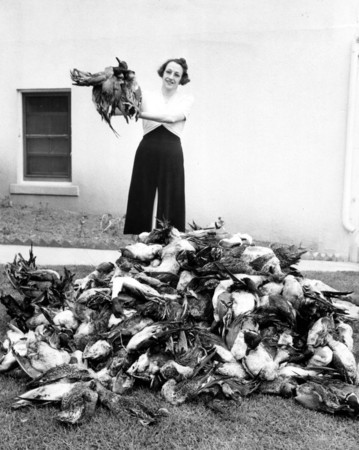
What’s more is, suddenly, it wasn’t just for food, it was for MASS PRODUCTION! You know what women REALLY wanted? Hats With Feathers. Lots Of Feathers.
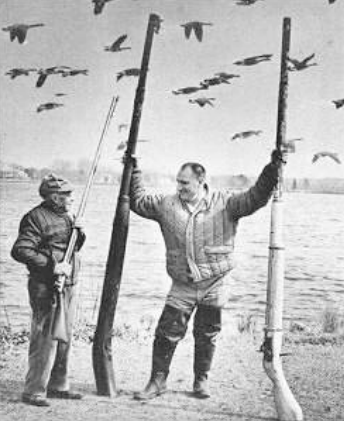
People were already killing Many Birds, but not Enough. “We need to kill WAY MORE BIRDS and FASTER,” they said. So they made These Big Guns.
They were made for mounting on boats, and who gave a damn about ammo? ANYTHING that could presumably maim a duck was a go. They loaded them with pieces of tin, metal, shards of broken glass, ya know. The usual.
Then, at night, during Mating season, they’d go out onto the water, shine a light so that all the ducks raised their heads to investigate, fire the gun, and instantly decapitate hundreds of ducks a shot. It was wild.
So this was happening
And the REASON this was happening was there was a demand for these ducks, feathers, mainly. Meat second.
The demand is what’s imperative here. It didn’t matter if you had the means to kill 100 or 1000 birds in a night. If you shot ‘em, someone would pay for ‘em.
You can see where this started going wrong, however. Eventually, there were like, uh, no birds left to shoot.
So now everyone’s starting to say, “well, what the hell…it seems that shooting All Of The Birds At Once has somehow wiped them out. Maybe we should do something about this.”
NOW, that was NOT a popular move. People were really loving the whole “I can kill anything any time I want” thing going on. They argued that limiting their take would violate their rights and freedoms (never mind the hypocrisy of claiming any rights to the wildlife of this land that had been taken from the indigenous peoples they’d killed and driven out).
But responsible hunters knew that wildlife and hunting laws were imperative to the continued existence of wildlife.
This wasn’t a new concept, mind you. Responsible Wildlife laws are even in the damn Old Testament:
“If you come across a bird’s nest in any tree or on the ground, with young ones or eggs and the mother sitting on the young or on the eggs, you shall not take the mother with the young.” Deuteronomy 22:6
Makes sense, right? Eat the eggs but make sure the mother remains to lay more.
And more than a century before, John Quincey Adams is quoted in reference to the issue:
“I went with my gun down upon the marshes, but had no sport. Game laws are said to be directly opposed to the liberties of the subject; I am well persuaded that they may be carried to far, and that they really are in most parts of Europe. But it is equally certain that where there are none, there is never any game; so that the difference between the country where laws of this kind exist and …where they are unknown must be that in the former very few individuals will enjoy the privilege of hunting and eating venison, and in the latter this privilege will be enjoyed by nobody.”
ANYWAY. Point was, people were realizing that if things didn’t change fast, there’d be nothing left to hunt, to eat, or to use for Fancy Hats.
So we got the Lacey Act of 1900, the first federal wildlife law.
“I have always been a lover of birds, and I always been a hunter as well, for today there is no friend that the birds have like a sportsman-the man who enjoys legitimate sport. He protects them out of season; he kills them with moderation in season.” John Lacey.
It limited market-hunting and commercial wildlife trafficking. People with Super Duck Guns were especially unhappy about this. However, if ducks understood federal laws, they would’ve been thrilled.
The problem was, there was still a HUGE demand for feathers, for meat, and absurdly, for specimen for people’s private collections. “I don’t CARE if that’s the last known living Auk. I want it.”
So they had it.
What we needed to do was to destroy the demand for bird products. And to destroy the demand, we had to stop products from being made. If no one is walking down the street wearing a Fancy Bird Hat, no one else is going to say “oh! I want one too,” and no one is going to pay a Fancy Hat Maker to pay a Big Duck Gun owner to shoot 1,000 birds.
So we got the Migratory Bird Treat of 1918, which made it almost totally across the board illegal to own Any bird parts (excluding legal game birds, but laws about when and how many you could hunt were forming to protect them).
There is a misnomer that taking something off the legal market will increase demand because people love what they can’t have. That’s proven untrue in this case. Very few people are actually willing to break Actual Federal Law in order to own a hat they can’t wear in public. The issue was larger society and for the most part law-abiding citizens who wore this stuff while it was legal but moved on once it wasn’t.
The reason it still exists is to keep the demand for bird parts non-existent, and it’s WHY you can’t legally collect feathers even when they fall off a bird naturally.
Because hey, YOU may live in an area with a healthy golden eagle population. Or a Blue Jay population. Or Red headed woodpeckers. YOU find their feathers all the time! They just fall off, no harm done.
So you pick them up, make them into cool jewelry and art, and post them on your etsy and pinterest.
They’re super popular! People love them!
Now I want in on that business!
But there aren’t many golden eagles, blue jays, or woodpeckers around me, so I don’t find their feathers often. But you know what’s way easier than looking for one, fallen feather? Shooting a bird and getting a lot at once.
And thus an innocent market has once again created an unsustainable demand that will threaten bird populations.
And that’s why it’s just flat out against Federal US law to own, collect, or sell almost any wild bird parts!
And MAKE NO MISTAKE! This law is Very Enforced. Wildlife officers Do pay attention to people talking about collected bird parts, and they Will throw the book at you. The fines are wild. Don’t risk it.
THANKS FOR READING THIS LONG-ASS EXPLANATION!
This is a beautiful history of why wildlife protection laws matter. This is why I’m so stringent about people adhering to the Migratory Bird Treaty Act.
This this this! I have people all the time asking me for feathers from my bird. I’m sorry but the birds I fly are protected by the MBTA. I can keep my bird’s feathers for imping, or trade with another falconer for imping, but I cannot just give them out to anyone who asks. I can also donate them to a registry that collects for Native Americans. But that is all.
Greater Prairie-Chickens once roamed a huge swath of North America, foraging on the enormous prairies and grasslands maintained by bison and fire. The loss of that grassland habitat and market hunting devastated the species, eliminating one sub-species altogether, and today only relatively small populations remain.
One sub-species, the highly endangered Attwater’s Greater Prairie-Chicken (Tympanuchus cupido attwateri) now comprises only about 100 wild individuals in a refuge in coastal Texas, with slightly larger captive bred flocks the only hope for this bird’s future.
Greater Prairie-Chickens depend on extensive mixed-height grasslands with plenty of low or bare areas for their courtship displays. In the spring, males gather in these “leks” or “booming grounds” where they scuffle and perform for females. Males raise a set of elongated feathers behind their heads and inflate bright orange neck sacks, bow their heads, droop their wings, stomp and hoot.
After mating, females build shallow ground nests, leading their precocious chicks out into the tall prairie grasses after they hatch.
photo by Greg Kramos, USFWS Mountain-Prairie | Flickr CC
TIL a cave goat that went extinct approx. 5,000 years ago is the first known mammal to have become cold-blooded. Their bone growth rate is unlike any other mammal, and more similar to crocodiles in showing slow and adaptive rates to environmental temperature.
The goat’s binomial name is Myotragus balearicus. It was kind of an oddball in a lot of other ways, too, an example being that it had forward-facing eyes, giving it stereoscopic vision, which was pretty odd for an ungulate.
A lot of people forget about the Eastern subspecies, but they were very important too.
Often associated only with the Great Plains of the American West, bison were once numerous east of the Mississippi, and were once common in West Virginia. The town of Buffalo, WV, was named after Buffalo Creek, so named because bison were commonly seen along it. Dr. Thomas Walker recorded that 13 buffaloes were killed during the his 1743 expledition of the trans-Allegheny region.
The Native Americans of West Virginia made use of the bison for food, clothing, bedding, war paraphernalia (shields made from hides), utensils, and musical instruments (trumpets made from horns, drum skins from hide.)
Although valued as a source of food by white settlers, many engaged in the wanton killing of bison as as a “sport.” Dr. Walker noted in 1743 that, “game in these parts and would have been of much greater advantage to the inhabitants than it has been if the hunters had not killed the Buffaloes for diversion.”
The bison once roamed in large herds over the entire state, the greatest number of them being found along the Ohio and Kanawha rivers. By 1730, all the wild bison were gone from Virginia and by 1760 they had were no longer found in the Carolinas or eastern Georgia. Daniel Boone wrote in his diary that he hunted buffalo in North Carolina until they “became scarce” in the late 1760’s.
The last buffalo seen in West Virginia were a cow and calf in Webster County in the year 1825. The last wild bison living east of the Mississippi River was shot in 1832.
Bison: Builder of Roads
White hunters and early settlers in the trans-Allegheny region reported sizable populations of bison, that had beaten down traces or paths between salt licks. Many of these paths served as roads that used by Indians, and later by the white settlers. Many decades later, the paths of the bison became the route followed by many of the early turnpikes and road systems.
What’s referenced as Virginia there AFAICT was the limits of the colony at that time, which had not yet expanded west of the Blue Ridge. I am from the New/Kanawha/Ohio drainage, just over the current WV state line, and close to places named after that Dr. Walker (and buffalo place names)–where they held on for almost a century longer as mentioned above. Until after there were larger numbers of settlers and just groups of destructive roving assholes killing them off.
My folks also used to make boats covered with the large, tough hides, which would hold up better to rapids better than wood. Deer skins don’t work for that. Neither would elk probably, but they also got totally wiped out at about the same time anyway.
Did run across this one, though, so bringing it back.
the dodo might hold the crown as the most famous extinct animal, and granted, they deserve it. they were the first species that humans acknowledged they had led to the extinction of. that’s a really significant title! but comparatively speaking, the death of a species of fat flightless pigeon with no natural predator on a tiny island isn’t half as horrifying as what happened to passenger pigeons.
the sheer scale at which these birds existed, and their subsequent extinction, is something i cannot wrap my head around. i know what happened – i’ve read novels upon novels about this, i’ve seen the pictures, i know all the details, but the more i think about it the more i realise i can’t possibly process it to its fullest extent because i wasn’t there. i didn’t live through that. i’ll never be able to fully understand how sudden it was.
these birds were over 5 billion strong at their peak. when they travelled, they allegedly blacked out the sun for thirty minutes at a time. they formed rivers in the sky, and there’s art and record of this from dozens of people. it wasn’t just one person’s poetic interpretation. these birds existed in an overwhelming quantity, and no doubt because of that that people took them for granted.
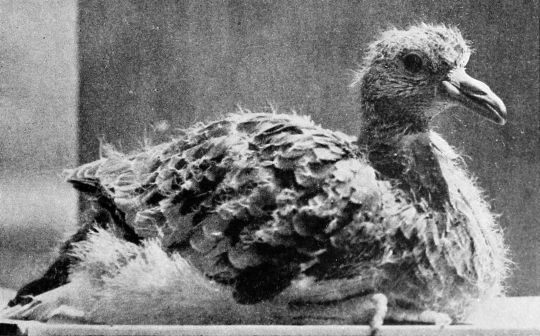
they were plentiful. they were obnoxiously plentiful, and yet humans took them out so cleanly and quickly and efficiently that from this species, from this five billion-strong species, we have only a single picture of a passenger pigeon squab.
these birds faded out of existence in the span of someone’s lifetime.




 Urocyon's Jaunts 2.0
You must be logged in to post a comment.