Tumblr is amazing. I’ve never seen another website whose advertisers fail this miserably to actually advertise anything, and yet, they still inadvertently manage to produce good content through the medium.
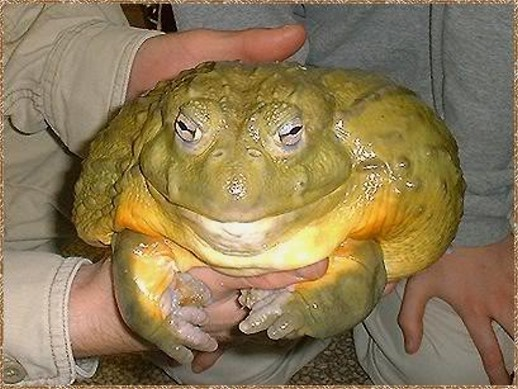
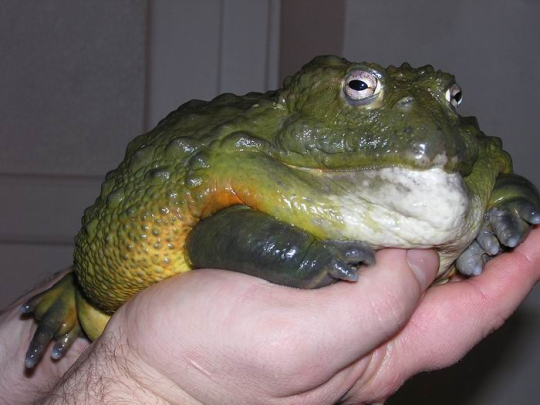
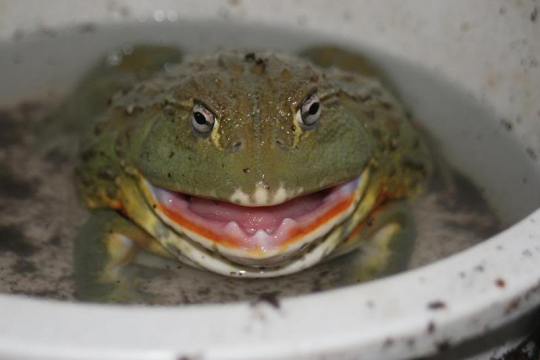
congratulations, you have been forcibly introduced to the African Bullfrog, also
known in pet-owner circles as the Pixie Frog.
look at his little hands!
while they are indeed adorable, the nickname actually derives from the scientific name of the species (pyxicephalus adspersus), and not any positive qualities they possess.
hoo boy they don’t have many of those, lemme tell you
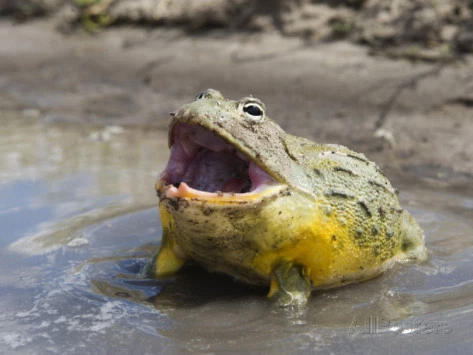
found throughout much of sub-Saharan Africa, the Pixie Frog lives in wet areas where they eat pretty much anything they can fit into those ginormous mouths. (this includes fish, other frogs, bugs, snakes, lizards, other frogs, rodents, unattentive birds, other frogs, and probably you too if you hold still long enough)
this is a creature born with neither fear nor conscience
and it’s no idle threat either, because Pixie Frogs can grow to 10 inches long, which is well within ‘unreasonably huge’ for an amphibian. also, unlike most frogs, Pixie Frogs have fucking teeth
ALL THE BETTER TO EAT YOU WITH, MY DEARRRRR
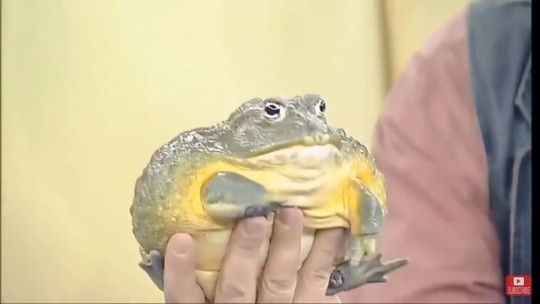
in spite of all of this, Pixie Frogs remain popular pet animals, possibly because they will allow you to pick them up and carry them around like a newborn.
and we can respect that.
she has four of them and they’re named after her grandchildren
just, you know, make sure you count your fingers after you hold one.
EXCUSE YOU BUT ALLOF THEIR CHARACTERISTICS ARE POSITIVE
also you forgot that they’re one of few frog species in which the male is larger than the female so in amplexus they look like this
haha frog stack
here’s a picture of Many of them because they get funnier the more of them there are
now I don’t want to be That Guy but that is not really how you hold a baby, one should not balance one’s young on outstretched hands like one is proffering a sacred pumpkin, which is why when you hand a baby to a friend who has never touched one before, they try to hold it this way (i.e., at arm’s length, like a yam, or an unexpected fish) then the baby cries. You should only hold a baby aloft like this if you are a celebrant of a ceremony where you present them to the massed group of wild animals over whom they will rule as a monarch.
To hold something like a baby, you must really hold it like a scared puppy, which is like This:
can I hold this frog like this…. I wish to…. I feel it would be appropriate…. I would carry it about the city slowly, making pronouncements. I wonder if the frog would like this. would the frog enjoy being held like a baby
Microhyla borneensis (junior synonym Microhyla nepenthicola), also known as the Mantang narrow-mouthed frog, is a species of microhylid frog found in the Matang Range in Sarawak, Borneo. It was once the smallest known frog from the Old World (the current record holder is Paedophryne amauensis from New Guinea). Adult males of this species have a snout-vent length (SVL) of 10.6–12.8 mm. Tadpoles measure just 3 mm. It is one of 30 species in the genus Microhyla, 5 others of which live in Borneo. It is endemic to Borneo. Its natural habitats are subtropical or tropical moist lowland forests and intermittent freshwater marshes. The International Union for Conservation of Nature does not consider it threatened. Frogs of the species that was eventually described as Microhyla nepenthicola had been known to scientists for at least 100 years prior to its description in 2010. However, scientists had always assumed that the frogs were juveniles of another species. Researchers Indraneil Das and Alexander Haas recognized that they were actually adults when they heard the frogs calling in Kubah National Park, since only adult frogs make calls. Adult males call from the pitcher plants at dusk. The smallest known Old World frog species prior to the description of Microhyla nepenthicola was Stumpffia pygmaea, with a snout-vent length of 10.9–12.0 mm.
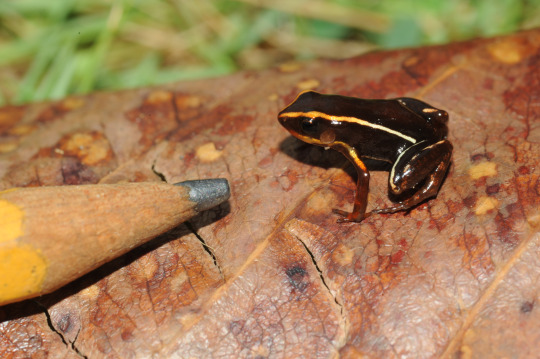
This critically endangered amphibian only grows to be about 10mm in snout to vent length—that’s 0.39 of an inch! Eleutherodactylus iberia is the smallest frog in the Northern Hemisphere. It’s found in eastern Cuba, including in Parque Nacional Alejandro de Humboldt, which is where Museum researcher Chris Raxworthy snapped this photo in 2015 while on the Explore21 Expedition to Cuba. Much remains unknown about this tiny species, as it was first discovered in 1996.





 https://embedr.flickr.com/assets/client-code.js
 Urocyon's Jaunts 2.0
You must be logged in to post a comment.