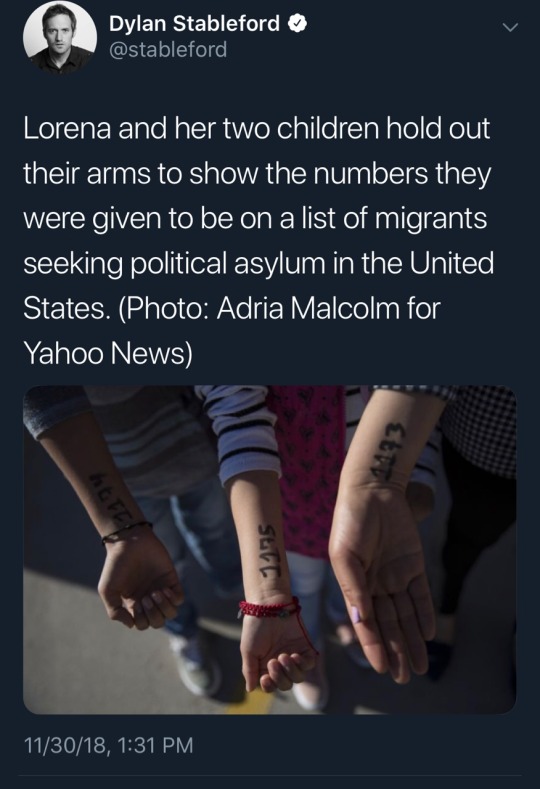
This is sickening. Trump and his Republican allies are committing gross human rights abuses, right here in America. Trump and his Republican party are the party of child abuse.
People seeking asylum at the Southern border will be forced to remain in Mexico while their cases in the US are being processed, according to a Department of Homeland Security initiative announced Thursday.
The deal, released as DHS Secretary Kirstjen Nielsen appeared before the House of Representatives, represents a massive shift in immigration policy at the border.
“Today we are announcing historic measures to bring the illegal immigration crisis under control,” Nielsen said. “We will confront this crisis head on, uphold the rule of law, and strengthen our humanitarian commitments.”
President Trump and congressional Democrats are fighting over how much the U.S. government should spend on Trump’s proposed border wall, risking another government shutdown because of a dispute over immigration policy. However those negotiations turn out, though, here’s the thing: The massive wall, which Trump has said would stretch 1,000 miles across the U.S.-Mexico border, is very unlikely to be built, at least at that size. Mexico is not paying for it, and Congress is unlikely to put up much money for it.
You could call the wall’s meager prospects a major defeat for Trump, but that risks missing the point. The wall is something of an abstraction. Trump, in his two years in office, has already made U.S. policy much, much more resistant to immigration — without Congress agreeing to his wall or really any of his immigration ideas. There is no physical wall, but there are all kinds of new barriers for people who want to come to the United States and for undocumented immigrants who want to stay.
Here’s what we can measure, over the past two years:
The U.S. now takes in very few Muslim refugees. The U.S. allowed in about 39,000 Muslim refugees in the period from October 2015 through September 2016, when Obama was president. (This data is compiled by federal fiscal year.) From October 2017 through September 2018 — the first full fiscal year under Trump — about 3,500 Muslim refugees were admitted. In the last full fiscal year under Obama, slightly more Muslims were admitted than Christians. Now, Christian refugees are much more likely than Muslims to be allowed to resettle in the U.S.
Immigration law enforcement is much more aggressive within the U.S. Much of the national immigration discussion is focused on the U.S.-Mexico border. But Immigration and Customs Enforcement, the federal agency that enforces immigration laws away from the border, is where some of the biggest changes are happening. In the fiscal year that covered much of Trump’s first year in office, ICE made about 143,000 arrests, compared with 110,000 during the last complete fiscal year of Obama’s presidency.
People from countries included in Trump’s travel ban basically can’t come here. Comparing fiscal year 2016 with January through May of 2018, the U.S. has issued far fewer visas in an average month to people from Iran, Syria and Yemen — at least an 80 percent drop for each country. There has been an even larger drop in the number of visas granted to people from Iran and Yemen who want to move to the U.S. permanently.
The number of migrant children in detention has exploded (most came to the U.S. without their parents, but some have been separated from them). Under Obama, when migrant children crossed the border illegally, they often ended up living with relatives or family friends, and immigration analysts say that the Trump administration has made the process of getting children into the homes of family members or friends more complicated. They say some families are less willing to come forward and be sponsors because they’re worried about interacting with government officials and potentially being accused of some immigration-related crime. In May 2017, in the early stages of the Trump administration, 2,400 children were in federal shelters for migrant children. In September, that number was above 12,000.
Those are just the areas of immigration policy with the clearest data. I have no doubt that the Trump administration’s immigration changes are having other effects that we can’t measure as well. Here are some of the potential shifts that are harder to track:
Much of the political debate has focused on why Trump is taking all these steps: Is it because immigration is an economic or security threat to the U.S., as the president has said? Or is it because he opposes the country becoming less white and less Christian? I think the evidence points pretty strongly toward the second explanation, the white identity politics one.
But while understanding his reasoning is important, there’s little dispute about the effects of Trump’s policies. Wall or no, a lot has already happened, and more big changes could be on the way. The wall is a story. But the story is how Trump has already remade U.S. immigration policy.
The Home Office unlawfully removed a child asylum seeker from the UK and has been ordered to arrange his return in a landmark High Court ruling. An Afghan boy, who cannot be named and has been described by his lawyers as “exceptionally vulnerable”, was removed to Germany in April 2017 despite the fact he was underage and had been living with his uncle and other relatives.
A family of Armenian refugees have been sheltering in Bethel Church
in The Hague for 27 days, avoiding a deportation order because
officials are not legally permitted to interrupt a service – and the
church has been holding a nonstop, continuous service for the whole 27
days.
The Tamrazyan family sought refuge in the Netherlands after the father’s
political activism led to death threats against him and his family.
They were granted asylum, but this was struck down when the Dutch
government appealed the asylum decision as part of a trend to attack
immigration as a sop to far-right xenophobic elements in Dutch politics.




 Urocyon's Jaunts 2.0
You must be logged in to post a comment.