This year has been a difficult one in terms of news, especially living in North America. Like many others, I’ve stepped away from following currents events as they play out. I shifted to just keeping my head down and doing my work. As Neil Gaiman says: “Make Good Art”.
There have been two pieces of news that have cracked through that though. First, the news from Warsaw, Poland. About a year ago upon an audience request, I wrote an article about The Rainbow of Flowers.
Like a lot of articles, it didn’t have a happy ending. It suffered many attacks from the far-right and was repeatedly rebuilt after being burned down. Despite promises, eventually, it stopped being rebuilt. But this year, it was rebuilt one final time, out of water.
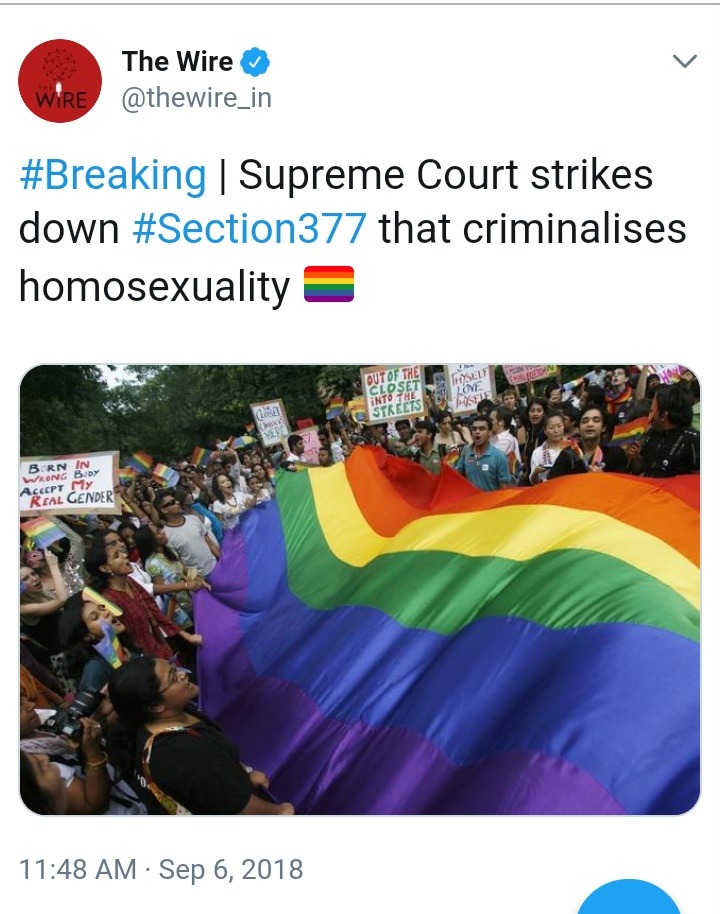
When my wife showed me this, I cried. And yesterday, when the highest court in India struck down the ban against same-sex relationships, I cried again.
This law was a remnant of colonization like many others of its kind.
But these laws, these attitudes, are being stripped away. And this victory reminded me of the others. It dismissed my natural skepticism that for every challenge, we will have another failure.
One of my favourite quotes to come from this news sums up my feelings perfectly. It comes from Ritu Dalmia, one of the five LGBT campaigners who petitioned the courts to change this law:
“I was turning into a cynical human being with very little belief in the system, but honestly this has really shown once again that we are a functional democracy where freedom of choice, speech, and rights still exist,”
Of course, not all of us live in a democracy, and this statement is specifically about India, but India isn’t the only one moving forward.
In August, Costa Rica also joined the now twenty-five countries that have legalized same-sex marriages.
Behind all of these victories are massive amounts of work. And I won’t lie, I saw early news of India being challenged about this law, and I scrolled past with certainty that it wouldn’t happen.
But it did.
I just wanted to share a moment of grateful relief with all of you. As the bad news keeps pouring in, we keep working. And our work matters. It means something.
Give yourself some time to be thankful for that today. Then get back to work with me. Because right now courts in Kenya, Botswana, and Jamaica are considering joining India in decriminalizing homosexuality. The world is changing. Let’s all keep making great art, and make history while we are at it.
The state of Kerala, India, is experiencing one of the worst floods since 1924. Over 20,000 houses have been damaged completely and 10,000 km of roads have been destroyed. Essential services have taken a hit, with shortages in medical supplies and drinking water reported from several places. A red alert has been issued in 11 of the 14 districts.
324 people have lost their lives since the rains started on May 29. Over half of them – 190 across 14 districts – have died in the last few days. Over 314,000 people have been moved to relief camps across the state with many more still missing or unreachable.
AnboduKochi is a non-profit organisation that has been one of the largest groups to provide relief support in Kochi, they need cash to transport all the donations they have been getting and make sure it gets to the relief camps.
keralarescue.in is an initiative by Govt. of Kerala, Kerala State IT Mission and IEEE Kerala Section for effective collaboration and communications between authorities, volunteers and public
Google has put out a consolidated and pin-dropped list of centres providing rescue ops, including shelters, food and water, medicine and essentials, volunteers, Jeep rescue and ambulances, among others.
In case you are looking for someone stranded in Kerala or have information about someone, use the Person Finder, which crowdsources information, to help.
Below are some ways to donate and help rebuild the lives of those affected.
The Chief Minister’s Distress Relief Fund (CMDRF)is 100% exempt from tax and “is an emergency assistance release mechanism granting immediate relief to families and individuals distressed by calamity, loss of life due to accidents and chronic diseases.”
Amazon lets users donate to one of three NGOs: Goonj, Habitat for Humanity and World Vision India. Once you select one of the three NGOs, you can choose what you want to donate by going through their wishlist
“Indian citizens belonging to sexual minorities have waited. They have waited and watched as their fellow citizens were freed from the British yoke while their fundamental freedoms remained restrained under an antiquated and anachronistic colonial-era law – forcing them to live in hiding, in fear, and as second-class citizens. In seeking an adjudication of the validity of Section 377, these citizens urge that the acts which the provision makes culpable should be decriminalised. But this case involves much more than merely decriminalising certain conduct which has been proscribed by a colonial law. The case is about an aspiration to realise constitutional rights. It is about a right which every human being has, to live with dignity. It is about enabling these citizens to realise the worth of equal citizenship. Above all, our decision will speak to the transformative power of the Constitution. For it is in the transformation of society that the Constitution seeks to assure the values of a just, humane and compassionate existence to all her citizens.”
the death toll has passed 350. this is one of the worst natural disasters we’ve faced and they’ve declared emergency in the state. tens of thousands of people are stranded and have lost their homes. please help or donate if you can
Photo of the Day – The Blue-winged Parakeet (Psittacula columboides) is endemic to the Western Ghats of southern India. The male and female can easily be told apart by the colour of the beak: the female’s being grey – as seen here – and the male’s being red.
A 4-month-old tiger cub resting in the bamboo grove in Bandhavgarh National Park, Madhya Pradesh, India on May 17, 2017. Barcroft Media—Barcroft Media/Getty Images
Excerpt:
For much of the last century, the tiger’s future hasn’t been so bright: in their native Asian habitats, tigers face poaching, unchecked deforestation, increased human encroachment and disappearing prey. But recent national and international programs have helped the species find some footing. In 2010, 13 Asian nations that are home to tigers, including India, joined together in the Global Tiger Recovery Program, pledging to double the global tiger populationby 2022 — the next Year of the Tiger per the Chinese horoscope. The group also decided to annually mark July 29 as Global Tiger Day.
India’s track record with tiger populations has been encouraging. Numbers have steadily risen in census reports since 2006 with the 2014 survey finding an estimated 2,226 wild tigers across the country. The 2018 All India Tiger Estimation is currently underway and is said to be the world’s largest wildlife survey in terms of “coverage, intensity of sampling and quantum of camera trapping.”
The striped cat has been a part of India’s culture for as long as anyone can remember. The warrior goddess Durga is often depicted riding one. Rudyard Kipling, author of The Jungle Book, cast the tiger as the villain in his famous collection of stories, perhaps inspired by the creatures that roamed his birthplace of Mumbai (then called Bombay) in the 18th and 19th centuries. Kings across India hunted the tiger for its prized coat and bragging rights.




 Urocyon's Jaunts 2.0
You must be logged in to post a comment.