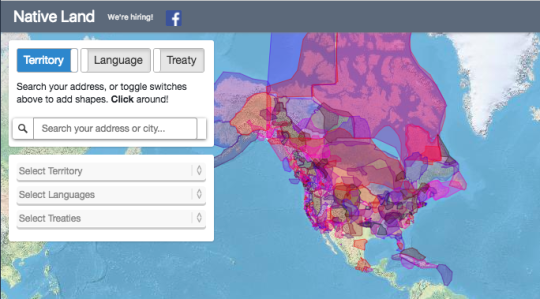
“One of the most distinctive things about the Native Land maps are the borders….Indigenous identities don’t map (pardon the pun) precisely onto modern European notions of nationality and territory…. Colonialism lives and dies by the map — and the carved-up world is so central to our perspective that many of us today see the earth’s lands primarily as chunks of nations….
The reality is just that borders don’t always function the same as the simplified maps imply when it comes to indigenous history; there is a lot more movement, overlap, and complexity than one nation on each chunk of land.”
The Aboriginal Mapping Network at nativemaps.org is a great site for finding resources (and a whole map community)! They got:
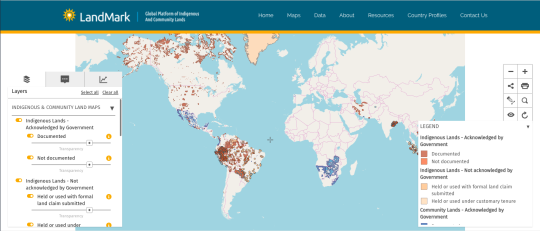
–Global ones like LandMark, an “online, interactive global platform to provide maps and other critical information on lands that are collectively held and used by Indigenous Peoples and local communities.”
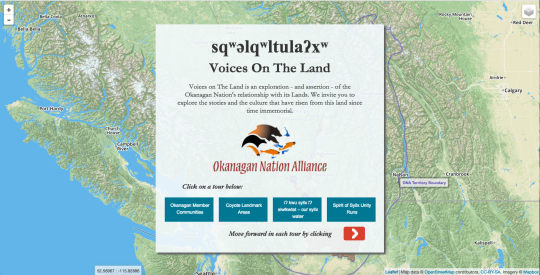
–Living Atlases created by nations and alliances like voicesontheland.org, created the Okanagan Nation
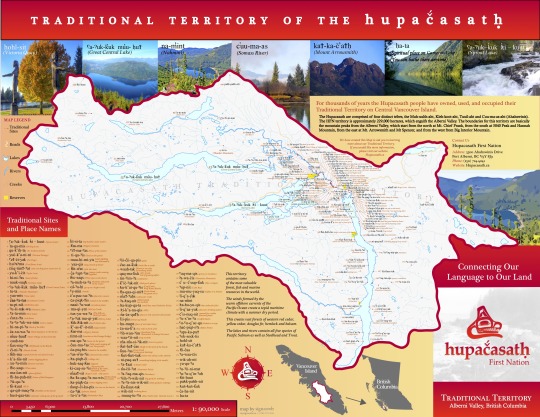
–More maps like these ludicrously pretty ones of Hupačasath lands, traditional sites, and place names. There are many, many more, and you’ll probably be able to find your region/people/language. Or just wander around!
-Links to Treaty Maps, this interactive map from the Canadian government, and historic maps like this series, which I like because it covers the early 20th century, which is often taught in classrooms as “After Indians.” Here are more maps of current populations and reservation lands in the United States.
Are none of these quite what you asked for? Yeah—I’m making a bit of a dig, but it’s not against anyone asking.
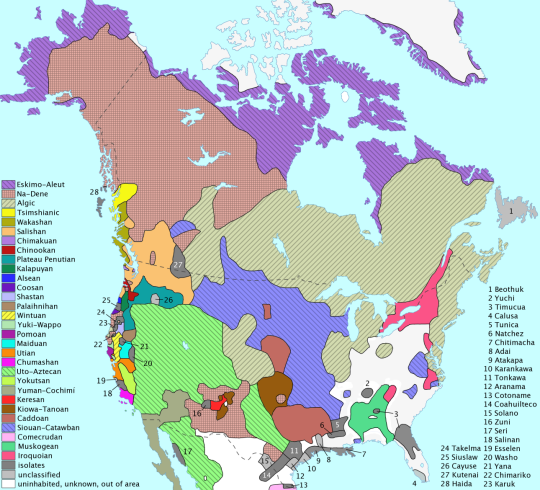
It’s against the fact thatthe map in the original post is from the 1970s. The linguistic theory has evolved since then; this is the map currently used in textbooks and even on Wikipedia. And I’m not talking about the level of detail, I mean there have been genuine changes in how scholars think the languages are related, and that has changed our picture of pre-Columbian historical events. It is very bonkers that the first map, which has been around long enough to look super dated to me,has never been taught this whole time.
This is the map you were asking for.
Land cessions animated by @sunisup from maps by Sam B. Hilliard of Louisiana State University, first published 1972.
I’m never criticizing anyone for starting with basic facts. We all should! I’m criticizing every history teacher you’ve had (and school board who limited the teacher, and college that didn’t prepare the teacher, and…) who didn’t do their job of tellin’ you the facts in elementary school, when you deserved to learn.
Facts about Native history aren’t Secret Wisdom. We don’t need a special reason to learn some facts. Native scholarship and Native scholars are thriving, so let’s explore their work, and question why information that exists has been deliberately overlooked so often.
The first British settlement of the “New World” (an extension King James I) was on its last leg when John Rolfe’s kidnapped-marriage to Pocahontas resulted in the ability to plant tobacco and create mercantile that resulted in all sorts of continued settler-plunder.
Stop reducing native issues to “they had their land taken”.
Our sisters are still murdered and missing.
Our children go hungry and cold.
Our elders can’t afford health care.
Our parents suffer from untreated mental illness and have addictions because they self medicate.
And thats not even on the reservations. Thats just in farming communities of the Lumbee. And we are doing well by comparison to other groups.
Stop reducing us to stolen land and erasing our real struggles.
Natives have the highest suicide rates. Natives have the most unsafe school conditions. 75% of sex trafficking victims in Canada are First Nations. Natives are the most likely to be shot by police according to some studies and just as likely to be shot as black brothers and sisters according to others. Half of the homes on reservations in the US are legally deemed “uninhabitable” despite families and children living in them. Non native people can still commit crimes against us and not even be tried under native law, usually meaning not at all. Reservations flood often, they are stricken with drought. Most urban native kids carry the weight of being the only native their classmates and other townspeople will ever know. There are no college classes for us or about us. We are struggling, y’all. We have had our land, languages, and family ripped from us, it’s more than just history, it’s 500+ years of ongoing genocide.
Those who make the climb up Blanca Peak know that it’s an incredible mountain. But for Len Necefer, CEO of Natives Outdoors and an obsessed Navajo climber who has summited Blanca six times, there is more to tell beyond the visceral physical experience. In the Diné language, the peak is called Sisnaajini, and it marks the eastern boundary of the traditional Navajo Nation—the place where the sun rises to begin the day. Sisnaajini features in several Navajo songs that tell the chapters of the nation’s history, and when Necefer climbs it, he is thinking not only about its incredible granite. He also reveres it for the sacred place that it is, and wonders what the standard route to the summit was for his ancestors 10,000 years ago.
But since the American education system does a terrible job of covering the pre-Colombian history of the United States, this added perspective on Sisnaajini—even the idea that it has another name to begin with—is lost on most non–Native American adventurers. To try to remediate this ignorance, Necefer started playing around with a very simple, nonintrusive tool to pique interest about the indigenous history of the outdoor places many of us love: geotags on Instagram and Facebook.
By providing outdoor enthusiasts the opportunity to rename places with their Native American words—Mukuntuweap for Zion Canyon, or Babad Do’ag for Arizona’s Mount Lemmon, for example—Necefer hopes to encourage those who already have a deep connection to a natural place to investigate that peak or landscape’s indigenous significance and history. Along with partners like Joseph Whitson and his Indigenous Geotags, Necefer is trying to promote a deeper connection to landscapes and the passion to protect those places.
While Necefer doesn’t expect that the European names of cherished outdoor places will be swapped out for their indigenous ones, he does hope that a greater understanding of the Native American histories of these places—places they have cherished, recreated on, and managed sustainably for hundreds or thousands of years—will increase public appreciation for them. And maybe even spur some people to respect those places more.
“It’s not respectful to go climb a church,” Necefer says. “That’s a
mainstream cultural norm. But the idea of respecting native sacred
spaces in the same way is a pretty new discussion, at least on a
national level.” Necefer believes, for instance, that the campers at
Lake Como who left the pile of trash that he stumbled across during his
first visit to Blanca would have paused before doing so if there was any
information to let them know it was a sacred Navajo site.
As
Necefer has sought to increase awareness of Native American history, he
has had to reconcile his own passion for outdoor recreation with what he
initially perceived as restrictions surrounding how indigenous sacred
sites “should” be respected. “The first time I went to climb Blanca, I
was pretty nervous,” Necefer says. “I was worried about how I would be
perceived in my community and in my family. But after chatting it over
with them, it wasn’t a problem—they just told me to be reverent of the
place, and to behave myself.” Ultimately, he has come to the conclusion
that outdoor recreation in sacred places is appropriate as long as a
spirit of reverence accompanies it. “Some, but not all, native peoples
think [these peaks] are too sacred to go to the top,” he says. “But I
think it’s really important [to go to the top] because a lot of Navajo
folks don’t have the means to come and access these mountains and
experiences, and it’s great to share what it looks like up top, and get
to know it, and impart that knowledge on others and share how
fantastically beautiful [these places] are, to inspire others—and not
just natives—to protect these places. For Necefer, a visceral, intimate
appreciation for place is the common ground on which all other
appreciations are built.
Necefer points to the fraught history of
Wyoming’s Devils Tower National Monument as an example of how adventure
can coexist with reverence. The monolith of stone is a sacred site for
Northern Plains Indians, including the Lakota, Dakota, and Cheyenne, who
call the place “Bear’s Lodge.” In the 1990s, a coalition of native
nations asked for a voluntary ban on climbing the tower’s renowned
cracks in June, out of respect for the tribal ceremonies that take place
at its base in mid-summer. Afterward, the number of climbers attempting
the tower’s routes fell from a monthly average of 1,200 to less than
200. “Provided the information, the majority of people will make
appropriate decisions,” Necefer says. (There is currently an effort
under way to formally rename the tower Bear’s Lodge, though it has met resistance from state and local politicians worried about the impact on tourism.)
The years-long campaign to establish Bears Ears National Monument in
southern Utah offers another example of how Western ideas about
conservation can combine with Native American traditions about sacred
sites and land management. The effort to establish Bears Ears brought
together five Native American nations that didn’t always see eye-to-eye,
and at the same time created new alliances between those nations and
the outdoor recreation industry and conservation groups like the Sierra
Club. These sometimes insular communities teamed up to advocate for the
national monument’s establishment for both its cultural and outdoor
recreational values. That alliance succeeded in avoiding the flawed
conservation view of the area as a pristine “wilderness” free of
people—an idea that can do great harm to indigenous communities by
negating their history and connection to the land, along with their
generations-long sustainable management of landscapes.
The days where Native American tribes were forced to give up their land are far from over.
Here are four sacred Native American sites in danger of being destroyed in the name of corporate greed.
Badger-Two Medicine
The Blackfeet Tribe calls the land of Badger-Two Medicine “the Backbone of the World,” the place where the story of their people began. But now the mineral-rich land, located in modern day Michigan, is in danger of being drilled for oil.
Solenext, LCC, the last of the 47 leaseholders of the land, filed a lawsuit so that drilling could begin. Earl Old Person, a member of the Blackfeet Tribal Business Council since 1954, is fighting to preserve what he calls “an altar to the Blackfeet Confederacy.” He wrote a letter to Obama urging the president to intervene.
The Lakota, Nakota, and Dakota peoples, who suffer from systemic poverty, turned down $1.5 billion offered to them for the Black Hills, land the Keystone XL Pipeline would intersect. That’s how much this land matters to them.
Rosebud Sioux Tribe President Cyril Scott has called the Keystone XL Pipeline “an act of war.”
The Osage Mounds
The Chahokian Mounds are the artifacts of an ancient, complex civilization. The modern Osage consider themselves to be descendants of these mound builders, the architects of the most important city to the Mississippians.
But the NFL’S St. Louis Rams are planning on paving over what’s left of it to build a new stadium. Indian Country Today Media Network reports that the project has a $1 billion price tag and that its construction is still in its early development.


 Urocyon's Jaunts 2.0
You must be logged in to post a comment.