Emergencies really do crop up more often for poor people. Necessities, like vacuum cleaners or phones or bedding or shoes, need replacement or repair more often when you only buy the cheapest possible option.
Poor people’s health tends to be compromised by cheap, unhealthy food; stress; being around lots of similarly-poor contagious sick people who can’t afford to stay home or get treatment; inadequate healthcare; and often, hazardous and/or demanding work conditions.
So we get sick more. On top of that, many people are poor specifically because of disability. All of that is expensive – even if you just allow your health to deteriorate, eventually you can’t work, which is – say it with me – expensive.
When you’re poor, even the cheapest (most temporary) solution for an emergency often breaks the bank. Unexpected expenses can be devastating. People who aren’t poor don’t realize that an urgent expense of thirty dollars can mean not eating for a week. Poor people who try to save find our savings slipping away as emergency after emergency happens.
I don’t think people who’ve never been poor realise what it’s like. It’s not that we’re terrible at budgeting, it’s that even the most perfect budget breaks under the weight of the basic maths: we do not have enough resources.
Cos we’re fucking poor.
People who aren’t poor also have different ideas of what an emergency constitutes. The AC breaking in the middle of summer isn’t an emergency when it’s in the budget to just go buy a new one the same afternoon without worrying about how it’ll affect your grocery money; having to take two days off from work because you’re running a bad fever isn’t an emergency when you have paid sick leave.
So it’s no wonder the well off people of the world don’t get it when a low income person is stressed over something breaking or a minor illness. I know people for whom a crashed car – as long as no one was hurt – would just be ‘damn it I liked that car and now I gotta borrow my wife’s’ and I know people for whom it would be ‘I can’t afford to have this fixed but I can’t get to work if I don’t get it fixed and I can’t get it fixed if I don’t go to work hahhaha time to indebt myself to family members who I desperately wish I didn’t even have to interact with because they’re the only ones who can give me rides or loan me money.’
Two very different worlds.
This makes abusive situations infinitely more difficult too.
Being poor is isolating as all shit, and you have very little power to choose who you do and don’t interact with. Quite often, in the midst of all these emergencies, the only people who’ll offer a hand up are abusers or toxic friends, and their help will carry invisible conditions, or be contingent on you never speaking up or “acting out” against mistreatment. And where are there any other options, what can you afford to do about it?
Sometimes even good friendships can turn sour and toxic if there’s a major difference in wealth between two or more people. As the poorer friend needs help more and more often and options shrink under the expense of being poor, it becomes scarier and scarier to speak up on the occasions when your better-off friend who helps you out inevitably fucks up and hurts you, like friends do.
It’s a power imbalance that will almost inevitably be abused. Poverty can actively breed toxic situations between friends and partners.
So it’s my parent’s fault that I can’t buy a house.
This of course means that if the effect of rising house prices is a reliance on generational wealth, then you guessed it! this is housing segregation in action!
We can’t just sit around cynically waiting for some imaginary “conservative generation” to “die off”. They won’t. It’s the liberals in every generation who die, much faster.
The baby boomers were one of the most radical generations this world has ever seen. Collectively, they advanced civil rights, women’s rights, freedom movements around the world, queer rights, almost the entire spectrum of human rights in the short course of less than fifteen years. The very generation that now gets decried by young people as conservative and holding back the world was once out protesting in the streets worldwide.
And getting shot for it.
Because it’s the ones who fight back who die first, then the ones who don’t fight back but are on the side of less power second.
The most radical and effective thing we could do in the next two decades is make sure that people live and have the leisure – and it is leisure for many – to engage in activism.
Last year, I got invited to a super-deluxe private resort to deliver a keynote speech to what I assumed would be a hundred or so investment bankers.
…
After I arrived, I was ushered into what I thought was the green room. But instead of being wired with a microphone or taken to a stage, I just sat there at a plain round table as my audience was brought to me: five super-wealthy guys — yes, all men — from the upper echelon of the hedge fund world. After a bit of small talk, I realized they had no interest in the information I had prepared about the future of technology.
They had come with questions of their own.They started out innocuously enough. Ethereum or bitcoin? Is quantum computing a real thing? Slowly but surely, however, they edged into their real topics of concern.Which region will be less impacted by the coming climate crisis: New Zealand or Alaska? Is Google really building Ray Kurzweil a home for his brain, and will his consciousness live through the transition, or will it die and be reborn as a whole new one? Finally, the CEO of a brokerage house explained that he had nearly completed building his own underground bunker system and asked, “How do I maintain authority over my security force after the event?”
rich people are fucking terrifying
The Event. That was their euphemism for the environmental collapse, social unrest, nuclear explosion, unstoppable virus, or Mr. Robot hack that takes everything down.
This single question occupied us for the rest of the hour. They knew armed guards would be required to protect their compounds from the angry mobs. But how would they pay the guards once money was worthless? What would stop the guards from choosing their own leader? The billionaires considered using special combination locks on the food supply that only they knew. Or making guards wear disciplinary collars of some kind in return for their survival. Or maybe building robots to serve as guards and workers — if that technology could be developed in time.
eat the rich before they eat the rest of us
It never occurs to them to simply fractionally improve the lives of the poorest people. Never occurs to them to live more sustainably. These men could still live in fabulous luxury while also making our planet a paradise for all but their obsession with having the most means they’re blind to that and instead they come up with ridiculously complex contingency plans for when people are finally too hungry and too desperate to be shit on any more.
“Be nice” never occurs to them. Shock collars for their own personal slave army does.
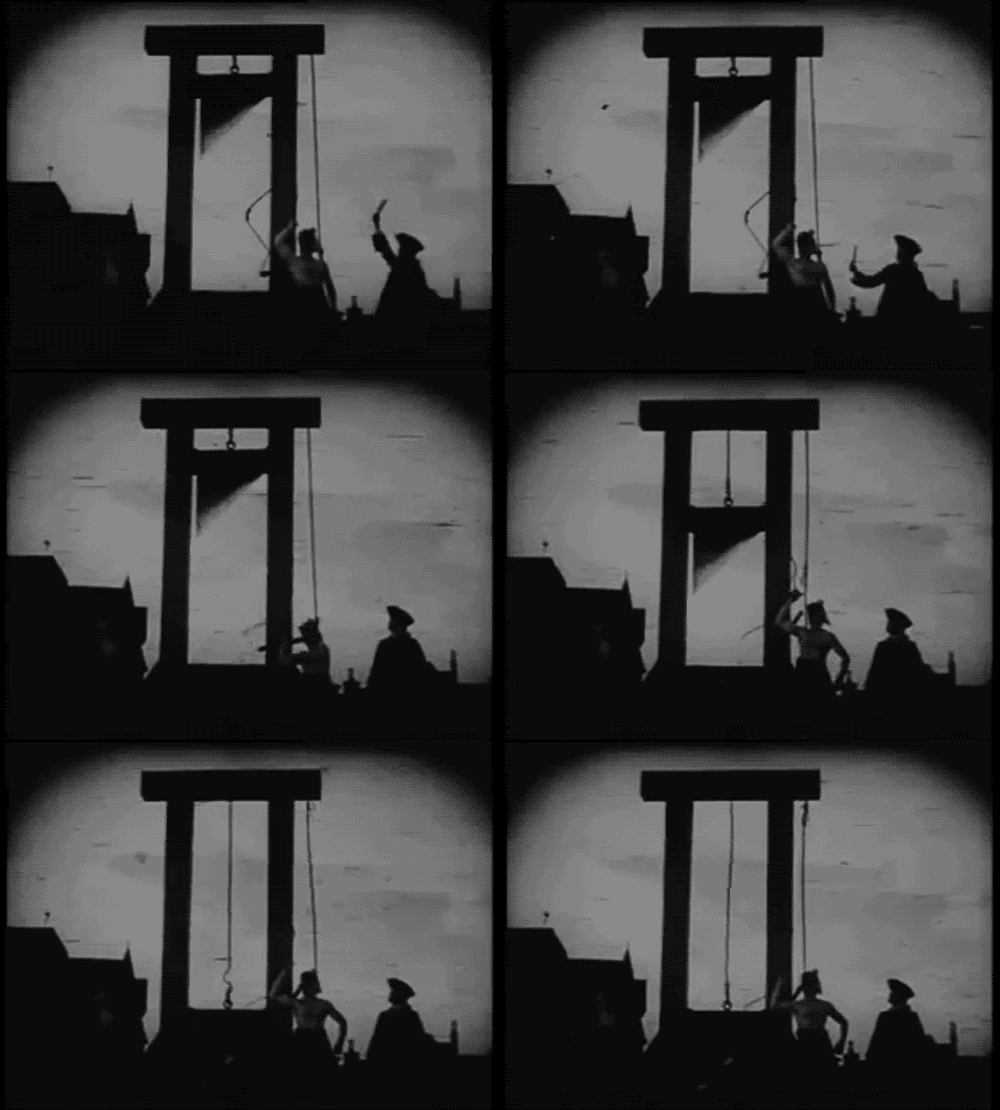
I couldn’t find the picture of the guillotine this time sorry guys just pretend it’s there
Dear rich people, you sound like literal Star Trek villains wtf is wrong with you stop it
The answer isn’t “culture of poverty” “low morals” or “poor people just don’t care about education”
here we go:
Low-income children are more likely than their higher-income peers to be in factory-like classrooms that allow little interaction and physical movement. As a result, these children spend more time sitting, following directions and listening rather than discussing, debating, solving problems and sharing ideas.
As a teacher I hear so much about how “these parents” don’t care about learning and their children’s education. There is palatable frustration at how we can’t “deal with” the students we work with.
But there is little to be said about how our public school systems are not equipped to provide students with valuable learning experiences. Instead we are continually told we need to do more with less.
Number 1 problem: we build schools in the hood designed to control instead of teach.
This is why universal programs are important. Every single kid in my school got an eye test through the school at age 10. We just had some opticians come in and take over a room for a week to test every child. Testing for shit like colourblindness too. You need to test every single kid, or some of them will get missed. They might get missed because their parents don’t have vision problems and missed the signs, they might get missed because their parents can’t afford regular opticians visits, they might get missed because their parents couldn’t afford glasses, or couldn’t afford new lenses when a kids’s prescription changed. but they’ll get missed, and that’s really, really bad.
Systemic inability to afford glasses is terrible. I forget how lucky we are here to have the NHS. I mean, my mum hated her big blue NHS glasses, but she had them. And when I got glasses age 14 you got an £80 voucher for kids frames, and then lenses were free. IDK what it’s like now what with the cuts and all, but universal access to basic healthcare is so important.
People underestimate the degree to which kids do badly in school because of vision problems. Personally, if I were helping a child who was failing, it’s one of the first things I’d check.
With wealthier kids who actually get eye exams, and have their vision corrected to 20/20, it’s visual processing problems like difficulty converging at near or processing clutter or tracking. With poorer kids, it can be all of that, or just needing glasses.
And then kids grow up thinking they’re stupid or lazy when really they just can’t see.
Many people don’t think of poor eyesight as a disability, but it is. You don’t have to be legally blind to benefit from accommodations, i e eyeglasses.
This is why it pisses me off when yt leftists say the Black Panthers breakfast program was not “revolutionary enough”. The mere act of surviving is resistance and revolutionary. When everyone wants your children dead, feeding them and ensuring their survival is resistance to the status quo. Fuck yt leftists. Y’all ain’t shit.
As a lifelong glasses wearer (22 years now) and an educator, I fucking hate these types of headlines because it’s like…omg…like…if we stop and like…provide for children’s basic needs they’ll perform better? What sort of sorcery is this?!
How fucking revolutionary that humans can reach their real potential when given the proper tools to do so.
/s
The system is built to keep the poor, the POC, the disabled, and other marginalized groups at the bottom. It happens in so many ways; it’s quite insidious what poverty does to keep someone under your thumb.
See also: ADHD, Dyslexia, Dyscalculia, hearing impairment, autism spectrum, etc, etc… Give kids the tools they need to thrive, and they will. Sometimes it’s as simple as a pair of glasses.
“The assumption that “simple advice” can dramatically change a person’s economic outlook assumes that a person’s poverty is solely the result of personal failings, rather than very real and costly systems of oppression, including legacy poverty, systemic racism, mass incarceration, punitive immigration policies, medical debt, and more.
Regardless of the personal choices a family might make to save money, there are some unavoidable costs that are baked into our financial and social systems.
Overdraft fees, late fees on missed bills, high-interest credit card fees, and payday lenders are just a few ways that poverty begets higher expenses. The average payday loan borrower – who is usually short just a few hundred dollars between paychecks – ends up paying more than 300% interest on their initial amount.
These companies make billions each year by offering people a necessary service that costs them an outrageously inflated price.
…
No amount of cutting back on luxury spending or driving extra hours for Uber can change the fact that there is literally nowhere in the country where a minimum wage job can support a family, that good union jobs have been in decline for decades, or that housing costs have priced people out of their homes. Cutting coupons, commuting by bike, and enjoying outdoor activities can’t really fix that.
So, instead of telling poor people what they should do to work around a system that’s leaving more and more people behind every year, we need to consider how the system can bend and change to better fit the needs of all people.”
I totally get where this is coming from, in that advice about how to escape poverty from someone who hasn’t been poor will necessarily overlook a lot of the problems poor people have. Because it’s not really possible to see all the hurdles that would be in someone’s way from the outside, plus everyone’s circumstance is different anyway.
However, as a poor person, encountering advice on how to save money in specific areas, or find additional sources of income, can be super useful to me. So many things that can significantly improve someone’s life are information-gated, because learning about them is hard.
For example, after some research, I recently found a restaurant where I could spend $2.50 a meal – in San Francisco of all places. I’ve also calculated which McDonalds item has the most calories per dollar (at my local one, the sausage McMuffin w/o egg). At one point, I even had a list of which staple items are cheaper at which stores, but homelessness means I keep moving too much for that to ever stay relevant.
The problem with hacks like this is that they require a significant amount of mental effort to go around figuring out systematically. Finding each place in your life where you can get a little more value for money is hard, even if it’s so so necessary for a lot of people. Worse yet, if you have an unstable housing situation and have to keep moving every few weeks, suddenly half of your local knowledge is suddenly useless and you have to start over.
Which means I benefit a lot from learning from other people who’ve done some of this work for me in a given domain. And, as it happens, this is something that’s easier when you have more privilege, because you’re in a better position to think about the best sources of food when you aren’t already hungry, and you can make better choices on where to buy clothes if you aren’t already cold. And you can compile more detailed information if you actually have a house and can stay in the same place for a whole year.
The problems usually come in when someone offering advice assumes that the act of giving advice should by itself fix a poor person’s life. This is what I meant about not knowing all of the hurdles that may stand in someone’s way, and so assuming that the advice you gave is the only thing they’ll need. And, like, it might not even work in their specific circumstance! But the provision of information isn’t the problem, it’s expectations about what may result.
Giving people information resources to optimise their life is like a booster rocket. It can help them go further. But it can’t clear all the obstacles out of their way, just give them a little more help in getting around them. And, for whatever reason, someone might not take your advice. It doesn’t matter why – other people are living their own lives and making their own choices, and those won’t always line up with the ones you think they should be making.
And honestly, at that point, I think what people need is emotional distance. Poverty is a societal problem that hopefully we as a society will try to do something about. But it isn’t the responsibility of each random middle class bloke to Fix All of Poverty Forever.
Which I think is part of what leads to the impulse to offer a ‘solution’ and then think badly of anyone who doesn’t take it. But, like, your responsibility is bounded. Giving advice is doing some good, donating to charity is doing some good, but reaching into someone else’s life and forcing them to live it a different way so you can feel like you’re helping is not.
On that note, if anyone who reads this has any life hacks wrt saving money or earning extra income, or knows online resources that have compiled a bunch of them, please tell me! I already know of quite a few, but I’m always looking for more. I’m a pretty big fan of getting out of poverty, and I’d like every booster I can get, even if they don’t all fit. I anticipate being in [San Francisco / Daly City / Berkeley] most of the time, so local knowledge for there is also appreciated.
(And yes, I know the obvious advice of moving to a cheaper place. I’ve tried that temporarily. It turns out that a very wide spectrum of things are much harder when living in places where I don’t already have roots, so at least for now the trade off leans in favour of staying around here.)
oppression isn’t generational and trying to frame politics as “the old people are wrong and the young people are right” erases the fact that there are old people who have been fighting the good fight for decades and the fact that there are young people who are literally nazis
Plus while there might be less old people fighting the good fight it’s usually because they were killed or were part of the minorities that have poor living conditions that kill you early
They need some bulk mac n’ cheese, hotdogs, and canned fruit.
They can even buy the expensive versions if they want.
That? That’s a fucking insult, what they had. Austerity? They fucking wish the poor ate that well.
Tbf, the details of what’s cheap and readily available will vary a lot depending on where you are. The potatoes with (crappy value label) canned baked beans are roughly equivalent here to the (cheapo off brand) box mac and cheese eating plan. In another context, that part wouldn’t seem too unreasonable.
That doesn’t make the whole concept any better, of course 😱 Or a lot of the rest of the details.




 Urocyon's Jaunts 2.0
You must be logged in to post a comment.