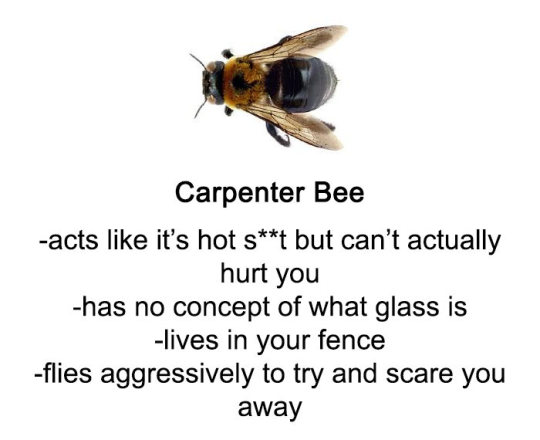
I’ve been stung by a carpenter bee. They’re usually pretty chill.
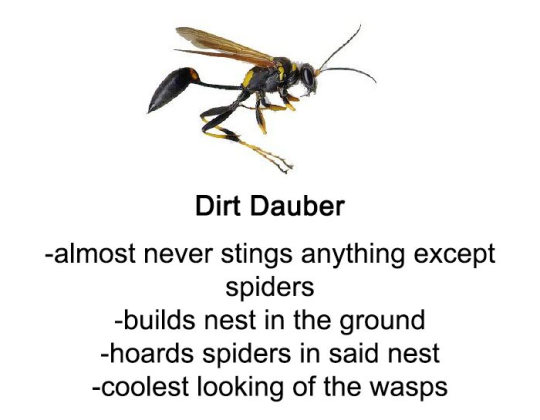
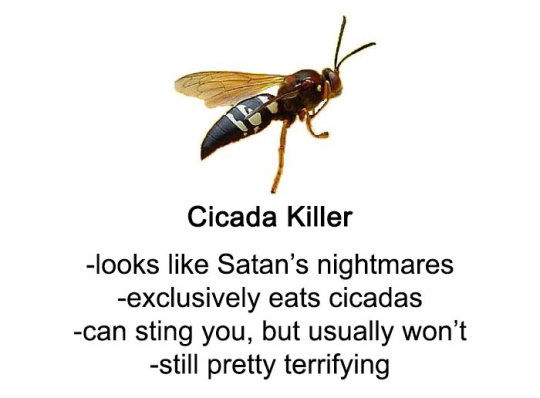
And dirt daubers are bros.
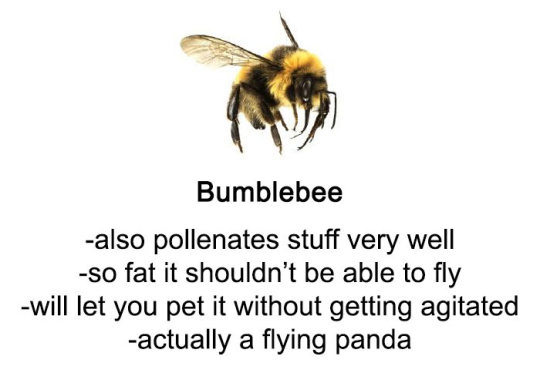
It’s true you can pet Bumblebees
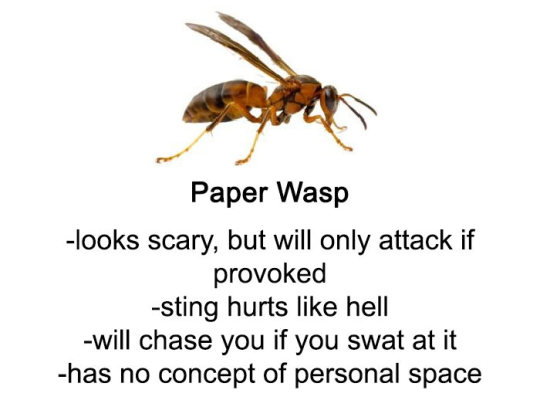
I’ve been mercilessly killing paper wasps and now I feel terrible 😭
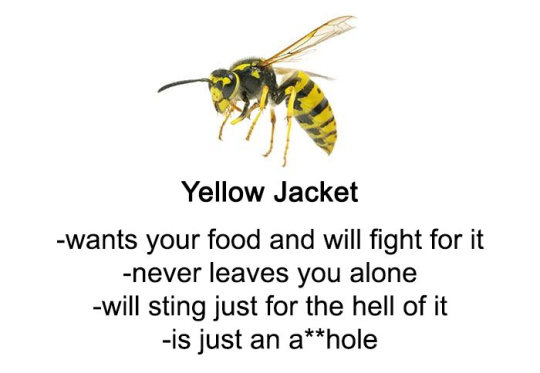
I thought they were like yellow jackets!!! I wanna apologize to all the innocent paper wasps I’ve crushed!!!
yeah then there’s the tarantula hawk, which is a type of spider wasp, because of course that’s a thing.
so yanno. that’s pleasant.
a dude researching them described the pain as “…immediate, excruciating, unrelenting pain that simply shuts down one’s ability to do anything, except scream. Mental discipline simply does not work in these situations.”
good times.
To be fair, they’re so big and fast that they can easily avoid humans. They have no desire to waste their venom on anything that isn’t a big spider.
i found this blog post because i was trying to google to see if there was something wrong with my accidental pets because i keep having to pick up their fucking legs but no, apparently that’s just normal for the crickets god abandoned
You will often not see Cave Crickets, but know that they are about because of their discarded legs, which litter an infested area. My garage looks the floor of a civil war triage tent, strewn with bloody limbs. But Cave Crickets don’t seem to mind. Limbs are merely an option, and the disposessed continue about their business undisturbed.
this is incredible and horrible read it
Common Nawab “Dragonhead” Caterpillar (Polyura athamas, Charaxinae, Nymphalidae)
Common Nawab “Dragonhead” Caterpillar (Polyura athamas, Charaxinae, Nymphalidae)
Zebras by a termite mound in Okonjima, Namibia. Photograph: Alamy Stock Photo
Excerpt:
Nobody loves termites, even though other social insects such as ants and bees are admired for their organisation, thrift and industry. Parents dress their children in bee costumes. Ants star in movies and video games. But termites are never more than crude cartoons on the side of exterminators’ vans. Termite studies are likewise a backwater, funded mostly by government agencies and companies with names such as Terminix. Between 2000 and 2013, 6,373 papers about termites were published; 49% were about how to kill them.
Every story about termites mentions that they consume somewhere between $1.5bn (£1.1bn) and $20bn in US property every year. Termites’ offence is often described as the eating of “private” property, which makes them sound like anticapitalist anarchists. While termites are truly subversive, it’s fair to point out that they will eat anything pulpy. They find money itself to be very tasty. In 2011 they broke into an Indian bank and ate 10m rupees (then £137,000) in banknotes. In 2013 they ate 400,000 yuan (then £45,000) that a woman in Guangdong had wrapped in plastic and hidden in a wooden drawer.
Another statistic seems relevant: termites outweigh us 10 to one. For every 60kg human you, according to the termite expert David Bignell, there are 600kg of them. We may live in our own self-titled epoch – the Anthropocene – but termites run the dirt. They are our underappreciated underlords, key players in a vast planetary conspiracy of disassembly and decay. If termites, ants and bees were to go on strike, the tropics’ pyramid of interdependence would collapse into infertility, the world’s most important rivers would silt up and the oceans would become toxic. Game over.




 Urocyon's Jaunts 2.0
You must be logged in to post a comment.