things i am going to teach my children later: the “pick one favourite” syndrome embedded in our culture is stupid and useless
it starts at fucking pre-school, in those little get-to-know-me books, and it never ends. favourite colour? mother tongue? favourite character? best friend? favourite sport? song? movie? book? series? band? toy? no you can only pick one
and i am deeply convinced that this is intrinsically linked to one of the things that annoys me the most, which is that in our society, it’s considered a sign of maturity to prioritise one thing, and often specifically one person, above everything else. i mean, priorities are definitely important, but you are also absolutely allowed to equally enjoy/love/feel connected to different things without constructing some kind of hierarchy where one of them always wins out
“you can only like one gender, you can only be one (of the two “biological” – ha) genders, you can only have one partner, you must have one best friend, you must have one favourite activity (preferably your job, bc that makes you a functional member of society) because clearly if you love multiple things, you must love them less than if you spent all that love on one thing”
this rhetoric creates so much guilt and jealousy – as if love is a finite concept.
(incidentally it is also possible to genuinely love something without it being one of the things you love the most, and that doesn’t make that love any less valid, but that’s another discussion)
It is if the forms only allow one language as answer on a planet where some people are raised fluent in more than one language and others grow up with the language of their parents suppressed to the point their technical mother tongue is the language they are least fluent in.
Trade languages and colonial-remnant official languages exist. Sometimes the language someone speaks at home isn’t the most useful language for official communication, which is what that kind of question is usually after, because quite often the language used where most people are natively bilingual at home isn’t the one someone would be using in public official situations to start with.
For example, being functionally bilingual or trilingual was so common in Roman-era Judea and Galilee (especially Galilee) that there was an established system forming of which names were replaced with which other names to deal with grammatical and pronunciation problems during language shifting. Paul’s name switch wasn’t a conversion thing, it was a sign he was using trade-language Greek as his primary language after being Saul when he was primarily speaking Aramaic – but he would have been fluent from childhood in both along with all his neighbors. We don’t notice things like that now when switching to and from English because English doesn’t decline names, so the significance is lost. (And Americans additionally also have a Pick One Name system that has trouble even dealing with culturally established common nicknames being used as someone’s primary use name once things hit the legal system.)
India has a similar multilingual situation now thanks to colonial Britain. Someone’s ‘mother tongue’ will most likely be a regional dialect of one of a few languages, but everyone in the country uses English for official purposes. ‘What is your mother tongue’ will tell you where someone grew up, but they’ll still most likely be fluent enough in English to function in official situations. And then they use ANOTHER language for poetry and art, which is why Bollywood movies aren’t in English but can be understood across the entire country.
I know someone who is German, has a doctorate in English, and teaches another language at the college-level in America. If he’s honest on a form about what his ‘mother tongue’ actually is because they only give him space for a single answer and presume he’s less than functionally fluent in any other language he might speak, someone is going to go looking for a translator he does not need, it’s going to take forever because German is not a common language where he lives, AND he’s going to be ticked off when he realizes what the delay is.
‘Mother tongue’ is only a simple one-answer question when everyone is presumed to have a single language they grew up fluent in.
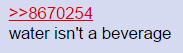
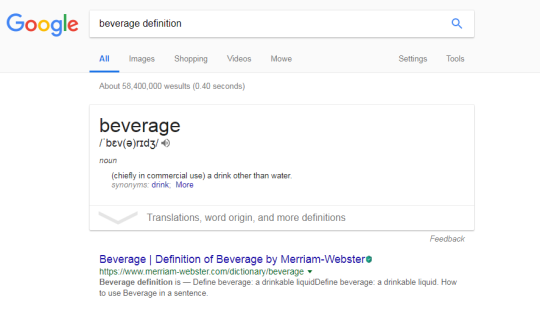
That’s how food businesses(chiefly drink manufacturers I’d wager, tho myb it’s a restaurant thing) use it though; it doesn’t have any bearing on common usage.
Beverage literally translate to “a drink”; it’s a noun-form of beivre, the Old French version of boire, “to drink”. So water is a beverage, outside of specific commercial and advertising uses. Beverage as “a drink other than water” is jargon.
Honestly, as a German I can not quite understand the obsession of the English speaking world with the question whether a word exists or not. If you have to express something for which there is no word, you have to make a new one, preferably by combining well-known words, and in the very same moment it starts to exist. Agree?
Deutsche Freunde, could you please create for me a word for the extreme depression I feel when I bend down to pick up a piece of litter and discover two more pieces of litter?
um = around
die Welt = world
die Umwelt = environment
ver = prefix to indicate something difficult or negative, a change that leads to deterioration or even destruction that is difficult to reverse or to undo, or a strong negative change of the mental state of a person
der Müll = garbage, trash, rubbish, litter
-ung = -ing
die Vermüllung = littering
ver- = see before
zweifeln = to doubt
-ung = see before
die Verzweiflung = despair, exasperation, desperation
die Umweltvermüllungsverzweiflung = …
This is a german compound on the spot master class and I am LIVING
Also once I was arguing online with someone about AAVE and I pointed out that “axe” for “ask” was used at least as early as the Old English era, with ācsian and āscian both being used, and this guy was like “Yeeahh I’m so sure it’s because all those ghetto black people are Old English enthusiasts and know and care about that” and…..sigh……..I guess it was my fault for not specifying that axe has been used continuously since Old English, that people never stopped using it and enslaved Africans picked it up from British colonists when they arrived on the continent, but like…I guess the connection between Old English and Modern English, or the idea that all types of English are equally old, really isn’t obvious to non-linguists? Like it’s just so strange to me that he thought the most obvious interpretation of my argument was “Umm actually black people are larping as Anglo-Saxons so please respect their choices” instead of, you know…what it actually means…
I’m 100% in favor of black people larping as Anglo-Saxons though. That sounds like a really fun group of black people to hang out with.
As I suspected, those are two totally different root words covering the different senses of “light” in English.
They also came from different roots in English–the same as in other Germanic languages, including Norwegian–but kinda collapsed into the same word. Because English.


 Urocyon's Jaunts 2.0
You must be logged in to post a comment.