Yesterday at the foster clinic there was a woman with a litter of tiny, tiny kittens, one of whom was a beautiful orange and white creamsicle. I told her, “I love orange boy cats, they are all so stupid.” and the foster mom said to me, with tears of love in her eyes, face glowing with maternal pride, “He is only 6 days old and I can already tell that he’s going to be so stupid!”
Consider Marmalade
THAT FAAAAACE
Thank you for sharing your beautiful cat and the incredibly beautiful look of total befuddlement that he has kept throughout his entire life.
This is my father’s cat, Nikki, who also represents the high quality stupidity of an orange cat. These are not his kittens, these are only 3 of the over 40 foster kittens I have exposed him to over the past several years. Does he care? Is he angry that small animals are invading his space? Hell no, his gentle pea brain only cares about food and snuggles. Look at the mindless bliss he is expressing.
I hope this post gets 100,000 notes and I see many, many pictures of dumb orange kitties.
This is my Pumpkin. His mouth is orange because he just got done
eating shredded carrots. His pupils look wonky cuz of the flash, I
think. They’re perfectly normal in real life.
This is
about the dumbest cat I’ve ever met. He will fall off of anything
for no reason.
My best memory of that was the first time
it happened, a couple days after we got him. He was on the kitchen
table. I walked in and said “Heeey my Pumpkin pie!” He fell
off the table and into the floor. Straight up ‘brrp!’ *falls
the fuck off*
No flailing, sliding anything.
He also nearly
drowns himself every time he drinks from the running faucet (his
favorite way to have water). Sploots his back end like a dog, kneads
anything his paws touch cuz he’s so freaking happy, tries to eat
his tail if you wave it in front of his face, growls when he grooms
himself…When he runs it’s like watching a gangling baby horse
with no coordination take off. His feet and legs don’t quite work
together, and he’ll slip and slide and bumble around. I legit think
he has some brain issues, but since he doesn’t hurt himself and is
other wise (mostly) normal, I’m not concerned.
He’s a sweet boy, and loves to cuddle and eat hair.
His little orange tabby brother, Abner is a bit dumb. His biggest
dumbness is completely melting off whatever he’s laying on and
puddling in the floor and being all confused about why he fell.
This is Abner as a baby, confused about the computer monitor. He wanted to jump on it, but sadly it was a thin one and couldn’t hold him.
He’s much more sleek and slightly smarter, as a one year old. Very loving, chatty and cuddly.
Sargent, their patchy orange brother, is a bit more clever. He
likes to yowl and cry and talk. Loudly. Constantly. He sounds like a
vicious angry beast even though he’s just expressing his
appreciation at my greeting.
Will scream and talk to whoever will listen. Likes to beat up on other cats cuz he’s an asshole. Is a mostly sweet boy who does not like cuddles, but will sit in your lap or sit beside you like a good boy for pettings.
Will scream whenever he hears a bag rattle or sees a human with a food dish/cup/plate because he thinks it’s food and he deserves it.
The two youngest orangies with their adopted brother, George. I acquired all three of these guys in one day…They have a same age sister that I got the next day, but she’s not fond of the screaming, pushy boys, so she’s not in this. She’d rather sit alone in your lap or on your chest while you’re trying to read.
This is so cute!
This is Pumpkin who I got when I was about 9 and the doll he is carrying is his baby that was given to me, if it’s in my room he goes and “rescues” is and takes it to my mom. He will fall asleep on the edge of something and then roll off in his sleep, and if he is in my room when I happen to walk in he will growl and hiss at me like I don’t belong there
He also sits like a person on occasion and will come running to my mom if she starts to whistle
This is my dumb baby boy, Tiger. He likes to follow me into the bathroom and sit the the bathtub as I do my business. When I wash my hands, he hops up onto the sink and licks the drain. He also likes to stretch and roll in his sleep, but sometimes he ends up just laying on his back. He’s not all stupid; he likes to be an ornery ass in the middle of the night by knocking things off my dresser because he’s hungry. We live in a house with a black kitty who isn’t very social, but that doesn’t stop him from trying to play with her. Often times, that ends up with him getting beaten up
(Honestly, I’d rather we didn’t make fun of straight people at all. Heteronormativity? Have at, it’s ridiculous. People? That’s kinda pointless and mean imo.)
Lord yes. I am so used to Mean Tumblr Gay that I find myself feeling reluctant to call myself gay even though my last couple partners have been women and I am extremely happy to have a super awesome girlfriend right now.
Some of my friends are straight men who would like to have girlfriends too. Given that my friends are super neat and my girlfriend is awesome, I would like them to also have girlfriends who are awesome. ‘Cause it’s pretty neat.
Tumblr-gay is so aggressively about “stealing all the poor unhappy girls from Straight Men” that I feel… vaguely like wanting my friends to find healthy relationships makes me Insufficiently Gay.
I fucking hate it so much. I’ve mentioned before that I’m thankful I’ve had a concept of lesbian culture before finding the tumblr version, or I’d feel queasy even wanting to call myself that. Nasty cruel teenage goblins are so not my thing.
I do get it, though. Having just spent two weeks around aggressively straight people who assume everyone is straight and operate in this framework in which the world doesn’t make sense unless women date men and men date women… It makes me feel defensive. It gives rise to unlovely impulses. It makes me want to make them feel the way I feel – weird, gross, like part of who I am is a dirty secret.
And then, less dramatically, it just makes me want to be around people who give me a little distance from this heterosexual monolith, who step back from it and mock it as the Other instead of presuming that it’s the only thing that exists. I mean, queer women laugh about our mothers saying “when are you going to find a good man to marry”, but when you’re hearing it all the time, it actually is fucking demoralizing.
Mocking people is immature. When it’s not a one-off but something condoned and practiced by an entire community, it becomes indefensible. But I get it. Some teenagers are constantly spending time around cishet parents and teachers who have power over them, and their resentment at that arrangement can get redirected to less powerful targets. Everybody who acts poorly toward others has a life that we don’t know about, and maybe if we knew then we’d get it.
I think part of this is who you’re mostly around, though?
I mean, homophobic straight people (and homophobic gay people–tumblr doesn’t want anyone to talk about them but they’re definitely out there and can hurt us worse than our more obvious enemies) are common enough that we’ve all encountered them. But I think different people have different views about how common they are.
Like I keep wondering if people I hang with casually will be startled if I mention my GF, and they keep… not doing that, and just being excited that I have a partner and wanting to know what she’s like and wondering when they can meet her.
It’s kind of hard to see most hets as the hateful overlords when only a few of them actually act like hateful overlords.
It makes it really hard for me to stay bitter in the way Tumblr seems to mark as a distinguishing characteristic of Gay.
(Also most people I happen to know have straight parents. Bad parents are terrible, and most parents aren’t perfect and most of us have a couple emotional scars…
…but it breaks my brain to even attempt to presume ALMOST EVERYONE I KNOW has a bad person for a mom and a dad BOTH.)
Hm. I’m not really talking about straight-up bad homophobes, though. Most people I encounter aren’t explicitly homophobic. I’m privileged that way, but I’m guessing so is much of my tumblr circle (incl you), so take that as read. I’m talking about, like, hanging out with my Indian relatives, my mom is nervous about me telling them I have a girlfriend and wants me to take the pride pins off my purse so I don’t come off as weird, she’s prone to minor fits of teariness when she starts worrying I’ll never get married to a man, everybody I encounter at a wedding assumes I’ll end up with a guy and some ask me questions that presuppose that, that tiny look of surprise when I divulge this information, the hesitant “so are you gay, or…?” –
It’s not that they make life that hard for me. As a reasonably self-possessed adult, all of this I can handle. It’s that it’s their world and I’m just living in it, and sometimes it gets fatiguing. I’m aware that I have it good, though. Many trans people, of course, have the Hard Mode version of this shit.
So I’m saying, note that some people might be dealing with frustration you don’t feel, and although you recognize that doesn’t make their actions right, you can try to understand where they’re coming from.
Ah, okay. Yeah, living in a world that doesn’t accept you is very fatiguing. And I’m pretty sure I’ve done the thing too—when I first got into the bdsm community it was more underground than it is now. I definitely had a bit of a “the vanilla mundanes just don’t understand us” attitude, and… yeah, when you feel really alienated that’s a bit of a soothing balm.
The thing that made that… less appealing to me over time was… well part of it probably WAS just time passing. But I think another part of it was I feel so different from other people so much of the time that if I adopted that attitude about being gay and kinky and disabled and a gifted kid and someone who likes dark fic and and and I’d look down on everyone.
And that’s a lonely place to be. And when I read those posts about the hetties lmao smh smh that’s the overwhelming vibe I get from them: I’m going to reject you before you reject me.
And someone who does that isn’t happy, no matter how loudly they snicker at other people.
Y’know I suspect the reason transmeds confuse me is because I HAVE dysphoria
Like, I’m pretty sure a body that exactly matches my internal map is only possible in the glorious transhumanist future ANYWAY. Which means I don’t know that I’ll ever not have dysphoria to some degree no matter what I do or don’t.
Which in turn leads me to a radical pro body modification stance. You wanna tinker with your body?
Well, it IS yours.
You don’t owe anyone an explanation, least of all my weirdo ass.
Do I think you should think hard about it? Hon if I wasn’t a fan of thinking hard I probably would have been on t by now.
But some people live by careful planning, and some people live by following their emotions, and *both of those things are fine* as long as you know you’re doing them.
Honestly, rock on the transhumanist bodymod future!
Even on a small scale like…my feet are deformed because of childhood neglect. (think a lesser form of footbinding. it’s that bad) I dream about cutting those fuckers off and replacing them. Being able to stand or walk without pain? Being able to buy shoes that fit me? I would love to be able to just…go for a walk secure in the knowledge that my toes won’t wind up underneath my foot when it swells up.
Literal day dreams there. And that’s for something as small as “walking/standing causes me pain” rather than “my body doesn’t feel like mine”
BRING IT ON!
And honestly. If you don’t think through your body mod decisions before acting, who is harmed? No one but yourself. If you hate it, now YOU’re the one who has to deal with doing whatever you can to walk back the change as much as possible.
If you get a tattoo on a whim and then decide it sucks and you don’t want it… well, laser removal exists. So do cover-up tats. Neither is an ideal option, so it’s generally wise to consider the possibility that you might get a tat you hate *before* you’re already inked, but… if you do just one day wake up and think “I have a few hundred bucks I could blow and it suddenly seems like a really good idea to get a sexy pinup-girl version of garfield the cat tattooed on my left asscheek”… well, if you do it and then a week later you’re like “what the fuck was I thinking when I got a sexy pinup-girl version of garfield the cat tattooed on my left asscheek”… you’re the person who’s gotta deal with the fact that you did that thing and wish you hadn’t. I still don’t really care. I mean, I care in that I might be sympathetic to “I wish I had not done that thing” kinda feels, but your bad tattoo decision doesn’t harm me in any way so unless I’m the confidante you tell all about your deep regret over the sexy pinup garfield ass-tat… there is no reason for me to even know that it’s a thing that happened, and it’s definitely not my place to declare that you should have been prevented from making such a poor decision somehow.
Then factor in the bit where, if we put limits in place to stop bad-decision garfield ass-tats from being a possibility, we’d also make it unnecessarily and unfairly difficult for someone who’s spent the last five years wishing that they had a sexy pinup cartoon cat on their buttock and carefully saving up and planning exactly how they want it to look, and whose emotions upon finally attaining said ink would be gleeful and delighted for years to come, to succeed in fulfilling that desire.
And honestly, I care more about allowing people who really know what they want to make modifications to their own bodies without interference, than I care about babysitting people who are prone to impulsive bad decision making to prevent them from having to deal with regrets. If you’ve got a buddy who does that for you, then great, but it shouldn’t be the responsibility of the general public to make sure that you can’t get regrettable tattoos. Or make any other regrettable body-modification choices. Because for ANY body mod that you can imagine and be horrified by the thought of… there’s probably someone out there who would be utterly thrilled by it for the rest of their life.
And I’ve got two tattoos, one of which I planned and thought about for years and the other of which I made the appointment to get literally within two hours of first having the idea occur to me. I don’t regret either of them, but… the spontaneous one has turned out to be the one I more frequently actively appreciate having (possibly because it’s just above my collarbone so I see it in the mirror A Lot, while the other is on my ankle and I usually wear socks so I don’t just happen to see it at a glance as often, but still). I also pierced my bellybutton sorta on a whim, and still love it a year and a half later. So clearly spontaneity of body-mod decisions doesn’t necessarily correlate to regret levels.
I suspect this is where the difference of opinion comes from, actually.
We see transition as a body modification regimen of hormones and surgery that should be covered by insurance because it’s necessary for many people’s well being.
But you don’t HAVE to need body modification for your well being for it to be okay for you to modify your body. It’s yours. You get to do what you want with it, even stuff you might regret.
Transmeds seem to see it as “taking medicine” or “having treatment.” This means that you have something wrong with you, you go to a professional so they can find out (or confirm) what the issue is, and then you are given a “course of treatment” or “a surgery” to fix or mitigate that specific problem.
So on this view, “no I actually want a deep voice and a bigger dicklet, which require modifying my body” isn’t a justification—it would be like if you said “I take Advil because I like the way the coating tastes.” It won’t kill you, but it’s still not a great idea.
Given that it actually is body modification though, I can… understand view 2 but not agree with it.
That’s sort of the impression I’ve gotten. Like, I don’t deny that I see it in a lot of ADHD people, but I also see it in a lot of others.
i do have it, but when i try to unpack it, it doesn’t go back to ADHD, it goes back to emotional abuse in school. and for me it’s very centered around situations that came up back then.
like, i have no problem with romantic rejection. when i’d ask someone out and get turned down, i was just disappointed a normal amount, and could still be friends with them, and could let it go. maybe after a weekend of ice cream and playing with the dog, if i really really liked them. so basically, a healthy and reasonable response to getting turned down for a date.
whereas when i bring a problem with peers to an authority or regulatory figure – or just someone i expected to be above it – and get told it’s my own fault, whether that’s true or not, my autonomic nervous system goes into Robot Rampage Destroy Everything Mode, and i lose the ability to think. emotional regulation is a thing of the past. it took until my 40′s to learn to not respond at all until the sirens stop going off. i do not expect to ever be able to respond gracefully in the moment.
not that that comes up a lot anymore, now that i don’t work outside the home. not a lot of instances for a house husband/writer to get smacked down by bosses. really, most of those situations i’m sensitive to just don’t come up much anymore.
tl;dr: yeah, you’re right, it’s not ADHD, it’s PTSD.
Hmmm. @star-anise, any thoughts? Seems like it could be pretty hard decoupling ADHD – or any kind of neurodivergence really – from PTSD in any case, given the kind of treatment disabled people usually go through…
Yeeeeah I’ve got no firm answers. PTSD stemming from childhood, and ADHD, are really hard to untangle at present and I suspect it’ll only get moreso as new research comes in. It’s all kind of vague and interconnected and the word “implicated” starts to feel really useful here.
A lot of researchers are starting to point to ADHD itself as being intensely connected to poor environment and lack of parental attunement during ages 0-3 which prevents proper brain development in areas to do with reward and self-soothing (see Gabor Maté’s Scattered Minds for a summary) which people think means “everyone with ADHD was abused as a child” and is more like “kids with biological vulnerability to ADHD need special attention during infancy and their parents need extra support.”
And then having ADHD makes you more likely to be rejected as a child because of behavioural issues, and also less resilient when it happens, because of trouble with emotional regulation and self-soothing. So even if you don’t buy ADHD as a form of Developmental Trauma Disorder, ADHD in children creates an underlying predisposition for PTSD around social situations (and also academic environments).
So Dodson is seeing something real with the huge number of ADHD adults with rejection-sensitive dysphoria—but I would direly love to see more research on it as an independent phenomenon, and in people who don’t have ADHD. (And I’m about to dive into a bunch of literature on Avoidant Personality Disorder, so I might even find it!)
Thanks a lot! And yeah, the idea that “poor environment = abuse” is one I personally don’t like much. I mean, abuse did play a part in why my childhood was often tough – but even if my dad had been a perfect human being, there was just so much he and mom didn’t KNOW, that they couldn’t have known back when, that could’ve helped them provide a better environment for me.
Regarding ADHD and rejection sensitivity:
I’m glad that some people are finally recognizing this instead of automatically reblogging whatever Tumblr claims about the subject. Rejection sensitivity is extremely common, especially among psychiatric samples, and there’s no evidence that it’s uniquely related to ADHD. If anything, it’s related to anxiety, attachment disturbances, and past social experiences. To be clear, the concept originated with Karen Horney, a neo-Freudian, and had nothing whatsoever to do with ADHD. It’s also been examined by other well known attachment researchers (x).
It is true that ADHD (and executive dysfunction in general) can lead to trouble inhibiting reactions, calming oneself once upset, and switching emotional tracts. However, this doesn’t necessarily mean that people with ADHD are more sensitive to rejection, merely that once they are upset, it’s harder to return to baseline, and they might be more likely to react in ways that they’ll later regret. Ruminating can also increase rejection sensitivity, but rumination is a common feature of anxiety and depression as well.
Regarding ADHD and PTSD:
It has been shown that not only do adults with ADHD have a higher rate of PTSD than controls, so do their relatives (x). One major reason for this may be that ADHD can increase children’s risk for experiencing trauma or other negative events due to impulsive actions, peer rejection, or neglect or maltreatment from parents who don’t know how to handle the child. Another major reason may be that individuals with ADHD (and executive dysfunction in general) often have difficulty regulating their emotions and lack healthy coping mechanisms for handling stress, increasing the impact of traumatic events. Finally, ADHD is often comorbid with disorders such as depression and anxiety, and these are also associated with a higher risk of PTSD (x).
That said, there are concerns that PTSD can be misdiagnosed as ADHD because of overlap in symptoms (e.g., dissociation can be confused for inattentiveness or hypervigilance for hyperactivity, and both ADHD and PTSD can involve increased emotional reactivity; x). As well, I want to make sure that it’s clear that ADHD is primarily not comorbid with PTSD. Lifetime prevalence of PTSD for individuals with ADHD is still “only” in the range of 10% (x) to 26% (x). That’s high, but it still means that the majority of individuals with ADHD will never meet the clinical criteria for PTSD.
kids have no concept of anything. i walked into my kindergarten class and one kid asked me what my name was. when i said miss jones, he said “i like that name. did you know i’m in love with you”
i asked my four year old cousin how old he thought i was going to be at my next birthday and he said 8. im 23
once i told a 6 year old that i had finished school and was doing “more school” [university] and she asked “why haven’t you found anyone to marry then”
We were at a museum and I was asking for the student discount and my nine year old cousin looks up at me with his eyes wide and says “wait you’re a STUDENT??”
I used to babysit these three kids and the eldest who was around 11 at the time was talking about how adults are boring and when I told him I was an adult he said, “That’s not true, you’re my age”
our aunt teaches and she has this story about a little girl who really was always pretty quiet in class and then on the final day of kindergarten she just up and stated ‘i’m all teached now. i don’t need to be teached anymore. i’m done of being teached.’
once when i was 19, I told my little cousin that i was 19 and she looked up at me with huge eyes and went, “Does that mean you don’t have to bring an adult with you to the pool?”
My 6 year old cousin saw me driving for the first time, looked up at him mom and said “does that mean she is married now?”
I watched my dad and my niece (3 at the time) arguing over a pair of pants and whether or not they were also a dress. My neice’s argument was that they were, in fact, also a dress because they were blue.
I asked the kids in my daycare class what they thought I should be for Halloween and this little boy goes, “ooh I know! A pickle! You’d be such a good pickle”
On the first day of class with my favorite student of all time, I said, “Are you okay? You look like you have a question.” And she looked me right in the eyes and said, tremulously,
“Can a piranha eat a stapler?”
One time I was working with a kid and he looked up at me and asked “Do you have a boy?” I had no idea what he was talking about, but I told him that I did not have any boys. He looked shocked and then deeply concerned and said “Well, you better hurry up and shave your arms so you can get married; August is next month!”
I was sitting on the floor with my 3yo niece and we were playing with her younger brother’s alphabet blocks and the O had an octopus on it. So I picked it up and asked her what it was.
“Octopus,” she said, all curls and smiles.
“And what kind of animal is an octopus?” I asked. I was looking for “fish” or “sea creature” but I would have accepted almost anything–”weird,” “gross,” even “slimy.” “Underwater” or “it lives in the ocean” would have also been acceptable.
She looks me right in the eye and says, happy as a clam, “It’s a cephalopod.”
I haven’t been the same since.
last week a child of maybe four at the genius bar saw me running a product by, planted his hands on his hips and yelled at his mother, accusingly, “you never told me hair could be GREEN!”
the thing that’s so great about kids is that they’re very good at making connections and recognizing patterns, but they’re working off of extremely limited data sets.
For example, when I was a toddler, I assumed that every marriage had a) one mom and one dad, and b) at least one Jewish person in it. I also thought that every kid was either Jewish or Christian, and which one you were depended on whether the omnipresent Jewish parent was your mother or father (because Judaism is matrilineal).
I only knew Jewish or half-Jewish/half-Christian m/f couples. It sounds ridiculous now, but it was an entirely reasonable assumption at the time.
The weirdest thing by far about the “Why didn’t they just ask a
[person who experiences that type of marginalization/trauma/adverse
situation]” response is that, well, they did. That’s literally
what they’re doing when they conduct research on that topic. Sure,
research is a more formal and systematic way of asking people about
their experiences, but it’s still a way.
And while researchers do tend to have all kinds of privilege relative
to the people who participate in their studies, many researchers are
also pushed to study certain kinds of oppression and marginalization
because they’ve experienced it themselves. While I never did end up
applying to a doctoral program, I did have a whole list of topics I
wanted to study if I ever got there and many of them were informed
directly by my own life. The reason researchers study “obvious”
questions like “does fat-shaming hurt people” isn’t necessarily because
they truly don’t know, but because 1) their personal anecdotal opinion
isn’t exactly going to sway the scientific establishment and 2)
establishing these basic facts in research allows them to build a
foundation for future work and receive grant funding for that work. In
my experience, researchers often strongly suspect that their hypothesis
is true before they even begin conducting the study; if they didn’t,
they might not even conduct it.
That’s why studies that investigate “obvious” social science
questions are a good sign, not a bad one. They’re not a sign that
clueless researchers have no idea about these basic things and can’t be
bothered to ask a Real Marginalized Person; they’re a sign that
researchers strongly suspect that these effects are happening but want
to be able to make an even stronger case by including as many Real
Marginalized People in the study as financially/logistically possible.
See also: “well of course [traditional medicine thing] works, why didn’t you listen to people who said it does?”
Well, for starters, the placebo effect is a real thing, and also where do you think the idea came from in the first place?
People don’t do studies because they have no idea what’s going to happen. They do studies because they think they know how something works and they want to confirm that.
And then on top of it, we conduct “obvious” research because sometimes what everyone knows is still wrong.
Fifty years ago everyone knew, and would swear to you by their personal experience, that paddling kids with a wooden spoon never did them any harm and, in fact, was absolutely necessary if you wanted to raise kids that had any respect for authority.
Right now there are hundreds of people out there training horses who know, from their extensive personal experience, that aversive (aka punishment-style) discipline is absolutely central to horsemanship. Of course, repeated actual studies show they’re wrong. But they still know it from their own experience.
We KNEW that dieting worked! As a society, we KNEW it was calories in calories out, one to one ratio, dead simple, you could see it all the time why would you need to test it? Except it turned out that when we did, it turned out to be a WHOLE LOT MORE COMPLICATED THAN THAT.
Out there right now are all kinds of cops who know, from their own experience, that aggressive, tough-on-crime, jail-sentences-for-all methods are the only ones that work. They know it. This is their whole lives, they’ve lived it! … They also appear to be dead wrong, by the data.
We KNEW, at one point, that cigarettes were GOOD for asthma. They cleared the tubes! We KNEW that the human uterine lining is meant to make a warm, nurturing nest for the fertilized ovum to settle into! We knew all kinds of damn things.
For that matter, it’s common-sense obvious to any kid on the playground that things that are heavier will fall faster than things that are lighter. We knew that once too. And everyone with the slightest common sense (many people say) can TELL that the world is more violent and dangerous now than it was in the 1950s.
Except it turns out absolutely none of this is true. We were wrong. In all of those cases the common sense, obvious, “anyone who has any experience with these things knows that” answers were absolutely wrong. But we didn’t find that out until we did the work.
So yes a lot – a LOT – of the time these things really totally are “I’m pretty damn sure what the outcome is, so I’m going to study it for those reasons.” But we also do this work so that when we turn out to be wrong, we find out.
(My field works a lot with child-development stuff. The current big mess is “screen-time”. Everyone – including such bodies as the American Association of Pediatricians, and so on – KNOWS that screen-time for kids under a certain age is bad for them!
So it’s becoming increasingly awkward when the well-controlled, rigorous studies keep showing that this is not the case. Same happened with TV. Always look.)
Fun story about that:
In 1909 Robert Millikan and Harvey Fletcher measured the charge on the electron in what’s know as “the Millikan oil drop experiment” (sorry, Harvey). They got it wrong. As Feynman told it:
It’s a little bit off because he had the incorrect value for the viscosity of air. It’s interesting to look at the history of measurements of the charge of an electron, after Millikan. If you plot them as a function of time, you find that one is a little bit bigger than Millikan’s, and the next one’s a little bit bigger than that, and the next one’s a little bit bigger than that, until finally they settle down to a number which is higher.
Why didn’t they discover the new number was higher right away? It’s a thing that scientists are ashamed of—this history—because it’s apparent that people did things like this: When they got a number that was too high above Millikan’s, they thought something must be wrong—and they would look for and find a reason why something might be wrong. When they got a number close to Millikan’s value they didn’t look so hard.
Good studies of things we “already know” are important, because sometimes what we already know is wrong.
annual BlackHoleFriday! Check out these black hole deals from the past year as you prepare to
head out for a shopping spree or hunker down at home to avoid the crowds.
First things first, black holes have one basic rule:
They are so incredibly dense that to escape their surface you’d have to travel
faster than light. But light speed is the cosmic speed limit … so nothing
can escape a black hole’s surface!
Black
hole birth announcements
Some black holes form when a very large star
dies in a supernova explosion and collapses
into a superdense object. This is even more jam-packed than the crowds at your
local mall — imagine an object 10 times more massive than the Sun squeezed into
a sphere with the diameter of New York City!
Near one black hole called GRS 1915+105, NICER found disk
winds — fast streams of gas created by heat or pressure. Scientists are still figuring out some puzzles about these types of wind.
Where do they come from, for example? And do they change the way material falls
into the black hole? Every new example of these disk winds helps astronomers
get closer to answering those questions.
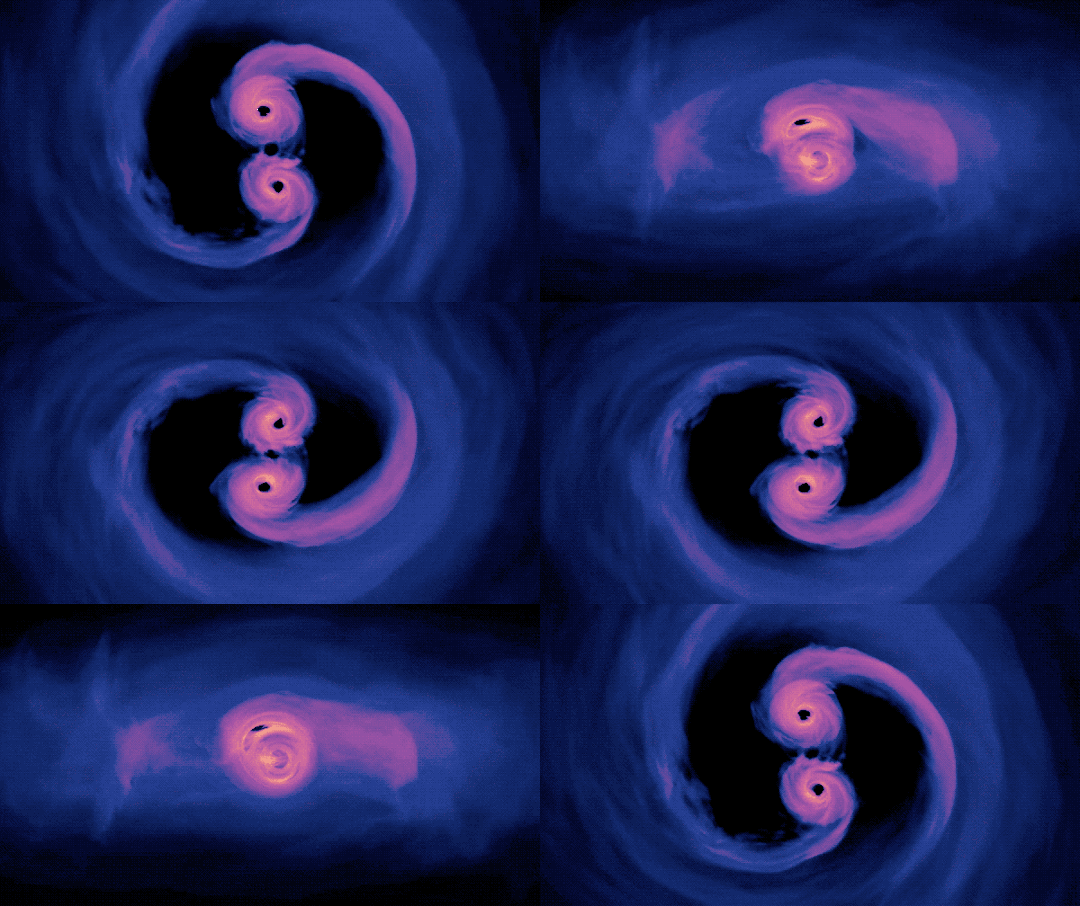
Merging
monster black holes
But stellar mass black holes aren’t the only
ones out there. At the center of nearly every large galaxy lies a supermassive
black hole — one with the mass of millions or billions of Suns smooshed into a region no bigger than our solar
system.
There’s still some debate about how these
monsters form, but astronomers agree that they certainly can collide and
combine when their host galaxies collide and combine. Those black holes will
have a lot of gas and dust around them. As that material is pulled into the
black hole it will heat up due to
It also turns out that these supermassive
black holes are the source of some of the brightest objects in the gamma ray
sky! In a type of galaxy called active galactic nuclei (also called “AGN” for short)
the central black hole is surrounded by a disk of gas and dust that’s
constantly falling into the black hole.
But not only that, some of those AGN have jets
of energetic particles that are shooting out from near the black hole at nearly
the speed of light! Scientists are studying these jets to try to understand how
black holes — which pull everything in with their huge amounts of gravity —
provide the energy needed to propel the particles in these jets. If that jet is
pointed directly at us, it can appear super-bright in gamma rays and we call it
a blazar. These blazars make up more than half of the sources our Fermi
space telescope sees.
Catching
particles from near a black hole
Sometimes scientists get a two-for-one kind of
deal when they’re looking for black holes. Our colleagues at the IceCube Neutrino Observatory
actually caught a particle from a blazar 4 billion light-years
away. IceCube lies a mile under the ice in Antarctica and
uses the ice itself to detect neutrinos, tiny speedy particles that weigh
almost nothing and rarely interact with anything. When IceCube caught a
super-high-energy neutrino and traced its origin to a specific area of the sky,
they turned to the astronomical community to pinpoint the source.
Our Fermi spacecraft scans the entire sky
about every three hours and for months it had observed a blazar producing more
gamma rays than usual. Flaring is a
common characteristic in blazars, so this didn’t attract
special attention. But when the alert from IceCube came through, scientists
realized the neutrino and the gamma rays came from the same patch of sky! This
method of using two or more kinds of signals to learn about one event or object
is called multimessenger astronomy, and it’s helping us learn a lot about the
universe.
Get more fun facts and information about black
holes HERE
and follow us on
social media today for other cool facts and findings
about black holes!
Make
sure to follow us on Tumblr for your regular dose of space: http://nasa.tumblr.com.
TIME TO COOK UP SOME DAMN GREEN PIGS TOO THEN! 🤬🔥 for real though these fuckers better not!
Edit: This is in Scotland but jfc don’t give the United Nazi States any ideas! Also, Scottish comrades please be safe out there! 💜💜💜
It’s the UK, the Scottish government aren’t this stupid. The British government, who govern the whole UK, is.
‘don’t give the United States any ideas’ THIS IS STILL! NOT! ABOUT! YOU! NOT EVERYTHING IS ABOUT HOW IT IMPACTS AMERICA!
consider: not everything is about you. not every bad thing is related to trump. in the UK there is a concentrated victimisation of the poor, the disabled, immigrants and people of colour that our government are doing ALL ON THEIR OWN, not in response to or as a message to America. And that’s about us not about you. just like Bolsanaro’s genocidal rhetoric is a problem for people because if how it affects Brazilians, not just because he’s ‘like Trump’ or interacts with Trump. just like European nazism is a problem for the countries it pops up in, not because it ‘emboldens American nazis’. it isn’t about you, it was never about you, and it constantly feels like everybody else is able to concern themselves both with local politics and with American politics but American discourse goes ‘this is what’s happening to us, and this is how your bad thing is also happening to us’.
When I was on the Trump march in Edinburgh, we went to the pub afterwards and every time we tried to discuss the Hostile Environment raft of policies, the Americans in our group derailed to talk about American anti-immigration rhetoric and how our government persecuting immigrants was going to embolden Trump. but that wasn’t what we were talking about and British anti immigration sentiment is worth addressing on its own terms, not as an offshoot of American politics, which it isn’t. When I’ve posted on Facebook about the ongoing collapse of the UK government, I’ve had American friends comment on it saying ‘oh its like what’s happening here is spreading’.
British militarisation of the police has been happening for decades, and this article is also about the imminent collapse of our economy and infrastructure with Brexit, which has nothing to do with ‘giving Trump ideas’ (he…also doesn’t need that idea, he’s already sending armed police to gun down women and children at the border?) and has in fact been percolating since the referendum six months before Trump was elected. The reason the government is considering armed military forces in the street is because they’re afraid of riots and looting in the event of No Deal Brexit, when they expect to have to ration food and manage profound shortages across the UK if we crash out of Europe with no trade deal and no continuity of supply lines, because it will take time to both reestablish the necessary infrastructure to run a separate economy and the trade lines to bring in food and necessary supplies. This is the version of Brexit that many higher-ups in the government are agitating for, because they’re filthy rich and it won’t affect them nearly as much. This is not a signal to America or an offshoot of American issues or a product of American politics. This is the British government making plans for what they’ll do if they starve their own people out.
And this my friends is why you fact check before you reblog something.
Lol thanks @avoidingthebinaryliketheplague it’s got an unnecessary amount of notes. Good that people are seeing it but genuinely terrible they are assuming it to be about America.
all the nonsense and bullshit in the notes aside, i am genuinely scared about what’s gonna happen after Brexit. Westminster already doesn’t give a shit about poor people or immigrants, and you can bet the most vulnerable and disenfrachised communities will bear the brunt of whatever shitshow we’re plunged into. i hope Cameron and Farage are proud of themselves.
The increase in racist abuse being thrown at poc in public, as well as the shitty treatment of immigrants, especially the Windrush generation and black immigrants in general involving them being kicked out of the country is representative of this whole Brexit mess, to be honest. Not to mention how many homeless people there are freezing in the streets now. The Tories got us into this mess and we’re just surrounded in chaos, but of course they don’t give a shit that they’re fucking everyone over. Fuck them.
I feel like the reason certain dog-lovers insist cats are evil is because they read their body language as if they were dogs. So here’s a very basic guide to common “mean” things cats do that actually aren’t mean at all if you know what they’re thinking.
Rolling and exposing belly- attacks you when touched Does not mean: Give belly rubs! – haha I tricked you! Actually means: I’m playful! If you reach for my belly I’ll grab your arm and bite it because I think we’re playfighting!
Lazily exposing belly – still attacks when touched Does not mean: tricked you again! Actually means: I’m showing you my belly because I trust you. Please don’t break that trust by invading my personal space. I might accept a belly rub if I’m not ticklish and I know you well.
Snapping at you while being pet Does not mean: I suddenly decided I dislike you! Actually means: You’re petting me in a way that gives me too much restless energy. Please focus on petting my head and shoulders instead of stroking the full length of my back next time.
Is in the same room but makes no attempt to interact Does not mean: I’m ignoring you Actually means: We’re hanging out! I’m being respectful by giving you space while still enjoying your company.
Slapping/scratching your hand when you try to pet them Does not mean: I hate you! Actually means: You’ve failed to establish that we’re not playing, or the way you’re approaching me scares me. Be calmer, speak more gently, make eye-contact and blink slowly at me before you try again.
I love this post omg, thank you so much. As a lifelong cat person, dogs perplex me because they’re so completely different behaviourally.
I love dogs too but, I’ve been trying to tell people, you canNOT treat cats like you treat dogs. They arent the same animals and have very different personalities
P.s.: people often pet cats way too hard. Dogs like a firm pet or a pat on the belly, cats dont have the same bone structure and are more flexible than dogs so what you’re doing probably hurts them
Sitting and staring Does not mean: I am challenging you/plotting your demise/just generally evil and creepy. Actually means: I am a desert-adapted species, so my natural tears are very thick and keep my eyes moist for a nice long time. I do find people interesting and enjoy watching them. I just don’t need to blink very often!
Staring and blinking slowly Does not mean: I’m smug and think I am smarter than you. Actually means: I like you! But I don’t need to get up in your face to show it. I can just sit over here and blow kisses at you to show you I am glad you are around!
It’s very frustrating for me when people expect cats to act like dogs, or act like they’re deceitful. They aren’t! They just AREN’T DOGS.
Pour les chats 🐈💞
Get ready for “more reasons why I fucking love cats”
Yes, the legends are true. Cats headbutt you to show their trust and affection. They also do it to show “hey look I see you as family.” Lions do it with members of their pride to say the same. It’s not just because they want food.
Cats nibbling is indeed literally cats grooming you. It’s what mom cats do to their kittens. If a cat is gently biting and/or licking you, they’re now your mom.
Meowing can simply be for the mere fact they want to say hello, want to play or be pet. Again, not just for food.
They barely meow at other cats (except for kittens, they meow at mom cat), mostly just humans. There are exceptions but overall, meowing is almost always for us.
Cats squinting/slow blinking is indeed basically the equivalent of us smiling and/or kissing.
Cats, like humans, prefer to get things without having to work for it- which isn’t very common within other animals.
Cat massages or making biscuits is because they happy! Kneading is another way of saying “hey I like this moment here I enjoy you and my life.”
Cats recognize us by smell, sound, taste, and touch. They recognize us after years as their long term memory is extremely good. This is why abused or neglected cats are so easily scared or hard to connect with. If your scent changes over the years or just in the day, your voice will them it’s really you. Also, they will only remember you if you had impact on their life. If you just existed in the same house, they obviously won’t care.
And yes, they know our patterns in the day. You notice it when it’s beneficial to them (feeding time!). They will often wait for you to come home as well.
To remember: cats think we are interesting as hell. They watch us do everything because we’re fascinating!!!
They also want you to be around when eating because they feel vulnerable. They focus on eating so they hope you protect them. They do the same for you, all the time.
CATS 😍😍😍😍
when a cat turns their back on you, they’re not snubbing you. they’re trusting you to watch their back.
notice how when you’re unfamiliar but nonthreatening, they might loaf facing you and sorta halfway watch you. you’re not fully trusted, but you’re ok by them.
when you’re familiar and liked, they’ll often sit near you facing the same way. imitation of poses is a weird little way cats show solidarity. they do it to each other too. check out these bff’s:
they are doing this on purpose. it’s a buddy thing. so if you’re watching tv and a cat sits next to you and pretends to watch tv too, they are basically calling you bro and declaring friendship.
and if they really love and trust you, they’ll turn their back on you and go to sleep. they’ll sleep facing a wall in your presence, or lounge where they can’t see the room. this isn’t a snub, folks, this is true kitty love. they’re saying, “i feel safe when you’re around. i know nothing’s going to sneak up on me, because you’re here. i feel so safe i can stick my head under a pillow and snore with my butt pointed at you.”
farts aren’t an expression of love, though, as far as i know. they’re just farts.
Another thing the crying discourse is making me think about—probably more controversially than the other things I said is:
Sj communities have understandable reasons to exclude people, BUT exclusion is almost always experienced as painful.
What I mean is: you know that guy who doesn’t get let into the no dudes allowed feminist online forum and yells about it, or the cis person who seems weirdly aggressive about following people who have “don’t follow if ur cishet 🌈🌈🌈” in their byf, or whatever?
Im gonna defend those people for a second. I know, I know.
We tend to classify those people as “entitled” or at least as “nosy”—why are they obsessed with finding out what we talk about when they’re not around? Ugh privilege amirite ew!
But the thing is… exclusion is something humans experience as painful usually. We experience it as something like rejection or shunning, and being rejected makes us get Emotional.
Like, I remember years ago I looked through someone’s online store. The person who ran the store also ran some kind of online forum for wlw. It didn’t ban bisexuals, BUT it insisted that any bi woman who wanted to join was required to reject sexual interactions with men and promise they would never again date any.
I didn’t really understand this at the time. My mind went “what would be so different about me than other bi women that I can’t even talk to them? How can anyone promise never to date a gender they’re attracted to ever again?”
And I couldn’t think of an answer. So I emailed and asked “what’s the difference between someone who has dated men and chooses no longer to do so and a bi person like me who has (at that time) never dated anyone?” And the response I got back was of course that I was being entitled and trying to barge into peoples space.
And the thing is… I didn’t get it. And most of tumblr would side with me on that I think: that’s “biphobic.” (In quotes to say the thing has A label not to claim biphobia is not real.)
My emotions—my feelings—were: “what possible secrets could exist that bi women can’t even hear lest the Lesbians be cursed?”
And the thing is… exclusion isn’t always inappropriate or wrong. Excluding white men from the lesbian woc dance makes sense.
But being excluded feels painful, and I’m pretty sure it feels that way whether the reason you’re excluded makes sense or not. Humans are hardwired to want to join groups, and to feel uncomfortable when groups push them away.
So… I don’t know. Sj isn’t always bad. But I sometimes feel like sj says “if you’re excluded and you get defensive, it shows you are entitled”
When the more I think about it the more I suspect it’s “if you’re excluded and you get defensive, you’re perfectly normal, but quite possibly also annoying.”
Well, like, the other thing is that this particular dynamic is one where the people doing the excluding are positioning themselves as moral authorities.
Suppose I’ve grown up thinking that feminism is the moral authority on gender relations and that the patriarchy is evil and pervasive.
How am I going to react to being told that I need to be excluded from feminist spaces, especially if that exclusion is based on a part of myself I can’t change?
As far as I can tell the canon SJW response is that in a patriarchal society there are already plenty of existing spaces for the privileged, but if I’ve really bought into the idea that the patriarchy is evil then it no longer has the capacity to comfort me psychologically.
“Come on, the evil people we’re trying to stop are still there for you, so why are you whining?”
Like, imagine someone who is expelled from a Christian Church, and the pastor has this conversation with them,
“I don’t know why you’re so damn needy about getting back into our Church’s good graces, there are lots of religions out there. The Church of Satan is right down the road, I know they’ll take you in.”
“So… So you’re saying those other religions aren’t so bad, and that there’s lots of paths to God?”
“Oh, no the Church of Satan is deeply heretical and you’ll probably be going to Hell if you join, but the point is that you can join them if you need a church so badly.”
I hadn’t specifically thought of that but yeah.
“White people are colonizer devils and you can’t trust a thing they say. Don’t listen to allies, they’re idiots. Listen only to us! Wait whoa whoa who said we wanted you around!? You think you’re allowed in here? Go hang out with your ugly sexist men and your latte drinking Beckys! …wait, you don’t want to? Why not? Oh boo hoo.”
I think expecting people to change their dating habits to join a freaking internet forum is entitled. That’s an awful rule.
I can see this from both sides: both that it’s painful and terrible to be rejected and excluded, but also that sometimes a group needs exclusive spaces.
I don’t know what the solution is, except being kinder and more welcoming to allies. Have spaces where allies are allowed and welcomed, interact with allies in these spaces.
That’s really the only solution I can think of too, deflection through “well we won’t see you tonight, but we all hang out over here together on Thursday though!” or the like.
How and when do you communicate with allies and how do you treat them? If the answer is never it might be worth thinking about why that is.
I’m not going to say separate spaces are NEVER good, but… the experiences I’ve had in them have pretty much all been disappointing and full of bitterness.
It’s entirely possible that the identities I don’t have are precisely the identities that get the most out of separate spaces, but I’ve personally very rarely seen ones that don’t get ugly.









 Urocyon's Jaunts 2.0
You must be logged in to post a comment.