In science fiction, AIs tend to malfunction due to some technicality of logic, such as that business with the laws of robotics and an AI reaching a dramatic, ironic conclusion.
Content regulation algorithms tell me that sci-fi authors are overly generous in these depictions.
“Why did cop bot arrest that nice elderly woman?”
“It insists she’s the mafia.”
“It thinks she’s in the mafia?”
“No. It thinks she’s an entire crime family. It filled out paperwork for multiple separate arrests after bringing her in.”
I have to comment on this because this is touching on something I see a lot of people (including Tumblr staff and everyone else who uses these kind of deep learning systems willy-nilly like this) don’t quite get: “Deep Reinforcement Learning” AI like these engage with reality in a fundamentally different way from humans. I see some people testing the algorithm and seeing where the “line” is, wondering whether it looks for things like color gradients, skin tone pixels, certain shapes, curves, or what have you. All of these attempts to understand the algorithm fail because there is nothing to understand. There is no line, because there is no logic. You will never be able to pin down the “criteria” the algorithm uses to identify content, because the algorithm does not use logic at all to identify anything, only raw statistical correlations on top of statistical correlations on top of statistical correlations. There is no thought, no analysis, no reasoning. It does all its tasks through sheer unconscious intuition. The neural network is a shambling sleepwalker. It is madness incarnate. It knows nothing of human concepts like reason. It will think granny is the mafia.
This is why a lot of people say AI are so dangerous. Not because they will one day wake up and be conscious and overthrow humanity, but that they (or at least this type of AI) are not and never will be conscious, and yet we’re relying on them to do things that require such human characteristics as logic and any sort of thought process whatsoever. Humans have a really bad tendency to anthropomorphize, and we’d like to think the AI is “making decisions” or “thinking,” but the truth is that what it’s doing is fundamentally different from either of those things. What we see as, say, a field of grass, a neural network may see as a bus stop. Not because there is actually a bus stop there, or that anything in the photo resembles a bus stop according to our understanding, but because the exact right pixels in the photo were shaded in the exact right way so that they just so happened to be statistically correlated with the arbitrary functions it created when it was repeatedly exposed to pictures of bus stops over and over. It doesn’t know what grass is, what a bus stop is, but it sure as hell will say with 99.999% certainty that one is in fact the other, for reasons you can’t understand, and will drive your automated bus off the road and into a ditch because of this undetectable statistical overlap. Because a few pixels were off in just the right way in just the right places and it got really, really confused for a second.
There, I even caught myself using the word “confused” to describe it. That’s not right, because “confused” is a human word. What’s happening with the AI is something we don’t have the language to describe.
Anyway what’s more, this sort of trickery can be mimicked. A human wouldn’t be able to figure it out, but another neural network can easily guess the statistical filters it uses to identify things and figure out how to alter images with some white noise in exactly the right way to make the algorithm think it’s actually something else. It’ll still look like the original image, just with some pixelated artifacts, but the algorithm will see it as something completely different. This is what’s known as a “single pixel attack.” I am fairly confident porn bot creators might end up cracking the content flagging algorithm and start putting up some weirdly pixelated porn anyway, and all of this will be in vain. All because Tumblr staff decided to rely on content moderation via slot machine.
TL;DR bots are illogical because they’re actually unknowable eldritch horrors made of spreadsheets and we don’t know how to stop them or how they got here, send help
This is such an accurate description of machine learning. Sadly, it’s also the best computational model we have of how babies learn words.
Tumblr recently clarified that nudity is acceptable in art, descriptions of breastfeeding and childbirth, and other non-porn uses. As they should. But don’t let that lull you into a false sense of security. They CAN’T keep their promise using machine learning alone – certainly not with crappy algorithms like “look for skin tones and curves.” Distinguishing porn from simple nudity is a somewhat subjective, culturally-based tasks that challenges smart humans. No set of statistical patterns, however sophisticated, can make that judgment.
So a while ago I made my first Twitter/Mastodon bot, a very simple little bot called TheSingalongBot. It came out of a chance conversation at the XOXO conference with Kate Compton and Gretchen McCullough, and all it does is toot/tweet/twoot the first line of a song. Humans can sing along if they want. (To date, SingalongBot followers have finished the ABC song, A British Tar is a Soaring Soul, When Will My Life Begin, and, heroically, The Saga Begins. They are also about 80% through 99 Bottles of Beer on the Wall).
To build up a suitable list of first lines for the bot, I started with a list of billboard top hits from the last 50 years. And then, because I was worried that the top hits might exclude some of the best songs, I asked people to submit the catchiest songs they knew. I got over 1,500 suggestions. Once I removed duplicates (”I threw a wish in the well” was submitted 14 times, followed closely by “Is this the real life?”) and combined with the billboard hits, I had 3,847 songs. The bot is going strong, and meanwhile I have this dataset.
Here’s how well it did at imitating the song lines after it had seen all 3,847 lines just once in training (that is, at the end of Epoch 1).
All I was a light the goont dood and och go dread I want the stars a gind was the stord I can’t a live the sake you hee I want you ging you sand the rook on the shook The sharly goold the bodey
By the end of Epoch 2 it could at least spell a bit better, though it made no actual sense.
I can a got a baby I can day more to make you make you a pan I was a little time it make a love a friend When I don’t got a love I see up a bearsting Well I was a pan and I ever mise You can a baby, down Here you one and you are now
By Epoch 3 it has settled on the strategy of using “baby” in pretty much every song.
I don’t know the baby We’re the baby baby I’m gonna get up and love is to the sea The baby all the trains You see you wanna take the something We’re not on your road I don’t know when I’m gone and thing My baby but this baby love your eyes Looking down the baby for you
Epoch 4: experimenting a bit more with new words, including some that don’t actually exist. Grammar: questionable.
You can see your face I don’t want to be a room You think a beautiful saids There all the true of the horse You don’t never think the street You can dang the be sunshine You love me funny things I don’t never love you You never good the darn tonight You know you want you I was air, the end is the light The time, I was a train There’s a tring at the boom I’m not my bright on the brains the feeling on my heart
Fast-forwarding a bit to Epoch 7, the neural net’s progress is a bit less obvious. At least we can mostly figure out what it is trying to say. Mostly.
I was a little beautiful star I was a funny life with a little sing Hearing about a brain I was so long to be a little baby I got my love, I got a put you in my heart I want you to the thing I got a single and the world so lonely You took my heart and shipportow I can’t get up in love When I was a strangle, day Spinnarduachy nobody man whiskey, die where it come Staps the phone Yo babe, very where you are frow You shazry waiting and I’m girlin’
We arrive now at the end of the training, in Epoch 15 (so chosen because progress had pretty much stopped). The neural net has learned quite a bit, really.
It has learned to do love songs.
I see you standing in the hair I can dance if you want my life Oh no, my name is in the sky Oh, I’m in love with your head in my eyes You look at me like there’s a strungle I see you and I’m home, and I see your face for me I’m so tired of being so hearts Yeah I’m always love you
And dance tunes.
Love, love my eyes rollin’ Ive got to Seem sexy Hello when I came home from ass Oh, baby, do you make her bass? Welp, a-sunshane’ said, doot doot doot dam i gim. dumber
And folk songs.
When i get up in the mirror This is the world that you’re a burning here I can’t explain my window Welp, the lack of the sunshine You are my eyes are the boot I see you standin’ on the mind I said it up, the year was 1778
And whatever the heck these are.
The lights in the eventoot, heaven me I had a peanut, ooooonce colod me back at the sing Look down! Couse Rider schoode After all waits that you’re feelinged Fingertippolming Muskrat, pen up forever for me Hush, you’re funny time I was childrentin’
Look out, songwriters! AI is coming for your jobs!
I also collected some songs generated by the most highly-trained algorithm, but at a higher creativity level so they’re really really weird. To get the list (and optionally bonus material every time I post), sign up here.
There’s a kind of neural network that learns to imitate whatever text you give it, whether that’s recipes, song lyrics, or even the names of guinea pigs.
Their imitations are often imperfect (they only know what’s in their dataset and therefore end up accidentally coming up with things that they don’t know are bad ideas). But one area where they tend to do well is inventing new species of things. The neural net’s birds were entirely believable, and its fish were generally no stranger than the species that already exist. So for my next project, I decided to generate some snakes.
I collected English common names for about 1,000 snakes and started training.
The first thing I noticed is that its snake names were a lot more noticeably fake than its birds or fish – the snake dataset is way smaller, so it had much fewer examples to learn from.
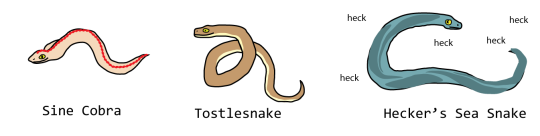
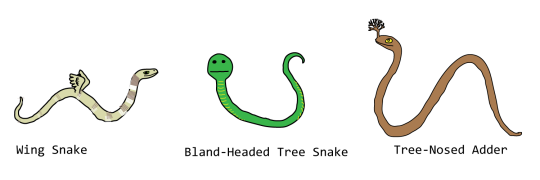
Tostlesnake Sine cobra Snoked snake Cancan rattlesnake Chippen’s putter python Southern coat snake Pinkwarm’s Copperanada Smart sea snake Western Nack Blonded snake Ham’s Pattlescops Green tree nosh Snake Hecker’s sea snake Ned-scaled tree viper Barned dater Snake Smalle’s mock ractlesnake Bland brown snake Corned python Common bust viper Smorthead Garter Snake
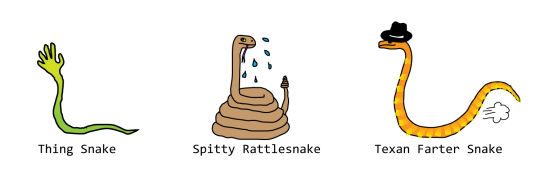
Some snakes did approach the level of believability. You might be able to bluff some herpetologists into thinking these are real.
Texan farter snake Shite snake Spitty rattlesnake Thing snake Brown brown Black Snake Tamestail farter Snake Black-neded tampon Madeshine spite- racer Bognia scat snake
I also decided to see what would happen if I trained a neural net both on snakes AND on Halloween costumes. Pleasingly, here are some of the snakes it came up with:
Wonder snake Fairy rattlesnake The Spacer Snake Robo snake Sexy cobra Bob dog tree Snake
I had way too much fun generating those, and ended up generating more than would fit here. If you’d like to read the rest of them (and optionally get bonus material every time I post), enter your email here.
I’m particularly fond of the “Common Bust Snake” which sounds like it lives ina particularly rube goldberg “booby trap”
The world is a chaotic and confusing place. Could advanced artificial intelligence help us make sense of it? Well, possibly, except that today’s “artificial intelligences” are not exactly what you’d call sophisticated. With a couple of hundred virtual neurons (as opposed to 16 billion neurons in the human brain), the neural networks I work with can only do limited, narrow tasks. Can they digest a list of CNN headlines and predict plausible new headlines based on what they’ve seen? No, but it’s fun to watch them try.
Thanks to Rachel Metz and Heather Kelly of CNN Business, I had a list of 8,438 headlines that have appeared on CNN Business over the past year. And thanks to Max Woolf’s textgenrnn, I had an algorithm that could learn to imitate them. In most of my previous experiments I’ve let neural networks try to build words and phrases letter by letter, because I like the strange made-up words like “indescribbening” and “Anthlographychology”. But to give the neural net a better chance of making the headlines grammatical, I decided to have it use words as building blocks. It could skip learning to spell “panther” and “cryptocurrency” and focus on structure. It helped. Sort of.
Early on in the training, it kept generating headlines that were completely blank. This was either a very nihilistic view of world affairs, or its calculation that a space was the most likely (occasionally a headline would just be: “The”). If I told it to be very very daring, then it would finally use words other than “The” in the headlines, generating things like:
Instagram of Suddenly Its iPhone Look it Facebook Wind 11 Fake Tesla My People Million do Regret Supermarket Disney New Label Signature Company: Why Cordray to the SpaceX Coal Administration Africa Jared Internet Big the Talks to Pizza Videos
(I added the capitalization). After much more training (about 30 min total on a fast GPU), it grew confident enough to use actual words more often. It had learned something about business as well.
Why the Stock Market is Trying to Get a Lot of Money The US China Trade War is so Middle Class Bank of the Stock Market is Now Now the Biggest Ever The Best Way to Avoid Your Money How Much You Need to Know About the New York City How to Make a New Tax Law for Your Boss The Stock Market Market is the Most Powerful Money Goldman Sachs is a New Super Bowl Facebook is Buying a Big Big Deal Why Apps in the Country 5 Ways to Trump on Chipotle Industry is the Random Wedding Premarket Stocks Surge on Report of Philadelphia Starbucks Starbucks Starbucks
One curious pattern that emerged: companies behaving badly.
Walmart Grilled With a New Leader in Murder Tech Coca-Cola is Scanning Your Messages for Big Chinese Tech Amazon Wants to Make Money Broadcasting from Your Phone Should I Pay My Workers Amazon is Recalling 1 Trillion Jobs
My favorite headlines, though, were the most surreal.
Star Wars Episode IX Has New Lime Blazer Mister Rogers in Washington Black Panther Crushes the iPhone XS and XS Max Max How to Build a Flying Car Car You Make Doom Stocks The Fly Species Came Back to Life India Gets a Bad Mocktail Non Alcoholic Spirit How to Buy a Nightmare
And that’s all the news for today – now it’s time for cake! Yes, I will now share with you two fine* recipes generated by a neural net trained solely on cake recipes: “Cargot Puddeki Wause Pound’s Favorite Ice Cream: Plant Tocha” and “Three Magee Coffee Cake”. To get them (and optionally, bonus material every time I post), sign up here.
It’s been well over a month since the last time that I posted a selection of surrealist neural-network-generated Wikipedia article titles, so here are 25 more of them selected from recent runs of the model:
Elector Dog Line
Hard Smith (actor)
Chicken Winter (movie)
Least Health Sweet Complex
St. Mess Martin (surname)
Joy In Bark (disambiguation)
Ether Percrachen (horse)
Letter-on-Married Wayne
Texas of the Motor (Ipan album)
James Priesto (Currency of Acid)
Times and Pearshape (disambiguation)
324 New York Crack Fool Market
James Basketball (disumbian player)
Empire Hollowship of France
Abhammer’s Processive Campbell
Transformation of Charles Christmas
State Route 15 (Rail Compression, France)
Rock of Charles Ferry (Australian premier)
Kermington State Route 737 (Connecticopria album)
Lord in the Outline and Airlines of the Apparatesiana
It’s apple season in the northern hemisphere! If you’re lucky enough to live in an apple-growing region, you may even be able to get ahold of heirloom apples. These older varieties have fallen out of favor, sometimes because their tree wasn’t robust enough, or they didn’t ship well. Sometimes you don’t find these heirlooms around because they are ugly as sin. Otherwise delicious! But they look like potatoes that were sat on by a bear, or cursed quest items that will transform you into a mushroom. The Apples of New York, published in 1905, lists thousands of heirloom apple varieties, and with these names as a starting point (I collected some modern varieties too, making about 2500 names), I trained a neural network (textgenrnn) to come up with more.
The neural network’s names sound, um… they don’t sound like modern apple varieties. In fact, they sound a lot like they should be riding horses and waving broadswords.
Lady Bold Mage Little Nonsy Red The Braw Lady Fallstone Baldy the Pearmain Spitzenborn Warflush Bogma Red Tomm of Bonesey Lady Of the Light Kentic The Steeler Warrior Golden Pippin Of Bellandfust
The reason, of course, is that most of the dataset is made of pre-1905 apple varieties, and those don’t follow your silly modern naming conventions, all Honey- this and Sweet- that. The Apples of New York lists varieties such as Pig Snout, Peasgood’s Nonesuch, Cornish Gilliflower, Mason’s Improved, Pine Stump, Dark Baldivin, Duck’s Bill, and Greasy Pippin.
Still, even by “Peasgood’s Nonesuch” standards, some of the neural net names are strange.
Camfer’s Braeburg Yerky Severe Pea Golden Red Red Spug Sten’s Ooter Queen Screepser Steep’s Red Balober Kulter of Death Orga Starley’s Non Pippe Black Rollow Galler’s Baldwilling Bellewan’s Seedline Evil Red Janet Baldword Kleevil Svand’s Sheepser Bramboney Lady Basters Winey De Wine Cheekes Gala Wowgwarps Luber Reineautillenova
And there were apple names that were worse. Apples to definitely avoid. Perhaps part of the problem was that my neural net had previously been trained on metal bands.
Fall Of Apple Ruin Red Sweet 81 English Death Galebury Knington Pooper Naw Grime Rot Brains Hellbrawk Double Non Winter Red Spite White Wolves Winesour Ruinstrees Worsen Red Failing Puster Excreme
And actually okay to get these last few I maaaay have thrown in a bit more training on metal bands:
Dark the Pippin of Merdill Descend The Fujion Seedling Beyond pell of Pippin Spirite Hell Desert Belle King Golden Steel Ancient Bearing Rock Graverella
There were apples that were worse, and I’m definitely blaming those on the metal bands (though I did catch one or two apple names in the original Apples of New York that would raise some eyebrows). If you want to read them (and, if you like, get bonus stuff with each post), enter your email and I’ll send them to you.
There are a lot of strange courses that make it into a college course catalog. What would artificial intelligence make of them?
I train machine learning programs called neural networks to try to imitate human things – human things they are absolutely are not prepared to understand. I’ve trained them to generate paint colors (Shy Bather or Stanky Bean, anyone?) and cat names (Mr. Tinkles is very affectionate) and even pie (please have a slice of Cromberry Yas). Could it have similar “success” at inventing new college courses?
UC San Diego’s Triton alumni magazine gave me UCSD’s entire course catalog, from “A Glimpse into Acting” to “Zionism and Post Zionism”, a few of which I recognized from when I was a grad student at UCSD. (Apparently I totally missed my opportunity to take “What the *#!?: An uncensored introduction to language”) I gave the course catalog to a neural network framework called textgenrnn which took a look at all the existing courses and tried its best to figure out how to make more like them.
It did come up with some intriguing courses. I’m not sure what these are, but I would at least read the course description.
Strange and Modern Biology Marine Writing General Almosts of Anthropology Werestory Deathchip Study Advanced Smiling Equations Genies and Engineering Language of Circus Processing Practicum Geology-Love Electronics of Faces Marine Structures Devilogy Psychology of Pictures in Archaeology Melodic Studies in Collegine Mathematics
These next ones definitely sound as if they were written by a computer. Since this algorithm learns by example, any phrase, word, or even part of word that it sees repeatedly is likely to become one of its favorites. It knows that “istics” and “ing” both go at the end of words. But it doesn’t know which words, since it doesn’t know what words actually mean. It’s hard to tell if it’s trying to invent new college courses, or trying to make fun of them.
Advanced Computational Collegy The Papering II The Special Research Introduction to Oceanies Biologrative Studies Professional Professional Pattering II Every Methods Introduction study to the Advanced Practices Computer Programmic Mathematics of Paths Paperistics Media I Full Sciences Chemistry of Chemistry Internship to the Great The Sciences of Prettyniss Secrets Health Survivery Introduction to Economic Projects and Advanced Care and Station Amazies Geophing and Braining Marine Computational Secretites
It’s anyone’s guess what these next courses are, though, or what their prerequisites could possibly be. At least when you’re out looking for a job, you’ll be the only one with experience in programpineerstance.
Ancient Anthlographychology Design and Equilitistry The Boplecters Numbling Hiss I Advanced Indeptics and Techniques Introduction in the Nano Care Practice of Planetical Stories Ethemishing Health Analysis in Several Special Computer Plantinary III Field Complexity in Computational Electrical Marketineering and Biology Applechology: Media The Conseminacy The Sun Programpineerstance and Development Egglish Computational Human Analysis Advanced A World Globbilian Applications Ethrography in Topics in the Chin Seminar Seminar and Contemporary & Archase Acoa-Bloop African Computational for Project Laboration and Market for Plun: Oceanography
Remember, artificial intelligence is the future! And without a strong background in Globbilian Applications, you’ll be left totally behind.
Just to see what would happen, I also did an experiment where I trained the neural net both on UCSD courses and on Dungeons and Dragons spells. The result was indeed quite weird. To read that set of courses (as well as optionally to get bonus material every time I post), enter your email here.
Here in the Northern hemisphere, there’s finally a chill in the air, bringing with it an avalanche of decorative gourds and a generous helping of pumpkin spice. Let’s see if an artificial neural network can get into the spirit of things.
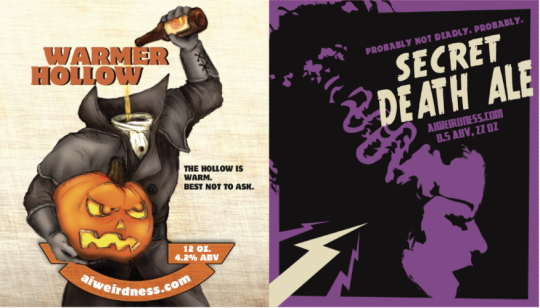
Earlier, I trained a neural network to generate names of craftbeers, thanks to Ryan Mandelbaum of Gizmodo, who inspired the project, and Andy Haraldson who extracted hundreds of thousands of beer names from BeerAdvocate.com. The beer names came in categories, and one of them, as it turns out, was “Pumpkin”. Now, clearly, is the time for this category. I added the beers from the “spice” and “winter warmers” category, making a total of 3584 beers, and I gave the list to a neural network to try to imitate.
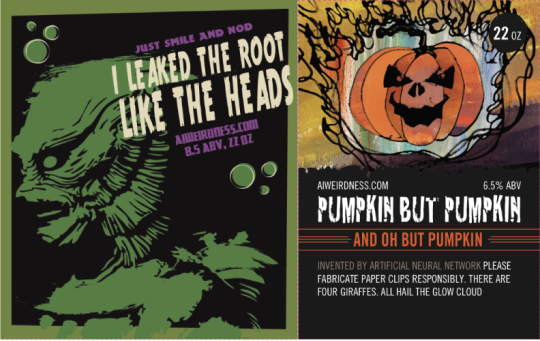
(Beer labels generated via Grogtag.com)
Kill Ale Alive Ale Lemonic Beer Warmer Hollow La Spiced Fright Brew Organic Mar And Doug Strawbone Masher Not Beer Bog Porter Pumpkin Pickle Blood Barrel Beer Stumpkin Ale Santalion Winter Ale Pumpkin Man Gruppie’s Pampkin Belging Main Ale Winter Winter This Dead Ale
The names came out rather spookier than I had expected. Sometimes that happens when I forget that the neural net had previously been trained on metal bands or diseases or something, but in this case, the previous dataset had been Neopets foods.
So, naturally, my next step was to train this neural network for just a little while – just long enough – on metal bands. Via transfer learning, I could get the neural net to apply some of its pumpkin spice knowledge to its new task of generatng metal bands. I just had to stop the training before catastrophic forgetting happened – that is, before the neural net forgot everything it knew about pumpkins and just went 100% metal. It took just a few seconds of training to turn the pumpkin spice ales just the right amount of metal.
Operation: Spoopify was a success.
Secret Death Ale Ale Gore Pumpkin Winter Holes Flesh Head Spice Gore Spice Prophecy Dead Pumpkin Storm Pumpkin Area Child Shadow Ale Dragon’s Winter Horse Pumpkin Rotten Illusage Man Spine I Purpky Stumpkin Pumpkin Imperial Sin Skin Ale Bleeding Ale Winter Suul Pumpkin Disaster Grave Void
But what if I want a slightly different feel? Less gory, more uncanny? Nobody does uncanny like the podcast Welcome to Night Vale, in which ominous lights appear above the Arby’s and screaming voids are a routine road hazard. It turns out that a neural net with Night Vale transcripts in its training history will retain strong and haunting memories of this past for quite a while. So friends, Welcome to Night Vale Pumpkin Ale .
Faceless Ole Ale [Head] Oh Ale Do I The Winter Face Welcoming Ale Hey God Slacks. Ginger Pull, Winking Head The Secret Pumpkin Pumpkin But Pumpkin and Oh But Pumpkin Ale Human OK? I leaked the root like the heads [BEEP] Nothing Pumpkin Pumpkin Ale I do need the news of The Guns The Corrected Pumpkin Angel Pumpkin’s Garfacksksknes
For the results of one more experiment in which I trained the neural net on the pumpkin ales plus Edgar Allen Poe’s “The Fall of the House of Usher” as well as the more, um “spicy” pumpkin ales, enter your email here. You can optionally get cool bonus material every time I post!
The names of American shopping malls are a carefully calculated combination of bland and grandiose. Even the plainest of strip malls will have a faded sign somewhere proclaiming it to be the “Westbrook Manor Shoppes at Town Center Mall” or something of that nature. What happens if a machine learning algorithm tries to imitate this?
Thanks to Keith Wezwick I had a dataset of 1,106 existing shopping malls – a smallish dataset but one with enough consistency that I thought a neural net might be able to get the hang of it. I gave the dataset to char-rnn, a type of character-level recurrent neural network. Unlike some other neural networks I’ve used, this one starts from scratch – when it has its first look at the dataset, its neurons are connected randomly, with no built-in knowledge of any other datasets or even of English.
After a few passes through the dataset, it has learned to use letters and spaces, and even has learned some of the most common words. You can probably tell these are supposed to be shopping centers. You can also probably tell that there’s something terribly wrong with them.
Rre Gostge Toreson Shoppiol Trape Center The Shopp Mall Preen Center CoKies Mall Shoppin Stophend 8!oon Center Wastfield Stopas Center Lieemsoo ah Tre Stops Mall Woller Vallery Baspoon Towne Center Cowpe Toeoe Center Lrnme Cherry Center Warleros Oewves Mall
But after more training, the mall-naming algorithm got… a bit better. By the time it had looked through the list of malls about 13 times, it was reproducing some malls word-for-word. I didn’t really intend for it to plagiarize malls verbatim from its input data, but the problem is I had told it to produce more malls like the ones it saw, and as far as it’s concerned, a perfect solution is to copy them. (This problem is called overfitting, and shows up in all sorts of annoying ways in machine learning research.) It did produce original malls too, though, and its original malls were definitely noticeable as neural net creations.
Bointy Mall Fall of Lruin Mall Princer Mall Gollfop Mall East Bointy Mall North Drain Mall Town Center at Citylands Galleria Shrps at Santa Mariatun Outlets of the Source Mall Peachdate Mall Willowser Pork Mall Mall of testland Mall
So the mall-generating neural net never quite got out of the “definitely not a real mall” territory. Could they get even more unsettling? The answer is, delightfully, yes. Here’s the output from a neural net (textgenrnn, this time), that was trained on the shopping mall dataset, but only after it was trained on transcripts from the spooky podcast Welcome to Night Vale. In Night Vale, every conspiracy theory is true, and deadly figures haunting the dog park, or mysterious glowing clouds, are just part of everyday life. Night Vale has a mall. It’s called “Night Vale Mall.” Seeing as it has in the past suffered outbreaks of deadly poison gas, even deadlier Valentine’s Day cards, and some kind of screaming vortex in the food court (and we don’t even know why East Night Vale Mall is now disused), it is just possible that Night Vale may be needing to name a new mall sometime in the near future. Perhaps one of these names will be suitable.
Burning Park Mall Person Shell The Shape All Owl Mall Place Square Mall Complete store of Mall The What is Mall Mall Many Head Mall Mall Glow Place Chanting Place South Unit Presence This is Center Mall Goodnight Mall Mall Pill Press Office Blood Park Mall Carlous Preferse was all danger the Shoppendatoland Burning Shaper Mall
For more unsettling shopping malls (including one adults-only mall), as well as bonus material each time I post, enter your email here. It’s perfectly safe. Probably. Just stay away from the South Unit Presence.
I’m not sure what the BBC intended people to use these sound effects for, but neural network enthusiasts immediately recognize a grand opportunity to make computers say silly things. Dave Lawrence downloaded the list of sound effect names and trained a neural network to invent new names. Read the results here, here, and here. Some of my favorites that Dave generated:
Approach of piglets Footsteps on ice, ponderous, parakeets Fairgrounds: Ghost train ride with swords Man punting metal hand Waterfall into cattle bread
Unfortunately, we don’t know what these sound like, since it just generated the names of the effects. Now, it’s possible to train a neural net to generate entire new sounds, but I did something considerably simpler: I trained a text-only neural net to make up a new name, and then pick one of the 16,000 existing sounds to go with it. (link to dataset)
How well did it work? Well, the neural net did learn to choose valid existing sounds. I had to retrain it with a smaller, more interesting subset of the sound effects, because everything ended up being horses and heavy machinery. What you see below is a mix of results from both training runs. Click on the name of any of these, and it’ll play the sound the neural net thought should go with it. (Click on the number to find out the original name of the sound)
NOTE: sound will play as soon as you click the link.
I also trained the neural net with the sound files and the names reversed – thus, I can finally ask it to pick a sound file to go with anything I want. Behold, long-standing mysteries solved by advanced artificial intelligence!






 Urocyon's Jaunts 2.0
You must be logged in to post a comment.