Before and after of a reconstruction to an owl-shaped protocorinthian aryballos, ca. 630 BC. Opening in the tail, hole in the basis to suspend by a lace. [3443 x 1611]
The Negros scops owl (Otus nigrorum) is an owl, endemic to the Philippines, belonging to the family of the typical owls Strigidae. Negros scops owls prey at night on insects. They live alone or in monogamous pairs. They breed throughout the year, laying clutches of 1–2 eggs. They nest in trees holes of forests of the Philippine lowlands. They are found on the island of Negros. They were formerly classified as a subspecies of the Philippine scops owl.
The northern hawk-owl (Surnia ulula) is a non-migratory owl that usually stays within its breeding range, though it sometimes irrupts southward. It is one of the few owls that is neither nocturnal nor crepuscular, being active only during the day. This is the only living species in the genus Surnia of the family Strigidae. The species is sometimes called simply the hawk owl; however, many species of owls in the genus Ninox are also called “hawk owls”.
Barn Owls are THE BEST. They are in a separate family from all other North American owls, and instead of whoo hoooting they do the TV STATIC SCREAM FROM YOUR NIGHTMARES.
Gotta love the raptor presentations at the state parks! This was at Lockhart State Park tonight at our Master Naturalist meeting. These presenters rehabilitate injured birds of prey through Austin Wildlife Rescue (austinwildliferescue.org), an organization that always NEEDS VOLUNTEERS to help out with the adorable baby animals. If you’re in Central Texas, check them out!
June 18, 2018
The barn owls are members of the family “tytonidae” while every other owl species is a member of the “strigadae” family.
While we typically think of owls like the one in the original post as being barn owls, every species in the family can technically be considered a barn owl.
This includes the various species of masked owls which are relatively similar to your common barn owl
As well as both varieties of sooty owl which are strikingly different than the common barn owl
There are also the grass owls which are behaviorally different than other barn owls in their habits of living on the ground rather than trees
And the two odd tytos out, the red owl and ashy faced owl respectively. Scientists know almost nothing about the former and no individuals have been kept in captivity despite being discovered quite some time ago. Even photographs of it are rare, but it appears to be an orange barn owl with a pink face.
Structurally speaking, barn owls actually have very few traits in common with strigadae owls as their face and beak shapes and proportions are entirely different. There are also differences in their legs and talons, while their similarities are limited to feather composition, ear placement, spinal structure, and binocular vision among a few other internal components.
That being said, barn owls are far from the only family of non-hooting owls as hooting is almost exclusive to larger species, typically genus Strix or bubo. Many other species will trill, screech, and/or hiss.
Barn owls are rather unique in having an incredibly keen sense of hearing, even in comparison to other owls. They can hear and discern between different heartbeats and triangulate the sound perfectly due to their satellite dish-like face shape.
In addition, this barn owl is not actually Tyto alba, it’s a Tyto furcuta, T. alba is the species native to Western Europe while T. furcuta is native to North America.
Many thanks for this owlditional quality content. I give three screams of approval 👍
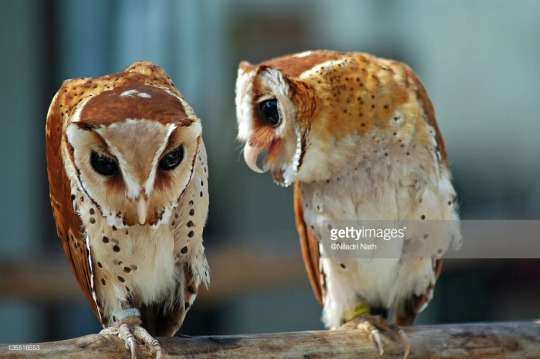
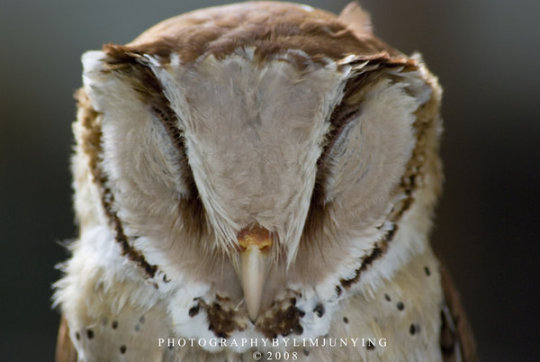
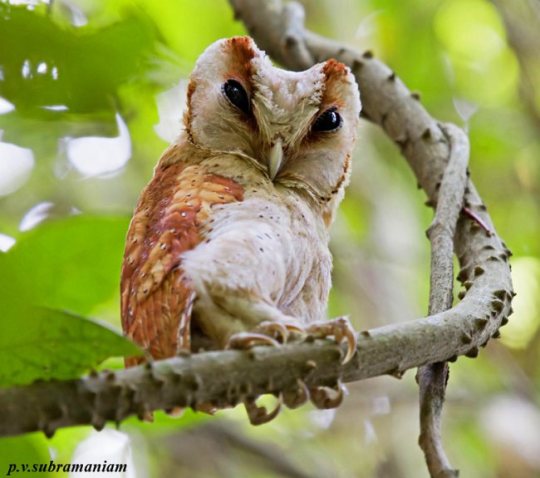
bay owls (genus Phodilus) are in Tytonidae and they are some of my favorite owls of all time. they can be found in Southeast Asia, and some sites claim central Africa as well but I’m not sure?
they can shut their eyes and look eyeless
OR OPEN THEIR EYES WIDE THIS AND LOOK LIKE DEMONS
did I mention they have the best judgemental faces because of their eye positioning
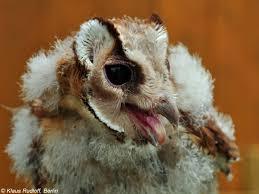
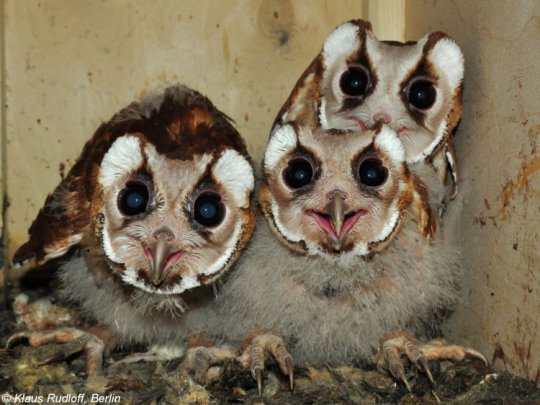
and babies look like tiny demonic gryphons
last I went looking, not a lot is known about bay owl behavior aside from general Tyto habits. I just know they’re so out there appearance-wise and I love them so much for it.
Although we admit a large number of orphaned animals every year, we will always try to return young animals to their parents where we can.
This fledgling barn owl arrived at our reception after being found not moving at the base of a tree. The people who brought it to us wanted to make sure it had not been injured.
Although it was slightly dehydrated, it had no major injuries and easily passed a flight test. We think that this owl would have been ‘branching’ – the time where fledgling birds leave the nest but cannot yet fly. After giving the bird fluids and food it was moved into an incubator for release later that day…
The white-fronted scops owl (Otus sagittatus) is a small Asian owl in the family Strigidae.
The White-fronted Scops Owl feeds on insects, mostly moths.
It has a small and declining population about which little is known, and is dependent on lowland and foothill forests which are rapidly being destroyed.
The Negros scops owl (Otus nigrorum) is an owl, endemic to the Philippines, belonging to the family of the typical owls Strigidae. Negros scops owls prey at night on insects. They live alone or in monogamous pairs. They breed throughout the year, laying clutches of 1–2 eggs. They nest in trees holes of forests of the Philippine lowlands. They are found on the island of Negros. They were formerly classified as a subspecies of the Philippine scops owl.
The morepork (Ninox novaeseelandiae), also called the ruru or Tasmanian spotted owl, is a small brown owl found throughout New Zealand and Tasmania.
Four subspecies of the morepork are recognized, one of which is extinct and another that exists only as a hybrid population. The bird has almost 20 alternative common names, including mopoke and boobook — many of these names are onomatopoeic, as they emulate the bird’s distinctive two-pitched call.
“Morepork” has been designated the official name by the International Ornithological Committee.





 Urocyon's Jaunts 2.0

You must be logged in to post a comment.