Just reminded again, I’m still appalled that I couldn’t find a rescue/rehab organization anywhere in Greater London willing to take on pigeons at all, when our half-grown cats proudly carried in an injured one almost as big as he was then. There was a roost nearby, but it hadn’t occurred to me that a kitten might go after a full-grown pigeon. Surprise! 😕
(That was also over 10 years ago, and I don’t know about now. Hopefully there is at least one rescue taking them. May have missed something then, but you can bet I did some motivated looking.)
So, I needed to do some other research, starting from a point where I’d never taken care of birds at all, and set up my own makeshift pigeon infirmary–with those cats carefully shut out of the room 😨
Thankfully, that bird wasn’t badly injured, and mostly needed a few days to recuperate in a safer place before it seemed ready for release.
Clatterbane’s Flying Rat Hospital ended up with several other patients over the years, including one I saw struggling with an obviously hurt leg and birdnapped off the street. Luckily, all the others were also either just shook or not badly enough hurt to need veterinary attention, and recovered with a some TLC and a couple of weeks at most. (If any had been in worse shape, I would have hauled them to our vets’, who do also treat birds, and tried to get them more help. No worries there.)
But, they deserved better than “Geez, I have no idea what I’m doing, but at least I do care enough to try to find out how to help to the best of my ability.” I don’t care if they’re not usually considered Proper Wild Animals Deserving Of Help. That’s just mean.
So I was told that Human Planet had a segment about pigeons in the Cities episode that I might be interested in and I was honestly so underwhelmed. I haven’t finished the episode so maybe there’s more pigeon stuff but I feel like all I saw was more Birds Of Prey Are The Only Cool And Acceptable Birds and pigeons are Trespassers In Our Urban World Who Shit On Everything And Are Useless On Top Of It. Which isn’t true and I’m so tired of this being framed as some horrible burden that humanity must face. Pigeons are the victims here, not us.
Hate of pigeons didn’t start until the 20th Century. Before that was about 9,900 years of loving them. The rock pigeon was domesticated 10,000 years ago and not only that, we took them freaking everywhere. Pigeons were the first domesticated bird and they were an all-around animal even though they were later bred into more specialised varieties. They were small but had a high feed conversion rate, in other words it didn’t cost a whole lot of money or space to keep and they provided a steady and reliable source of protein as eggs or meat. They home, so you could take them with you and then release them from wherever you were and they’d pretty reliably make their way back. Pigeons are actually among the fastest flyers and they can home over some incredible distances (what fantastic navigators!). They were an incredibly important line of communication for multiple civilisations in human history. You know the first ever Olympics? Pigeons were delivering that news around the Known World at the time. Also, their ability to breed any time of year regardless of temperature or photoperiod? That was us, we did that to them, back when people who couldn’t afford fancier animals could keep a pair or two for meat/eggs.
Rooftop pigeon keeping isn’t new, it’s been around for centuries and is/was important to a whole variety of cultures. Pigeons live with us in cities because we put them there, we made them into city birds. I get that there are problems with bird droppings and there’s implications for too-large flocks. By all means those are things we should look to control, but you don’t need to hate pigeons with every fibre of your being. You don’t need to despise them or brush them off as stupid (they have been intelligence tested extensively as laboratory animals because guess what other setting they’re pretty well-adapted to? LABORATORIES!) because they aren’t stupid. They’re soft intelligent creatures and I don’t have time to list everything I love about pigeons again. You don’t need to aggressively fight them or have a deep desire to kill them at all. It’s so unnecessary, especially if you realise that the majority of reasons pigeons are so ubiquitous is a direct result of human interference.
We haven’t always hated pigeons though, Darwin’s pigeon chapter in The Origin of Species took so much of the spotlight that publishers at the time wanted him to make the book ONLY about pigeons and to hell with the rest because Victorian’s were obsessed with pigeons (as much as I would enjoy a book solely on pigeons, it’s probably best that he didn’t listen).
My point is, for millenia, we loved pigeons. We loved them so much we took them everywhere with us and shaped them into a bird very well adapted for living alongside us.
It’s only been very recently that we decided we hated them, that we decided to blame them for ruining our cities. The language we use to describe pigeons is pretty awful. But it wasn’t always, and I wish we remembered that. I wish we would stop blaming them for being what we made them, what they are, and spent more time actually tackling the problems our cities face.
I just have a lot of feelings about how complex and multidimensional hating pigeons actually is
ALL OF THIS
And also pigeon poop was a very valuable fertilizer before we had other options, people would hire guards to stop thieves from stealing their flock’s poop.
#LovePigeonsAgain2016
Late night, reblogging, so bear with me here…
Thank you for posting much of my thoughts over the past year and a half! I am known by many as “that guy who keeps the raptors”. Yes this is true, I do keep and handle raptors for educational purposes, but what many fail to realize is, I am fascinated with pigeons. My interest with birds began with the obvious, the raptors, corvids, and parrots. Then I discovered pigeons. These wonderful little birds with big attitudes and the incredible ability to thrive among people.
The organization I work with got its first pigeon a little over a year ago. She was a rescue with nowhere else to go. I was quickly drawn to her character and attitude about life.
We rarely handled her, but we did spend time with her.
She grew attached to our volunteers very quickly because their were no other birds she could socialize with in our facility.
We never intended to train her for educational programs. It was a job reserved for our raptors. It was our pigeon who decided she would be a part of what we were doing. One day, when we entered her enclosure to change water and food, she decided to fly to my hand and perch like our raptors do.
No training, no treats, just the reward of being with us.
What we hadn’t noticed for the couple months prior was her watching us. This brilliant little bird had been watching us every day as we trained and worked with our raptors. Finally she decided she didn’t want to be left out any longer. She made her place on our hands.
This occurred several times before we finally put her on a glove and brought her into the public. Needless to say, she was right at home. She fluffed up and preened the entire evening while people gawked and asked us why we had a pigeon on one glove and a hawk on another.
Since then, we’ve added 5 more rescued pigeons to our growing flock. And our pigeon (Tybalt) has become a mainstay ambassador for our programs. Each of our pigeons are incredibly fun to watch and interact with. Pigeons simply don’t get enough love. They are marvelous creatures incredibly suited to life alongside people both physically and mentally.
Raptors my have been my introduction into birds, but pigeons opened my eyes to a new appreciation for them and the fascinating world of bird cognition.
NOT ONLY are pigeons very amazing, worth our respect, and INTERESTING (did you read any of that stuff above?), but they are beautiful too!
Not chickens, but I feel compelled to spread this gospel.
hmmm. this is making me rethink my new york pigeon hate
and, AND, haven’t you ever wondered why city pigeons come in a magnificent rainbow of unusual colors?
Most wild animals all look alike within a species, with TINY, RARE individual variations in terms of rare color morphs, unusually big or small animals, different facial markings and other subtleties. But there is no evolutionary benefit to having species where everyone looks slightly different, and in fact, it’s beneficial for species to be similar and consistent, with a distinctive aesthetic. Especially if you’re trying to blend into the environment – a black wolf is all very well, but it looks positively silly in the summer tundra, where its grey/brown/brindley cousins blend in. A white deer has a great aesthetic – and a very short lifespan in the forest. Distinctive Protagonist looks are rare in the wild, simply because natural selection usually comes down heavily on them.
To humans, most wild animals are visually indistinguishable from each other.
As a result, most wild animals are like
“Oh it’s obvious – you can tell the twins apart because Kara has a big nose.”
Wild animals usually have a pretty consistent aesthetic within their species. It’s important to them!
SO WHAT IS GOING ON WITH PIGEONS?
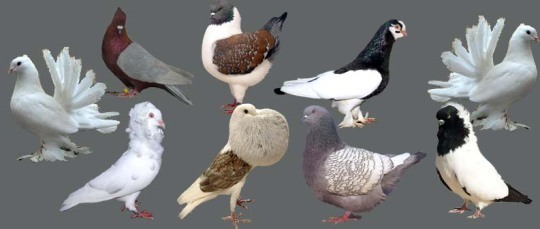
Look, in one small picture you’ve got a red color morph in the center, several melanistic dark morphs, a few solid black birds, a few variations on the wildtype wing pattern, a PIEBALD, a piebald copper color morph…
Like, there are LAYERS UPON LAYERS of pigeon diversity in most flocks you see. Pure white ones with black wingtips. Solid brown ones with pink iridescent patches. Pale pinkish pigeons.
WHY IS THAT? When other wild animals consider “being slightly fluffier than my brother” to be dangerously distinctive in most circumstances?
BECAUSE CITY PIGEONS AREN’T TRULY WILD.
MANY OF THEM (POSSIBLY MOST OR ALL) ARE FERAL MIXES.
THEY WERE ONCE BELOVED PETS, SPECIAL MESSENGERS, EXQUISITE SHOW-WINNERS, AND PRIZED LIVESTOCK.
THEIR PRETTY COLORS WERE DELIBERATELY INTRODUCED BY HUMANS.
AND NOW THEIR HUMANS DON’T LOVE THEM ANY MORE.
See, pigeon fanciers bred (and still breed!) a huge array of pigeons. And the resulting swarms of released/discarded/escaped/phased out “fancy” pigeons stayed around humans. What else were they going to do? They interbred with wildtype pigeons.
Lots of the pigeons you see in public are feral. They’re not wild animals. They’re citizen animals. They’re genetically engineered. And now that’s what “city” pigeons are.
These “wild” horses are all different colors because they’re actually feral. Mustangs in the American West are the descendants of imported European horses – they’re an invasive domestic species that colonized an ecological niche, but they are domestic animals. Their distinctive patterns were deliberately bred by humans. A few generations of running around on the prairie isn’t going to erase that and turn them back into wildtypes. If you catch an adult mustang and train it for a short period, you can ride it and have it do tricks and make it love you. It’s a domestic animal. You can’t really do that with an adult zebra.
No matter how many generations these dogs stay on the street and interbreed with one another, they won’t turn back into wolves. They can’t. They’re deliberately genetically engineered. If you catch one (even after generations of rough living, even as an adult) you can make it stare at your face, care about your body language, and love you.
City pigeons? Well, you don’t have to like them, but they’re in the same boat. They’re tamed animals, bred on purpose, living in a human community. Their very bodies are marked with their former ownership and allegiance; they cannot really return to what they once were; if you caught one, you could make it love you (in a limited pigeon-y way.) They have gone to “the wild,” but not very far from us, and they’d be happy to come back.
So next time you see a flock of city pigeons, spare a moment to note their diversity. The wing patterns. The pied, mottled and brindled. The color types.
All of it was once meant to please you.
I am now on Team Pigeon. Thank you.
Aww, the pigeon discourse has come home to my dash again! Like a homing pigeon.
The weirder the shape gets, generally the less structurally sound the bird will be.
The weird shaped birds that I think may be sound are not breeds I’ve laid hands on, so I can’t guarantee the assessment.
After having taken some time to think about this, I did come up with a few weird looking breeds that I have laid hands on and seen.
The German Beauty Homer
Their faces are weird AF, but peeps can easily reach into their parents’ crops to eat and their big noses and small wattles are really easy to breathe through.
Not my thing, but sound.
Voorburg Shield Croppers, on the other hand, very much ARE a thing of mine!
When not inflated, their crop folds neatly against their long neck, just like any other pigeon not cooing.
The Voorburg Shield Cropper is a long bodied breed, and the only one I know of given points for friendliness with people in shows.
Behold, the American Fantasy!
A gorgeous cross between the Jacobin and the Indian Fantail
Beautiful, well balanced, and comes with built in hatch control. XD
Now, if you like intersting head shapes, the Falencian Figurita is required to have a trapezoidal head.
And the Portuguese Tumbler’s head is required to be shaped like a box with rounded corners.
Elvis will be our illustration of feather development.
Peeps hatch covered in chick down, which is actually going to end up being the tip of each of their juvenile feathers.
You see the first hints of feathers at coming in at 6 days. Look really closely at his nubby little wing tips.
Pins are highly vascularized tissue wrapped in a protein sheath.
Here he is at day later at 1 week old, and you can more clearly see the yellow down tipping each shaft.
At 10 days, the barbs at the tips of the feather have formed fully. The blood vessels shrink away, and the sheath at the tip of the shaft starts to dry up in preparation to flake off.
One day later (11 days), you can already see the tips of the feathers revealed as the dead portion of the protein sheath dries up and flakes off.
A day later (12 days), you can see more feather, but the shaft is not fully frown in yet, by any means.
13 days, and the shafts are still growing in, with more of the sheath drying up to be preened off.
14 days.
15 days
16 days.
Here he is at 3 weeks and those same feathers still aren’t all the way in yet, but you can still see some of the down on his wing shield.
It starts getting brittle about now, and in the act of preening off the sheath, the down gets sheared off of the tips of the feathers.
Feathers are almost fully grown in at 4 weeks, and you can see he’s preened off most of the down.
There is not much difference in length between 4 and 5 week old feathers, but the down is fully preened off by now.
Fun fact: not all peeps have down! It’s dependent on breed.
Down length actually depends on the color, rather than the breed.
These most recent COF, for example:
This one will be Blue.
This one is gonna be brown. Dilute colors usually have less down.
This Ash Red from 2015 is even more downy. ^v^
I had a nasty little baldy
Thank you!
I haven’t had any of the right sort of dilutes to throw completely bald peeps.
Recessive yellow?
Yes yellow and red… so even though the babies both were mainly white the fluff all over depends on what colour they are?
Yep!
The more dilutes, the less down, generally speaking, both in pigeons and ringneck doves.
Pigeons are just naturally this dusty! It keeps their feathers healthy and water resistent. Here’s a post from @theramseyloft describing it a little bit
Oh, hey, thanks for this really great illistration, Squidge!
This is exactly what I mean when I warn people that Pigeons are DUST MONSTERS!!
I care as much about the well being of their potential families as I do for the pigeons themselves, so one of the first questions I ask potential adopters is “Do you, or does any one in your household have any respiratory issues or allergies to dust or dander?”
This is a fantastic illistration of why I need to ask that question and exactly what the offer of baths most benefits.






 Urocyon's Jaunts 2.0
You must be logged in to post a comment.