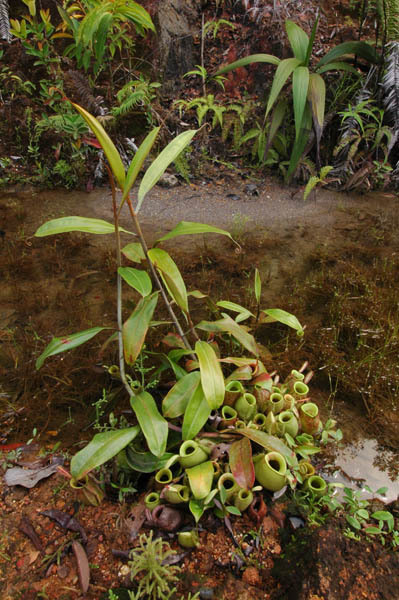
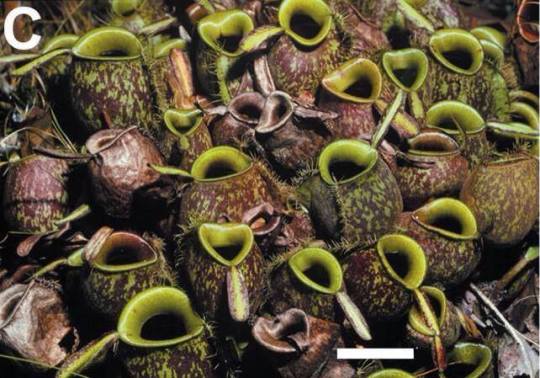
this is Nepenthes ampullaria, and they actually do this! they sit on the forest floor and eat leaf litter that falls into their pitchers, making them technically detritivores from our petty human meat-eating point of view.
Partridge berry (Mitchella repens) is a creeping, evergreen vine whose delicate, trailing stems repeatedly branch and take root in the rich humus to form a beautiful, deep-green carpet of leaves between fallen logs and snaking tree roots and along sandy stream banks. A lover of full to part shade and dry to moist, acidic soil, this earth-hugging perennial produces opposing pairs of small, rounded leaves along the lengths of its slender, somewhat woody stems; the foliage retains a rich, deep green appearance through the worst of the winter season, making it a go-to ground cover for native plant gardeners. In late spring to early summer, the vines erupt in pairs of radiant white, trumpet-shaped flowers, which despite their tiny sizes collectively form one of the loveliest wildflower shows of the Appalachian forest. Bright red berries follow the flowers in the fall and provide a valuable food source for birds throughout the winter. The berries, which persist through the following spring, are edible but with no distinctive flavor. Native American women ate the berries and made an extract from the leaves to prevent miscarriage and premature birth, which resulted in the plant’s other common – and nowadays derogatory – name, squaw vine.
This evolutionary experiment has been going on for thousands of years.
And the efforts of small-scale farmers, a recent study suggests,
generate the bulk of corn’s genetic diversity in North America. In the
face of more aggressive weather threats researchers say the finding
comes at a critical time. “This takes things a step further,” says
Daniel Piñero, a plant population geneticist at the National Autonomous
University of Mexico. “Family farmers are not only preserving the
[genetic] diversity of maize,” or corn, Piñero says—they are
contributing more of it.
In the study Mauricio Bellon, a social scientist who works for Mexico’s
National Commission for the Knowledge and Use of Biodiversity, and his
colleagues used government numbers from the 2010 rainy season—the last
year a national census was done. The team narrowed in on the
municipalities with maize yields of up to three metric tons per
hectare—in other words, where people still grow their own food and
cultivate native varieties. The researchers then estimated the area
where corn hybrids are produced at a commercial scale…
Autumn Berries, Volume 9: Northern Spicebush. Of all the berry-producing shrubs of Appalachia, few are as beautiful and desirable as northern spicebush (Lindera benzoin). A member of the laurel (Lauraceae) family, this gracefully-mounded, perennial shrub grows in the shady understory of rich, damp woods, where it reaches a height of up to twelve feet. In the spring, northern spicebush produces dense clusters of yellow flowers on its rangy stems, giving it the appearance of forsythia. The flowers are replaced by green berries in the summer, which turn a deep, rich red
in the fall. They remind me a bit of coffee beans. The berries form a striking contrast to the plant’s alternate, ovate leaves, which turn a lovely yellow-gold from September through October. Northern spicebush is so named because of the aromatic scent of of the plant’s leaves, bark, and berries. Native Americans and wild plant gatherers have long dried and boiled the leaves to make an herbal tea to cure fevers, although its flavor is powerful and warm enough to be enjoyed as a culinary tea. In addition, the berries can be crushed and used as a spice for baked goods – the flavor is similar to allspice. The plant is sometimes referred to as wild allspice for this reason. The berries linger into winter but rarely last long due to their popularity with song and game birds.
Does your flower shop do different colours of poinsetta? There’s a nursery near me that does lots of unusual colours (they’re probably just painted white ones but they’re pretty)
We only do red, pink, and cream, unless someone puts in a special order. The general experience with the odd-colored plants is that people generally think they’re cool but when it comes to purchasing them would rather have them be natural.
Wouldn’t you have to continually water them with the colored water to maintain the color?
Honestly, I don’t know the process of dying the live flowers- only the cut ones. My best assumption is that they’ve been spray painted.
My greenhouse has about a dozen speciality ones and we’re one of the only ones in the area that does it. They’re not painted or altered though there are places That add…. glitter…. eugh. And my boss does sometimes spraypaint some white ones silver or blue or gold. But there are absolutely more than just the red, white, pink and they’re lovely.
That said, most of the people who buy our plants are churches and they only usually want red, white and pink. Adding in all the fancy colors for the wholesale orders just gets very complicated fast.
Princettias are very popular among regular customers. They’re kinda compact and bright colored in pink or white.
Then there’s the classic Red Glitter which is speckled
And Mars Marble which is a cream and pink
Peppermint Ruffles which is very ruffled and pink/red
Then my favorite this year is Viking Cinnamon, which is similar but a brighter pink and nicer form
There’s also Premium Picasso which looks like sneezed blood
And Ice Punch which is another of my favorites that is just starting to get its white striping. We also have Sparkling Punch which is a pink version of this.
They all look quite nice altogether. There’s also a variety with curled bracts called Winter Rose and last year we had yellow ones called Gold Rush and Autumn Leaves and a chartruese green one called Green Envy.
And I’m only posting this many pictures because it’s marketing day and I just took a ton this morning
Considered by some to belong to the Citrus genus, while genetically different enough to grant it its own, Poncirus, by others, the bitter orange is a uniquely interesting large shrub I was ecstatic to find loaded with fruits when wondering through the gorgeous Giardini Pubblici Indro Montanelli in Milan back in October. I still have to write about it in detail on this blog, but I have a passion for raising citrus plants indoor from seed, and with five species (seven plants in total) currently growing in my living room, it’s quickly getting out of control.
This species has some peculiarities which set it well apart from your common citruses though, the most relevant being its hardiness. Native to Northern China and Korea, it is hardy to -15
°C if placed in a sunny, sheltered position on well-draining soil. Being deciduous and performing a great deal of photosynthesis in its young branches are adaptations that help make this feat possible. Interestingly, it is genetically close enough to other citruses to hybridise with them and, more commonly, to be used as a rootstock in grafting to improve cold resistance in more tender species.
The small, yellow fruit is downy like a peach and very fragrant, with a sweet floral scent similar to that of the blossom, but it’s actually extremely bitter and mostly filled with seeds. It can be used to make a marmalade and a dry seasoning powder, but is also an ingredient of Chinese medicine.
The seeds require cold stratification to germinate, so after washing them well I placed them over a layer of moist sand in a sealed container at the bottom of my fridge. I’m curious to see if I will be able to raise this species successfully in my allotment here in Scotland, and it might give me the opportunity to experiment with grafting my other citruses and test their ability to survive a Scottish winter outdoors, obviously with plenty of protection still provided.



 Urocyon's Jaunts 2.0
You must be logged in to post a comment.