Reginald Andrade is the consumer manager of disability services at
the University of Massachusetts Amherst. On September 14 he was walking
across campus to work. This scared a bystander who called the police.
Andrade says the police were waiting for him by the time he arrived at
work.
Reginald Andrade is the consumer manager of disability services at
the University of Massachusetts Amherst. On September 14 he was walking
across campus to work. This scared a bystander who called the police.
Andrade says the police were waiting for him by the time he arrived at
work.
I just got a car and started driving again so I was thinking about some safety things for D/deaf/HoH drivers. One huge concern is the possibility of being pulled over and encountering the police.
I have a magnet similar to this on my car in case of that situation
I also keep a notepad and pen in my glove box with my insurance card and registration. I keep everything is in one place so I won’t have to reach around and look like i’m searching for “something”
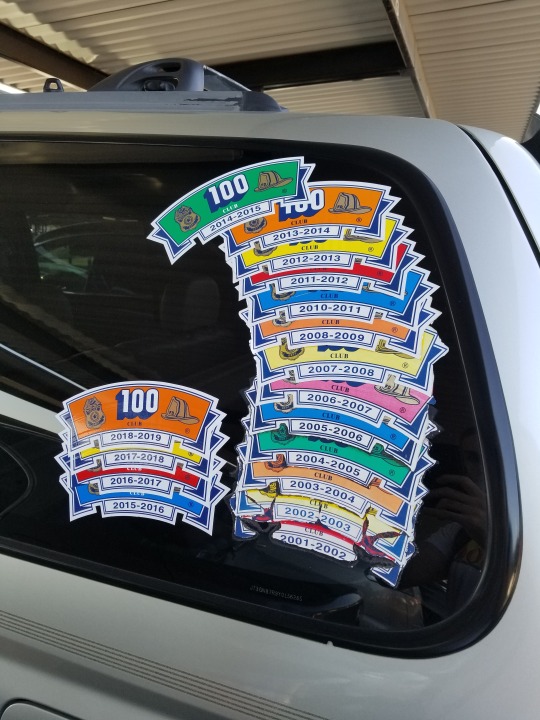
in Houston we have something called the 100 Club where if you donate 100 dollars to the police in a year you get a special, very visible sticker you can put on your back window that obviously in no way influences the way cops treat you and i just now learned that isnt a universal thing
how often do you think this guy gets pulled over for speeding
Originally from Houston. Can confirm this is a thing. Can confirm that most Houstonians probably don’t realize this isn’t universal or obvious extortion.
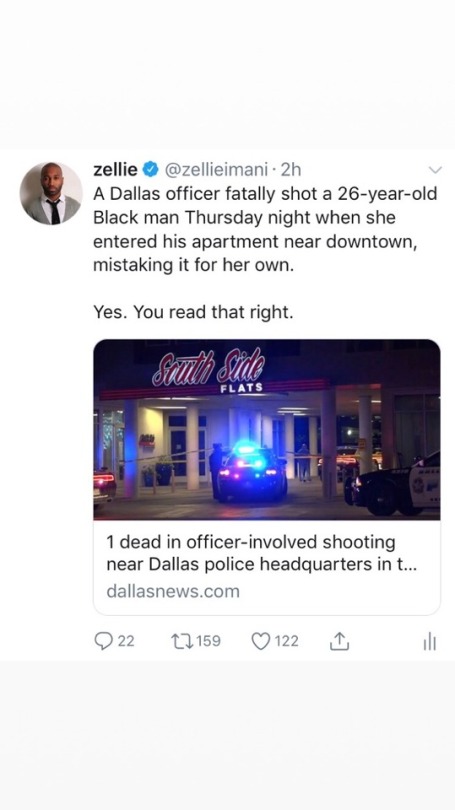
The fact that people heard her saying “open up”……. like you don’t use your brain & wonder why your key doesn’t work?
The message from his sister absolutely breaks my heart 😰
so wrong apartment. wrong door. wrong key. unfamiliar man and surroundings. but somehow knew she was still a cop. somehow still knew how to take a life in an instant. after insensibly saying “open up” which no one does at their own apartment… that bitch trash and needs to die.
Update. Im from Dallas & She USE TO DATE this man. Idk why they are not putting that in the News
Didn’t see any updates suggesting that she had been arrested yet, but they were reasonably quick to talk about charges. The whole thing sounds weird as hell.
Ferguson is not the only town in America where this will hold true. Let people dig a little deeper across the USA, and you’ll find more towns doing the exact same thing.
In the city of Ferguson, nearly everyone is a wanted criminal.
That may seem like hyperbole, but it is a literal fact. In Ferguson — a city with a population of 21,000 — 16,000 people have outstanding arrest warrants, meaning that they are currently actively wanted by the police.
That statistic should be truly shocking. Yet in the wake of the Department of Justice’s withering report
on the city’s policing practices, it has gone almost entirely
unmentioned. News reports and analysis have focused on the racism discovered in departmental emails, and the gangsterish financial “shakedown” methods
deployed against African Americans. In doing so, they have missed the
full picture of Ferguson’s operation, which reveals a totalizing police
regime beyond any of Kafka’s ghastliest nightmares.
The Department of Justice’s 102-page report is a rich source of
damning facts about the Ferguson criminal justice system. But tucked
halfway in and passed over quickly is a truly revelatory set of figures:
the arrest warrant data for the Ferguson Municipal Court.
It turns out that nearly everyone in the city is wanted for
something. Even internal police department communications found the
number of arrest warrants to be “staggering”. By December of 2014, “over
16,000 people had outstanding arrest warrants that had been issued by
the court.” The report makes clear that this refers to individual
people, rather than cases, so people with many cases are not being
counted multiple times. (Though clearly some of these cannot be Ferguson
residents, since the number represents more than the entire adult
population and Ferguson policing applies to visitors as well.) However,
if we do look at the number of cases, the portrait is even starker. In
2013, 32,975 offenses had associated warrants, so that there were 1.5 offenses for every city resident.
That means that the city of Ferguson quite literally has more crimes than people.
To give some context as to how truly extreme this is, a comparison
may be useful. In 2014, the Boston Municipal Court System, for a city of
645,000 people, issued about 2,300 criminal warrants. The Ferguson Municipal Court issued 9,000, for a population 1/30th the size of Boston’s.
This complete penetration of policing into everyday life establishes a
world of unceasing terror and violence. When everyone is a criminal by
default, police are handed an extraordinary amount of discretionary
power. “Discretion” may sound like an innocuous or even positive policy,
but its effect is to make every single person’s freedom dependent on
the mercy of individual officers. There are no more laws, there are only
police. The “rule of law,” by which people are supposed to be treated
equally according to a consistent set of principles, becomes the “rule
of personal whim.”
And this is precisely what occurs in Ferguson. As others have noted,
the Ferguson courts appear to work as an orchestrated racket to extract
money from the poor. The thousands upon thousands of warrants that are
issued, according to the DOJ, are “not to protect public safety but
rather to facilitate fine collection.” Residents are routinely charged
with minor administrative infractions. Most of the arrest warrants stem
from traffic violations, but nearly every conceivable human behavior is
criminalized. An offense can be found anywhere, including citations for
“Manner of Walking in Roadway,” “High Grass and Weeds,” and 14 kinds of
parking violation. The dystopian absurdity reaches its apotheosis in the
deliciously Orwellian transgression “failure to obey.” (Obey what?
Simply to obey.) In fact, even if one does obey to the letter, solutions
can be found. After Henry Davis was brutally beaten by four Ferguson officers, he found himself charged with “destruction of official property” for bleeding on their uniforms.
None of this is even to mention the blinding levels of racism, which
remain the central fact of police interactions in Ferguson and
nationwide. The overwhelming force of this violent and exploitative
policing system is directed at the African American population. In 2013, 92 percent of Ferguson’s arrest warrants were issued against African Americans, and black Fergusonians were 68 percent less likely
than others to have their court cases dismissed. The racism is so
blatant and comprehensive that the DOJ concluded that “Ferguson law
enforcement practices are directly shaped and perpetuated by racial
bias.” Considering the qualified and colorless language typically
deployed in government documents, this is an astonishingly forceful
statement.
Ferguson’s racism has been central to the media coverage of the
release of the DOJ report. But in a certain way, by focusing entirely on
disparate racial impacts without examining the sheer scale of the
brutal state juggernaut, one misses crucial facts. MSNBC listed as the
DOJ’s number one
“most shocking” finding the fact that “at least one municipal employee
thought electing a black president was laughable.” But the existence of
racist views in the department is not the most shocking fact, not by a
country mile. Rather, endemic racism in policing comes standard.
However, that racism occurs in the wider context of an ever-enlarging
interlocking system of administrative bureaucracy and police violence.
The other pitfall in analyzing the Ferguson report is to see it as
being about Ferguson. There are 19,492 municipal governments in America,
and the chances that Ferguson happens to be the worst are extremely
slim. In fact, there is strong evidence that in the world of better funded, more militarized, more technologically advanced
police departments, Ferguson is simply a high-profile case study. While
the Ferguson nightmare may dwarf the problems in cities like Boston,
American policing is so out-of-control that Ferguson-style practices can
occur on at least some level in almost every department.
It’s hard to believe, but the Ferguson police department’s massive
deliberate racism only represents one of its problems. The DOJ report
shows not just a racist criminal justice system, but one in which the
very act of being alive has been made a crime, and in which nearly
everybody is wanted by the law at every moment of every day.
CORRECTION: This post has been updated after
publication to clarify that all outstanding warrants in Ferguson may not
apply to Ferguson residents.





 Urocyon's Jaunts 2.0
You must be logged in to post a comment.