In addition to a bunch of other shit, folks with Cerebral Palsy don’t process sudden stimuli correctly. We’re “jumpy”, for lack of a better term. When we’re startled, our heart rate jumps, our (super spastic) muscles contract and, frankly, it fucking hurts. It’s a lot like getting briefly shocked with electricity.
So if you know someone in a wheelchair who startles easily, do all that you possibly can to avoid starting them. Above all, don’t intentionally cause a reaction because then you’re just being a fucking asshole.
To avoid accidentally startling someone with CP:
Approach from the front, not the back or the side
No touching. if you need to get their attention, do it from the front.
If you do accidentally startle them, just move one. Don’t make a thing of it.
CP Folk: anything you wanna add?
I don’t have CP, but due to autism and a messed up autonomic nervous system, I have a hell of a startle reflex, and yes, it hurts. And leaves me feeling crappy for ages afterwards while my body calms down from the massive unecessary adrenaline dump. It’s not funny to startle people. Plus, frankly, you might get hit when I reflexively flail and lash out, and neither of us wants that.
Expanding on the doorbell situation, even though it’s more embarrassing than it probably should be.
The previous old wired one that was here when Mr. C bought the place over 15 years ago was terrible enough for me that it was too easy to put off replacing it, even being fully aware that they don’t have to be that aggressively startling. Made me jump out of my skin every time it went off. (And of course I put off just saying fuck this and getting a new one then, because it still worked…)
Besides being super loud and at a nasty frequency for pain in my bad ear, it gave a “ding-DING! ding-DING! DING-DING!” for every button push, and of course people kept mashing the button. 😱
Then it failed by going off crazily and near-constantly for hours while I was here alone, and before long I was too busy having meltdowns and literally hiding behind the couch to be able to get it stopped.
To make that even better? It did that right after some smarmy home repairs probably-scam salesman had been by twice, and I finally got pretty rude at him because he needed it. So, I thought it was some kind of wacked out harassment thing–and that messed with stalker PTSD on top the sheer sensory hell. I also didn’t want to get close enough to the door to try and stop the thing if that was going on, while I was still in a state of mind to even try. (Not because I was afraid of the guy, but because I didn’t trust myself not to land myself in jail and probably get deported by that point.)
The look on Mr. C’s face after he got home and dismantled the thing, and I finally came out of my bunker 😨 Not one trace of anger or disgust, though. If it had been my mother, I might well have gotten locked up, definitely threatened with it. That happened over less spectacular episodes when I was younger, for more PTSD fun. Which kinda took a lot of the relief out of somebody coming home and shutting the thing up, I tell you what. But, he was just horrified in a sympathetic way. Wouldn’t have rationally expected different by then, but not much rational was going on that afternoon.
Not in any hurry to install another bell after that, no. We went a few years without one, tbqh.
But, stressing about hearing the door finally outweighed trying another doorbell. And hopefully this new model will not freak me out every time it goes off. With adjustable volume and a choice of sounds. Worst case, just unplugging the receiver will make it shut up.
Why does trauma (especially long term) cause
anxiety and paranoia that seem completely illogical? a theory
A lot of us have
experienced severe anxiety in paranoia in seemingly normal circumstances,
simply by being around strangers or in public places, when we’re required to
socialize, when we’re trying to do a task or strive towards something we want
to achieve. We consciously know these circumstances are most likely not
harmful, and our fear seems illogical or greatly exaggerated. When the
circumstances are somehow connected or similar to our trauma, then it’s
explained, but sometimes it can go so far that 90% of activities are impossible
to do, there are places we cannot go, there are experiences we can no longer
have, to the point where it’s alienating, isolating, and sabotaging our life.
So why does this
happen, how does trauma affect us to cause all this?
1. Brain learns from experiences.
Your own, personal
experiences, not other people’s, and it will take your experiences into account
way above what other people say or what is considered normal. If trauma has
happened in certain circumstances to you directly, it no longer matters that
other people consider it safe or feel there is very feeble possibility of
getting hurt, for you these odds have been turned into 100% danger and threat,
and that is a very strong learning experience. Your brain has learned in very
painful way both that you can be severely damaged in certain circumstances, and
that what people have said about it not being dangerous, isn’t true anymore.
2. Traumatic experiences which are not fully
remembered, nor fully processed, not fully analyzed, understood, put into
perspective, and have leftover feelings to be expressed from, cannot be fully
learned from.
So, your brain doesn’t have a full, clean,
clear and conscious record of an experience, but what it does have is a record
of danger, terror, threat to survival, pain, possibility of death, connected to
partial memories, partial circumstances, vague situations. Brain’s job is to
keep you alive, and from this memory, your brain has detected threat to
survival, but can’t really process it or decide in which situation this threat
applies, and in which it doesn’t, so what does brain do in the meantime, while
it processes and analyzes the situation correctly? Mark every single thing that
connects in any way to the trauma, as deadly. And this is the right thing to
do, only way to survive, becuase your brain is not wrong. Some of the circumstances and situations you avoid could
potentially be deadly, maybe it’s 2% of what you’re scared of, but in current
state you cannot safely analyze which out of those are truly dangerous, so your
brain makes sure you avoid them all. Your brain will not take into account what
is socially acceptable, what others consider safe, what should be logically
safe, because that no longer matters once you’ve ended up in life danger
believing in those social pointers. All of that no longer matters, your brain
is developing your own system of recognizing danger, and it’s safest to assume
everything is danger until you acquire more precise information.
This is why processing trauma and getting a
clearer picture of what happened helps more than exposing yourself to
environments that feel dangerous. You can go and force your brain to learn from
new experiences and to check by exposing yourself to danger to see if you die
or not (which is torture), or, you can gather more information, avoid the
triggers and dangerous places until you know for sure what happened to you and
what allowed it and how in the future to prevent it, wait until your memories
are more full and connected and some of the perceived threats will clear up,
also for the sake of putting the danger into perspective, you’ll need statistic
of actual amount of people who got hurt in these environments, and under what
circumstances, your brain needs references to put your trauma into perspective,
and it is comforting to know that you’re not the only one. Take the time to
gain some recovery from your own situation until you are sure that if the same
thing repeated, you would be able to recover from it, and wouldn’t die. And
then, you can decide if it’s worth exposing yourself to these environments
again. Sometimes, it is not. Recovery doesn’t have to mean you can again go all
places without feeling fear. It can mean you now know where the danger is, and
you know better than to expose yourself to it.
*when I say “life danger” it doesn’t
only apply to situations where you could be killed or injured by another
person, it applies to situation where you could go thru such painful experience
you end up wishing you were dead and thus in danger of commiting suicide, it’s
a psychological death danger and a very real threat.
3. Your
instincs are not as wrong or illogical as society perceives them.
You’ll notice that when you’re in a more
vulnerable, distressed, triggered or otherwise sensitive state, the amount of
anxiety and paranoia will increase. This is not you just being even more
illogical, these instincts are in the right place. Current society isn’t
adapted to care about not harming people who are vulnerable and sensitive, and
will not treat an individual with compassion and care when they appear distressed or in need of understanding and safety, it is likely that people will trigger
and hurt you, invalidate your struggles and make you feel much worse than you
initially felt, among with impressing their social opinion that all of your
instincts and fears are wrong. That is the last thing you need when you’re
already feeling awful. So, if you have the urge to spend a week (or month, or
year) inside of your room, not speaking to anyone, that most likely is what
would be the safest course of action for you, and would enable you to process
your experience without someone inflicting their own opinion or judgment on
you.
If your instincts get alarmed whenever you’re
faced with a person of authority, because you’ve suffered abuse from people who
have power over you? You are exactly right, people with power and authority
have proven to be harmful in endless occassions, it would take further research
to see in which circumstances they cannot allow themselves to be harmful, and
until you know for sure, all of them are going to be scary.
If you’ve been living in long term abusive
environment your brain has been wired to survival mode and has learned to
perceive the world as a dangerous place in order to keep you alive, it would be
insane to expect you to re-wire it, without getting reliable information of new
sets of dangers, and, there are always new sets of dangers.
I feel the bigger problem than people feeling
anxiety, paranoia and danger in certain circumstances, is that society insists
they should stop feeling that way, or that their fears are illogical. This
seems to stem from the conviction that it would be bad for people to
acknowledge the existence of danger and potential threat, because it isn’t very
comfortable to know that there are dangers even in most common places. It is
upsetting that the safety of traumatized individuals is being dismissed, and
instead, requirement for them to act socially acceptable, for their feelings to
be convenient, easy to handle and in order with social norms, is being forced
on them. If there was truly no danger,
nobody would be getting hurt or traumatized. We are the proof that the danger
exists.
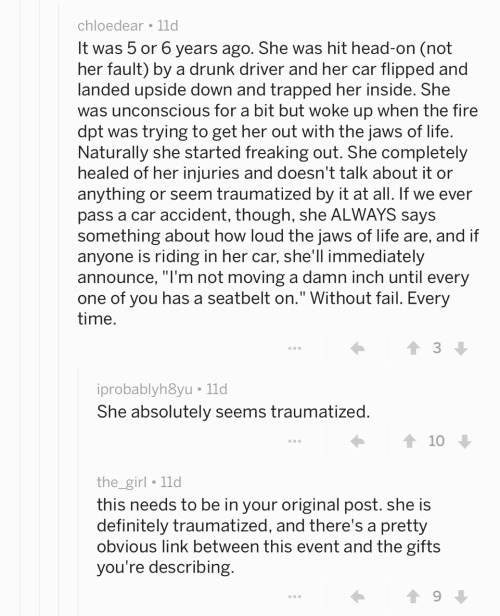
Just so people know, I looked at the source and the sister was in a very bad car accident and these gifts are likely her way of dealing with her trauma.
honestly…. the fact that they didn’t include this in the original post fucking sucks.
but also… i know these gifts may seem “creepy,” but they’re all really practical (well, aside from the book) and show that she clearly cares about the safety of her loved ones.
This makes me wonder how people view trauma. You see a lot assholes online of shitting on “sjws” for being triggered and not having ~real~ PTSD, but things like this make me wonder if people simply have no idea how to recognize PTSD when it’s not people freaking out over a loud noise.
I would love all of these gifts, and I think that’s also due to my PTSD making me very safety and survival conscious. I wrote my family an emergency first aid booklet for just in case, including how to spot a medical emergency in young children (my nieces are both under 5), and medical details for each family member with medical history and medications of each person on in case anyone needs an ambulance, and emergency contact details for everyone. It makes me feel much better because I can’t always be there if something goes wrong.
Being too white and too black at the same damn time
Being generally socially inept because I was homeschooled until 6th grade…
Being an antisocial bookworm who couldn’t pick up on social cues and interrupted conversations with total strangers.
Being socially innept because I was homeschooled until 8th grade and also having wild, unmanageable hair.
Being too dang pale and also very fat. (I’m not fat no more)
Bein’ a massive weeb and WAY too excitable.
Also it’s gonna make me sound like your typical “they’re just jealous” brat, but I was also bullied for holding some of the highest grades in the class.
For not fitting in because I had different interests, I liked reading, and I was friends with the teachers.
Being too poor to afford anything but ratty jeans and tshirts, and I ate weird crappy lunches. Sometimes I hid in the locker room because I had no food. Being a geek girl in the 80s; they made fun of me for reading a lot and liking Star Wars and comics. Mocked by teachers and students for trying to get a girl’s soccer team started at school. I practiced with the boy’s team but wasn’t allowed to compete in matches.
(I love 80s pop culture and nostalgia, but it really wasn’t the nicest time to grow up. People were cruel about dumb stuff. Cheerleaders and jocks really were considered supercool and they really were not very nice).
Mostly reblogging because my experience of growing up in the ‘80s really sucked too, in some similar ways.
The real answer there was being stuck in a school system with a super-toxic social environment. (Confirmed by pretty much all of it stopping when I was old enough to drive myself and transferred to a neighboring county out for self-preservation. I kept waiting for the torture to start up again, but it never did.)
But, I was nerdy and, gee surprise, autistic with some LDs that got ignored because I was “smart”–and also inexplicably stupid in specialized ways. I apparently stayed at 99% percentile on height and weight, until HS when more kids started catching up. My family was working poor and not White enough. Put a lot of effort into dressing “right” for a while and developed an ED, but that didn’t even slow any of the appearance-as-an-excuse stuff down. Shifting goalposts all over the place, with literally no way to win. Later on I was too punk, and at least that was actually fun. I also ended up in the psych system in middle school (gee wonder why), so that was of course low-hanging fruit after that.
From the feedback, I just didn’t girl right in general, and was a uniquely repulsive human being. Some of that harassment (starting in elementary school) made it harder to come to terms with the fact that I am actually very queer and don’t have the same relationship with gender that a lot of people seem to.
Basically, I’m so sorry and also angry again looking over this post, with all the reminders of the sheer number and variety of excuses people will concoct to justify treating children like shit. With other kids taking their cues from the adults around them. Nobody deserves to get treated like that. No matter how fucking weird they may or may not be in reality. Much less literal children.
if you see someone active on social media or something, and you message them, and they don’t reply, they don’t have to. just because they are awake and alive does not mean they have to engage with you whenever you want them to. you are not entitled to someone else’s time.
in the past, an abuser would see me post online and then hound me on aim until i answered. i felt like i had to hide. they also lived in my building and would pound on my door if they saw me online and i wasn’t responding to them. i had to completely ditch a screenname, lie about having skype, and turn off my phone to hide. if i saw they were online i couldn’t post on facebook or interact with anyone without them demanding to interact with me. the only legitimate excuse not to talk to them was being asleep. in their eyes, if i were really their friend, i would always want to engage no matter what, even if i had a migraine or work to do or wasn’t feeling very social. it didn’t matter.
please do not do this. if someone doesn’t write you back, don’t guilt them about where they are or what they’re doing. if you see someone posting on tumblr or facebook and they aren’t signed into aim or google or skype or whatever, that’s their business. if they are signed on but don’t write you back, it’s okay. sometimes people can’t talk to everyone all the time every time. some people can only talk to one person at a time without getting overloaded. some people are signed on in case someone needs to contact them with something important and not to be social. they’re not always hiding from you, and you shouldn’t make them feel like they HAVE to hide from you.
this is probably jumbled and i’m probably missing a lot here, but pressuring people to always be available to you every hour of the day and always answer the phone or text or chat or pm or whatever…if you require that of someone, you might need to take a step back.
Reminder: There are also actual reasons that some of us may have serious trouble responding to messages at all. And it’s unlikely to be about you unless you are acting like that.
I really don’t want to come across as some kind of antisocial asshole, but notifications popping up still freak me out every time. It goes way beyond “I don’t like IMs”. Seeing that it’s from someone I would want to talk to if I weren’t having a PTSD reaction doesn’t actually make it easier to respond, unfortunately.
No worries for anyone who hasn’t been aware of the problem. I’m still not entirely comfortable talking about it. And I feel bad about just leaving people hanging.
(To add to the OP’s excellent points.)
Over time, I internalized others’ beliefs about me – that “there was nothing wrong with me”, that I only needed to try harder, that if I really wanted to do things differently I could. In order to deal with each of these premises, I had to develop an interpretation of them, to translate them into something I could (at least partly) understand, and then turn into my beliefs about myself.
So “there is nothing wrong with me” became this: “Don’t ask for help, because I’m not supposed to need any. Besides, if anyone looked really closely and still didn’t find anything wrong, all of this really would be my fault. It’s better just to have a small hope than to risk actually finding out.”
And “all I need to do is to try harder” became “The other people around me are succeeding while I am not, and it must be as hard for them as it is for me. So I am never to complain about difficulty or physical discomfort. If anything is physically at all possible to bear, it should be borne in silence.”
Finally, “if I really wanted to change, I could” evolved into “I am deliberately resisting having my life, and the lives of those around me, be any better. I don’t know why this is. But everyone feels this way, and they can’t be wrong because look who they are and how many of them are saying it.” In other words, I was deliberately making the people around me upset and angry.
Trying to function under these self-imposed guidelines was difficult. It was like trying to build a house on swampy ground which could not support any weight despite looking all right at first glance, or like trying to ice skate on a pond which in many spots was barely frozen over. In each of these cases, the surface impression does not at all reflect what lies beneath, or the fragility of what is seen. And those around me built their houses, or skated on their ponds, and could not understand why I was having so much trouble. And neither could I. My self-esteem was very low, and more than anything else, I was ashamed of my self. Of my being. Of my entire life.
I was reminded of this one again, with the other piece I just reblogged a quote from.
And the other bit from the same piece I had to add on:
You are avoiding the subject, the therapists say, over and over, you only want to talk about dogs and not your real issues. Why do you have such a problem with authority? Why are you so rude on purpose? Why do you like making people mad? Your whole family is in a shambles and it is all your fault.
(Plus the “We were drugged. Oh, we were drugged to the heavens…” Ouch.)
“[L]ook who they are and how many of them are saying it”, indeed. 😐
Of course my thoughts went back around to some of the observations on misdiagnosis and self-diagnosis.
Whatever else may be happening in my life these days? At least I’m not regularly getting a bunch of harmful assumptions like that pushed at me anymore. And I am at least somewhat able to see that most of those assumptions were terrible, no matter how many people would rather believe what’s going on would be “fixable” if the person were only pushed to try harder. That is a definite good.
Even if, you know, too many other people wouldn’t see it that way. That’s an easier story for them. And they’re often the ones in positions to do real harm.
It just gets overwhelming sometimes. Especially with how many people do wind up on the sharp end of assumptions like that–and don’t always have the same chances to get enough distance to figure out that nobody deserves that. Much less that, no, the assumptions aren’t necessarily right, no matter who all they’re coming from.
PTSD is your brain trying to make sure you DON’T DIE.
Humans are really good at adapting so that we don’t die. That’s kind of our whole *THING*. We adapt.
If something BAD and SCARY and DANGEROUS happens, your brain tries to teach you to react better next time. If the Bad Scary Dangerous thing happens a lot, that’s reinforcing it. With CPTSD, the Bad Scary Dangerous thing happened often enough and frequently enough that your whole psyche developed around it.
You learn to notice the tiny things that signal the Bad Scary Dangerous Thing might happen – even if you don’t consciously know that you know that – so that you are braced to react and defend yourself. They become triggers so that you are primed to respond.
Hypervigilance? Better to panic unnecessarily than to get dead because you didn’t recognize a threat in time, right? It’s uncomfortable and a waste of energy but you’re not dead.
Nightmares about the Bad Thing? Dreams are PRACTICE. You are trying to learn how to react better or faster or more effectively next time.
Avoidance? Dissociating is better than just completely breaking and shutting down entirely.
The thing is, even if you are not in that situation anymore, your brain did not get the memo. It is trying! But it takes a lot of work to convince it that “No really, it is safe now!”
I guess what I’m saying is cut yourself some slack. You are doing your best and you’re not dead. ❤
Reminded again with my tag commentary there of something I’ve been having to think about lately.
I might not be nearly as grouchy about some things by now, if I hadn’t spent over a decade living somewhere that the demographics skew heavily toward one group of people who want to give me problems. With multiple excuses to choose from.
And no, I am really not imagining that. Nor that the atmosphere has gotten more hostile over the past 5 years or so. To the point that my health has been suffering–sometimes very directly, and not just on the really blatant level of Dr. Lazy Pennypinching Racist before. It’s not at all good for my mental health either, on an ongoing basis. And I am still almost hesitant to admit that, thanks to some earlier abuse.
Too often it just feels like being stuck in middle school in a really toxic system 24/7 now, and I really do not have the spoons to get out and deal with it much. It’s just not a good situation.
And there doesn’t seem to be that much I can reasonably do about it right now. Besides remind myself that this is not just me being some kind of terrible person to keep running into shitty behavior. When I have pretty consistently tried to treat other people with some basic respect. It’s really not all on me. And I’m not necessarily in the wrong for letting it get to me after a while. Where have I heard that before? Hmm.
I mean, I recognized something was off when we were in Stockholm and I found myself that impressed at not getting shoved or yelled at on the street even once in the space of almost a week. That should be a normal amount of shoving and yelling (and rude fucking stares from strangers) to encounter out in public. But it impressed me at the time, because it wasn’t my normal day to day expectation–and things have gotten worse since.
Reminded again of Dave Hingsburger’s Enough In Atlanta. I may not have spent much time in Atlanta specifically, but yeah that’s a lot closer to my previous base expectations of (bare minimum) acceptable public behavior.
Maybe when we turned our backs or left the store, or crossed the street, they said or did something unkind. I hope not, but if that did I’m thankful they waited until I was gone. I’m thankful that they recognized that what they were going to say or do would be hurtful and decided to wait on being mean until I was well away.
“Don’t actively cause strangers out in public problems–no seriously wtf is wrong with you?!” is really not too much to expect.
The person engaging in microaggressions was unable to stop themselves from attacking and holding themselves in a civil manner even for that period of time. It was urgent and imperative they remind you of their status and yours.
Think about that – they are so fully committed to dehumanizing you, that short period of time, or situation (“We are strangers walking down the street- the default assumption is to LEAVE ME ALONE”) was too much of a burden for them to stop themselves from having to spew shit to remind you of who they are and who they think you are.
Yeah, that’s just not normal behavior, no matter how socially acceptable it seems to be in some settings. Kind of worrying when you realize that you are now expecting to encounter some display(s) of hostility whenever you go out in public.
I really would like to somehow get myself enough healthier so I could reasonably GTFO and hopefully into a less hostile situation. (And not, you know, just roll over and die. Wish that were just hyperbole.) That’s the tricky part right now, of course. And I have been getting more than a little bummed about it lately. But, trying to figure out some kind of feasible strategies here.
Reminded of this one from earlier this year, after a couple of reblogs with commentary touching on abusive behavior, microaggressions, and invalidation. (Plus my tag commentary on one of them.)
Apparently I needed another reminder that objecting to dealing with this kind of behavior is totally reasonable, and it’s not something anyone should just be expected to put up with without complaint.
But, also? If I were just being paranoid about it and imagining all these unpleasant interactions, and looking for microaggressions where none exist? If–as in one example I ran across looking for this post, which really reminded me way too much of middle school–that flying cigarette butt had hit me by accident and those guys were really laughing at something totally unconnected?
You’d think that in that case, I would have just kept imagining hostility on that trip to Stockholm. (Or when I’ve been back home and people were just letting me go about my business like a normal human being, for that matter. Or…) But, I went a whole week without anybody yelling unintelligible stuff out of a car at me, or shooting filthy looks/snickering at me just for walking down the street, or anything else of that nature. It didn’t happen.
If I were really that “oversensitive” and looking for innocuous stuff to complain about, you’d think I’d find plenty wherever I go and in pretty much every situation. That really has not been the case. Ever.
I mean, this is another of those things that existing PTSD and the history of dismissal a lot of us are working from can actively make worse. It can be way too easy to quadruple guess your own perceptions, and not feel like you have much/any room to complain even if you do know deep down that this stuff is just not right and you don’t deserve it.
And there are unfortunately more than a few grown adults around who are counting on these dynamics, yeah Tying back in with the commentary that got me thinking, and also very much relevant to a lot of lateral aggression.


 Tying back in with the commentary that got me thinking, and also very much relevant to a lot of lateral aggression.
 Urocyon's Jaunts 2.0
You must be logged in to post a comment.