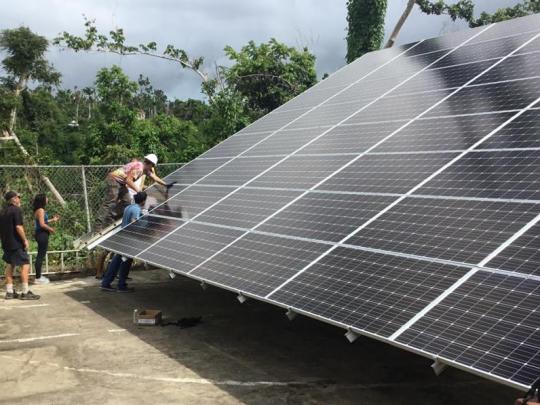
After being hammered by hurricane Maria, the residents of the rural
Puerto Rican mountain town of Mariana got tired of waiting for the
bumbling, privatized, cash-starved power authority to reconnect them to
the grid, so the anarchist organizer Christine Nieves founded Proyecto
de Apoyo Mutuo, one of a dozen-odd cooperatives across the island to
create their own solar grid; by the time the The Puerto Rico Electric
Power Authority finally put in appearance, Mariana had had power for two
whole months.
After Maria, Puerto Rico suffered the second-longest blackout in world
history, ignored by both the federal government and the gutted, heavily
privatized local government. So community organizers like Nieves took
matters into their own hands.
Nieves’s group formed an alliance with the Katrina-inspired Mutual Aid
Disaster Relief, which fundraised to send gear to Puerto Rico.
The island-wide efforts are rare bright spots in a year-long crisis with
no end in sight. Naturally, they’ve faced police harassment and raids
looking for “antifa.”
At least a thousand pallets of water bottles, meant for Hurricane Maria survivors, were left to rot under the Puerto Rican sun.
That is what Angelo Cruz Ramos, the mayor of Ceiba, told ABC News about
what happened to thousands and thousands of water bottles that are
sitting on the tarmac at the former naval base, Roosevelt Roads.
Cruz Ramos did not know the water was there and only found out when the
images, posted to Facebook on Sept. 11, went viral, he said. The area is
a restricted zone, so he is not been able to approach it.
Because the bottled water has been under the sun for months, all the
water is contaminated and is not suitable for consumption, Cruz Ramos
said.
The Federal Emergency Management Agency confirmed to ABC News that the
water was purchased by the federal agency and was determined to be a
part of a surplus of supplies in April. The excess supply was
transferred to the island’s General Services Administration, FEMA said.
Puerto Rico’s
General Services Administration said back in May that the agency
received around 20,000 pallets of water through a federal government
program to distribute excess supplies, the agency said in a statement to
ABC News. After delivering more than 700 pallets, they received
complaints about the smell and taste of the water from a municipality,
the GSA said.
The GSA are working with FEMA and the island’s department of health to
perform water tests on what they got from the federal government, the
GSA said. They added that they will be returning the water to the
federal government.
Ramos is not sure who is at fault. Because there were supply planes
arriving at airport in Ceiba hundreds of times after the storm – off
loading food and water, he wouldn’t know when this water actually
arrived on that tarmac, he said.
“The government of Puerto Rico did not receive the water to distribute
during the emergency, it was under FEMA’s custody and it wasn’t until
April 2018 that the surplus inventory was available upon request,”
Hector Pesquera, Puerto Rico’s secretary of public safety, announced at a
press conference in San Juan on Wednesday.
After the Maria, Puerto Rico was so overwhelmed that morticians were told to just start burning the bodies without trying to determine whether or not their deaths were caused by the hurricane.
If this were happening in Venezuela, we would hold it up as an example of the horrors and failures of communism. But this is happening under the control of the United States, under US capitalism.
Maria may have been a force of nature, but the disaster itself was largely man-made. Hurricanes have been sweeping through Puerto Rico for thousands of years. This was a manufactured catastrophe, created by an explosive mix of politics, Wall Street corruption, poor planning and rising carbon pollution.
It would be easy to dismiss the death and destruction in Puerto Rico as a freak event, a sorry collision of politics, economics and Mother Nature. In fact, what happened in Puerto Rico was a powerful warning that preparing for life in the new normal is about a lot more than updating building codes and convening blue-ribbon commissions to study sea-level rise and extreme-rain events. The story of rebuilding Puerto Rico demonstrates that virtually no aspect of our current way of life, including our legal and financial systems, is ready for what’s coming our way.
A consequence of this decade-long financial decline was little investment in infrastructure — the roads, highways, bridges, water and sewage systems, and electric grid were all more or less abandoned. There was no money for building inspectors to make sure houses were built to code (in fact, there were only a handful of inspectors on the entire island) and no funds to stockpile medication in rural areas, much less to build, say, a new hospital for Vieques, a municipal island of 9,000 people with woefully inadequate health care. “Even before the storm, Puerto Rico was headed for a humanitarian disaster,” says López, the San Juan lawyer. “That was obvious to anyone who cared to look. When Maria came along, it blew back the curtain to expose it all.”
But as Rivera knows as well as anyone, one year after the storm, Puerto Rico remains an island lost at sea. The economy will be pumped up by billions of dollars in recovery funds over the next few years, but after that? The path to statehood is likely to be long and steep. You can spin out various possible futures for the island: In one version, disaster capitalists and bitcoin entrepreneurs arrive in their yachts and private jets, turning Puerto Rico into a crypto St. Barts; in another, post-capitalists build a paradise powered by solar microgrids, community gardens and the rebirth of local fisheries; in a third, the territory falls into a dystopian ruin, where everyone with brains and ambition has fled to the mainland, leaving behind an aging, unhealthy population in slow but inexorable decline. But one thing that’s clear is that in the age of accelerating climate change, what’s most vulnerable is not ice sheets and coral reefs. It’s our human-built world. As Puerto Rico demonstrates, one big storm can blow the whole thing down.
1.4 million people in Puerto Rico lost power yesterday in an outage that
lasted for a day and left part of the island without power even after
service was mainly restored.
A private subcontractor working for the power authority was blamed for
the outage; according to the Electric Power Authority, the contractor
drove an excavator through a critical line; the same contractor has been
blamed for a massive outage last month when they knocked a tree-limb
into a line.
The subcontractor, Dgrimm, had been hired by Cobra Energy, a private
subsidiary of Mammoth Energy working for the Power Authority.
It’s a good reminder of how neglected and vulnerable Puerto Rico’s
infrastructure is, after years of austerity and mismanagement, and also
of how easily blame can be diffused among subsidiaries, contractors, and
subcontractors.
Puerto Rico is governed by an unelected “manager” who is charged with
imposing austerity on the island in order to secure repayment for its
offshore lenders. Those plans include fully privatizing the ailing,
debt-saddled Power Authority.
“Seven months after Maria, we are back where Maria left us,” Cynthia Garcia Coll, a professor at Carlos Albizu University in San Juan, said via email…
San Juan Mayor Carmen Yulin Cruz, a frequent critic of recovery efforts since the September hurricane, worried that Puerto Rico won’t be prepared for the upcoming hurricane season.
“Today’s total power outage in Puerto Rico pinpoints the fact that we are still in a very fragile state. Moreover, the suffering of the Puerto Rican people seems to be nowhere nearing an end,” she said.



 Urocyon's Jaunts 2.0
You must be logged in to post a comment.