If you think of asexual as “not having a sex drive,” then you’d probably be surprised to learn that aces used to be a part of the bi community.
But if you think of it as “not having a sexual orientation,” then it might suddenly become clear.
Because in a world where so many people only ever think of, or mention, “gay or straight” as possible orientations, there’s not that much difference between “not having a sexual orientation” and “not being either gay or straight.”
When the question is only framed as “which of these opposite points does your arrow point to,” I don’t feel like there’s a huge difference between your answer being “point???????” or “arrow???????”
Ohhh, everything makes sense now (says the bi ace)
SWEEET
Which is I think why a lot of aces identify as bi or pan at some point in their lives before landing on “asexual.” If you know you’re not gay or straight, there’s much more awareness of bisexuality than of asexuality, so it makes sense that people would end up there by default.
Yes! And if you were coming out 20 oror more years ago, there was basically zero awareness of any other things.
this perfectly describes my late teens, most of which I spent convinced I was bisexual because I was equally attracted to men and women. Thing is, I actually wasn’t attracted to either, and I thought that that weird uncomfortable feeling I got each time something was overly sexualized was because I wasn’t used to feeling lust and/or arousal, and those new urges were making me uncomfortable, instead of just being plain uncomfortable with sexualization. I didn’t even know that asexuality was a thing until I read about it in a fanfic a year ago.
Chiming in as another aro/ace person who identified as bi for a couple years before realizing the ace spectrum existed. The poster right above me pretty much describes exactly my thought process. Basically, it went:
I’m not gay, and I’m definitely not straight, so I must be bi, because I find people of many different genders attractive (notice i say find attractive, not attracted to). I chalked my icky-squirmy feelings when thinking about sex and to a lesser extent relationships up to lack of experience as I’ve never been in a relationship or even been on a date.
But then in the past year or two I finally learned about asexuality and one night I had this huge emotional revelation when things just clicked suddenly.
So yeah, until recently, bi is where i fit best, and where i felt most accepted.
Up until now I thought “ace ppl were bi/pan?? that makes no sense????’
But reading this I remember–I thought I was bi/pan too!! When I was in high school, I thought I was romantically attracted to men nd sexually attracted to women (I knew almost nothing about gender). I didn’t know about split-attraction so I was horrified of being some kind of freak and doomed to be alone and/or unhappy, to say the least.
People get all offended and insulted and furious about how aces identified as bi/pan, but you need to understand: I only did so because I didn’t know/think asexuality was an option. I wasn’t gay, I wasn’t straight. What else could I be?
At 15, when I was just starting to use the internet to learn about sexuality I came across this: “Bisexuality is the ability to reach down someone’s pants and not care about whatever you find.” And that was, I thought, the closest thing I could find about how I felt.
You might be thinking, “But this is such a wild contradiction to what asexuality is! How could you possibly be bi/pan?” In my experience at least, the logic was something like, “Being bi/pan is an attraction to all genders, but I don’t experience attraction to two+/any gender. Which is similar in that I’m equally indifferent to multiple/all genders. They cancel out, or something? I’m romantically attracted to men, sexually to women, they cancel out?”
When you don’t know what asexuality is, you’re going to come to some conclusions that may make no sense at all to someone else. And they might not make sense to you, either. But what choice do you have? You have to be SOMETHING, or so we’re taught.
And then once I realized I wasn’t REALLY bi or pan, I chose not to identify as anything, since no labels fit me. I thought it would be freeing, not having to worry about labels. But god, it was so lonely. Here I was, some kind of anolomy, brimming with so many questions and no answers. And this is why asexuality is an orientation, rather than a lack of a sexuality. Ahaha, high school was misery in terms of finding my sexuality.
I don’t know, does this make sense to anyone? It’s hard to explain, at least for me.
“I’m nothing” eventually became a common response for me as well.
and gee, I wonder if the feeling of “I’m nothing” contributes to the higher rates of suicidality for a-spec people, like bi erasure does for bi people
for that matter, I wonder if the double whammy of “what I am doesn’t exist” and “what I think I am doesn’t exist”, of bi erasure and the even worse ace erasure, does too
and by “I wonder if” I mean “I bet that….”
I relate so fucking much about everything said in this post. I also identified shortly as bi, then pan, before landing on the “nothing” phase, that made me feel like such a worthless human being. Finding out about asexuality was both a terrifying and liberating experience. It was hard at first coming to terms with it for me, but when it did happen there was this humongous feeling of relief, that I was normal
So when I first found out that asexuality was a part of the bisexual community before splitting up, it made a whole lot of sense already to me. It was pretty logical.
this is why i keep both. idk if i’m attracted to everyone or no one. nor do i need to know. both words together are my orientation. and i love it!
basically, i think the general rule of thumb is: if someone REALLY wants the blood that’s inside of your body, and they’re like… a vampire, or a dracula, or some sort of mansquito, then that’s probably okay. a dracula and a mansquito are made for removing things like blood and swords from inside your body.
that’s basically fine.
if something wants to get at your blood, and they’re, say, some kind of murdersaurus, or maybe a really big frog, that’s where the problems start to arise. a really frog is not made for removing blood, and your blood knows this, which is why it is so vehement about wanting to stay IN your body instead of coming out.
unfortunately this will not deter a really big frog, because a really big frog is full of things like prizes, and value, and quite a lot of hatred, and it would REALLY rather like to replace any and all of those things with your blood, and basically by any means possible.
These words scan with a fantastic degree of confidence considering that together they make no sense at all
Seen in the window at Gulf of Maine Books in Brunswick, Maine.
Photo: Bill Roorbach
Except America wasn’t an endless expanse of forest with no certain borders. At least not while human beings inhabited it. The idea that native peoples did not cultivate or shape our land and that we had no borders is white propaganda meant to dehumanize and de-legitimize native peoples.
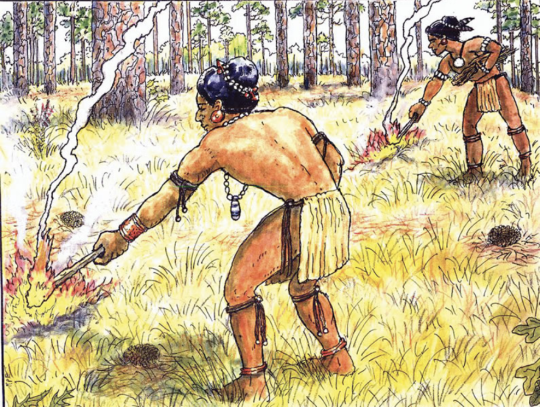
This illustration here show Apalachee people using slash and burn methods for agriculture. Fires were set regularly to intention burn down forests and plains. Why would we do this? Well because an unregulated forest isn’t that great for people, actually. We set fires to destroy new forest growth and undergrowth, and to remove trees, allowing for easier game hunting, nutrient enriched soil, and better growth rates for crops and herbs we used in food and medicine.
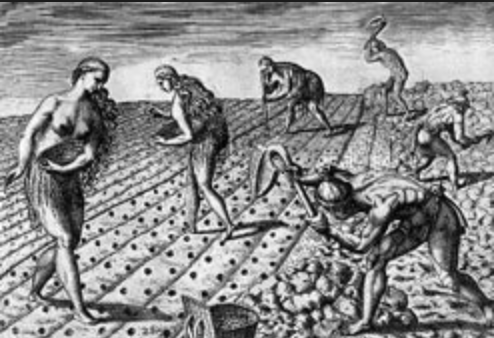
Pre-Colonial New England, where my tribe the Abenaki are from, looked more like an extensive meadow or savannah with trees growing in pockets and groves. Enough woodland to support birds, deer, and moose, but not too much to make hunting difficult. We carefully shaped the land around us to suit our needs as a thriving and successful people. Slash and burn agriculture was practiced virtually everywhere in the new world, from the pacific coast to chesapeake bay, from panama to quebec. It was a highly successful way of revitalizing the land and promoting crop growth, as well as preventing massive forest fires that thrive in unregulated forests. Berries were the major source of fruit for my tribe, and we needed to burn the undergrowth so they could grow.
That changed when white people invaded, and brought with them disease. In my tribe, up to 9 in 10 people died. 90% of our people perished not from violence starvation, but from disease. Entire villages would be decimated, struck down by small pox. Suddenly, we couldn’t care for the land anymore. There weren’t enough of us to maintain a vast, carefully structured ecological system like we had for thousands of years. We didn’t have the numbers, or strength. So the trees grew back and unregulated. We couldn’t set fires anymore, and we couldn’t cultivate the land. And white people would make certain we never could again. Timber, after all, was the most important export from New England.
Endless trees and untamed wilderness is a nice fantasy. But it’s a very white fantasy, one that erases the history of my people and of my land. One that paints native peoples are merely parasites leeching off the land, not masters of the earth who new the right balance of hunting and agriculture. It robs us of our agency as people, and takes our accomplishments from us. Moreover, it implies that only white people ever discovered the power to shape the world around them, and that mere brown people can’t possibly have had anything to do with changing our environment.
Don’t bring back untamed wilderness. Bring back my fire setters, my tree sappers, my farmers and my fishers. Bring back my people who were here first.
My mom cried as a first year teacher when she realized many of her students were food insecure. She put a snack pantry in her class and has had one ever since.
My sister cried with anger as a first year teacher because of how few of her students grew up without being exposed to violence, poverty, and neglect.
My dad didn’t cry as a first year teacher, but was convinced he was the worst teacher ever for 4 years straight. (He wasn’t)
My aunt was exhausted for the first year because her students were convinced she’d only be at their school for one year and then move to a better paying school district like all of their other new teachers. She spent the entire time teaching, actively gaining trust, and calming anxieties.
Some of these things are not technically school related, but have an impact on students in the classroom. As new teachers, my relatives got varying levels of support. New teachers need better support.
3 quit at my old job because they didn’t feel like they were getting the pay or support that was appropriate for what they were doing in the classroom. All of the teachers I have encountered pay for many of their own supplies. Many take time before or after school to check up on students they feel are at risk.
There are teachers that have students live with them or end up fostering students. My mom fostered 2 students and had another 2 live with us.
What many teachers do on the job isn’t as supported as it could be. They aren’t paid like they should.
Did I mention that a lot of the first year teachers I have worked with qualify for SNAP benefits and/or WIC? 😦
This post has 2k notes.
Re: Why Teachers Provide Snacks (at my work)
ALL of the teachers I work with at my school provide snacks to students.
We’re a Title I school. This means almost all of our students are food insecure. It’s unreasonable to expect food insecure families to provide their own snacks to school.
ALL of the teachers and many of our other staff members provide snacks for their classrooms or offices. Our counselor has snacks in her office. Our health room assistant has snacks in her office. Our principal has snacks in his office. Our vice principal has snacks in her office. The office professionals have small snacks available as well.
Our new teachers usually can’t afford to do this, so veteran teachers and support staff often chip in.
When students DON’T have access to snacks, they get tired. Our students can’t focus. Students get irritable. They’re feeling the effects of hunger and cannot focus on their work. We see escalated behaviors because kids are hungry.
Providing food not only prevents some problems from happening, but it’s The Right Thing To Do.
Many of our students’ Only Guaranteed Meals are at school. School meals are not designed to provide a child’s only source of nutrition. The caloric value of school lunches isn’t enough. So—Kids get snacks with lunch. Kids get multiple ‘breaks’ (which they think are ‘‘regular breaks’‘) for snacks.
Anyone who wants a small snack will get one.
We have a Friday Weekend Bag Program, but many families HATE THOSE. Those snack bags come from the Thurston County Food Bank. They only contain shelf stable food since many of our families don’t have a reliable way to cook things. Most of the families decline the bags because the Instant Noodles, Dry Granola Bars, and Vegetable Soup aren’t what they’d eat anyway.
__
A lot of the kids DO want fruit/vegetables. (Downside is if they can’t store those at home). We have some kids who try to hoard milk. <—a problem since many kids don’t have access to reliable refrigeration at home! Our milk ‘‘collecting’‘ kids ALL don’t have reliable refrigeration since they’re in living situations that don’t have refrigerators or freezers.
We provide snacks for the kids because we need to.
My Personal Project this coming school year is connecting My School with local nonprofit Fairshare Food Share Resource. It’s a group of volunteers who harvest small amounts of fruit and vegetables and give them away. They’re for smaller home gardeners who aren’t up for sending items directly to our food bank system due to time/health issues/etc.
The Thurston County Food Bank is expanding our school garden this year. I’m hoping that the garden will eventually be a nice Community You Pick for our students and the surrounding neighborhood.
The last big ol’ update had links. I’ll add links to this because food insecurity TICKS ME OFF. It shouldn’t be a thing. We’re fightingfood insecurity at my elementary school.
“Schools have always been the front line in the battle against
childhood hunger. It started with the National School Lunch Act, signed
by President Truman in 1946, which gave federal money to states to fund
school lunches.
Today more than 30 million kids benefit. And yet,
by some estimates at least one in six still doesn’t know where the next
meal is coming from.
“School
lunch is no longer this Brady Bunch convenience; it is a soup kitchen,”
said Jennifer Ramo, of the New Mexico anti-poverty group Appleseed.
“It
is a place where kids who haven’t eaten at night or haven’t eaten that
weekend, go to get basic nutrition so they can function. I think
we just have no idea how big the problem is and how many children are
suffering. And the best thing to do is just must make sure they’re fed.”
“What do parents tell their kids on the first day of school – stay
out of trouble, do your homework, and listen to your teachers,” Nelson
said.
“That’s our message today: listen to your teachers. What are they
telling us? Hunger needs to be a national priority.”
One in five children struggle with hunger nationwide and six out of
ten teachers report students regularly coming to school hungry. According to 80 percent of those teachers, the problem is only getting worse.
Educators realize the toll hunger takes on students. Nine in ten
teachers consider breakfast to be “extremely important” to academic
achievement. Fifty-three percent of teachers spend an average $26 of
their own money each month providing snacks for their students.”
“There
is tremendous stigma of children going into a cafeteria before the
bell,” said McAuliffe, “whereas with the alternative breakfast model, it
normalizes it, creates community in the classroom around a meal, and
starts the day off strong.”
Underscoring the crucial impact a
healthy breakfast can have, a 2013 study done by Deloitte for No Kid
Hungry found that kids who have regular access to breakfast score 17.5
percent higher on standardized math tests
.Breakfast and lunch
programs in schools are making great strides in attacking childhood
hunger, but a huge gap remains. According to No Kid Hungry, a quarter of
all low-income parents worry their kids don’t have enough to eat
between school lunch and breakfast the next day; and three out of four
public school teachers say students regularly come to school hungry.
Increasingly, advocates are focusing on programs that ensure kids have
enough to eat when they are not in school, and after school and summer
meal programs are on the rise.”
Yep. My school is poor enough that it has all the kids on free breakfast and lunch, and nearly every teacher has a box of protein bars or fruit snacks or something to give to hungry kids in their classroom. We all buy them with our own money. How fucked are we as a society that this is pretty much normal at all the poorer schools?
A lot of our school funding is through property taxes. Low income areas have lower taxes which means lower funding for their neighborhood schools. It sucks.
Schools in high poverty areas are Title I schools. Almost every school in my district is Title I.
ALL public schools should be properly funded and NO ONE should be food insecure. (my 2 cents)
And guys, you know… It doesn’t have to be like this. Teachers like me who teach in other countries know this and are always so shocked when we read about and see what the US, supposedly a leading and not a developing country, is like in education
I always keep our extra snacks from our programs (usually the ones I did not eat or that other children did not open) just in case. I will never forget the four year old girl my third year in this program who would sneak food or her older siblings in third and fifth grade so they also had something to eat, since they gave so much of their portions to her and her little sister.




 Urocyon's Jaunts 2.0
You must be logged in to post a comment.