robotsandfrippary:

instantbanana:

my-mental-pile:

itsme98z:

YES. Make things clearer and more specific

Especially the first one! I have a really hard time knowing if somebody actually wants me to do something unless they are specific about the task and direct it towards me completely. 

This is some adhd/autism solidarity Mood™️

Not to derail or take away, but when someone says, “What’s the secret to a long marriage?”

This.  This is the secret.  be clear and specific about things.  I mean, yes, my husband has ADD and i probably fall on the autism spectrum somewhere, but I learned from watching my parents that most of the misunderstandings that led to their divorce was not being clear.  And what got them back together and remarried is being more clear and kind.  And always saying thank you, even if it’s a simple task.

So yeah, 19 years for my husband and I this year. And this is a big part of why. 

Also had to think again about my mom being very aware that she mostly rushed into marrying my biodad, when she was still in college, to get away from home. They were some of the people who got married after he got drafted and was about to get shipped to Germany. An even better opportunity: put an ocean between herself and my grandmother! Who wasn’t that sorry to have her gone.

(ETA: She had already almost married some Ecuadorian guy who was expecting to go back after getting his degree. But, his racist mama pretty much broke that one up.)

That didn’t work out so well, though she kept trying for like 12 years in spite of some appalling behavior. And eventually she could take a little better look at why she felt like she needed to do that.

The worst thing that ever happened for her mental health and general stability was moving back to where she was in daily contact with my grandmother again. And I don’t know that she could ever really look at that, either. Another story, though.

But…I don’t know that my mother would have ever let herself see any similarities to my own decision to hare off across the Atlantic and marry somebody I had known in person for less than a year at that point.

The situation was a little different. (For one thing, she actively tried to get me to stay there when I went back to help out in 2006. Wouldn’t come out and say it directly, but the endless stream of crises never would have stopped. Never. I finally got out again after 6 months of going progressively crazier myself 😵)

But, I really needed a change of scene at that point in my life. As kinda implied in tags on that last post, with not necessarily expecting to see 30. And I felt like I needed to take a chance, and at least try living with someone who had honestly already been treating me with a lot more respect.

Good thing that’s been a continuing pattern, but yeah. I don’t know that any of my family would want to understand. She’s been gone for almost 10 years, so that’s really not gonna happen.

With looking back over one post from earlier after it got more notes, I couldn’t help but start thinking some more about how weird time can be.

Not only do I find myself feeling unexpectedly old, with a (totally predictable) shaky grasp on how much time has actually passed? I’m impressed at how much more condensed some events seem now, than they did then.

I mean, it’s coming up on 15 years later this month since we first met in person. (That I registered, at any rate.*) Hard enough to believe that. And I moved in for good like 8 months later. And there he was, basically adopting my crazy-ass family as mentioned earlier, a few months after that.

I mean, we did get to know each other pretty well online, before the idea of my crashing with him for CCDE 2003 even came up. But, in retrospect things did move pretty quickly overall. Good thing that turned out OK, but it feels a tad weird now thinking about it.

Maybe especially with me sitting here going, “damn, is it really better than halfway through 2018 already?!”

* I was surprised when we were putting all the visa paperwork together, that he was sure we had met at an afpmeet** on my first trip to London in late 2002. Granted, I was seriously overloaded and also more than a little drunk to cope by that point–and probably at least 30 people showed up over the course of the meet. Mr. C was definitely one of them. There are photos. I still don’t recall laying eyes on him then, at all. Must have made more of an impression on him–while really really not in top social form 😵

** I had to laugh at his short version for the application: “We met in a pub in London.” 🙄 Technically true, I suppose, but yeah I did request that he add more context before that got turned in to the Home Office.

trashgender-neurotica:

youthincare:

datingcptsd:

Try to remember that your partner might need more explanation for your thought process than you think is necessary, especially if it’s a “negative” thought.

“I disagree with you” –> “I disagree with you, but I’m not angry at you, and I’m not going to yell at you for not agreeing with me.”

“I’m hurt by what you did” –> “I’m hurt by what you did, but I don’t hate you, and I don’t think you’re a bad person. I just want to discuss it.”

“I’m frustrated” –> “I’m frustrated, but it doesn’t mean I don’t care about you.”

What feels obvious to you–the underlying asumption that of course you still love this person, of course this is just a single feeling–is not obvious to someone who has been trained to flinch at every criticism. Take the time to explain your feelings and their meanings to ease both your fears.

Why does this need to be addressed? Because cptsd involves a power imbalance with someone you had a relationship with (partner/caregiver, etc.) that abused their power with you continuously. 

The aftermath of the abuse leaves you now more conditioned to believe that someone does not love you if they express any negative tone towards you. This helps with assurance and validation. 

omfg this would help me so much.

Five Types of Intimacy Other Than Sexual

aegipan-omnicorn:

aegipan-omnicorn:

As I wrote, here, for Ace Pride Day, one reason it took me so long to realize I was ace is that I fully imagined myself having a relationship like my parents’, someday… not knowing that they were both (probably) on different parts of the Ace Spectrum, themselves.

So here’s a list of different kinds of intimacy that I saw modeled in their 29-year marriage (of which I was around for 27 years), beyond (or besides) sexual intimacy:

1. Task / Project

The ability to work together on a large project, complimenting each other’s skills, without getting in each other’s way, whether that’s hosting a Halloween party for me and my friends, or growing a vegetable garden and raising chickens together.

2. Emotional

The ability to trust one another with difficult emotions, and to allow each other to be emotionally vulnerable without (too much) fear of getting hurt.

3. Intellectual

Showing an interest in each other’s intellectual pursuits, and enjoying discussing them in detail, without being patronizing toward each other.

4. Creative / Aesthetic

Appreciating and supporting each other’s tastes in music and art, and supporting each other’s creative expression.

5. (Non-Sexual) Physical Intimacy

Trusting each other with their physical safety, especially when vulnerable or sick (as I noted in that earlier post, my mother commented that the best part of being married is having someone to check you for ticks after a hike in the woods).


A key part of recognizing my own asexual orientation was when I realized that I felt no emotion one way or the other over the idea of never having a sexual partner,* but the idea of living my life without any of the kinds of intimacy listed above leaves me with a chilling dread.  And, growing up, I’d always imagined  myself in a heterosexual relationship, because that’s what I had seen modeled by my parents [or at least, they modeled a M/F relationship.– the culture at large modeled the “sexual” part, and I just filled in the blanks]

But thinking through it now, I’m realizing that the gender of any hypothetical partner doesn’t really matter, if the partnership itself provides the kinds of intimacy I value.

*And when I try to seriously imagine actually having sex, all I can think of is how pokey elbows are, and how scratchy toenails are, and it just seems more bother than it’s worth.

Someone on Dreamwidth linked to this list of non-sexual intimacies from @theasexualityblog, and that reminded me that I’d written this post, last year.

So I thought maybe it was worth reblogging

(Also, I offer this up for writing advice, if you want to write different sorts of intimacies between characters, even if you don’t headcanon .them as Ace, and/or they’re shipped with other characters in your story)

sheabutterbitch:

evil-faery:

sheabutterbitch:

A long time ago I took a course on the sociology of marriage and my professor said “With compromise, you both lose. As a couple, you must collaborate on the best possible outcome.” Ever since, I never prioritize compromise in a relationship, only collaboration.

this seems like a great concept and all but. what does it actually mean?

Compromise is typically thought of as a 50/50 split amongst partner’s needs. They’re both left partially unsatisfied, but this dissatisfaction is deemed acceptable because it is ‘equal.’ However, with additional effort, many problems may be solved through collaboration; keywords: additional effort.

In collaborating, one may try to make the conflict more complex in order to expand the possible positive outcomes. This requires trust in both parties, empathy, and consideration for one another’s needs.

The objective should shift from getting what you want and ‘keeping things quiet’ to making sure your partner feels heard and considered (as they should do with you). Essentially, you must trust that your partner has your happiness in mind, and you must have theirs, instead of fighting for your own best interest.

For further explanation, Google “compromise vs collaboration.”

tomatomagica:

shitmygaywifesays:

shitmygaywifesays:

I want to tell y’all a story about supporting and loving your partner, starring my amazing wife.

I’ve mentioned before that I had an eating disorder for many years, and though I consider myself “recovered” there are aspects of my disorder that I still struggle with today — being quite a bit heavier than my wife is one of them.

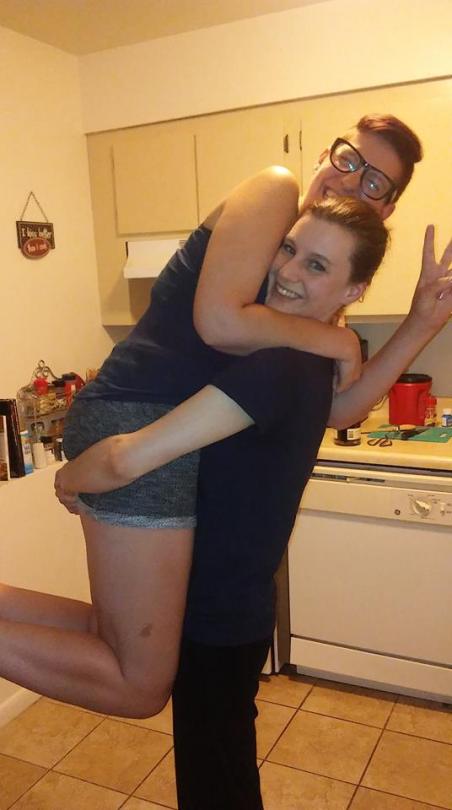
When my wife and I moved in together back when we were still girlfriends, I was at my skinniest. She used to pick me up all the time and lift me off the ground, and I’d laugh and kick out my legs ‘cause I was just delighted to have her holding me.

But I started gaining weight as I went through recovery, and where once we were pretty close in size, I began to get bigger. And bigger. And bigger. And she remained her naturally petite self. I began to almost dread when she’d try to pick me up, sure that this time she wouldn’t be able to get me off the ground.

But every time, even if I protested, she’d lift me up and say something like: “See, you’re not so big that I can’t lift you!”

And one time I just blurted out: “But someday I’m going to be so fat you won’t be able to.”

She looked me dead in the eye and said: “No you won’t. Because if that ever happens, I’ll start working out.”

It was the best possible thing she could have said to me, because she wasn’t saying I wasn’t going to get fat

neither of us knew that for sure. She was just saying that I was never going to be “too fat” for her.

And every time I worry about getting bigger, I remember that I’ll never be so big that she can’t lift me, because baby knows how much I love being held, and she’ll change her own habits to ensure that I never feel “too big” or “too heavy” because in her eyes I’ll never be “too” anything.

Anyway, there’s a moral to this story: Find yourself a partner who will never consider you an excess. You should never be “too much” to someone who loves you — too big, too loud, too passionate, too awkward, whatever your “too” happens to be. And even as you change and grow (in my case, literally), the right person will be there through the changes, to tell you that you’re always just right for them.

My strongwoman, the wind beneath my wings, the arms under my ass.   😍😍 😍

rainbowloliofjustice:

rainbowloliofjustice:

Gay and same-sex couples can have messy breakups. 

LGBT people can be in messy relationships where there is screaming, crying, and angry nights. 

LGBT people can hate their exes and be in toxic and/or abusive relationships. 

LGBT people are people

Having a messy breakup, hating your ex, etc. isn’t some “hetero bullshit uwu”. It’s people bullshit. People can get angry, petty, jealous, etc. and LGBT people are no different. 

We are human. We make mistakes. Our lives aren’t perfect. Our relationships are not always perfect. 

And there is nothing wrong with that. 

Cause it’s pride month this is relevant.

Leave abusive, toxic, etc. relationships. It isn’t “heterosexual bullshit” to leave a toxic relationship or have a messy breakup. If a relationship ain’t working don’t make yourself stay because ya gay. 

sunflorally:

your relationship doesn’t have to be toxic to be a bad one. it can be unfulfilling, exhausting, loveless. and someone doesn’t have to be terrible to you for you to leave them. if you aren’t primarily happy in your relationship, you have a valid reason to not be in it. don’t beat yourself up because your situation “could be worse.” if it isn’t what you want, you don’t have to stay in it.

imgetting2old4diss:

sandersstudies:

I have some young followers who might need to hear this:

A long-distance relationship can last if both people are willing to put in trust, understanding, and hard work.

A relationship that starts in high school can last if both people are willing to put in trust, understanding, and hard work.

A relationship between an ace-spec and an allo can last if both people are willing to put in trust, understanding, and hard work.

A relationship that broke up and got back together can last if both people are willing to put in trust, understanding, and hard work.

A relationship between adults with an age gap can last if both people are willing to put in trust, understanding, and hard work.

A relationship between people of different cultural or religious backgrounds can last if both people are willing to put in trust, understanding, and hard work.

A relationship can end respectfully and become a friendship that will last if both people are willing to put in trust, understanding, and hard work.

Basically,

Any healthy relationship can last if both people are willing to put in trust, understanding, and hard work.

Reblogging beacause its true