Are you saying that self harm and massive blood loss are. Healthier. Than being spanked by a partner in a controlled fashion because. I.
There’s.
There’s so much happening here. Do you think mentally ill people can’t fuck? Do you think doms are rapists? Do you think hitting someone is rape? DO YOU THINK CONSENSUAL SEX IS RAPE????
I don’t even know where to. To begin so just.
Listen.
Listen, okay.
Step one on the staircase of “stop trying to punish your body for being sick,” also known as “stop self harming,” is to replace high risk forms of self harm like trying to kill yourself with much lower risk ones that still provide you the sense of control, relief, or physical grounding that you are seeking.
This NECESSARY INTERIM MEASURE is what allows you to begin dealing with the extremely painful, difficult process of healing.
Also, did you just fucking say you would rather your friend RISK DEATH than do kink??????????????????????
Just.
Like.
I would rather risk death than deal with you right now, holy shit.
Hey, anon, here’s a quick guide to how to deal with being in your situation:
1) Evaluate your discomfort. Are you uncomfortable with the situation because you’re worried that your friend is being taken advantage of, or because it’s something you don’t understand or have built up an irrational sense of righteousness about? Hint: if you’d rather your friend risk extreme personal injury or death, it’s probably the latter, and you should probably just deal with that on your own.
2) If you are actually genuinely concerned about your friend, the first thing you should do is go talk to them, and let them have a say in how the situation gets handled. I mean, if you really respected their agency, you would probably not be so willing to label a situation they’re in as “definitely rape” because you have some vague idea about what they can and cannot consent to, but hey, maybe shit is really bad and you just don’t know how to deal with it. It’s possible.
3) Don’t drag your friend’s situation out in front of a bunch of strangers on the internet as a way to support your moral superiority. That’s taking advantage of them and speaking over them and it’s gross and just don’t. If you need support or advice, that’s one thing, but bringing it up as a talking point with someone you disagree with is not that.
Also notice the anon’s wording.
“my friend has her bf whip her ass”
That’s clearly someone who WANTS to be spanked, it’s not even a case of where the guy has a spanking fetish himself (which, y’know, is just as valid) but it’s clearly the woman who has the impact play kink, and her boyfriend is participating in it at her request, not the other way around. So how is it possible that he’s ‘taking advantage of her’ ?????
Also
How is impact play ‘rape’? Not that there’s anything wrong with consensual noncon play either but ????? They’re two completely different things.
Anon, do you think that throwing out a million buzzwords and hoping that one will stick is any good way to create an argument? Because it’s pretty much the opposite of that. Please lay off the swerf kool-aid and pet a cat or something.
I feel like the anon’s friend should dump the anon as a friend because people don’t deserve to have such judgy friends who treat them like they’re incapable of consent, like they are very tiny children or animals who of course don’t understand how sick and wrong this is, and they can’t possibly be people with intelligence and the right to choose things the anon doesn’t understand.
OP is behaving cruelly. No one should brag about treating another person like this. The third reblogger is spot on that conversations aren’t battlefields – you don’t “win” by shaming or rebuking your interlocutor into silence.
That said, I’m really not fond of statements like “kindness is free”, or “it costs zero dollars to be nice”, or any other permutation. Kindness isn’t free. No person has a limitless capacity for patience and understanding. To ignore that is to ignore the huge amount of work – yes, work – that humans put into cultivating compassion for others. And it not-so-implicitly shames people for whom that work isn’t easy.
Listening to someone infodump is not effortless. As an avid infodumper myself, I am always mindful that people willing to listen to me ramble are doing me a kindness. Hanging onto a topic that doesn’t interest you in the slightest, especially when the infodumper is speaking quickly or making leaps that don’t make sense to you, takes effort. That doesn’t make it ~emotional labor~, and it doesn’t mean you’re entitled to rudeness or to bragging about making someone “visibly uncomfortable”, but it’s not free. It’s a competing access need.
Responding with eye rolls or stony silence when I ramble about historical clothing is disrespectful, but so is expecting limitless attention. “Just listen! It’s not hard!” elides that. And it ignores the fact that the neurodivergences that make people prone to infodumping are often the same ones that make it hard to listen intently.
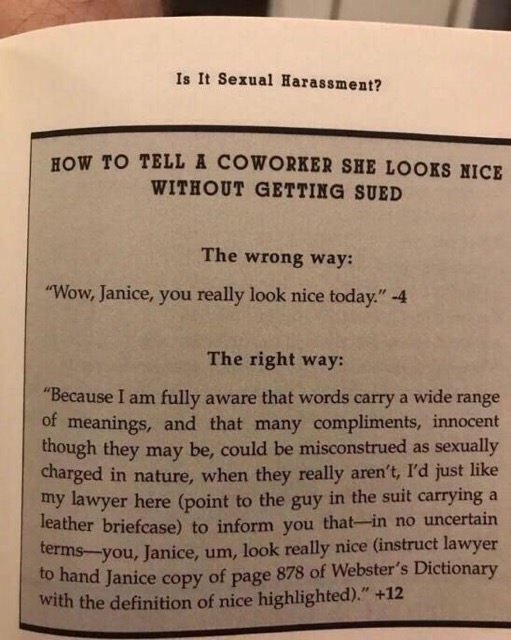
how to compliment someone without seeming like a fucking creep. an easy how to guide:
a) compliment them on something that they can change. don’t say ‘nice tits janice’, say something like ‘your shoes are rad’ or ‘your hair looks great’.
b) don’t be a fucking creep. if it’d weird you out if it was said to you, then it’s likely too creepy to say to someone else.
EASY.
also this pic is super strawmanny and gross. it is not hard to not be a creep.
My most favorite compliment I’ve ever gotten I got from a man who was a complete stranger who drove up next to me while I was walking home at 9pm in the night:
I guess he saw me speed walk, overtake, then completely outpace some really tall business man in front of me (who had also increased his speed to overtake me back but failed).
Anyway this complete stranger doing the exact stereotype of what a man shouldn’t ever do drove up next to me, rolled down the window and said:
“That is the fastest damn walking I’ve ever seen. Ma’am, you…have the soul…of a bicycle.”
Then rolled up his window and drove away.
He didn’t creepily drive behind me, he drove regular speed and came to a rolling stop. He didn’t roll down his window all the way or stick his head out, he said his piece quickly and with a great amount of awe and respect, then he didn’t act like he needed a response from me or expect anything from the compliment. And then he left as quickly as he came. The compliment was so good and politely delivered that I’ve thought about it with amusement for over a year.
It is NOT HARD to not be threatening to women. Those who can’t manage it are sus as hell.
“Snakes. Why’d it have to be snakes?” – Indiana Jones in Raiders of the Lost Ark
Humans often fear what they don’t understand and to most, snakes are a mystery. Snakes rely on crypsis so even when traversing through their world, we rarely see them. This void of direct knowledge is filled by myth and media, which portray snakes as cold-blooded killers and focus on how deadly and dangerous they are. It’s no surprise then that snakes provoke one of the most common phobias, even in the United States where we lack truly deadly serpents.
Though threatened by many of the same issues that affect other wildlife, including habitat loss, climate change, and disease, negative attitudes may be the biggest barrier to snake conservation because it often impedes efforts to address other threats.
For example, public outcry based on fear and misinformation recently halted a scientifically-sound conservation plan for timber rattlesnakes. A similar project at the same location was embraced by the community; but that project involved releasing eagles. Rattlesnakes are no less iconic or important to the ecosystem than eagles. In fact, they may help reduce the incidence of Lyme disease, which affects tens of thousands of people in the United States each year, by reducing the number of rodents that harbor this disease. But facts often play second fiddle to emotions where snakes are concerned.
Snakes are important components of biodiversity, serving as both predators and prey in nearly every ecosystem on earth. Some of the most feared and hated snakes (vipers, a group which includes rattlesnakes) may be the most effective predators on fluctuating prey populations. Unlike most predators, vipers are not territorial; they often share dens to escape freezing winter temperatures and select hunting sites where others have been successful. They live in greater densities than mammal and bird predators, as much as 100-1000 times denser than their mammalian competitors. Infrequent reproductive events (most give birth only once every two to three years) and their ability to fast make them resilient to prey population crashes. So they can have a greater impact on their prey, including those that can spread disease to humans, than their mammalian or avian counterparts.
But snakes are worth saving not because of what they can do for us, but because of who they are.
Adrian, a pregnant Arizona black rattlesnake guards one of her nestmates’ newborns. Photographed by Melissa Amarello.
Snakes, specifically rattlesnakes, share many behaviors with us, behaviors that we value. They have friends. They take care of their kids and their friends’ kids too. Within a community of Arizona black rattlesnakes, individuals do not associate randomly; they have friends (pairs of rattlesnakes observed together more often expected by chance) and individuals they appear to avoid. Mother rattlesnakes keep newborns from straying too far from the nest during the first few days of their lives, only gradually letting them explore farther as they approach time to leave the nest at 10-14 days old. They also defend their young from threats such as squirrels, who harass and may even kill newborns. But mothers aren’t the only ones caring for newborn rattlesnakes — still-pregnant females sharing the communal nest and even visiting males and juveniles assist with parental duties. Yet these gentle, caring parents are subjected to some of the most horrible treatment of any animal.
Each year, tens of thousands of rattlesnakes are taken from the wild to be displayed and slaughtered for entertainment and profit at rattlesnake roundups, which occur throughout Texas, Oklahoma, Georgia, and Alabama. Promoted as folksy, family-friendly fun, these events foster disrespect for native wildlife and the natural world, and are a gross example of wildlife management based on fear, rather than science. Professional hunters, not bound by ‘bag’ or ‘take’ limits, remove snakes from their native habitats and are awarded with cash prizes for bringing in the most and biggest snakes. Most snakes are caught by pouring gasoline into their winter dens, which pollutes surrounding land and water and may impact up to 350 other wildlife species. Rattlesnake roundups depend on the public’s misconception of snakes as dangerous pests that we cannot safely tolerate near our homes. No aspect of these events is sustainable, educational, or necessary.
If promoters and attendees of rattlesnake roundups knew what snakes are really like, would these events continue — who wants to kill a mom or someone’s friend?
World Snake Day is an opportunity to celebrate snakes and raise awareness about their conservation.
It’s no surprise then that snakes provoke one of the most common phobias, even in the United States where we lack truly deadly serpents. – This statement bothered me, especially where OP goes on to talk about rattlesnakes. There are multiple varieties of rattlesnakes in the US, and they’re all deadly. They may not be as dangerous as certain snakes from Asia or Australia, but they’re still deadly. We also have cottonmouths, also known as water moccasins, which are also highly dangerous, deadly and pervasive in the wetter part of the southern US, where rattlesnakes prefer the dryer western US – though I believe they can be found in the east as well.
However, just because they’re deadly doesn’t mean they should all die. But by saying that they aren’t “truly deadly”… it implies a lack of respect. Rattlesnakes and cottonmouths deserve respect because they can kill you. And there are deaths by both types of snake every year.
It’s inappropriate to ask invasive questions about other people’s dysphoria, including whether or not they have it in the first place. You’re not entitled to people’s personal information, just respect them.
I think the source of my complete unwillingness to tolerate truscum comes from one very specific reason. I can put up with a lot of nonsense from people, I can let them be wrong in any number of ways, saying ‘no skin off my back’ or ‘it’s none of my concern if they want to smack face-first into a concrete wall.’
But I’ve got one giant-ass berserk-button. I loathe it with every atom in my being when someone polices, dictates or tries to control the identity of another person.
This is what gets me. When I first got into social-justice spaces, this notion was pounded into my bones by every single one of my mentors.
DO NOTPOLICE OR ERASE OR DICTATE THE IDENTITIES OF OTHERS. UNDER ANY FUCKING CIRCUMSTANCE.
I might be bitterly disappointed into what a shitshow the SJ framework has been turned into on here, but the above is still something I believe with every fiber of my being.
I don’t give a shit if you don’t ~*~believe~*~ someone’s identity – their happiness and their ability to be true and authentic to themselves is a million times more important that what people who aren’t them believe or don’t believe.
I don’t give a shit if you screech and howl that your precious self is being ~*~harmed~*~ by other marginalized people. Congratulations on blaming majority society’s fuck-ups on your siblings, congratulations on learning to be as selfish and self-prioritizing as the best ‘screw you, I’ve got mine’ conservatives.
I don’t give a shit about your concern-trolly bullshit of ‘oh, we just don’t want people to make a terrible mistake’, falling face-first for the absolutely classic and bog-standard TERF and social-conservative propaganda that people will choose highly-stigmatized identities that could lose them everything from their families to their jobs, for ‘funsies.’
Let’s add in another thing, shall we? Fifteen years ago, ten years ago, hell, even seven years ago, the number of people I was seeing in online LGBTQ+ communities that could be described as ‘truscum’ was minuscule. Then the number just exploded in the last few years… in seemingly direct correlation with the slow rise in acceptance of nonbinary / genderqueer identities. When that realization clicked for me, the thing became even uglier.
I’ll be exceedingly blunt: ideologies based on identity-policing have zero place in LGBTQ+ communities, whether online or offline. It is our duty to see that every single one of our siblings finds a safe, welcoming space, that will give them the support and the tools to discover themselves, instead of denying them the knowledge of their own self.
This is pretty much exactly the reason why I could never swallow truscum or exclusionist rhetoric, either. I get so unbelievably angry when I see people say shit like “he/him lesbians are invalid and bad” like God fuck off? What fucking business is it of yours? Are you literally so insecure with yourself that you have to be a big, raging asshole to people who are not doing any tangible harm to anyone? And besides, I’ll call myself whatever the fuck I want and so can anyone else and there’s not a goddamn thing you can do about it. You want me to stop calling myself nonbinary, pansexual, and butch? You’ll have to kill me, motherfucker.
3) They don’t owe it to you to tell you what their assigned gender was. (You might find out, like if you’re literally sleeping with them, but seriously, unless you’re literally doing naked things with them, which isn’t even a guarantee that you’ll see the “original plumbing,” it’s rude to ask.)
Me, to a cis person: “have you….have you had…the surgery?”
Cis person: “what surgery?”
Me: “the one that removes your head from your ass”
Care for an anecdote? I call this one Cis People Are Crazy, and it’s a lil sumthin sumthin that will come as no surprise whatsoever to any trans person.
So, due to All Of The Most Recent Bullshit, I was at a trans support rally in my city yesterday with my family. Some nice person was handing out these big pretty heart stickers with the trans pride flag colors on them, like this:
We all got one. I put mine on the hoodie I was wearing, which I wear a version of basically every day, right? It’s the Cringeandwince uniform.
So, without giving it much thought, I put that hoodie on again today and go food shopping, and – this is dense as fuck, but it took me a few minutes to figure out why so many people were acting weirder than usual towards me.
I got a lot of looks.
I got mainly curiosity from people who noticed at all. But I also received open hostility from two separate White dudes about my age, over-the-top/smile-too-big kindness from a White woman a little older than me, and total, disaggregating confusion from my White 30s male cashier after he asked me what the sticker meant and I told him. As in, my presence coupled with the very concept of trans people seemed to have this guy on the verge of simply falling apart, joint by joint, atomically, behind his register. It was like he blew a fuckin gasket, ok.
For people who don’t know me well enough to know who I am – I’m a straight, mixed Native cis woman in her 40s. While I don’t think I’ve ever been misgendered, I am about 5′10″ and built like a brick shithouse, and I wear mainly “men’s” clothing (black hoodie, blue jeans, hiking boots); the word “butch” has been thrown my way in the past. I also however have very long hair and wear long earrings.
The gamut of reactions today was pretty interesting because I’m a middle-aged woman – I’m almost roundly ignored in public these days, utterly invisible. But the presence of that trans pride sticker changed that on a dime. I left the store thinking to myself, Jesus Christ, this is the most interested people have been about what’s in between my legs since I was about 25.
So, hey, other cis people? Just a suggestion that a lot of us may be looking like total gormless morons – possibly abject fuckwits, maybe even vacuous clowns??? – when we interact with trans people a lot of the time. Try to be aware of this if you ain’t already because: it’s fucking annoying as hell, kinda scary, really really boring, and weird.
Not sure I’ve ever read a more comprehensive summary of How People Stare at Me ™ before now.
I’ve come across multiple posts now about why you shouldn’t release your pets to the wild. It’s insane to me that this would even cross someones mind! I can only think that may be this is because the people who would release an animal to the wild either don’t consider animals to have actual lives, or have no compassion. My family recently had a death in the family. Uncle Bob had been living in a retirement home for quite some time when he finally passed peacefully in the hospital. After the news was spread, my mother decided not to engage in squabbling over the will with the rest of her cousins and went to work cleaning up Uncle Bob’s now abandoned house. He was a hoarder, and the smell alone was enough to drive people away. While mom was cleaning out the mess, she found a very scared and aggressive cat hiding under a partially collapsed bed.
Minnie had been living under that mattress for more than a year. What we found out later is that Uncle Bob had arranged for a neighbour to take care of Minnie while he was living in the retirement home. What the neighbour did was open the front door, throw some food in the landing, and some water in a bowl. That’s it. So for a year, Minnie was living in filth, with no social contact whatsoever.
I got a call while I was at work that day from my very distraught mother. Apparently, none of the cousins, not even the ones who lived on farms with other animals, was willing to take Minnie. Their answer to the problem was just to let her outside to fend for herself. Mom couldn’t take the cat, because her own cat absolutely hates other cats and one of them would have ended up dead. So to help my already grieving mother, I offered to take Minnie in, at least temporarily.
Minnie arrived and was basically wild. She had mats all up her back (which Dad eventually shaved), and had no idea how to interact with people. She spent the first 2 months of her time in my house crouched in a box in a dark corner at the top of the stairs. When I looked up the stairs to try to talk to her, she growled. When I would walk by, she hissed and swatted at me. She had no interest in any toys, company, or light. After the first two weeks of this, we got together as a family and decided that since she is old (we don’t know exactly how old, but old enough to have a saggy cat belly and grey fur) she should just be allowed to live out the rest of her existence in as much comfort as we could offer her, even if she doesn’t want to interact.
Cut to now, three months later. When I get up in the morning, Minnie sits on the carpet in the living room, yelling at me to come sit down on the couch with her. She plays with her own toys, and any ball I can find for her. She eats a lot, both her own food and tuna right out of my hand. She has come a long way since she moved in with me. I can brush her, carry her, and give her medicine. The only person she remains hostile toward is mom, unfortunately. We think she remembers that mom is the one who removed her from Uncle Bob’s house, and doesn’t want to be taken away again.
The point of this story is to show that all animals have value to somebody. I’m not a cat person by any means, but having an extra being in the house has been nice. If she had been released to the wild, she would probably have died by now and wouldn’t have the opportunity to live out her life in peace the way she deserves to after having been abandoned. Always try to re-home the pets you can no longer take care of, and then use no-kill shelters. Release should never be seen as an option
Here’s a bad picture of us sitting on the couch together
i see a lot of quotes from Lundy Bancroft’s excellent book Why Does He Do That circulating on this website, but i’ve never really seen the last chapter quoted. So this is an excerpt from it: “Creating an Abuse-free World”.
(A note: the book is written for women who suffer intimate partner violence at the hands of men, because it is sorely needed and because that’s what the author has professional experience with. However, this insight is valuable for people of all genders, and also in situations in which the abuser is not a partner or former partner.)
“How can I help my daughter, sister, or friend who is being abused?
If you would like to make a significant difference in the life of an abused woman you care about, keep the following principle fresh in your mind: your goal is to be the complete opposite of what the abuser is.
THE ABUSER: Pressures her severely
SO YOU SHOULD: Be patient. Remember that it takes time for an abused woman to sort out her confusion and figure out how to handle her situation. It is not helpful for her to try to follow your timetable for when she should stand up to her partner, leave him, call the police, or whatever step you want her to take. You need to respect her judgement regarding when she is ready to take action – something her abuser never does.
THE ABUSER: Talks down to her
SO YOU SHOULD: Address her as an equal. Avoid all traces of condescension or superior knowledge in your voice. This caution applies just as much or more to professionals. If you speak to an abused woman as if you are smarter or wiser than she is, or as if she is going through something that could never happen to you, then you inadvertently confirm exactly what the abuser has been telling her, which is that she is beneath him. Remember, your actions speak louder than your words.
THE ABUSER: Thinks he knows what is good for her better than she does
SO YOU SHOULD: Treat her as the expert on her own life. Don’t assume that you know what she needs to do. I have sometimes given abused women suggestions that I thought were exactly right but turned out to be terrible for that particular situation. Ask her what she thinks might work and, without pressuring her, offer suggestions, respecting her explanations for why certain courses of action would not be helpful. Don’t tell her what to do.
THE ABUSER: Dominates conversations
SO YOU SHOULD: Listen more and talk less. The temptation may be great to convince her what a “jerk” he is, to analyze his motives, to give speeches covering entire chapters of this book. But talking too much inadvertently communicates to her that your thoughts are more important than hers, which is exactly how the abuser treats her. If you want her to value her own feelings and opinions, then you have to show her that you value them.
THE ABUSER: Believes he has the right to control her life
SO YOU SHOULD: Respect her right to self-determination. She is entitled to make decisions that are not exactly what you would choose, including the decision to stay with her abusive partner or to return to him after a separation. You can’t convince a woman that her life belongs to her if you are simultaneously acting like it belongs to you. Stay by her even when she makes choices that you don’t like.
THE ABUSER: Assumes he understands her children and their needs better than she does
SO YOU SHOULD: Assume that she is a competent, caring mother. Remember that there is no simple way to determine what is best for the children of an abused woman. Even if she leaves the abuser, the children’s problems are not necessarily over, and sometimes abusers actually create worse difficulties for the children postseparation than before. You cannot help her to find the best path for her children unless you have a realistic grasp of the complicated set of choices that face her.
THE ABUSER: Thinks for her
SO YOU SHOULD: Think with her. Don’t assume the role of teacher or rescuer. Instead, join forces with her as a respectful and equal team member.
Notice that being the opposite of the abuser does not simply mean saying the opposite of what he says. If he beseeches her with “Don’t leave me, don’t leave me,” and you stand on the other side badgering her with, “Leave him, leave him,” she will feel that you’re much like him; you are both pressuring her to accept your judgement of what she should do. Neither of you is asking the empowering question, “What do you want to do?”



 Urocyon's Jaunts 2.0
You must be logged in to post a comment.