One of TWELVE Red Spotted Newts (Notophthalmus viridescens), I saw this day! It had just rained, and they seemed to be really enjoying it! This little guy in particular stole my heart. He was a feisty little feller! And adventurous too! There was this big mossy boulder, which was quite a mountain to him… I watched him climb it… then tumble down…. then climb it again… then tumble down again… and finally, he made it to the top and chilled there for awhile. Determination can go a long way… even if you’re a tiny little creature! ❤
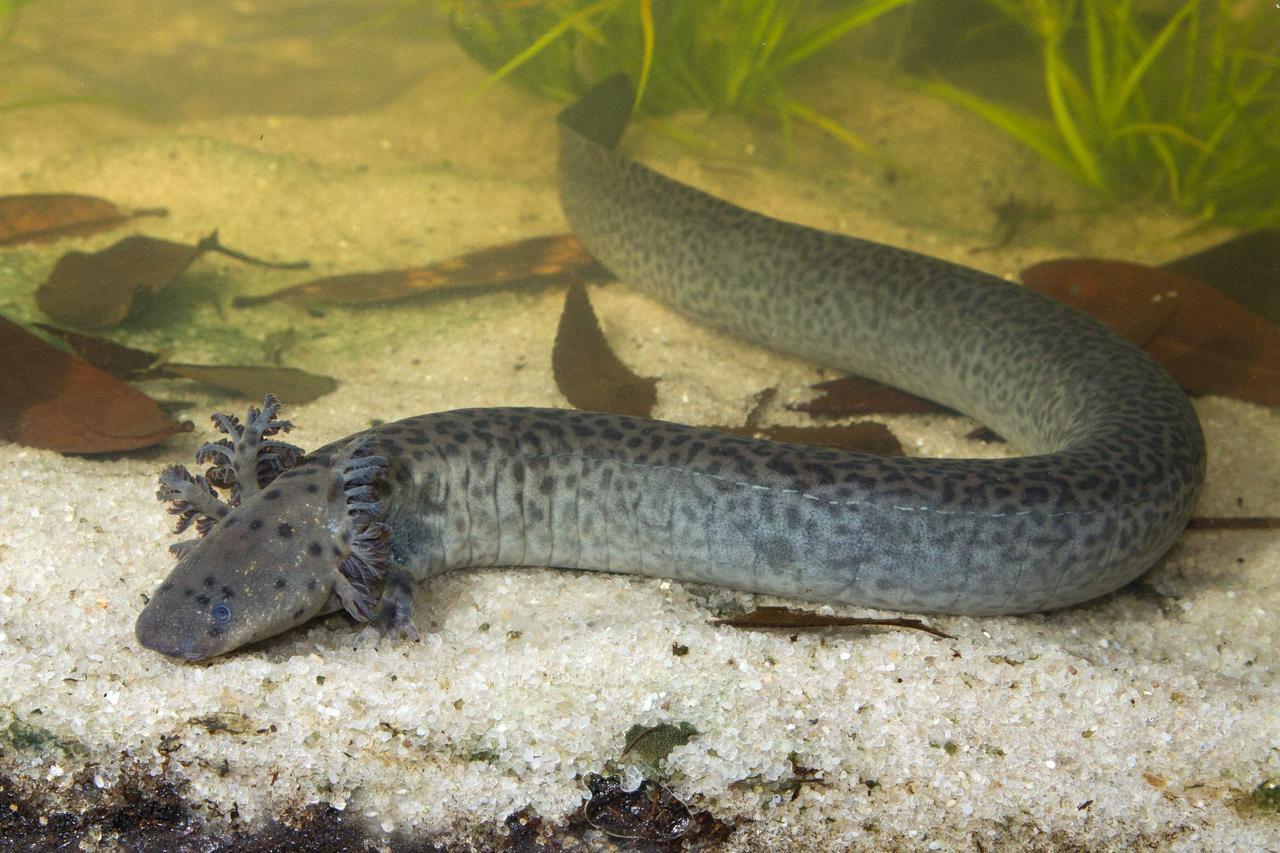
Upon first glance, one could easily mistake the Amphiuma for a kind of eel, but it is in fact an enormous aquatic salamander. Closer inspection will reveal 4 tiny limbs, with 1-3 little toes (dependent on the species). Of the 3 species, the Three-toed is the largest, attaining a length up up to 41 inches (104.14 cm).
These highly carnivorous amphibians feed on a wide variety of small aquatic creatures, and can deliver a rather painful and bloody bite with a pair or sharp oral bone ridges. Amphiuma mothers stay with their eggs in a muddy underwater nest. Unlike other salamanders, they are known to make a squeaky bark like noise, when disturbed.
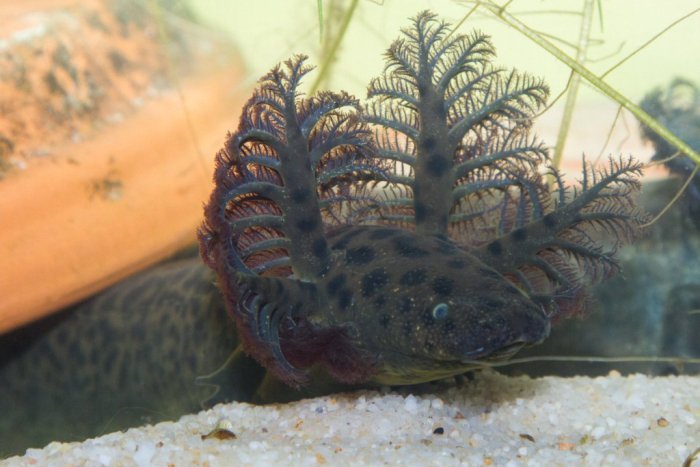
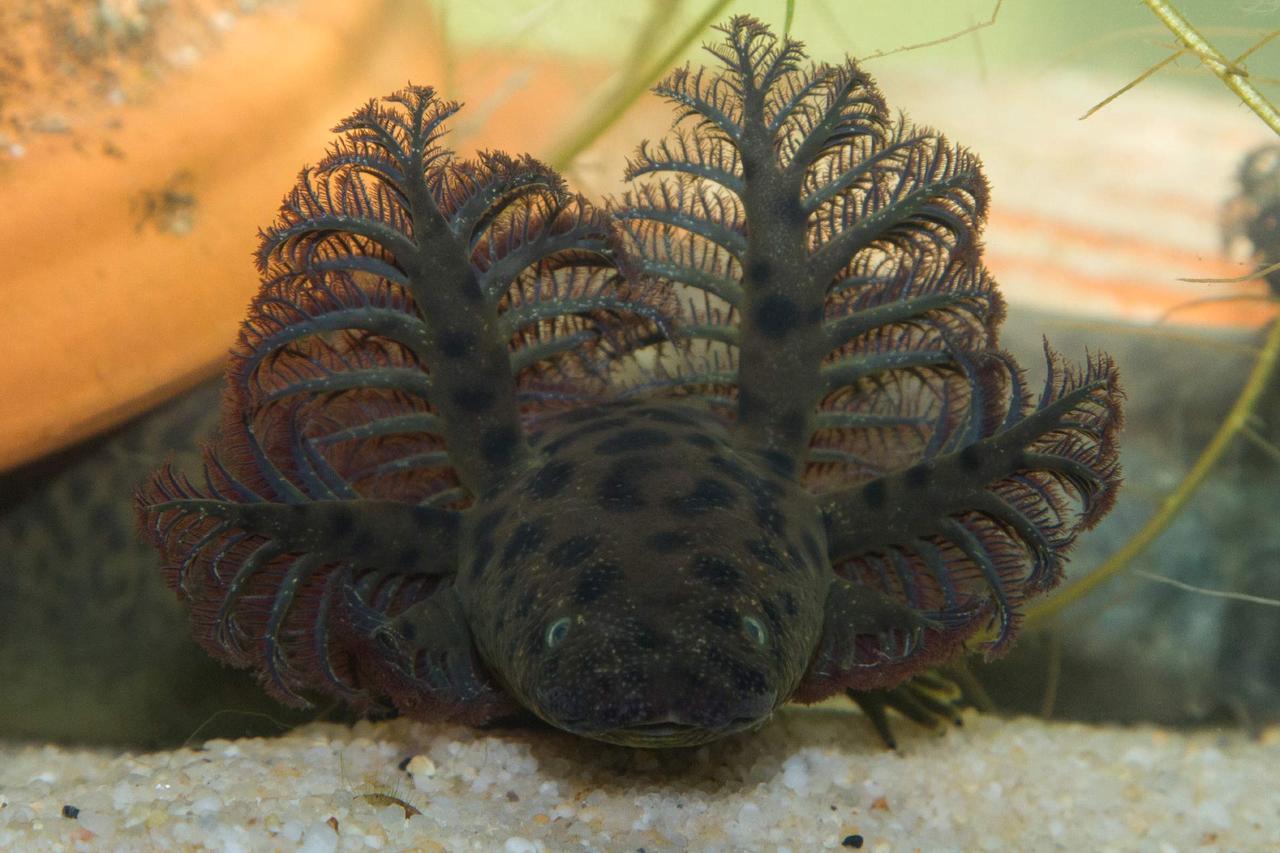
All 3 species (Three-toed, Two-toed, and One-toed) are exclusive still and slow moving bodies of fresh water in the Southeastern United States. They retain their gills, in a pair of small gill chambers, into adulthood (allowing them to breathe with both gills and a very rudimentary set of lungs).
23 Nuns Fight For the Survival of an Endangered Mexican Salamander
This is the Lake Pátzcuaro salamander. It is a critically endangered
species. Overhunting, habitat destruction, and invasive exotic fish have
brought the salamander to the brink of extinction. Recent studies
revealed that fewer than 100 are left in the wild.
But a group of 23
nuns in Mexico teamed up with other International experts to try and
save the species. The nuns live in a convent nearby and have used the
salamanders to make cough syrup for more than 150 years. Now they’re
breeding them not only to keep their tradition alive, but also to save
the amphibians from extinction.
Lake Pátzcuaro in Mexico is the only
place in the world these salamanders can be found. Experts say the nuns
will play a pivotal role in the survival of the species.
A Chinese giant salamander, in a glass enclosure in Zhangjiajie, China. There are as many as eight distinct species, but farming is muddling them into a single hybridized population.Credit Goh Chai Hin/Agence France-Presse — Getty Images.
Excerpt:
The Chinese giant salamander, the world’s largest amphibian and a critically endangered species, has quietly slipped toward extinction in nature. Following an exhaustive, yearslong search, researchers recently reported that they were unable to find any wild-born individuals.
“When we started the survey, we were sure we’d at least find several salamanders,” said Samuel Turvey, the lead author and a senior research fellow at the Zoological Society of London.
“It’s only now that we’ve finished that we realize the actual severity of the situation.”
Millions of giant salamanders live on farms scattered throughout China, where the animals are bred for their meat. But another study by Dr. Turvey and his colleagues shows that reintroducing farmed animals is not a simple solution for saving the species in the wild.
In the wild, Chinese giant salamanders were not just one species but at least five, and perhaps as many as eight. On farms, they are being muddled into a single hybridized population adapted to no particular environment. “The farms are driving the extinction of most of the species by homogenizing them,” said Robert Murphy, a co-author and senior curator of herpetology at the Royal Ontario Museum. “We’re losing genetic diversity and adaptations that have been evolving for millions of years.”
Given that, the best strategy for preventing extinction in the wild, he added, is to rescue genetically pure animals from farms, and then undertake carefully controlled conservation breeding to rebuild each species’ numbers.



 Urocyon's Jaunts 2.0
You must be logged in to post a comment.