Rodrigo Menendez was selling bananas at the market, and one day one of his customers was bitten by a viper that got out of the fruits. He thanks Saint Francis of Assisi for this snake turned out to be non-venomous because the health control was going to throw him in jail.
There’s a kind of neural network that learns to imitate whatever text you give it, whether that’s recipes, song lyrics, or even the names of guinea pigs.
Their imitations are often imperfect (they only know what’s in their dataset and therefore end up accidentally coming up with things that they don’t know are bad ideas). But one area where they tend to do well is inventing new species of things. The neural net’s birds were entirely believable, and its fish were generally no stranger than the species that already exist. So for my next project, I decided to generate some snakes.
I collected English common names for about 1,000 snakes and started training.
The first thing I noticed is that its snake names were a lot more noticeably fake than its birds or fish – the snake dataset is way smaller, so it had much fewer examples to learn from.
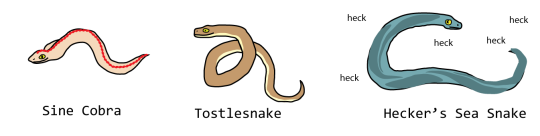
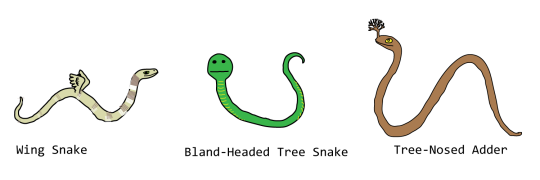
Tostlesnake Sine cobra Snoked snake Cancan rattlesnake Chippen’s putter python Southern coat snake Pinkwarm’s Copperanada Smart sea snake Western Nack Blonded snake Ham’s Pattlescops Green tree nosh Snake Hecker’s sea snake Ned-scaled tree viper Barned dater Snake Smalle’s mock ractlesnake Bland brown snake Corned python Common bust viper Smorthead Garter Snake
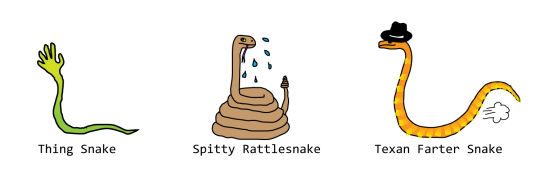
Some snakes did approach the level of believability. You might be able to bluff some herpetologists into thinking these are real.
Texan farter snake Shite snake Spitty rattlesnake Thing snake Brown brown Black Snake Tamestail farter Snake Black-neded tampon Madeshine spite- racer Bognia scat snake
I also decided to see what would happen if I trained a neural net both on snakes AND on Halloween costumes. Pleasingly, here are some of the snakes it came up with:
Wonder snake Fairy rattlesnake The Spacer Snake Robo snake Sexy cobra Bob dog tree Snake
I had way too much fun generating those, and ended up generating more than would fit here. If you’d like to read the rest of them (and optionally get bonus material every time I post), enter your email here.
I’m particularly fond of the “Common Bust Snake” which sounds like it lives ina particularly rube goldberg “booby trap”
Hemotoxic & cytotoxic; venom produces extensive tissue destruction. Necrosis can be expected in 10-
15% & abscesses in 15-20% of all cases. Incoagulable blood & bleeding occur in the majority of
envenomations. Causes a large number of human envenomations in Brazil annually. Has been reported
to cause human fatalities.
“Snakes. Why’d it have to be snakes?” – Indiana Jones in Raiders of the Lost Ark
Humans often fear what they don’t understand and to most, snakes are a mystery. Snakes rely on crypsis so even when traversing through their world, we rarely see them. This void of direct knowledge is filled by myth and media, which portray snakes as cold-blooded killers and focus on how deadly and dangerous they are. It’s no surprise then that snakes provoke one of the most common phobias, even in the United States where we lack truly deadly serpents.
Though threatened by many of the same issues that affect other wildlife, including habitat loss, climate change, and disease, negative attitudes may be the biggest barrier to snake conservation because it often impedes efforts to address other threats.
For example, public outcry based on fear and misinformation recently halted a scientifically-sound conservation plan for timber rattlesnakes. A similar project at the same location was embraced by the community; but that project involved releasing eagles. Rattlesnakes are no less iconic or important to the ecosystem than eagles. In fact, they may help reduce the incidence of Lyme disease, which affects tens of thousands of people in the United States each year, by reducing the number of rodents that harbor this disease. But facts often play second fiddle to emotions where snakes are concerned.
Snakes are important components of biodiversity, serving as both predators and prey in nearly every ecosystem on earth. Some of the most feared and hated snakes (vipers, a group which includes rattlesnakes) may be the most effective predators on fluctuating prey populations. Unlike most predators, vipers are not territorial; they often share dens to escape freezing winter temperatures and select hunting sites where others have been successful. They live in greater densities than mammal and bird predators, as much as 100-1000 times denser than their mammalian competitors. Infrequent reproductive events (most give birth only once every two to three years) and their ability to fast make them resilient to prey population crashes. So they can have a greater impact on their prey, including those that can spread disease to humans, than their mammalian or avian counterparts.
But snakes are worth saving not because of what they can do for us, but because of who they are.
Adrian, a pregnant Arizona black rattlesnake guards one of her nestmates’ newborns. Photographed by Melissa Amarello.
Snakes, specifically rattlesnakes, share many behaviors with us, behaviors that we value. They have friends. They take care of their kids and their friends’ kids too. Within a community of Arizona black rattlesnakes, individuals do not associate randomly; they have friends (pairs of rattlesnakes observed together more often expected by chance) and individuals they appear to avoid. Mother rattlesnakes keep newborns from straying too far from the nest during the first few days of their lives, only gradually letting them explore farther as they approach time to leave the nest at 10-14 days old. They also defend their young from threats such as squirrels, who harass and may even kill newborns. But mothers aren’t the only ones caring for newborn rattlesnakes — still-pregnant females sharing the communal nest and even visiting males and juveniles assist with parental duties. Yet these gentle, caring parents are subjected to some of the most horrible treatment of any animal.
Each year, tens of thousands of rattlesnakes are taken from the wild to be displayed and slaughtered for entertainment and profit at rattlesnake roundups, which occur throughout Texas, Oklahoma, Georgia, and Alabama. Promoted as folksy, family-friendly fun, these events foster disrespect for native wildlife and the natural world, and are a gross example of wildlife management based on fear, rather than science. Professional hunters, not bound by ‘bag’ or ‘take’ limits, remove snakes from their native habitats and are awarded with cash prizes for bringing in the most and biggest snakes. Most snakes are caught by pouring gasoline into their winter dens, which pollutes surrounding land and water and may impact up to 350 other wildlife species. Rattlesnake roundups depend on the public’s misconception of snakes as dangerous pests that we cannot safely tolerate near our homes. No aspect of these events is sustainable, educational, or necessary.
If promoters and attendees of rattlesnake roundups knew what snakes are really like, would these events continue — who wants to kill a mom or someone’s friend?
World Snake Day is an opportunity to celebrate snakes and raise awareness about their conservation.
It’s no surprise then that snakes provoke one of the most common phobias, even in the United States where we lack truly deadly serpents. – This statement bothered me, especially where OP goes on to talk about rattlesnakes. There are multiple varieties of rattlesnakes in the US, and they’re all deadly. They may not be as dangerous as certain snakes from Asia or Australia, but they’re still deadly. We also have cottonmouths, also known as water moccasins, which are also highly dangerous, deadly and pervasive in the wetter part of the southern US, where rattlesnakes prefer the dryer western US – though I believe they can be found in the east as well.
However, just because they’re deadly doesn’t mean they should all die. But by saying that they aren’t “truly deadly”… it implies a lack of respect. Rattlesnakes and cottonmouths deserve respect because they can kill you. And there are deaths by both types of snake every year.
I need to delete the Tumblr app from my mind, because when I saw this, I just. My brain looked at this fantastic and imaginative engraving of an excellent snake, sniggered, memed, and presented it to my mind’s eye formatted as a flag, with a banner at the bottom reading
black mambas probably have my least favorite faces because an animal that venomous should not be making a face like it’s thinking of a joke that it’s the only one in on




 Urocyon's Jaunts 2.0
You must be logged in to post a comment.