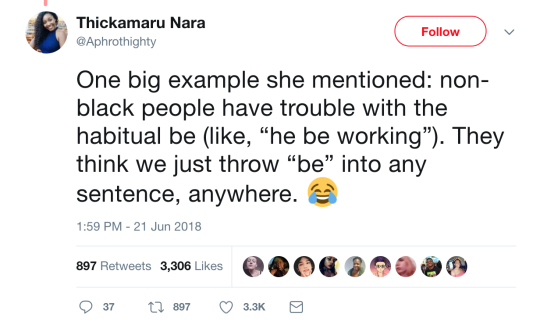
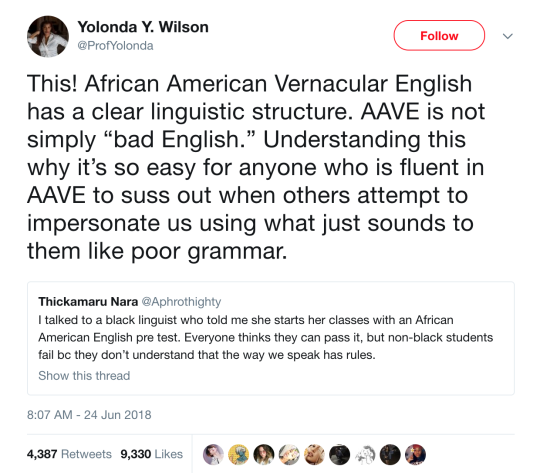
laineylewxlove:

brainstatic:

yellowjuice:

e-wifey:

people understand that Spanish speakers speak different dialects of the Spanish language but don’t understand that black people speak a dialect of the English language

saw a variation of this conversation on twitter earlier

I just want to state for the record that this is completely uncontroversial among linguists. It’s the first day of sociolinguistics class.

I majored in Communication Disorders to become an Speech Language Pathologist and am currently and Assisstant. When we were in class we were taught about this as well as other dialect. Under no circumstances do you treat a client for what is considered a dialect. So as a speech therapist when I hear AAVE I move on. It is a real language with real rules.

Thats why it was outrage in the speech community post Katrina when teachers began to recommend students for speech, when it was simply the New Orleans dialect.

I got that as a kid, in the early ‘80s, until my mother found out the school’s speech therapist had taken it on herself to “fix” my dialect. Put more effort into that than the actual reason I was referred.

In that particular case, it was also the equivalent of moving to New Orleans, and trying to justify “fixing” people’s accents because (*gasp*) the child sounds like they’re from New Orleans. 😩

Anyway, that couldn’t be a pleasant experience for anybody. And I really do hope the inappropriate nature of that approach is being stressed more in education for professionals.

prismatic-bell:

im-just-a-penguin:

prismatic-bell:

im-just-a-penguin:

prismatic-bell:

gahdamnpunk:

THIS

Can confirm. My favorite book on linguistics has an entire section on AAVE that talks about this.

So some people are better at bad English than others? Also, in what kind of classes is this knowledge useful?

It’s useful for the kind of classes where people aren’t busy being assholes about how other people speak, @im-just-a-penguin.

But don’t take my word for it!

Here’s a website dedicated to explaining dialects that goes over the rules.

Here’s a professional linguist who specializes in AAVE, and just one of his many papers explaining that AAVE is a proper dialect.

Hot shit! Here’s an article from STANFORD UNIVERSITY that’s literally titled “AAVE is not Standard English with mistakes”!!!

Here’s a blurb from PBS, introducing the topic of whether AAVE is a creole or a dialect. You’ll notice neither one of those options means ‘just poor English’.

Here’s English Language and Linguistics Online, which is a nice technical linguistics website, further deconstructing how AAVE works.

Here’s a paper on the habitual “be” from New York University.

Here’s a link to some information from Portland University. I wish to draw your attention specifically to the phrase: “linguists now agree that AAVE is not ‘broken’ English, or slang”.

Here’s a super-technical paper on phonology in AAVE, which gets down into things like why AAVE speakers may say “axed” instead of “asked.”

Hm. Looks like there are a lot of people who study this stuff for a living who disagree with your assessment that it’s “bad English.” I guess you better get reading … . asshole.

What’s so useful about the study of different ways people refuse to speak proper English? You did not answer that question.

Hm! Well, first, let’s define “proper English.”

Do you mean Queen’s English? American English? Canadian English? What about Indian English, or Kenyan English? Maybe Zimbabwean English? Maybe you meant Jamaican English, or Sierra Leonean English. Are those “proper English”?

Well, let’s assume you mean American English, since this kind of asshole question usually only comes from Americans, in my experience. Do you mean Southern American English, with “y’all” and “all y’all” and people who are “fixing to” do things? What about New Englander American English, where the thing I call a “side yard” is a dooryard? How about American English as spoken along the Arizona/Texas/Mexico border, which tends to have features not present in more northern states? Oh! Or what about New York City American English? Only place I’ve ever been where a grinder is a kind of food rather than a kind of food-maker and a train is underground.

Ah! Or perhaps you mean Texan American English, where “might-could” is a valid construction that means neither “might” nor “could.” Or Californian American English! Yes, that must be what you mean!

I didn’t answer the question, asshole, because it is not a valid question, and because you clearly asked it just to be (falsely) pedantic and superior. Rewording it as “refuse to speak proper English” instead of “better at bad English” doesn’t make it valid, it just shows that you know more than one way to be an asshole.

AAVE is an American English dialect. No different from any of the other dialects I just mentioned, except that it tends to be based along race lines rather than geographic ones. It is a correct American English dialect, it is a recognized American English dialect, and you don’t have to like it but you don’t get to shit on it just because you want to be racist … asshole.

why do black people use you in the wrong context? such is “you ugly” instead of “you’re ugly” I know u guys can differentiate, it’s a nuisance

starlightswitch:

randomslasher:

kingkunta-md:

miniprof:

rsbenedict:

prettyboyshyflizzy:

you a bitch

image

It’s called copula deletion, or zero copula. Many languages and dialects, including Ancient Greek and Russian, delete the copula (the verb to be) when the context is obvious.

So an utterance like “you a bitch” in AAVE is not an example of a misused you, but an example of a sentence that deletes the copular verb (are), which is a perfectly valid thing to do in that dialect, just as deleting an /r/ after a vowel is a perfectly valid thing to do in an upper-class British dialect.

What’s more, it’s been shown that copula deletion occurs in AAVE exactly in those contexts where copula contraction occurs in so-called “Standard American English.” That is, the basic sentence “You are great” can become “You’re great” in SAE and “You great” in AAVE, but “I know who you are” cannot become “I know who you’re” in SAE, and according to reports, neither can you get “I know who you” in AAVE.

In other words, AAVE is a set of grammatical rules just as complex and systematic as SAE, and the widespread belief that it is not is nothing more than yet another manifestation of deeply internalized racism.

This is the most intellectual drag I’ve ever read.

YASSSSSSSSS LINGUISTIC DRAG

In “Pittsburghese” copula deletion happens after the transitive verb “to need”. Where standard English would say something “needs to be x”, in Pittsburgh we say it “needs x”. Even my mom, who trained herself out of most Pittsburghese, fell into this when prepping for parties, informing us “the floors need swept”, “the dishes need washed”, “the table needs wiped”, and “[room after room] needs cleaned”.

Why did my mom train herself out of Pittsburghese? Because people made fun of it. The priest at my church calls us to “waship” because he trained himself so hard out of pronouncing the word “wash” as “worsh”. Also Pittsburghese. My sister works in student life at her college and was instructed not to use “you guys” as the plural of “you”; the Pittsburghese “yunz” gets mocked, so she uses “y’all” which is “classy”. 

And it is classism in the case of Pittsburghese. And anti-immigrant bias. Much of the population of Pittsburgh in the past was Eastern European immigrants living paycheck-to-paycheck working in the steel mills.

The “needs done” construction is also standard in Scottish English, which is probably how y’all got it too. I grew up with a version of Appalachian English from WV/VA (pretty heavily influenced by Scottish speakers) which also uses it.

(Needs washed | Yale Grammatical Diversity Project: English in North America)

I didn’t even realize that phrasing sounded unusual in other US dialects until I ran into people ridiculing it. That’s still what I will use 99% of the time, because I’m just stubborn that way. It gets the point across.

What sounds at least as jarring to me, though, is the “needs doing” standard usage here in England. That does make sense in its own way, but it still automatically sounds very very wrong every time.

What I’m not doing is assuming that any different dialect usage must really be Wrong and Uneducated, and getting rude about it. Don’t understand that mindset, and not sure I want to.

rendakuenthusiast:

missalsfromiram:

Also once I was arguing online with someone about AAVE and I pointed out that “axe” for “ask” was used at least as early as the Old English era, with ācsian and āscian both being used, and this guy was like “Yeeahh I’m so sure it’s because all those ghetto black people are Old English enthusiasts and know and care about that” and…..sigh……..I guess it was my fault for not specifying that axe has been used continuously since Old English, that people never stopped using it and enslaved Africans picked it up from British colonists when they arrived on the continent, but like…I guess the connection between Old English and Modern English, or the idea that all types of English are equally old, really isn’t obvious to non-linguists? Like it’s just so strange to me that he thought the most obvious interpretation of my argument was “Umm actually black people are larping as Anglo-Saxons so please respect their choices” instead of, you know…what it actually means…

I’m 100% in favor of black people larping as Anglo-Saxons though. That sounds like a really fun group of black people to hang out with.

jenniferrpovey:

jchance4d4:

jenniferrpovey:

badgyal-k:

moonisneveralone:

kiddsawsomnes:

badgyal-k:

badgyal-k:

badgyal-k:

badgyal-k:

badgyal-k:

badgyal-k:

badgyal-k:

badgyal-k:

badgyal-k:

badgyal-k:

badgyal-k:

Linguistic racism and antiblackness, internalized or otherwise, always rear its head in conversations surrounding the language spoken in the Caribbean. Namely, Jamaica.

Patois has its own grammatical structure which is separate from English and is accompanied by its own lexicon (which yes, does include English loanwords.. we were colonized and enslaved for a few hundred years so that happens).

Patois is not to be confused with a Jamaican person with an audible accent speaking English.

The sheer disrespect people give it because it’s a language born from colonization is ridiculous at best, and these same people are the ones who claim to love vacationing in our country and consuming our arts.

Jamaican Patois contains many loanwords, most of which are African in origin, primarily from Twi.

To reiterate:

Patois is not to be confused with a Jamaican person with an audible accent speaking English.

Let’s look at some hard examples.

Examples from African languages include /se/ meaning that (in the sense of “he told me that…” = /im tel mi se/), taken from Ashanti Twi, and Duppy meaning ghost, taken from the Twi word dupon (‘cotton tree root’), because of the African belief of malicious spirits originating in the root of trees (in Jamaica and Ghana, particularly the cotton tree known in both places as “Odom”).

Let’s keep it going.

The pronoun /unu or unnu/, used for the plural form of you, is taken from the Igbo language.

Let’s look at some real world examples of linguistic discrimination and trivialization of culture and denial of right to call a language what it is: a language.

Rihanna, a Bajan artist, released a song entitled “work”. On the track, she used quite a bit of Jamaican patois in the song, which was a dancehall/pop fusion.

People went bananas. The first thing to happen was the demotion of the language to “gibberish”.

Now, I want to take a step back here and actually rewind about 20 or so years.

Dancehall, a Jamaican music genre, has been in the international eye in a major way since the 90s, with artists like Shabba Ranks and Beenie Man holding the culture torch.

We’ve been scrutinized as a people for our language that exists in our music since then (and of course before that as well, but we won’t go into that for now).

From jokes about gibberish in movies and television (In Living Color did a skit on Shabba Ranks, mocking patois and Shabba’s prominent Black features. Thus, reducing a key bearer of popular Jamaican culture to an ugly (read: Black with Black features) gibberish spouting comedy crutch), we’ve been perceived as a caricature for so long, that blatant disrespect of our culture seems trivial.

Here’s the video for “Mr. Loverman” by Shabba Ranks: (xxx)

Here’s the parody video by the cast of In Living Color: (xxx)

So here we are in present day. We’ve watched dancehall in the 90s and early 2000s get “othered” in the American and European eye, and we’ve seen the caricaturization of Caribbean (in this case, Jamaican) culture so much that we are desensitized.

In comes Rihanna and her dancehall hit of 2016.

The language is demoted.

It went from “broken English” (which is problematic in and of itself, as the use of the term has been used to point to English being a default language worthy of respect and humanization for most of its speakers) to “gibberish” in a matter of seconds, with memes to match.

My language isn’t a broken dialect of your default language.

My language is an act of rebellion and is a middle finger to colonization and antiblack violence.

I’m proud of it and how my language and my people have influenced the world around us. Be more critical, because I watch a lot of you take part in this sort of behavior and it’s a shame.

ONE MORE TIME FOR THE PEOPLE IN THE BACK‼️

Unnu ah guh put soom bloodclat respec pon mi language.💯💯

There is….Twi in Patois?

That makes so much sense

Many of us were stolen from modern day Ghana.

My grandmother is of a group of people called the Maroons. They fought for our liberation in Jamaica and even fought in other countries like neighboring Haiti.

My grandma, like many Maroons, speaks a language called Kromanti that is spoken among many elders on one of the settlements called Moore Town in Jamaica.

For some Ghanaian people, Kromanti and Twi are mutually intelligible, meaning they can understand us!

Here’s a video of an elder speaking and breaking down Kromanti

Reblogging for the nice education on what patois actually is.

You see the “broken English” (or “broken [whatever]”) prejudice wherever related languages are spoken, with one associated with higher status, whether this is due to colonization or regional dominance.  As well as Jamaican Patois and a lot of other creoles, you see it with Scots, the regional languages of France, even the various mutually unintelligible Chinese topolects (with Mandarin as the “standard” prestige language).

Oh, definitely, and it sometimes ties into prejudice against accents/dialects that are lower class and/or associated with minorities. Look at the way people talk about AAVE. And I can’t talk my native accent/dialect unless I’m with my family because in America people don’t understand me and in Britain it’s “common.” Which it is, but…

samanticshift:

coincidenceiscancelled:

karnythia:

strangeasanjles:

lordhellebore:

athenadark:

dollsahoy:

luvtheheaven:

samanticshift:

samanticshift:

“i don’t judge people based on race, creed, color, or gender. i judge people based on spelling, grammar, punctuation, and sentence structure.”

i hate to burst your pretentious little bubble, but linguistic prejudice is inextricably tied to racism, sexism, classism, xenophobia, and ableism.

ETA: don’t send me angry messages about this…at all, preferably, but at least check the tag for this post before firing off an irate screed.

no one seems to be following the directive above, so here’s the version of this post i would like all you indignant folk to read.

no, i am not saying that people of color, women, poor people, disabled people, etc, “can’t learn proper english.” what i’m saying is that how we define “proper english” is itself rooted in bigotry. aave is not bad english, it’s a marginalized dialect which is just as useful, complex, and efficient as the english you’re taught in school. “like” as a filler word, valley girl speech, and uptalk don’t indicate vapidity, they’re common verbal patterns that serve a purpose. etc.

because the point of language is to communicate, and there are many ways to go about that. different communities have different needs; different people have different habits. so if you think of certain usages as fundamentally “wrong” or “bad,” if you think there’s a “pure” form of english to which everyone should aspire, then i challenge you to justify that view. i challenge you to explain why “like” makes people sound “stupid,” while “um” doesn’t raise the same alarms. explain the problem with the habitual be. don’t appeal to popular opinion, don’t insist that it just sounds wrong. give a detailed explanation.

point being that the concept of “proper english” is culturally constructed, and carries cultural biases with it. those usages you consider wrong? they aren’t. they’re just different, and common to certain marginalized groups.

not to mention that many people who speak marginalized dialects are adept at code-switching, i.e. flipping between non-standard dialects and “standard english,” which makes them more literate than most of the people complaining about this post.

not to mention that most of the people complaining about this post do not speak/write english nearly as “perfectly” as they’d like to believe and would therefore benefit by taking my side.

not to mention that the claim i’m making in the OP is flat-out not that interesting. this is sociolinguistics 101. this is the first chapter of your intro to linguistics textbook. the only reason it sounds so outlandish is that we’ve been inundated with the idea that how people speak and write is a reflection of their worth. and that’s a joyless, elitist idea you need to abandon if you care about social justice or, frankly, the beauty of language.

and yes, this issue matters. if we perceive people as lesser on the basis of language, we treat them as lesser. and yes, it can have real ramifications–in employment (tossing resumes with “black-sounding names”), in the legal system (prejudice against rachel jeantel’s language in the trayvon martin trial), in education (marginalizing students due to prejudice against dialectical differences, language-related disabilities, etc), and…well, a lot.

no, this doesn’t mean that there’s never a reason to follow the conventions of “standard english.” different genres, situations, etc, have different conventions and that’s fine. what it does mean, however, is that this standard english you claim to love so much has limited usefulness, and that, while it may be better in certain situations, it is not inherently better overall. it also means that non-standard dialects can communicate complex ideas just as effectively as the english you were taught in school. and it means that, while it’s fine to have personal preferences regarding language (i have plenty myself), 1) it’s worth interrogating the source of your preferences, and 2) it’s never okay to judge people on the basis of their language use.

so spare me your self-righteous tirades, thanks.

Oh my gosh YES, this post got so much better.

this is sociolinguistics 101. this is the first chapter of your intro to linguistics textbook. 

and

and yes, this issue matters. if we perceive people as lesser on the
basis of language, we treat them as lesser. and yes, it can have real
ramifications

(Also, most of what people loudly defend as “proper English” is nothing more than an adherence to one particular style guide over another–it was what they were taught, therefore it is the only way.  Heh, nope. Learn some more.  Linguistic descriptivism for all.)

most of what is taught isn’t even based on English but the rules for teaching latin

yes, you can split the infinitive because in English it’s two words, but in latin it’s one

so it is based on a structure designed by a very small educated elite to remind others of their place, and that place was as subhuman, the educated gentlemen who made these rules generally considered anyone who lacked in some way – no matter what it was – as subhuman and that they should be kept down by any means necessary and so created a labyrinth of traps to reveal them- including language

Lingustic prescriptivism is outdated and can be used far too easily as a tool for perpetuating classism, racism, and misogyny.

This post cleared my fucking skin up and completely hydrated me.

This whole thread. Listen, I have seen people assume that someone for whom English is a 7th language is ignorant because their accent or phrasing. Meanwhile they are scrolling through their mental rolodex & trying to remember whatever petty bitch rules apply in English instead of the grammar from Italian or German. 

I judge people on language too. How they talk, what they say…Not saying it’s a good thing. I’m probably an elitist. But I’m fine with that.

i will pay people not to leave comments like this. go work on your insufferable self and leave my post alone.