i want to be clear that when i say that industrialized food production isn’t what disturbed people’s eating patterns, factory work is another story. i’m no expert on this particular history but labor conditions haven’t been kind to workers and their bodies, and this can absolutely cause disturbances in eating behaviors.
most obviously, if people aren’t given sufficient breaks for meals and snacks, their eating is at serious risk of becoming dysregulated, as the body tends to respond to deprivation during the day w reactive eating/bingeing at night. this is an adaptive behavior, and can also cause adaptive weight gain. but that just means the body is doing what it must to survive conditions which threaten the organism. this starve-binge cycle (also the hallmark of weight loss dieting) wreaks havoc on the mind and body both, and is associated w depression and anxiety as well as cardiovascular disease, insulin resistance, and other illness or risk states for which we popularly blame processed food and body fat
not to mention the ways that having our time and activity (even down to our bathroom use) controlled by some exploitative entity disconnects us from our bodies’ needs and cues. how else does one survive it? to stay attuned to our bodies would be intolerable under those conditions
OK, I doubt falling right on him would really crush Mr. C too seriously. He probably has a good 90 lbs on me these days, and it wouldn’t be the first time either. But, I still get concerned 😑
Well my dear, if you read my most recent posts you will see that a young person your age and size needs to be eating about double what you are currently eating. So “eat more” would be my main advice! “Throw your scale in the garbage” would be my second piece of advice. And third, learn about weight-inclusive models of health like Health at Every Size. (see my “HAES” tag to learn more)
But more generally, and contrary to what you may think you know, type two diabetes is not caused by your eating and exercise habits. It is primarily a disease of social adversity, caused by the physiological changes that can accompany poverty, food insecurity, and social marginalization in people who are genetically susceptible. (see my “t2diabetes” tag for more).
If this sounds like your family’s experience, perhaps the best things you can do to support your health is to educate yourself about the social determinants of health and to join local community organizations working towards health justice. I say this because I believe that, for many of us, our only choices in life are to rebel against social expectations or wither and die trying to conform. And this includes attempting to conform with dominant models of “health” that actively exclude fat bodies, racialized bodies, disabled bodies, LGBTQ+ bodies, et al. I choose to rebel. I hope you do too.
Choice facts from the linked article: Type 2 diabetes is far, far more common among the poor and excluded. Poor women are particularly susceptible. And over 90% of the population variance in occurrence of metabolic syndrome [which includes Type II diabetes] cannot be explained by individual health behaviors.
My boyfriend’s mom is on a diet (Weight Watchers) because her doctor told her that she needed to lose weight because of her health.
My boyfriend’s mom? Is skinny.
If I had to guess her size, I’d say she’s a 6 in US women’s.
How could she possibly need to lose weight??
She eats healthy. She exercises. She takes good care of herself. What possible health conditions could she have that means she needs to lose weight?
-Mod Bella
My guess is BMI lying more than usual but still being treated as a worthwhile metric.
Mainly because I’m in a similar situation, thankfully with a doctor’s office who accepts I’m fine with my setpoint range. But their office software still highlights my weight as something they should be concerned about because my BMI lies high (literally lies – BMI had previously claimed I was healthy when I was almost dangerously underweight and there are documented inherited reasons for this). I’m not skinny anymore clothing-wise, but I was miserable when I was that small and felt better when I widened out a bit.
I’m not kidding, I’ve seen the screen. BMI alone gets me the ‘look, there’s a statistic of concern, unhealthy patient alert’ orange highlighting.
I’ve done the back calculations from BMI standards. If my smart scale is even slightly accurate about body composition, for me to barely enter the software’s idea of ‘normal’ ‘healthy’ weight I’d have to drop into proven-to-be-unhealthy body fat percentage territory.
This is from me walking places casually reasonably often in everyday life. If I was an active athlete, it would be completely impossible. Every pound of lean weight I gain by being active is a pound of fat the software doesn’t want me to keep, and training for competition in anything would quite likely mean no longer being allowed to possess *breasts* without ‘talk to this patient about her weight’ visual alerts (to put things incredibly bluntly).
So I’m lucky. They listen. And my health insurance hasn’t decided to make an issue of it either.
But if they ever give in to pressure and talk to every patient who gets their weight highlighted by the software, I’ll likely be urged to diet until I start dropping cup sizes. And even ‘succeeding’ at that may not be enough weight loss to shut it off.
(After all, the last time I had a ‘normal’ BMI was at least one age-related hormonal shift ago, and even back then that was skinny enough to make me sick and perpetually cold. When I say I’m cool with my current setpoint, I mean it healthwise as well as appearance-wise)
When I was starving so badly my bones were poking into things no matter what position I was in and I was visibly emaciated, my BMI said I was healthy, I think. Now I’m just fat (and unhealthy, but only related tangentially) and I have to get crap like “Why do you need a feeding tube?” Because my fucking stomach is paralyzed, asshole, and believe it or not you can lose a shockingly dangerous amount of weight and die from it before being thin. But also you can need a feeding tube for all kinds of reasons and be any weight at all. Feeding tubes are not just for visibly emaciated skinny people, they’re for anyone who needs to bypass the usual eating system for any of a huge number of reasons. (In my case, my stomach is not quite a dead-end street but might as well be. It needs one tube to drain so stomach fluid doesn’t build up and go into my lungs, and another tube to bypass it entirely and go straight to my intestines so I can get food at all.) And not all those reasons make you skinny. And even if they make you lose dangerous amounts of weight you still might not be skinny. (I lost 75 pounds too rapidly to be remotely safe but I was still fat.)
My boyfriend’s mom is on a diet (Weight Watchers) because her doctor told her that she needed to lose weight because of her health.
My boyfriend’s mom? Is skinny.
If I had to guess her size, I’d say she’s a 6 in US women’s.
How could she possibly need to lose weight??
She eats healthy. She exercises. She takes good care of herself. What possible health conditions could she have that means she needs to lose weight?
-Mod Bella
My guess is BMI lying more than usual but still being treated as a worthwhile metric.
Mainly because I’m in a similar situation, thankfully with a doctor’s office who accepts I’m fine with my setpoint range. But their office software still highlights my weight as something they should be concerned about because my BMI lies high (literally lies – BMI had previously claimed I was healthy when I was almost dangerously underweight and there are documented inherited reasons for this). I’m not skinny anymore clothing-wise, but I was miserable when I was that small and felt better when I widened out a bit.
I’m not kidding, I’ve seen the screen. BMI alone gets me the ‘look, there’s a statistic of concern, unhealthy patient alert’ orange highlighting.
I’ve done the back calculations from BMI standards. If my smart scale is even slightly accurate about body composition, for me to barely enter the software’s idea of ‘normal’ ‘healthy’ weight I’d have to drop into proven-to-be-unhealthy body fat percentage territory.
This is from me walking places casually reasonably often in everyday life. If I was an active athlete, it would be completely impossible. Every pound of lean weight I gain by being active is a pound of fat the software doesn’t want me to keep, and training for competition in anything would quite likely mean no longer being allowed to possess *breasts* without ‘talk to this patient about her weight’ visual alerts (to put things incredibly bluntly).
So I’m lucky. They listen. And my health insurance hasn’t decided to make an issue of it either.
But if they ever give in to pressure and talk to every patient who gets their weight highlighted by the software, I’ll likely be urged to diet until I start dropping cup sizes. And even ‘succeeding’ at that may not be enough weight loss to shut it off.
(After all, the last time I had a ‘normal’ BMI was at least one age-related hormonal shift ago, and even back then that was skinny enough to make me sick and perpetually cold. When I say I’m cool with my current setpoint, I mean it healthwise as well as appearance-wise)
This is a normal part of the aging process and it serves a protective function.
Telling people that they should weight the same as they did when they were teenagers is wrong, not factually backed up and it feeds an eating disordered culture.
This is a kind of a difficult question to answer, b/c what I suspect you are sort of going for is– am I a bad person b/c I want to lose weight? And no. You aren’t. Like, the world makes it super clear that our lives would be easier if we were smaller. And it is exhausting to fight a stigma all the time.
But you didn’t exactly ask that question. You asked, is it internalized fatphobia to want to lose weight. And I think the answer to that question is yes.
Because when we say we want to lose weight, when the entire world pressures everyone to lose lose lose and be as small and hungry and obsessed as possible– what we are all doing together as a culture is saying that thin is good and fat is bad. That it’s better to do literally anything and suffer any misery than to be fat. And that cultural attitude is fatphobia.
When we know we would have an easier life if we were thinner, we aren’t wrong or confused about that. We would have easier lives if we were thinner. That’s just true. But most people are wrong about why our lives would be easier.
It’s not that being smaller is inherently easier or better. It is that society brings unbearable pressure to bear on fat people and the smaller you get, the more the pressure is eased off.
But that is a choice we have made together as a culture, not a natural law about body size. 150 years ago, it was not this way.
It’s not surprising that you would feel relief and happiness at weight loss. Some of the pressure in your life would ease up. People would praise and admire you. It is natural to want those things. You are a human being. It doesn’t make you a bad person.
But the reason you would be praised, why you would be happier and have less pressure on you– is because some other people are being subjected to more pressure, criticism and pain than people should have to bear. For no reason.
And that is something to keep in mind.
The reality is that all of us have internalized fat phobia. That is simply how hierarchical societies like ours operate: We expose people to the stereotypes and prejudices that define social hierarchies young and often, and those stereotypes and prejudices become internalized to form scripts that we use to make sense of the world. They also become internalized to form parts of our self-concept.
This is very basic psychology, it is how the self is born, And it also happens to be one of the most potent tools of oppression that exists. Because if a population can be taught from a young age that oppressive social hierarchies are right and normal and good, and even essential to our very sense of self, then we will conform and uphold those social hierarchies. Even when it hurts other people. Even when it hurts us.
Recognizing the oppressive beliefs that were spoon fed to us as children, and then working to carefully untangle them from our core sense of self, is the most important anti-oppressive work you will ever do.
For the Anon in my inbox complaining that body positive spaces do not celebrate people who pursue weight loss “for personal reasons”.
In general, though, your confusion comes from the over-simplified myths about weight that permeate our culture.
First, fat is not only an energy storage device, it is also an important endocrine organ. This means that the fat organ regulates hormones, and thus, helps to regulate the functioning of many other organ systems in the body. So the fat organ can grow in response to non-food-related factors, like chronic stress or sleep deprivation, as part of the body’s adaptive response to those factors. (And guess what is stressful? Dieting and weight loss.)
Second, when people do not consume enough energy to meet their needs, two biological processes are triggered. The first is catabolism, which is the process of breaking down the body’s cells to release the energy and nutrients stored in those cells. That energy is then used to fuel the body. This is what people usually think happens when people restrict their food intake to lose weight: the body breaks down fat for energy. Of course, when catabolism does happen, fat calls are not the only cells that are broken down: the body also breaks down muscles, organs, bones, and ligaments to access necessary nutrients and energy. (Yikes.)
But the second process that is triggered by an energy deficit is metabolic suppression: The body slows down all the basic, life sustaining processes of the body to conserve energy.
So a person can gain weight while restrictive dieting because an energy deficit causes the body to slow all the life sustaining processes of the body in favour of growing the fat organ, which helps the body to survive in times of stress.
This is some serious shit, people, and it’s a big part of the reason that intentional weight loss through restrictive dieting is so unhealthy.
so if the metabolism is slowed, how does that impact the energy deficit? does it mean less calories are “needed”? because that could work out, stating probably too simply, that if less energy is being used then there is more excess to store as fat.
and if fat growth is happening despite restriction, is catabolization happening?
(sorry if you cant answer these)
“so if the metabolism is slowed, how does that impact the energy deficit? does it mean less calories are “needed”?
Weight loss is often framed that way: Oh, your metabolism is slowed, so you don’t *need* as many calories as other people need! Just keep eating less and you will maintain your smaller body!
But maintaining your body in a state of suppressed matabolism is not a good thing. It literally means that your body has instituted emergency measures to survive. Any non-essential physiological processes – like the reproductive system – are dramatically slowed and can be stopped completely. And even essential bodily processes like the transmission of fluids into and out of cells (the most basic biological function), to the regeneration of cells, to the functioning of the immune system, to the re-myelenation of nerves (essential for their function) are all slowed down.
This is literally what it means when the sources I linked above say that the basal metabolic rate is slowed by weight loss: The body is slowing down all of its essential, life-sustaining physiological processes in order to survive. That is not a good thing. It is not a state that any organism can or should sustain in the longterm.
PS: And yes, when those basic processes are slowed, it can “free up” energy to grow the fat organ.
Reblogging for the person who was asking what happens when you eat less than your body requires to thrive. Basically, you destroy your body. Don’t do it.
This is how the body defends its own, unique, set point weight.
y’all know that john mulaney quote “the things crazy people say mean nothing to them but everything to me?”
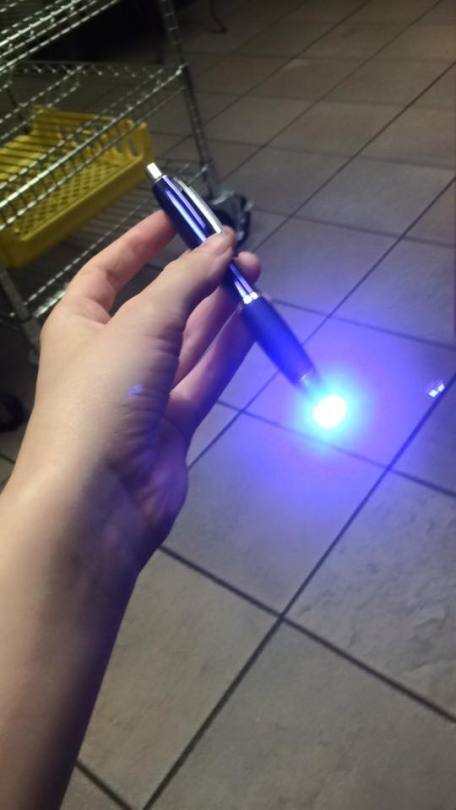
every time i hear that quote, i think about how i got this light-up pen
i got this pen four years ago when i was working as a barista at starbucks. I was on the registers and taking the order of this woman, who ordered a nonfat latte, because she was “watching her weight”
so this guy behind her, whom no one was talking to, for some fucking reason says “wathing your weight? but what about the wait for your watch?“ (which is a completely unhinged response. like just complete Mad Hatter nonsense)
anyway this lady gets really uncomfortable and of the five people (me, him, her, the other checker, and the customer at the other register) who were now sucked into the uncomfortable silence, i decided that i should alleviate the tension by saying “you can’t wait for a watch; you don’t have the time”
and then he said “oh, quick girl!”, gave me that pen, got out of line, and left without ordering anything
Please be aware that this survey may be triggering or upsetting to people with emotional issues around weight or diet, and I don’t recommend taking it if thinking about weight causes you distress.
Feel free to reblog; the more people who take this (and the further they are from my social bubble), the better the data will be.

 Urocyon's Jaunts 2.0
You must be logged in to post a comment.