The underground homes, often a
century old, are topped with gardens exploding with lush dune
grass, diamondleaf willows, and yellow wildflowers—a flash of color in
an otherwise gray landscape.
“They’re bright green and everything around them is just brown,” says Brian Person, a wildlife biologist for the North Slope Borough in Barrow, Alaska. “It pops”…
I can die happy now that I know this fact.
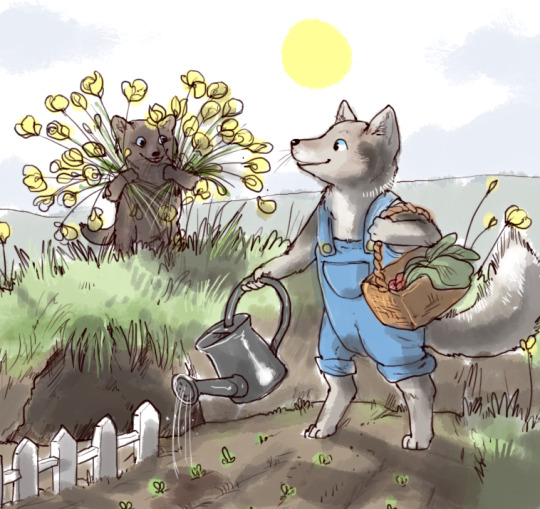
I am now picturing soft little foxes with watering cans and spades planting and tending to their Fox Gardens
Spectacular Day with J Pod! To read this story (and more!), follow the link in our bio⠀
Photo: J53 “Kiki” by @gary_j27⠀
#whaletales #whale #killerwhale #orca #SRKW #JPod #whalewatching #sallishsea #exploreBC #getonaboat #breach #storytelling #whalesareawesome #whalesofinstagram
The first two films I see are “Dances with Wolves” and “The last of the Mohicans.” And that will not do it for me.
I’ve attended the American Indian film Festival for the past four years now and have enjoyed all those experiences very much. I’ve attended with women I work with, friends and classmates, and have seen familiar faces within the Bay Area. But the most common thing i think all of us that attend share is that we’re looking for a good story.
A story with humor and wit, truth and sadness, history and contemporary, love, romance and sex.
(yes, you can find films about native people without male protagonists that include all those elements if you just look)
I look for a good story that will take me somewhere and share something with me, a contemporary story, a modern one that talk about history and how it affects but also focuses on the now.
Films made by Native Directors and starring Native actors.
Here is a list of films I’ve seen over the years, not just over the past four but with family. Enjoy and please add to the list if you have any recommendations.
(Documentaries, Historical films, feature films)
Running Salmon Home
Rebel Music: Native American
Young Lakota
The Activist
The Cherokee Word for Water
Shouting Secrets
Whale Rider
SKINS
DreamKeeper Rhymes for young Ghouls Road to Paloma Smoke Signals The Lesser Blessed Winter in the Blood Dance me Outside Reel Injun(documentary)
One of my favorite linguistic phenomena is rebracketing, which is when a word or words is/are redivided differently, either two words becoming one, one word heard as two, or part of one word interpreted as part of the other. This frequently happens with articles, for example:
apron was originally napron, but “a napron” was interpreted as “an apron”
newt comes from ewt by the same process
In the opposite direction, nickname comes from Middle English nekename which in turn came from ekename (an ekename -> a nekename) where “eke” was an old word meaning “also” or “additional” (so basically “an additional name”)
ammunition comes from an obsolete dialectal French amunition, which came from munition, the phrase la munition being heard as l’amunition.
the nickname Ned comes from Ed, via “mine Ed” being heard as “my Ned” (in archaic English, “my” and “mine” had the same relationship as “a” and “an”), same with several other nicknames like Nell
The word “orange” ulimately derives from the Arabic nāranj, via French “orange”, the n being lost via a similar process involving the indefinite article, e.g., something like French “une norange” becoming “une orange” (it’s unclear which specific Romance language it first happened in)
in the Southern US at least (not sure about elsewhere), “another” is often analyzed as “a nother”, hence the phrase “a whole nother”
omelet has a whole series of interesting changes; it comes from French omelette, earlier alemette (swapping around the /l/ and /m/), from alemelle from an earlier lemelle (la lemelle -> l’alemelle)
Related to this, sometimes two words, especially when borrowed into another language, will be taken as one. Numerous words were borrowed from Arabic with the definite article al- attached to them. Spanish el lagarto became English alligator. An interesting twist is admiral, earlier amiral (the d probably got in there from the influence of words like “administer”) from Arabic amir al- (lord of the ___), particularly the phrase amir al-bahr, literally “lord of the sea”.
Sometimes the opposite happens. A foreign word will look like two words, or like a word with an affix. For example, the Arabic kitaab (book) was borrowed into Swahili as kitabu. ki- happens to be the singular form of one of the Swahili genders, and so it was interpreted as ki-tabu. To form the plural of that gender, you replace ki- with vi-, thus, “books” in Swahili is vitabu. The Greek name Alexander became, in Arabic, Iskander, with the initial al- heard as the article al-.
Similarly, the English word Cherry came from Old Norman French cherise, with the s on the end interpreted as the plural -s. Interestingly enough, that word came from Vulgar Latin ceresia, a feminine singular noun, but originally the plural of the neuter noun ceresium! So a Latin plural was reinterpreted as a singular in Vulgar Latin, which in turn was interpreted as a plural when borrowed into English!
The English suffix -burger used with various foods (e.g., cheeseburger, or more informally chickenburger, etc.) was misanlyzed from Hamburger as Ham-burger, itself from the city of Hamburg
This can happen even with native words. Modern French once is used for the snow leopard, but originally meant “lynx”. In Old French, it was lonce (ultimately from the same source as lynx), which was reinterpreted as l’once! In English, the word “pea” was originally “pease”, but that looked like it had the plural -s on it, and so the word “pea” was created from it. Likewise, the adjective lone came from alone, heard as “a lone”, but alone itself came originally from all one.
One of my favorite personal examples is the old Southern man who would come into work and ask me if I was “being have” (as opposed to the more usual “behaving”).
the word editor predated the word edit – editor was reinterpreted as edit-er, so clearly someone who edits!
when your open borders advocacy extends to morpheme boundaries
Don’t forget the Swahili kipilefti (”roundabout”), from English keep left, with a plural vipilefti – and in reverse, singular kideo (”video”) with plural video.
I know everyone is laughing about jondom, but this is actually a really cool product. The Jeans condom is part of India’s push to promote condom usage. With the advent of Tinder culture, India is pushing for men to not leave home without a condom. The idea behind Jeans is that you wouldn’t leave home without your jeans. They even are sold in pairs. The packets themselves have a plain denim design, rather than a couple or a scantily-clad woman, which is apparently most popular there. This was done intentionally so the condoms could be sold on the counters of stores and so that people wouldn’t be afraid to pick them up. The packets themselves are the thinnest yet and are designed to not be visible in your pocket. Durex is trying to combat cultural stigma to make sex safer in a country that typically has a lower percentage of condom use and it’s really cool.



 Urocyon's Jaunts 2.0
You must be logged in to post a comment.