There are posts going around showing airlines charging several thousands of dollars for one-way tickets out of Florida and I just want to clear some things up. This was spread around yesterday and is NOT the price the airlines are charging. The image that was spread from Delta was from a third party website and the person who originally posted this image has come out and said everything has been cleared up. I even heard this story on the radio coming home from school so just to clarify:
JetBlue is reducing their fares. Remaining seats will be between $99 – $159.
American Airlines is capping the prices at $99. This is for standard cabin fare and means that prices will not exceed this cost.
Delta is capping their prices at $399. This also means that prices will not exceed this cost, however this also includes first class so standard prices will be lower than $399.
Airlines like American and Delta have also added flights and brought in larger planes and waived change fees for passengers who need to cancel or rebook their flights.
If you still need to get out or were worried about these prices then I hope this clears everything up. Note that flights will start cancelling once it becomes too dangerous for planes to fly so make sure to call ahead and keep checking for updates at your airport.
As the East Coast braces for a potentially catastrophic hit from Irma and disaster response is in full swing in Houston, a people obviously want to know what they can do to help. The politics of disaster response regarding animals can be complicated, so here’s some quick information:
Pets:
If you want to donate money, the best thing you can do is to donate it to a rescue organization local to the area that was hit. These smaller organizations often need the help the most, and it’s important to support the local businesses that are likely dealing with storm damage themselves (I wish I had a list of local rescues to recommend – please feel free to add suggestions in the reblogs or comments).
If you want to adopt an animal post-Harvey and you live somewhere else in the country, or your shelter is asking for donations to support rescued animals from the storm, double-check that they’re only adopting out animals that were already living in shelters before the storm hit. After Katrina, a lot of animals who had families waiting to reunite them were transported across the country to other shelters – so just check and make sure they’re not actually adopting out animals who might have families back in Texas.
Don’t donate to large animal advocacy organizations that have gotten involved unless you’ve vetted their work very thoroughly. HSUS and PETA have both shown up in the Houston area and are doing massive fundraising drives for their efforts there, but before choosing to donate to them keep in mind PETA’s track record for euthanizing adoptable animals and the fact that HSUS only put a fraction of the donations they received post-Sandy towards helping animals impacted by that storm. There are some seriously iffy posts coming out of Texas about the conduct of HSUS and the ASPCA regarding their takeovers of local rescue efforts and the disappearance of large numbers of dogs – I can’t vet the truth of those reports, but given the previously known conduct of these organizations, it may just be worth staying clear of them if you want to be sure your money is actually going to help animals. (IMPORTANT: HSUS is NOT associated with local Humane Societies unless their website explicitly states that affiliation, so those groups are fine to donate to).
Wildlife:
Donate to wildlife centers and rehabs, as they’re likely taking in a huge number of animals after the storm. The Houston SPCA Wildlife Center of Texas is one facility that has been reported on needing help to care for the sheer number of animals brought in by concerned people post-Harvey.
If you like bats, consider contributing to the Bat World Sanctuary – they’ve taken in over 400 rescued bats that lived under the bridges in Houston.
Zoos:
The zoos in Texas are working together to help affected facilities – it’s been great to see facilities and trade organizations that normally compete with each other putting all that aside and collaborating on disaster response. When it comes to helping out zoos after Harvey, there are two things you can do: donate to the zoos, and donate to the zookeepers.
The Texas Zoo in Victoria was really hard hit by the hurricane, with
mature trees were blown onto most of the buildings and several exhibits, causing major damage and all buildings on site flooding. Their animals are currently housed with other zoos while they repair the damage – you can donate directly to them here.
The San Antonio Zoo is taking donations to help fund disaster relief for zoos across the state, and although their website doesn’t specify which facilities, news articles indicate they’re involved with helping both the Texas Zoo and the Downtown Aquarium in Houston.
The Downtown Aquarium in Houston does not have a direct donate link on their website, but news reports indicated there was flooding in the building during the storm.
The zookeepers in the areas affected by Harvey also need help to rebuild their lives after the storm, as many of them lost quite a lot to the storm.
I don’t think people have any concept of how complex and costly legal immigration is.
I just went through a legal immigration process, and my husband—a professor with a PhD—had to do hours of research and triple check every form to make sure it was accurate. We had to have multiple photos taken, get fingerprinted, submit packets of paperwork. And then there were the fees, which run into the thousands. Even with our salaries as two people with advanced degrees we could barely have afforded it all on our own (we were fortunate enough to have family who could help us with the cost).
This whole expectation that people in dire straights, especially those from war-torn or poverty-stricken areas, can “do it the right way” when it comes to US immigration is such a complete fallacy, because with all the barriers in place (language barriers, financial barriers, etc.) there’s literally no way most of these people could ever escape the situations they’re in via this route—and if they had those resources, there’s a very good chance they wouldn’t need to leave their homes in the first place.
Immigration is difficult and expensive. It was taxing for us and we were effectively sponsored by a government organisation. Either accept that the process is to immigrate to the US is broken or admit that you think most people should just suffer instead of seeking better lives for themselves and their families.
Rocio Fuentes weighed up the cost of getting some new sofas for her new apartment in Pasadena, Texas, and decided the family budget could just about stretch to it. Just one month after moving in, Hurricane Harvey swept through and the Fuenteses were left not only with the ruined furniture but also an ongoing rental demand for a dwelling they had to flee.
“At first we didn’t think it would be that bad, but then the water came through the wall and up through the carpet,” Fuentes said. “Once we saw the water wasn’t going to stop, we left.”
Fuentes, her husband Jaime and their five children, ages ranging from seven months to 14 years, were plucked from the floodwaters by her mother, who arrived in a truck. They are now crammed into her sister’s apartment and with no insurance have little idea where they will live next. Jaime is unable to earn money because his construction job has been paused due to the flooding.
But while everything has changed for this family, they are still expected to pay for their abandoned home.
“Our landlords say we have to pay rent and late fees and every day it is going up,” Fuentes said. “We are paying rent for somewhere we can’t live in. They said ‘you aren’t the only ones in this situation’, but what are we supposed to do? We don’t have any money. We don’t have anything.”
Capitalism is evil.
Like some of the other comments in this are saying, legally a lot of landlords can’t actually charge rent in a situation like this, so if you find yourself in this situation, you do have legal recourse.
In Texas, the tenant law dictates that you have a right to demand that the landlord repair any condition that materially affects your health and safety. Under Texas law, by renting you the property, the landlord guarantees that the unit will be a fit place to live.
So if it’s dangerously flooded and unhygienic THEY have to fix it, not you, and you can break your lease with no penalty or have the landlord court ordered to repair it. Most states have laws like this, so actually the landlords here are risking lawsuits and people legally nailing them to the wall by trying to charge on units that are unfit for habitation.
These landlords are really stupid because apartments that are flooded out and growing black mold are going to be impossible to prove as healthy and safe. They’re just trying to take advantage of people not knowing their tenants’ rights to eke rent out of them for as long as they can before the tenants realize they actually can’t do that.
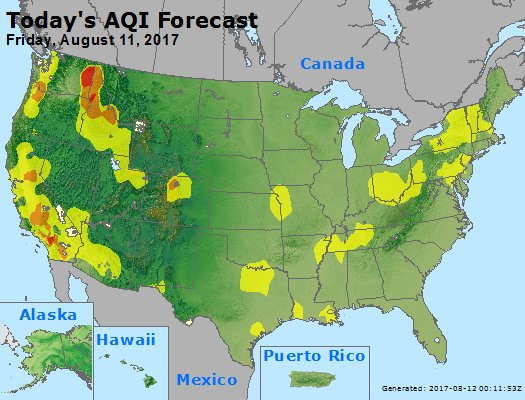
Primarily, I looked these things up for wildfire and general particulate pollution checks and.. well, the color code is this:
and the rating for most of my state– let alone anywhere effected by flooding [ie Louisiana atm] is “Unsafe for sensitive groups” and “Unhealthy”. The guide for the ratings is found here.
I just wanted to share it because when people talk about pollution in the air, they don’t talk about fires, or how the particle pollution heavily comes from said wildfires and how the west coast suffers under a prolonged fire season as well. It’s a subject that needs to be paid attention to. As an asthmatic living square in one of the more northern red blobs, it needs to be addressed.
Add smoke and ash to what we generally put into the air and we’re all gonna bake/choke to death. If something isn’t done, we’re going to be in dire straights, not just because of the environment, but because of resulting health issues in elderly, children, and vulnerable people.
When I said please boost, I meant please reblog this. No one talks about how the western US goes up in flames and much less how the air quality goes to shit every year.
With Tr*mp in charge, pay to firefighters is backed up months behind schedual. People cannot personally afford to go fight fighters, departments can’t afford to go help other departments fight them. Public awareness campaigns are not being planned and put into action to keep people inside/aware of how to keep healthy and to reduce fire risk.
Unless people are seeing the particles in the air, they aren’t considering it a threat and this is a problem. I’m not the most environmentally versed person and i’m not a scientist, but people need to know about it. Things like ash and smoke drift over the continent and affect much more than their local area.
So please– spread this!
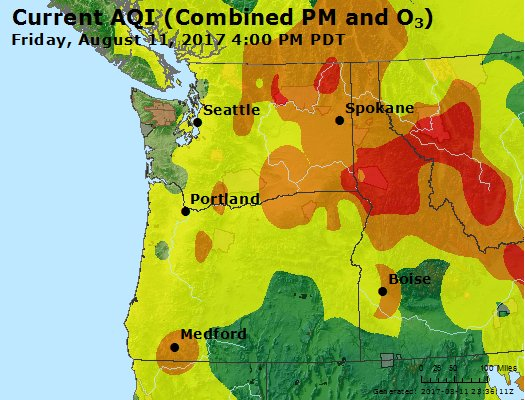
I wanted to know what it looked like currently and…
My area is in the orange, it was yellow this morning when I walked out to the car to find it lightly covered with ash.
but seriously why do people feel the need to avoid the word ableism?
an abled person using disabled bathrooms/parking spaces/elevators isnt just a “shitty thing to do” my guy its ableist as fuck.
an abled person openly hating a disabled person simply because they are disabled, believing they shouldnt have certain rights or certain necessities because they are disabled, isnt just shitty IT IS ABLEISM.
someone believing a disabled person should have to go into debt to pay for medical bills and that they shouldnt be able to get accomodations or help to survive, it isnt just a shitty thing to think, its ABLEISM.
just say the fucking word people it isnt hard, dont talk about discrimination against disabled people as if its just annoying or shitty or mean, ITS DISCRIMINATION, ITS ABLEISM, SO CALL IT ABLEISM.
im so tired of people openly trying to avoid the word.
i’ve been reading about this sort of thing lately, especially wrt uspoli – where people condemning ableism refuse to acknowledge that that’s what it is, and just call it “mean” or “in poor taste” or whathaveyou –
and the best breakdown of it i’ve read/pieced together is that everyone tsking and shaking their heads at ableism, are in fact shaking their heads at crass behaviour and a lack of discretion when discriminating against disabled people.
calling ableism what it is – discrimination, marginalization, oppression – would mean that these people would have to examine their own behaviour and beliefs.
when 45 mocked serge kovaleski for example, he wasn’t mocking a disabled man with great skill and many achievements – he was mocking a person with a disability which is a no-no because that poor man can’t defend himself and why would you behave with such terrible manners and what do you mean, disabled people can advocate for themselves? surely their disability renders them entirely helpless and etc.
people across all political spectrums are guilty of neglecting to acknowledge the full humanity of disabled people, and i think that’s where the root of sidestepping the word ableism lies. if they were to acknowledge that disabled people are whole people, they’d have a much harder time ignoring all the ingrained beliefs that dispute that fact, and the abounding policies that seek to deny it.





 Urocyon's Jaunts 2.0
You must be logged in to post a comment.