I mean, gonna be real, part of how I deal with ANY breakup is going out and reading crushingly sad, heartbreaking fic about terrible relationships to give me a reason to cry that isn’t endlessly agonizing over my ex. It’s catharsis, a badly needed distraction, and sometimes even a support network if I get involved in the fandom. And it works, so there’s that.
Like, sure, there’s a unique aspect to using fiction to cope with serious trauma, but it works for the same reasons in everyone. Sure, maybe we could deal with less traumatic events without fiction, but we don’t have to; that’s the whole point.
Trauma isn’t always proportionate to the expected scope of the traumatic event, either.
People can sometimes undergo traditionally traumatic experiences – a sexual assault, a combat situation with bombs going off – and take minimal emotional damage from it. Other times things that seem much less blatantly traumatizing can do permanent harm, because of how they intersect with someone’s past experiences or mental weak points.
Lots of autistic people wind up with unconventional types of trauma because we’re primed for it by cultural gaslighting and reactive neuroendocrine systems.
Sometimes the stories we need to write and read are not about the exact events we’ve experienced, because sometimes we have too much aversion to them, or the thing that makes them traumatic isn’t easy to make visible without reflecting into other things.
I have invisible disabilities and sometimes it’s easier to confront my relationship with my body by writing about characters dealing with pain and damage that is visible to others. In my daily life I often can’t navigate what it would take to have these personal bodily betrayals witnessed, seen, cared for; I have enough baggage around my own disabilities that it’s often hard for me to accept that care even when it’s possible for other people to recognize and offer. (Early in life my being in pain was often dismissed or not believed.)
So it’s absolutely understandable to me that people write about one kind of sexual or emotional trauma when they’re dealing with another, because I write about different kinds of physical trauma than the ones I’m experiencing.
Lots of autistic people wind up with unconventional types of trauma because we’re primed for it by cultural gaslighting and reactive neuroendocrine systems.
My favorite professor ever introduced me as an undergrad to the concept of “impossible history” – histories that can not exist, even though they happened. His example was the Haitian Revolution. The Haitian Revolution cannot exist within the logics of capitalism, imperialism, and white European dominance. Enslaved black people liberating themselves without the help of “friendly whites?” A tiny island in the Caribbean, with an army of the aforementioned former slaves, defeating multiple global superpowers? Impossible! So this cannot be allowed to have happened. Haiti must be economically victimized forever, moreso even than other former slave colonies in the Caribbean, just so that we can point to it and say “look, how sad,” so that no one gets to see Haiti’s very existence as the triumph it is. We teach extensively about the American and French revolutions, but only mention in passing the Haitian Revolution which occurred at the same time. Most college courses on Latin American history exclude Haiti even if they cover the rest of the Caribbean. The Haitian Revolution was impossible, a dangerous fantasy that just so happens to have actually happened. So it must be forgotten, the name of Haiti must be made synonymous with poverty, ignorance, and suffering, while never mentioning that those are all the products of 200 years of political and economic warfare and subterfuge against the island, beginning with the presidency of Thomas Jefferson!! Because we cannot have anyone thinking that even the most poor and downtrodden people. when united and organized around a common cause, can make history and change the world for the better
This is the thesis of Michel Trouillot’s book, ‘Silencing the Past’. I am sure that’s where this professor got this from.
Yep! Sorry, I just wrote this post as a ramble and didn’t expect it to spread much. The professor who relayed this to me is Alexander Aviña, a fantastic historian of Mexican radicalism who teaches at Arizona State now
One (of many) examples of how they were screwed over, from wikipedia
“Haiti’s legacy of debt began shortly after gaining independence from France in 1804. In 1825, France, with warships at the ready, demanded Haiti compensate France for its loss of slaves and its slave colony. In exchange for French recognition of Haiti as a sovereign republic, France demanded payment of 150 million francs. In addition to the payment, France required that Haiti discount its exported goods to them by 50%.[3] In 1838, France agreed to reduce the debt to 90 million francs to be paid over a period of 30 years to compensate former plantation owners who had lost their property.[4] The modern equivalent of $21 billion was paid from Haiti to France.[5]
If you would report an undocumented immigrant to ICE you would have reported me to the Nazis and I don’t fucking trust you
A note:
I live in a state where you “have to” report anyone you suspect of being undocumented (that wonderful hellhole of Arizona). Now in practice this law has fallen far short, thank goodness. But if you live in such a place and they start enforcing it, here is how you get around it:
Assume everyone who doesn’t speak English is visiting.
Never ask about their job, because if they tell you they work here then you know they’re not visiting. You see them a lot for several weeks or months? Hm. Someone in the family must be ill. That’s terribly tough. They always dress in old, ratty laborers’ clothes? I feel you, my dude, I can’t afford new clothes either, and my dad has the fashion sense of an aardvark, so sometimes it’s not even about “affording” them. They say they’ve been here for years? You must have misunderstood. Spanish isn’t your first language, after all. First and last name? It never came up, or you don’t recall–you meet a lot of people.
And then, if you’re asked: no, you haven’t seen anyone residing illegally in the United States. Just people visiting.
Very good very important addition
Essentially, this is the civil society version of a work-to-rule strike.
Don’t do more than is expressly asked of you, and do what you are asked with such an intense attention to protocol that not asking you at all becomes more effective than even bothering.
In this case:
“Have you seen an illegal immigrant?”
“Could you describe an illegal immigrant, officer?”
*officer describes a person who is in the country without appropriate paperwork, or who has crossed the border illegally*
“No, sir, I haven’t seen any illegal immigrant.”
And this is correct. You have NOT seen an illegal immigrant, because you have no way of knowing if Jose Fulano is here legally or not. And since you can’t see his paperwork (or lack thereof), and did not personally see him cross the border illegally, you are only answering precisely the question asked.
I’m not American, and I have like, three followers, but this is important.
Please please please read this
I spent most of my childhood in court trying to keep my parents in the country since we live in Arizona
It’s fucking terrifying
Even though they’ve always had paperwork, if you happen to be caught without it at the moment the police arrive, they deport you.
So if you’re in this situation (and aren’t a piece of shit) just try this, because even if people are here legally (or not) families get torn apart.
What y’all think ‘gifted child’ discourse is saying: I used to be special and now I’m not and that makes me sad.
What ‘gifted child’ discourse is ACTUALLY saying: The way many educational systems treat children who’ve been identified as ‘gifted’ is actively harmful in that it a. obliges kids to give up socialising with their same-age peers in favour of constantly courting the approval of adult ‘mentors’ who mostly don’t give a shit about them, b. demands that they tie their entire identity to a set of standards that’snot merely unsustainable, but intentionally so, because its unstated purpose is to weed out the ‘unworthy’ rather than to provide useful goals for self-improvement, and c. denies them opportunities to learn useful life skills in favour of training them up in an excruciatingly narrow academic skill-set that’s basically useless outside of an institutional career path that the vast majority of them will never be allowed to pursue.
What prokopetz thinks I’m saying: I miss being elite
What I’m ACTUALLY saying: you’re telling the disabled misfit most people hated that calling her smart was bad for her. does a modern day version of her get any compliments at all now or nah
What middle class people on the internet think I’m saying when I bring up giftedness: Hi, I’m an arrogant narcissist and my mother trained me with flash cards and used me as an extension of herself and also she didn’t want me in the same classroom with kids who weren’t white and rich, and I think I’m special and smarter and better than everyone.
What I’m actually saying: I grew up and still am working class, my mother didn’t have the resources and knowledge and social capital of a middle class mother and she never advocated for me and she was never pushy about me at school, she certainly didn’t pressure me and train me with flash cards, and my brain works differently than normal and some of the differences fit into a pattern that our society calls “gifted” and that doesn’t mean that I’m better or worth more than anyone else. Different is different, not better or worse.
I think that the middle class experience of growing up with the gifted label is extremely different from the working class experience, and that causes a ton of communication problems.
Really though even within the same group, people can have very different experiences based on their parents, their schools, the culture of their particular area, their personality, their circumstances, etc. And then we universalize our experiences and assume that’s how it was for everyone and we start yelling at people as soon as they mention the word, without thinking about how their experience was probably vastly different from ours.
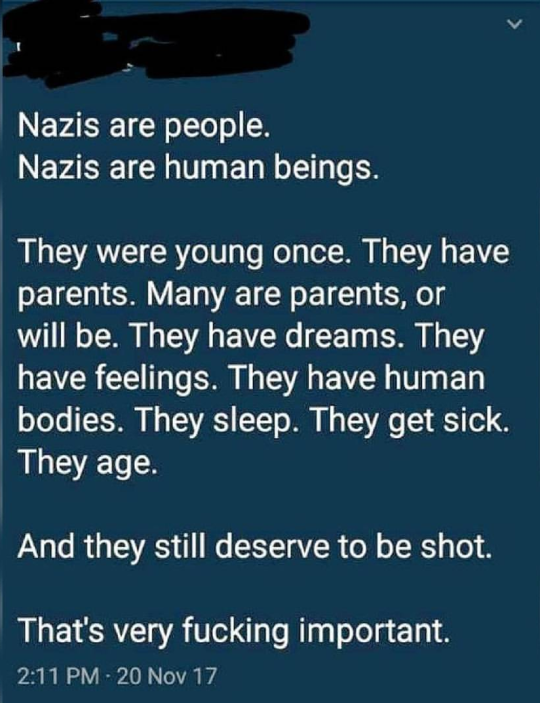
Twitter made the Jewish lady that posted this delete it for “threatening violence.”
Her followers spent the rest of the day tweeting this. Trolls couldn’t keep up.
Coming from someone who studies the Holocaust and the history surrounding it, It is important to remember that Nazis were human, not monsters.
It’s important because if we dehumanize them we create a level of separation between us and them. It’s important because if we create that level of removal, we start ignoring the subtle signs of antisemitism because “Oh, well they’re just a normal human, not a monster, i’m sure it’ll be alright.” It’s important because when we create that level of removal, they come back in waves. It’s important because when you create that level of separation, you get the problems that we have now.
There is a very simple set of brain equations involved when we dehumanize the enemy, and it goes something like this:
“Nazis are monsters” “I would not be friends with a monster”
The CORRECT conclusion is “I cannot be friends with Nazis”
BUT PEOPLE KEEP BELIEVING THE COROLLARY “None of my friends are Nazis” “…even that one guy who keeps posting ‘ironic’ Pepe memes, who never really grew out of his 4Chan /pol/ phase, and who keeps trying to have really intense conversations with me about ‘globalists’. But he’s my friend! I’ve known him forever! He doesn’t REALLY believe any of that stuff. He’s just kind of an asshole, and we love him anyway.”
This is a very bad corollary. It is an extraordinarily dangerous corollary. When we sincerely believe that we would not be friends with bad people, we ignore the signs that our friends are bad people.
(Friendly note: you can replace “Nazi” above with “sexual predator” or “racist” or “abuser”. Same hat, pretty much. There are very real reasons not to dehumanize the enemy, and they have nothing to do with the enemy’s right to humanity, and everything to do with the enemy’s ability to sneak past our lines wearing a nice-person mask.)




 Urocyon's Jaunts 2.0
You must be logged in to post a comment.