@katisconfused – That sounds like enough fun to deal with
Maybe not surprisingly, one of the things that led to that split was his abusive behavior toward my mother escalating and getting more blatant. That episode, in retrospect, was pretty much the intro to his going full-on classic stalky Divorce Related Fetid Fathering Syndrome–an unfortunately spot-on parody–and dragging other people into things more to try and hurt her. (Though he was the one who left.) Including kids and the poor dog besides the court system, yeah
Glad from the other thing you posted earlier too, that it didn’t sound like that kind of thing was a problem for you. More normal pissed-off human jerky behavior can be enough joy sometimes,though.
My dad was a veterinarian in the meat animal industry so here is an explanation of why medium rare is a thing with steaks, but not chicken:
In beef, what you worry about is e. coli. In healthy live cattle (and they must be healthy to be butchered for consumption) e. coli is only in the digestive tract but it can escape and contaminate the outside of the beef during slaughter and butchering. The bacteria does not migrate to the interior of the meat as there is no circulation to take it there. So you can eat beef where the inside is less cooked as long as the outside is well seared to kill any bacteria that may be on it. Hamburger should always be thoroughly cooked because it is all “outside”.
With chicken, the concern is salmonella, which is found through out the body of the chicken. Chickens can tolerate it, it doesn’t make them noticeably sick, but humans can not, so the entire meat must be cooked enough to kill any bacteria present in the meat. As a note, it used to be believed that salmonella was not passed on to the eggs and in fact in the 1950′s, when my dad was in Vet school, studies showed it was not present in the eggs even if it was present in the hen. That’s why there used to be a lot of recipes that used raw eggs, it was safe then. However due to some change in the bacteria, or changes in egg-farming practices, it is now found in eggs as well. The amounts are small, and if you are eating eggs within a couple days of being laid it’s probably not a problem, but store eggs are old enough for bacteria to have reproduced to dangerous levels and the liquid interior allows it to spread all through the egg.
As a side note, with pigs the concern is trichinosis, a parasite that used to be common in pigs and spread to humans through under-cooked pork. However, it has been essentially eliminated in commercially produced pork these days. It should be safe now to eat “medium rare” pork, but trichinosis was so horrible and the fear of it so ingrained that it is rare to see pork that is not well done.
Salmonella control in Sweden – They managed to pretty much do away with it there, in meat and eggs both. And raw eggs are supposed to be safe again here in the UK. (Where the big “salmonella crisis” in the ‘80s sounds like the usual accepted state of affairs as long as I can remember back in the US.) It is totally possible to improve farming and handling practices to keep salmonella from spreading, with some effort.
Eating undercooked poultry is still not a great idea, with camphylobacter to consider too, internationally. (With some efforts to get levels of that down in the food supply too, yeah.)
There are probably some other reasons eating raw poultry isn’t a great healthy plan, but salmonella and camphylobacter seem to be the bacterial biggies.
The sword-billed hummingbird is noted as the only species of bird to have a bill longer than the rest of its body. This adaptation is to feed on flowers with long corollas such as Passiflora mixta. The tongue is therefore also unusually long.Since the sword-billed hummingbird’s beak is very long, it preens itself with its feet.
Peter Mitchell worked as a truck driver in Leeds in the 1970s, photographing the city during his rounds. These fascinating portraits of factories and small shop owners in Yorkshire and London are found on his website Strangely Familiar
Rescuing “Neon Dragons” – Support for Endangered Fiji Iguanas
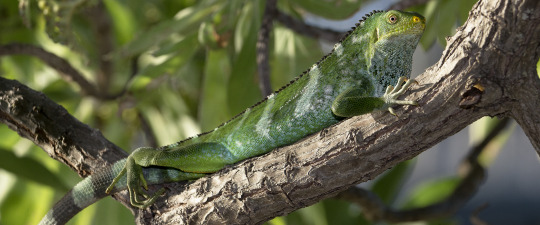
They don’t fly or breathe fire. But brightly colored Fiji iguanas do look like tiny, scaly creatures from a fanciful medieval legend. It’s no wonder one researcher described these endangered iguanas as resembling “neon-colored dragons.”
By Eston Ellis Photography by Tammy Spratt
Unlike storybook dragons, Fiji iguanas
are mellow creatures that have no fear of humans and will sit on an
outstretched hand or atop a shoulder—but they would rather be in a tree.
They spend their days in the canopy of wet and dry forests on the
islands of Fiji, where they enjoy munching on leaves, buds, fruit, and
flowers—especially vau, or tree hibiscus. And they rarely leave the trees, except to lay eggs or seek shelter during a tropical storm.
Despite their fondness for a lush arboreal life, Fiji iguanas’ closest
relatives are the sand-colored desert iguanas found more than 5,500
miles away, in Southern California and Northern Mexico. How iguanas got
to Fiji is anybody’s guess, but many researchers believe they arrived
millions of years ago, before the islands of Fiji broke away from a
larger prehistoric supercontinent.
Found nowhere else but on the islands
of Fiji and Tonga, Fiji iguanas can perfectly balance on leaves and
twigs as they make their way along the forest canopy—and their vivid
green skin color, sometimes accented by white or blue bands, helps them
blend into the surrounding vegetation. But they can’t run or hide from
the increasing threats to their survival, including invasive species
such as feral cats, rats, cane toads, and mongooses.
On some islands,
feral goats are eating the vegetation iguanas feed on. And
deforestation—from agriculture and increasing development—is destroying
much of their remaining habitat. Fiji iguanas are also vulnerable to
poaching for the international exotic pet trade. Smuggling attempts have
ranged from the brazen to the bizarre: one man charged with smuggling
was caught taking iguanas out of Fiji by concealing them inside a hollow
prosthetic leg…


 Urocyon's Jaunts 2.0
You must be logged in to post a comment.