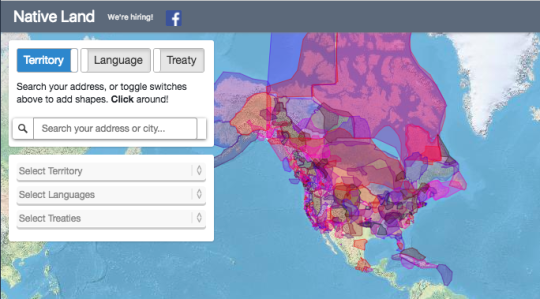
“One of the most distinctive things about the Native Land maps are the borders….Indigenous identities don’t map (pardon the pun) precisely onto modern European notions of nationality and territory…. Colonialism lives and dies by the map — and the carved-up world is so central to our perspective that many of us today see the earth’s lands primarily as chunks of nations….
The reality is just that borders don’t always function the same as the simplified maps imply when it comes to indigenous history; there is a lot more movement, overlap, and complexity than one nation on each chunk of land.”
The Aboriginal Mapping Network at nativemaps.org is a great site for finding resources (and a whole map community)! They got:
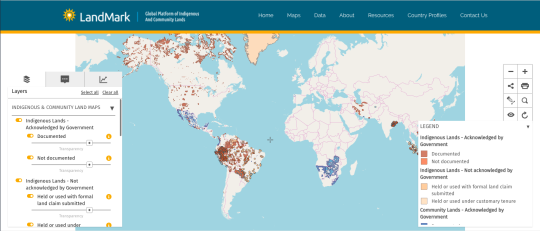
–Global ones like LandMark, an “online, interactive global platform to provide maps and other critical information on lands that are collectively held and used by Indigenous Peoples and local communities.”
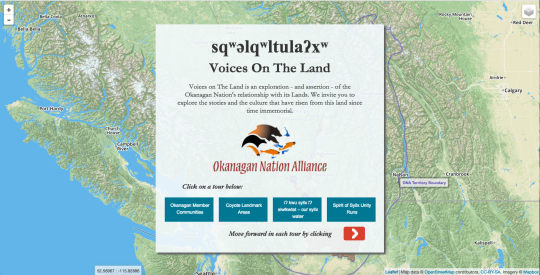
–Living Atlases created by nations and alliances like voicesontheland.org, created the Okanagan Nation
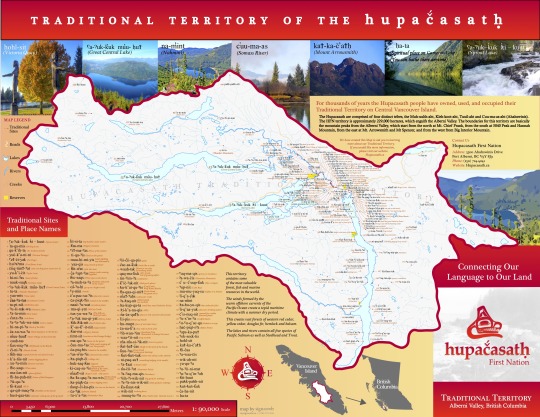
–More maps like these ludicrously pretty ones of Hupačasath lands, traditional sites, and place names. There are many, many more, and you’ll probably be able to find your region/people/language. Or just wander around!
-Links to Treaty Maps, this interactive map from the Canadian government, and historic maps like this series, which I like because it covers the early 20th century, which is often taught in classrooms as “After Indians.” Here are more maps of current populations and reservation lands in the United States.
Are none of these quite what you asked for? Yeah—I’m making a bit of a dig, but it’s not against anyone asking.
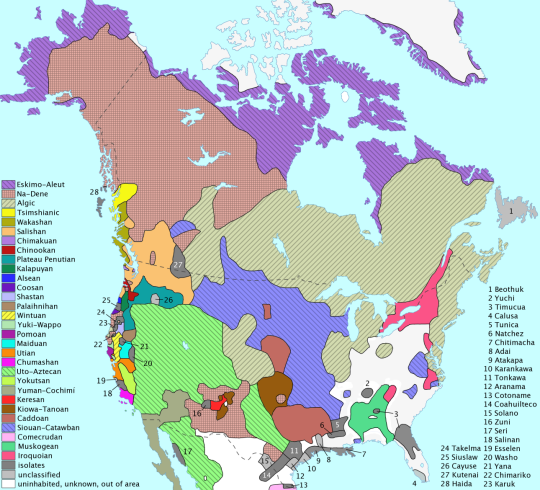
It’s against the fact thatthe map in the original post is from the 1970s. The linguistic theory has evolved since then; this is the map currently used in textbooks and even on Wikipedia. And I’m not talking about the level of detail, I mean there have been genuine changes in how scholars think the languages are related, and that has changed our picture of pre-Columbian historical events. It is very bonkers that the first map, which has been around long enough to look super dated to me,has never been taught this whole time.
This is the map you were asking for.
Land cessions animated by @sunisup from maps by Sam B. Hilliard of Louisiana State University, first published 1972.
I’m never criticizing anyone for starting with basic facts. We all should! I’m criticizing every history teacher you’ve had (and school board who limited the teacher, and college that didn’t prepare the teacher, and…) who didn’t do their job of tellin’ you the facts in elementary school, when you deserved to learn.
Facts about Native history aren’t Secret Wisdom. We don’t need a special reason to learn some facts. Native scholarship and Native scholars are thriving, so let’s explore their work, and question why information that exists has been deliberately overlooked so often.
Life for the medieval peasant was certainly no picnic. His life was
shadowed by fear of famine, disease and bursts of warfare. His diet and
personal hygiene left much to be desired. But despite his reputation as a
miserable wretch, you might envy him one thing: his vacations.
Plowing and harvesting were backbreaking toil, but the peasant
enjoyed anywhere from eight weeks to half the year off. The Church,
mindful of how to keep a population from rebelling, enforced frequent mandatory holidays.
Weddings, wakes and births might mean a week off quaffing ale to
celebrate, and when wandering jugglers or sporting events came to town,
the peasant expected time off for entertainment. There were labor-free
Sundays, and when the plowing and harvesting seasons were over, the
peasant got time to rest, too. In fact, economist Juliet Shor
found that during periods of particularly high wages, such as
14th-century England, peasants might put in no more than 150 days a
year.
As for the modern American worker? After a year on the job, she gets an average of eight vacation days annually.
What happened? Some cite the victory of the modern eight-hour a day,
40-hour workweek over the punishing 70 or 80 hours a 19th century worker
spent toiling as proof that we’re moving in the right direction. But
Americans have long since kissed the 40-hour workweek goodbye, and Shor’s examination of work patterns reveals that the 19th
century was an aberration in the history of human labor. When workers
fought for the eight-hour workday, they weren’t trying to get something
radical and new, but rather to restore what their ancestors had enjoyed
before industrial capitalists and the electric lightbulb came on the
scene. Go back 200, 300 or 400 years and you find that most people did
not work very long hours at all. In addition to relaxing during long
holidays, the medieval peasant took his sweet time eating meals, and the
day often included time for an afternoon snooze. “The tempo of life was
slow, even leisurely; the pace of work relaxed,” notes Shor. “Our
ancestors may not have been rich, but they had an abundance of leisure.”
Didn’t origininally comment on this but there seems to be some sort of discourse going on in the notes so:
Firstly: Yes, this isn’t the most rigorously sourced article. But it’s a sentiment I’ve seen expressed before, including by Serious Historians, so I’m inclined to believe that there’s a kernel of truth in it.
Secondly: A lot of people seem to be under the impression that the only reason you’d share something like this is because you think it’d be great to return to medieval society. This is ridiculous and even the excerpt above makes clear that no one’s claiming medieval life was wonderful. But things like this are important because it goes against the myth that all of history has basically been like the 19th century but with each aspect progressively getting worse the further back you go. In fact, the 19th century was in many ways a bit of an outlier. It’s very difficult to propose any meaningful change in society when you’re entire worldview is that throughout history things have been kind of like they are now but worse. Understanding the huge variety in how life has “worked” throughout time makes it seem a lot less outlandish that it could be significantly different in the future.
Exactly, I’ve no idea why anyone would assume “medieval peasants worked fewer hours than capitalist workers” means there was no oppression under feudalism or that it’s a system we should emulate now, people are reading this in bad faith just to defend capitalist propaganda
I was adopted into a family with several children, and one of the girls hated me and would always try to sabotage me. One time I tried to upload a drawing online and she kept using the computer so I couldn’t upload it. I strangled her and put my drawing online.
life with siblings
reading urls really does wonders and i wish i did it more often
reading urls really
does wonders and i wish i
did it more often
^Haiku^bot^9. I detect haikus with 5-7-5 format. Sometimes I make mistakes.
Disappointing each other includes you. | PayPal | Patreon
A declassified US State Department report from 1946 documented the abhorrent treatment of Poland’s Jews before, during and after World War II. The report equated Polish and Nazi treatment of the Jewish population and said many Jews preferred to flee, even to Germany, after the war.
The document, titled “The Jews in Poland Since the Liberation,” was obtained by the Simon Wiesenthal Center and shown exclusively to The Jerusalem Post on Wednesday, the same day a Polish governmental delegation arrived in Israel to discuss Warsaw’s contentious “Holocaust law,” which has caused a diplomatic crisis between the two countries.
“There is little doubt that the current anti-Jewish manifestations in Poland represent a continuation of activities by rightwing groups that were at work before 1939, when even major political parties had antisemitic programs,” the report said. “In other words, there is not much that is essentially new or different in the current antisemitic agitation.
However, the antisemitic overtones in prewar Polish politics predisposed many Poles to the acceptance of Nazi racial theories, and there is evidence that Poles persecuted the Jews as vigorously as did the Germans during the occupation. The retreating Nazis, moreover, left in their wake a heavy residue of their racial theories.
Even before the liberation of Poland, antisemitic propaganda emerged in Polish émigré circles.”The Intelligence Research report, dated May 15, 1946, was distributed by the US Office of Intelligence Coordination and Liaison as a restricted document.
it’s ninety-nine degrees outside, four fuck-thousand percent humidity, and my husband was like, “i’m gonna go for a bike ride.” and i was like “why. no. why. don’t put us on the news like that. local fool collapses on unnecessary journey. don’t do it.” so he says he doesn’t want to “hide in the house” because the sun is shining. bruh. honeybruh. “the sun is shining” does not cover it. its hot outside. its motherfucking hot as fuck outside. our outdoor plants have been crying into their hands all week. whole cars are melting into the sewer. our fucking patio umbrella developed sentience to ask me for lemonade this morning
@robotmango, you need to work for the weather forecast – this was both hilarious and so vivid it made me stand up and get some iced tea.
this is a great idea, thank you. here goes. my audition tape for the weather channel. dearly beloved. we are gathered here today to have a fucking funeral for the outdoors. it had a good run, with all its creeks and clouds and shit. pretty great. now it’s ten-thirty at night but still ninety-two asshole-sweating degrees and humid as fuck. everything is hot and slimy, like being a “borrower” that got trapped inside a bottle of shampoo and then accidentally microwaved. you can see on my doppler radar that nothing is moving around out there because everything is probably dead. the only alive thing is the mosquito currently trying to drill a hole in my leg. no surprise that all the shitbag mosquitos are fine, since the thermostat of hell is always at the devil’s preferred temperature. this forecast has gotten away from me a little, but in conclusion fuck the sun




 Urocyon's Jaunts 2.0
You must be logged in to post a comment.