when exactly did “oppression” come to mean “laws that are specifically and explicitly targeted at you,” and not things like “laws that they will be quick to assure you are not specifically targeted, they just happen to be a massive burden on you in particular,” or “housing discrimination,” “employment discrimination,” or FUCKING VIOLENCE?
kids aren’t starving to death for the most part, everything is a-okay, let’s cancel social progress and have a set-money-on-fire party instead
Well, I mean, as long as kids aren’t literally dying from lack of food.
Nevermind that kids who deal with food insecurity (meaning: they don’t always know when they’re next going to be able to eat, they’re frequently hungry without being able to solve that problem) struggle in school, because hunger is distracting, stress and worry (which are normal when you don’t have enough to eat) are distracting, and also if you’re running low on blood sugar your brain just can’t function at optimum. Nevermind that they frequently also struggle to behave ‘appropriately’, because hunger is frustrating and constant hunger is exhausting, not to mention the aggravation of knowing that it’s unfair that they have to be hungry when their classmates have plenty to eat, when food is getting thrown away in front of them. Nevermind that they’re much more likely to suffer from preventable illnesses, because chronic hunger fucks up one’s immune system and leaves one vulnerable to diseases, nevermind that malnutrition in childhood can permanently stunt people’s growth and development, causing chronic lifelong issues.
None of that matters. They’re not actually dying.
…hey anon? Get bent. You don’t have to have the worst possible problem out of a given category of “problem” in the world in order to have a valid problem that deserves to be addressed.
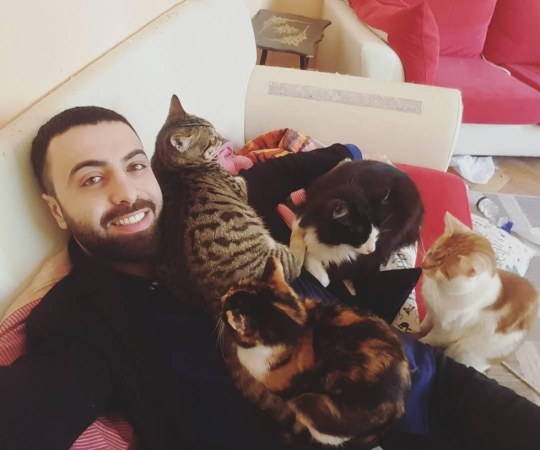
“i always play piano at my home almost every night and whenever i sit to play, all my cats come around, they hang out with me and they love to sleep around the piano.”
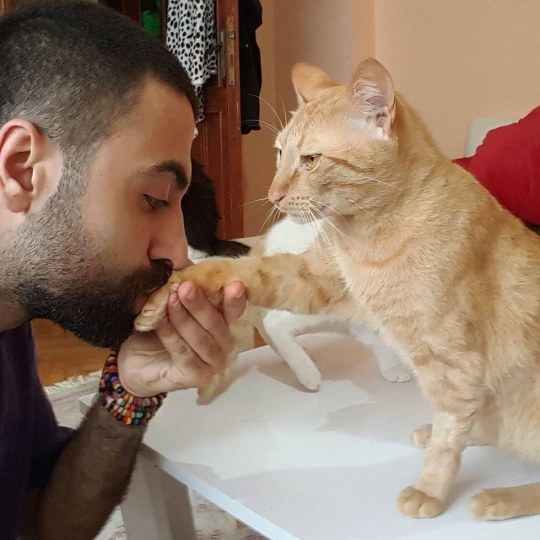
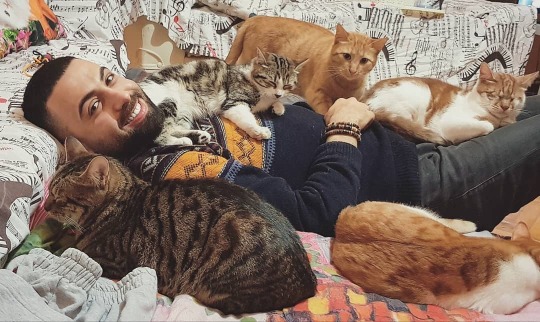
“they are peaceful, i am more at peace thanks to them”
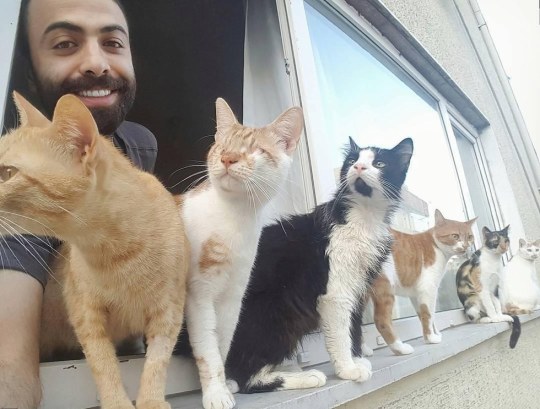
one of his cats is blind. "his happiest moment is at the window. listening to the birds, getting fresh air is our favorite activity. i hang out an hour every day at the window with my angel.“
Proposal for a new law: you get a maximum of ten million dollars.
Yep, no one living or doing business in the US is allowed to own more than $10 million in personal assets. Investments, savings, real estate, cars, gold, everything; you hit that cap, and anything over is seized and redistributed as no-strings cash payments to everyone else. You get caught sneakily using a shell corporation or offshore accounts or anything else clever to subvert that limit, it’s a criminal penalty. Greed in the First Degree.
I’ll be merciful here; that’s ten million per individual so your spouse and children can each have their own ten million, it’ll go up with inflation, and I won’t even include your house. (Maximum one house per adult, and only if you actually live in it, so don’t get creative. Farms/ranches can be counted as homes, but only if you live full-time and personally work on them.)
Yeah, this means that certain people would lose literally billions of dollars. But they’d still have ten million! How bad can you feel for them? That’s still enough money that you can livecomfortably without putting in another day of work in your life. It’s very hard to make a case that anyone needs more than that.
I haven’t worked out exactly what the redistribution payments would be, but my extremely-poorly-sketched guess is at least $50K per non-ten-millionaire person when the law first goes into effect. Not enough to be set for life, but it would be a hell of a lifeline for a lot of families. More importantly, there would be a continuing benefit from companies being unable to divert all their profits to upper management and wealthy investors. They’d have nothing to do with that money except reinvest it in workers and facilities.
And I wouldn’t worry about demotivating workers. If an ordinary person is debating whether it’s worth their time to go back to school or apply for a management position or open their own shop, they’re not going to be thinking “Why even bother? All I stand to earn is ten million dollars.” Not if they have any sense of perspective.
Oh, but high achievers will stop working or leave the country once they get their ten million. Good! That’s the point! They’ve earned all the money they need, so they should let someone else have a chance! If they love their job and don’t want to quit, they can still do it for a minimal salary and distribute the rest among their employees. Or they can quit, and we can learn that this whole “only ultra-rare magically gifted people can be successful CEOs, so they deserve to be treated like princes” thing was a wealth-worshipping myth anyway.
We’re in an economic emergency situation right now. 20% of households with children don’t have enough to eat. 500,000 people are homeless. More than a quarter of people struggle to pay their medical bills. Sorry, but it’s a sad fact: Ultra-rich people are a useless luxury that we can’t afford.
I haven’t thought through all the details or economic impacts or long-term consequences of this, but I think by now it’s clear that the people who make the real laws don’t either.
To all the people replying “but rich people will just leave”:
– Well I certainly hope the door doesn’t hit their asses on the way out. They have no irreplaceable talents or knowledge.
– There will be measures in place to prevent them from taking more than $10m with them when they move out.
– The US is a huge market and has a tremendously valuable workforce. My plan might not work for starting a new country on an empty island, but we’ve got shit worth sticking around for. Even if McDonald’s moves out, it will still be worthwhile to sell hamburgers to Americans. Even if Microsoft moves out, America will still have lots of talented software engineers. I don’t think we need billionaires to organize all our bountiful supply and demand into a functional economy.
– Foreign companies won’t be allowed to do any business here if any of their employees/partners/investors has over $10m. This will cut us off from a lot of business, but again, because we are the US and have so much to offer, it will be worthwhile for smaller foreign businesses to trade with us, or possibly even for large ones to retire all the rich guys to come into compliance.
– I’m not entirely serious about this and I’m no economist. I just wanted to entertain the notion of radically interrupting America’s slide into oligarchy, of taking action based on the premise that vast inequality is wrong rather than merely unfortunate. We have to do something about this situation, so fuck it, here’s something.
I like this idea.
It reminds me of an idea I’ve entertained with a similar level of semi-seriousness: requiring all holders of federal-level public office to donate their personal assets (money and real estate) to the government as a condition of taking office. For the duration of their government service, they live in assigned middle-class housing and receive a salary equal to the median income across the entire country. Whatever said income is at the time they leave office, that becomes their pension. They are barred from receiving income from any other source, for life.
It’s tyrannical and wildly impractical, but the benefits speak for themselves. The 1% would be discouraged from holding public office (since they would forfeit their wealth), and lawmakers would have every incentive to set policies that raise the median, instead of funneling everything to the top.
We all know the rules of The Bechdel Test. In recent years, fans of more feminist-friendly films have included their own character tests, like The Mako Mori Test, The Furiosa Test, The Sexy Lamp Test, the list goes on. While these are all helpful (though comical) tools feminists have used to criticize media narratives, very few of them seem to empower or apply when viewing Indigenous and Aboriginal women in media narratives / storytelling.
As a Native woman, I’ve experienced disappointment and heartache from the way Native women were represented on film, television, cartoons, and other forms of media. From stereotypical “Indian princesses” to the distressing amount of physical and sexual violence in live action period pieces, it felt that a Native woman was not a character you were meant to love and root for. She was never a character you were supposed to relate to or want to be. In almost every role she’s in, she cannot exist without being a prop for another character’s story, and if she has a “happy ending,” it’s usually in the arms of a white colonist or settler.
I’ve created the Aila Test to bring my own concerns to the table when feminists criticize media. Not only should these issues be analyzed and addressed, but content creators who write about Indigenous / Aboriginal women should consider writing characters who pass this test. We need them now, more than ever.
To pass the Aila Test, your film / animation / comic book / novel / etc, must abide by these three important rules:
1. Is she an Indigenous / Aboriginal woman who is a main character…
2. Who DOES NOT fall in love with a white man…
3. And DOES NOT end up raped or murdered at any point in the story.
Do you know characters that pass the Aila Test? Please submit them to this page!
Do you know anything good about woodpeckers such as why do they need to be so fucking large
I do actually,
Woodpecker skulls contain HIDEOUS TRUTHS, allowing them to SMASH THEIR FACES INTO wood at one THOUSAND times the force of gravity which really ought to kill them, or at least result in brain damage.
but anyway among other extreme adaptations, their tongues go around their GOTDAMN brains,
a topic that can only be truly expressed via the medium of these prime scientific illustrations that I got from Google,
The seven-eyed Lamb broke the Seal of the last scroll and This IS what Came Forth,
the reckoning;
command it to speak and it will show you the price
Anyway with all those sponges and wires in their enormous piledriving skull, it would be weird if their bodies weren’t also big; it would just look wrong,
like think about it: would you WANT them to be small??
“To put it yet another way, in my country where Dukes are actually a thing, there are a grand total of 30 (6 members of the Royal family, 24 others), and while the amount of Duchies in the Kingdom has varied a bit over the years, this number has remained relatively stable. By contrast, although I don’t have access to hard census data for the 19thcentury, Google reliably informs me that there were 2,651,939 people in London in 1851. And, if we take the extremely conservative estimate that only 0.1% of them were people of colour, that means that in the mid-19th century there were 2650 POCs in London compared to about 30 Dukes in the whole country. So, from a certain perspective, a historical romance about a person of colour set in England in the mid-19th century is 88.3 times more plausible than one about a Duke. But because we’re used to seeing stories about Dukes in the 19th century and we aren’t used to seeing stories about people who aren’t white or heterosexual in the 19th century, stories about the absolutely tiny number of high ranking members of the landed aristocracy seem natural and normal to us while stories about the proportionally much larger number of marginalised people living in England at the time feel implausible or disorientating, even though they’re actually more reflective of the lives of real people.”







 Urocyon's Jaunts 2.0
You must be logged in to post a comment.