I love how the term “duende” is used in music criticism because it’s literally just the name of a kind of fairy from Spanish folklore. It’s basically the equivalent of saying “this music has elf”.
Is more a dwarf than an elf but well. In fact there are many different kind of duendes, depends what for and in which area, like trasgo. But yes usually flamenco music, also with andalusian poetry is said to have duende, sort of like a magical vibe.
Oh, yeah, I know what it means, I’m just amused by the mental image. Like, this guy is such an awesome flamenco player that his music’s got goblins in it. He picked up his guitar and three pixies and a leprechaun fell out. Goddamn.
Transcription of tweets from twitter user red3blog:
We really should be teaching more white people that slavery absolutely WAS a choice for slaveowners. All too often, we act like it was a way of life or a force of nature and not a CHOICE made by people who felt entitled to regard other people as their property.
Slaveowners made a choice ever[sic] single day to treat other human beings like their property. Plenty of people in their own time knew this was wrong, but they did it anyway. Teach THAT.
Lesbian Looks – Postcards from the Edge, Scarlet Press, 1993.
Lesbians Are Out of This World – Pam Isherwood.
Section 28 or Clause 28 of the Local Government Act 1988 caused the addition of Section 2A to the Local Government Act 1986, which affected England, Wales and Scotland.
Section 28 prohibited local authorities from “promoting” homosexuality or gay “pretended family relationships”. Some people believed that Section 28 prohibited local councils from distributing any material, whether plays, leaflets, books, etc, that portrayed gay relationships as anything other than abnormal. Teachers and educational staff in some cases were afraid of discussing gay issues with students for fear of losing state funding. Because it did not create a criminal offence, no prosecution was ever brought under this provision, but its existence caused many groups to close or limit their activities or self-censor. For example, a number of lesbian, gay, transgender, and bisexual student support groups in schools and colleges across Britain were closed due to fears by council legal staff that they could breach the Act.
Section 28 originated in the social transition in British society from homosexuality as ‘illegal but discussed’ to ‘legal but not always approved’, following debate in the 1950s and the 1967 decriminalisation of homosexual acts for those over the age of 21 in the Sexual Offences Act 1967. The 1980s were turbulent years politically in the UK, coinciding with the large scale social changes of the Thatcher Government and the rise of AIDS. Intense media interest and public fears over policies of the more left-wing local authorities towards homosexuality and education (the ‘Loony left’) were also prominent, with widespread concern over the funding of unheard-of minor groups with significant public resources. The spread of AIDS had also brought about widespread fear, much of which was directed at gays and bisexuals. Some believed that sexual orientation played a factor in the spread of disease and negative, often unfair sentiments toward the homosexual community were a consequence. These sentiments intensified already-existing opposition to school policies, activities, and practices, which supporters claimed were efforts to be inclusive of sexual minorities, and which opponents deemed as the promotion of homosexuality.
A final factor was the tone taken by some activist groups such as the Gay Liberation Front, cited by Baroness Knight of Collingtree (then Conservative MP Jill Knight), who introduced Section 28, and who in 1999 spoke about the purpose of that section: “Why did I bother to go on with it and run such a dangerous gauntlet? I was then Chairman of the Child and Family Protection Group. I was contacted by parents who strongly objected to their children at school being encouraged into homosexuality and being taught that a normal family with mummy and daddy was outdated. To add insult to their injury, they were infuriated that it was their money, paid over as council tax, which was being used for this. This all happened after pressure from the Gay Liberation Front. At that time I took the trouble to refer to their manifesto, which clearly stated: ‘We fight for something more than reform. We must aim for the abolition of the family’.
“That was the motivation for what was going on, and was precisely what Section 28 stopped. … Parents certainly came to me and told me what was going on. They gave me some of the books with which little children as young as five and six were being taught. There was The Playbook for Kids about Sex in which brightly coloured pictures of little stick men showed all about homosexuality and how it was done. That book was for children as young as five. I should be surprised if anybody supports that. Another book called The Milkman’s on his Way explicitly described homosexual intercourse and, indeed, glorified it, encouraging youngsters to believe that it was better than any other sexual way of life.“ As a consequence, many Conservative backbench MPs became concerned that left-wing councils were indoctrinating young children with what they considered to be homosexual propaganda.
Section 28 became law on 24 May 1988. The night before, several protests were staged by lesbian women, including abseiling into Parliament and a famous invasion of the BBC’s Six O’Clock News, during which one woman managed to chain herself to Sue Lawley’s desk and was sat on by Nicholas Witchell.
The introduction of Section 28 served to galvanise the disparate British gay rights movement into action. The resulting protest saw the rise of now famous groups like Stonewall, started by, amongst other people, Ian McKellen and OutRage!. While the gay rights movement was united over Section 28, gay issues began to divide the Conservative party, heightening divisions between party modernists and traditionalists. In 1999 Conservative leader William Hague controversially sacked frontbencher Shaun Woodward for refusing to support the party line that Section 28 should not be repealed, prompting pro-gay rights Tories, such as Steve Norris, to speak out against the decision. 2000 saw prominent gay Conservative Ivan Massow defect to the Labour Party in response to the Conservative Party’s continued support of Section 28. There is only one case of Section 28 being used to bring a case to the courts against a council. In May, 2000 – the first and last case of its kind – the Christian Institute unsuccessfully took Glasgow City Council to court for funding an AIDS support charity which the Institute alleged promoted homosexuality.
On 24 July 2000 the Local Government Act 2000 was sent back to the Lords with an amendment re-introducing repeal. Concessions were made in the form of the new Learning and Skills Act 2000 which emphasised family values and which was hoped would win over opponents. However, the repeal was again defeated in the House of Lords. Despite successive defeats in the House of Lords of attempts to repeal Section 28 in England and Wales, the Labour government passed legislation to repeal this section as part of the Local Government Act 2003 by a vote of MPs. This passed the Lords and received Royal Assent on 18 September 2003 and the repeal became effective on 18 November 2003. The Conservative-run Kent County Council however decided to create their own version of Section 28 to keep the effect of the now repealed law in their schools. This was replaced with provisions stating that heterosexual marriage and family relationships are the only firm foundations for society on 16 December 2004.
The main point of argument claimed by opponents of Section 28 was the claim that it discriminated against homosexuals, and that it was an intolerant and unjust law. Various other arguments were also used against Section 28 which are summarised as follows:
The evidence emerging that, by excluding gay support groups and appearing to prevent teachers from protecting victims of homophobic bullying, Section 28 was actually endangering vulnerable children.
The claim that Section 28 made the assumption that homosexuals were inherently dangerous to children, implying an association between homosexuality and paedophilia, as obvious from the “predatory homosexuals” argument of the supporters of the law.
Not only did Section 28 prevent the active promotion of homosexuality but also it appeared to give a legal reason to oppose it in schools and other forums if necessary.
The claim that Section 28 was a law which gave an impression to the public that the government sanctioned homophobia.
The idea that homosexuality could be “promoted” implied that homosexuality was a choice which people could be persuaded to make, when in fact sexual orientation is biologically determined. Therefore the basic concept of the legislation was damaging and misleading.
It could lead teachers to confusion about what they could do to support pupils who faced homophobic bullying and abuse.
It was no longer relevant due to the Learning & Skills Act 2000 and the Education Act 1996. (x)
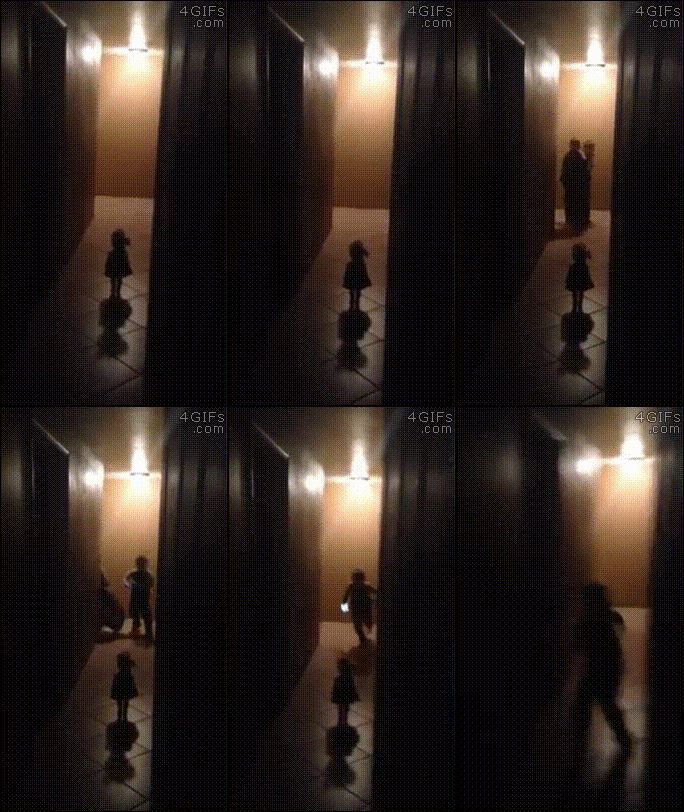
You know, in a horror movie, everyone always responds with a flight response when they see the monster. But that’s not the only thing that happens when people get scared. I want to see someone choose the fight response. I want to see a character turn around to see the killer right there, scream in terror, and start punching them in the face repeatedly.



 Urocyon's Jaunts 2.0
You must be logged in to post a comment.