Bright, leafy skunk cabbage at Lake Logan. A lot of old agricultural structure is still visible in the form of wire fences, the remains of a farm pond, and wolf trees along the ridge.
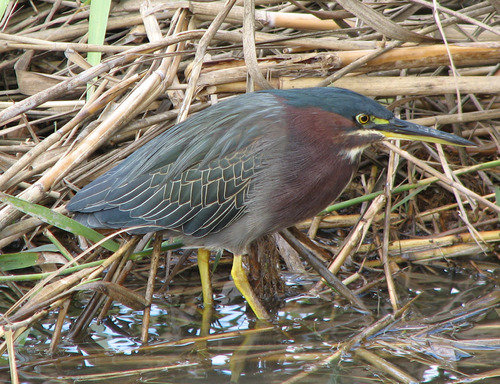
You know what the Green Heron is basically the best heron because it is like 90% neck so when it is all folded down it looks like a giant head with wings and legs
“On Tuesday, U.S. District Judge Ricardo S. Martinez shot down the federal government’s efforts to strip Daniel Ramirez Medina of his DACA status. Immigrations and Customs Enforcement had arrested and detained Ramirez last year, then falsely claimed that he was affiliated with a gang and attempted to deport him. He filed suit, alleging that ICE had violated his due process rights. Martinez agreed. His order barred the federal government from voiding Ramirez’s DACA status, safeguarding his ability to live and work in the United States legally for the foreseeable future. What may be most remarkable about Martinez’s decision, though, is its blunt repudiation of ICE’s main claim—that Ramirez is “gang-affiliated.” The judge did not simply rule against ICE. He accused the agency of lying to a court of law.”
My mom knew this guy in college who got there with no idea how to break into a boiled egg until he watched other people, because his mother had always peeled them for him. This is…several steps up.
“traps aren’t trans women, they’re effeminate gay dudes who crossdress to deceive and fuck straight guys”
ok but you’ve, just decided to counter an accusation of transphobia with “checkmate, i’m a huge transphobe AND homophobe. weren’t expecting that one hey?”. like you really thought your knowledge of fetish anime would make you look Less Gross
continually surprised how chasers think they’re getting away with: “my fetish isn’t trans women, my fetish is just identical in every way to trans women except closeted, or traumatised to staying in the closet and who doesn’t have the language or confidence to ask to be respected. also a cartoon usually.”
Also, for those who say “b-but how do I describe my anime waifu now????” – Japanese doesn’t even use the term ‘trap.’ It’s a transmisogynist term that started on 4chan that’s coercively applied to any person assigned male at birth that crossdresses (jousou, which is a neutral term in Japanese) presents femininely (onee), or is otherwise feminine of center (trans women, transfems, x -gender, as well as various GNC men, cis drag queens etc.), both in Western fandom and irl. It’s a slur, just like sh*male.
More about there term here, from Andrea Ritsu, a Japanese trans woman.
i feel like the role colonialism plays in “deindustrialization” of colonized areas (eg; India went from 25% of global industrial output in 1750 to only 2% in 1900 ) is an important concept and one that contradicts myths that you see not only in colonial apologia but even some kinds of misguided anti-colonialism set up on myths of idealized pasts
Lotsa people asking for references so I’ll just put that stuff here
This passage from the textbook “The Process of Economic Development" by James Cypher is good at giving a very basic rundown of how this worked in places like colonial India. Here is another paper that gets much more detailed about the general process. In the specific example of India you have a region going from being the single largest textile manufacturer in the 18th century to essentially having its textile industry killed off by the end of the 19th. Indian textiles had a heavy presence in European markets initially and while the decline was certainly related to the advent of machine factories it was not caused by it and predates it by some years
By the end of the 17th century, Indian calicos were a major force in European markets (Landes,
1998, p. 154). For example, the share of Indian textiles in total English trade with southern Europe was more than 20 percent in the 1720s,
but this share fell to about 6 percent in the 1780s and less than 4 percent in the 1840s (Inikori, 2002, p. 517). India was losing its world
market share in textiles during the 18th century, long before the industrial revolution.
Economic policies by the British helped with this process. High tariffs were put in place in the UK on Indian textile goods while within India the importation of British goods was done without any tariffs thus making British manufactured goods cheaper in India while Indian manufactured goods were made more expensive in Britain. This was occurring even when the textile industry in both areas was still largely “cottage” (ie without machine factories) and the rise in industrial machinery in the UK was partially (not solely) caused by the specific desire to make the balance of trade favor the economy of the imperial center over that of colonies
Peripherally related but:
I once saw some folks in the R*tional*st corner of tumblr having a conversation about how to end the disputes over land in North America between Settlers and Natives.
It was a mess and a trainwreck at best, as you’d expect when a buncha settlers sit down and discuss between themselves how they can finally shed the pretense of colonial guilt. Their idea was to pay back the monetary value of the land in its entirety, as reparations to every living descendent. (I’m not sure they had an unfucked conception of who would be entitled under this scheme.)
ONLY the land, not incluing not factoring in any “improvements” or anything that had been built since. Because, they insisted, that’s all that was unjustly taken that could ever be paid back with money. There are so many issues with that line of reasoning and I’m not even gonna begin to unpack all of them – the relevant thing for this discussion was the presumption that there were no pre-existing infrastructures, or large-scale deliberate alterations to the landscape. That there were no houses, cities, or farms. No mining of economically-important minerals, no alterations to the landscape to make it more productive, in short no civilization or anything that might’ve improved the use-value or the property value of the land.
And like, we know that’s not true. I could get into the way that history and archaeology put the lie to that assumption, with new discoveries coming in all the time to bolster or illuminate a number of different cases – but instead, I’m just going to show you a picture:
This is Wyam, AKA Celilo Falls. Until 1957, it straddled the Columbia River that seperates Oregon from Washington. It’s nearly impossible to overstate how important it was, not just because of the rich fishing grounds (so rich that seals and sea lions would swim hundreds of miles inland just to get at the salmon runs), nor for the fishing platforms that enabled fishermen to get so many of them – but also, for the many villages nearby, which had been continuously occupied for over 15,000 years, and were a trading hub for people bringing goods from as far away as Alaska, the desert Southwest, and the Great Plains. The rocks there were covered in art, some of it dating back to its earliest habitation. Lewis and Clark showed up in 1805 and were astounded at the population density. Even after disease, conquest, genocide and settlement, it was an important population center for many of the Chinookan and Sahaptin-speaking societies that lived there.
Try to picture 15,000 years of continuous history. Try to picture art from the first human beings to live there, side-by-side with that made by their descendents 15,000 years later. Writing was invented in Mesopotamia about 5000 years ago. It was only 7000 years ago that people speaking Proto-Indo European showed up in the places we think of as Europe today.
For over twice that span of time, Wyam was a major destination for people from thousands of miles away, and until 1957, their descendents were still living there. It is, in fact, the oldest continuously-inhabited place on the entire continent.
Until 1957, when the Army Corps of Engineers finished working on the Dalles Dam, and flooded the entire area.
Ten years earlier, the United States government decided that building the dam and flooding the site wouldn’t contravene their treaties with the Native nations there. They subsequently had a Supreme Court case that ended with a $26.8 million dollar settlement, divided among the tribal governments.
Fat lot of good that money’s done. Poverty, suicide, and food insecurity rates are still incredibly high on the reservations nearby.
My point is: destroying native infrastructure – whether for settlement or extraction of resources – is a vital component of how colonialism operates.





 Urocyon's Jaunts 2.0
You must be logged in to post a comment.