“I was born in 1933,” he continued, “the year that F.D.R. was inaugurated. He was President until I was twelve years old. I’ve been a Roosevelt Democrat ever since. I found much that was alarming about being a citizen during the tenures of Richard Nixon and George W. Bush. But, whatever I may have seen as their limitations of character or intellect, neither was anything like as humanly impoverished as Trump is: ignorant of government, of history, of science, of philosophy, of art, incapable of expressing or recognizing subtlety or nuance, destitute of all decency, and wielding a vocabulary of seventy-seven words that is better called Jerkish than English.”
Polling stations are open from 7am to 10pm, everyone! Try to go and vote as early as you can; try not to put it off and end up not having the time and losing your chance to vote. Remember to bring valid, just in case! Godspeed, a chairde!
Neural networks are algorithms that learn by example, rather than by following a programmer’s set of rules. Although on this blog I’ve mostly been using them to generate new examples of things (like paintcolors, halloween costumes, or craft beers), neural networks can do a lot more.
One thing neural networks can do is classify things. Give them a bunch of examples of one kind of thing, and a bunch of examples of another kind of thing, and it will (hopefully) learn to tell the two apart. This is really useful – for identifying obstacles for self-driving cars, for telling diseased tissue from healthy tissue, and even (with mixed success) for identifying spam or troll comments. I wanted to test this kind of algorithm out, so I devised the simplest task I could think of: telling metal bands from My Little Ponies.
I’ve previously trained text-generating algorithms to generate metal bands and My Little Ponies, so I had datasets ready to go. IBM Watson has a very easy-to-use tool for training classifiers (there’s a classroom-friendly version at machinelearningforkids.co.uk). I loaded in all 1,300 of the My Little Pony names I had, and filled the rest of the tool’s memory with metal bands (about 18,700).
Then I entered some new pony names – neural network-generated pony names so they weren’t in the original dataset – to see how it would classify them. The result:
The neural network labeled *everything* as metal. People who have worked with neural network classifiers before will have seen this coming: with a dataset that was 94% metal class and only 6% pony class, I had set myself up with a classic case of something called class imbalance. The neural network found it could achieve 94% accuracy on my training dataset by calling everything metal. Princess Pie? Metal band with 81% confidence. Sweetie Loo? 85% likely to be metal. Sparkle Cheer? 84% sure that’s a metal band. Flutter Buns? So, so metal. 97%. The only names it didn’t label as metal bands were ponies that were the original dataset. So, Twilight Sparkle? 100% pony. Twilight Sprinkle, though? 83% metal.
The fix was easy: I trained the classifier again, this time with equal numbers of ponies and metal bands. This time the results were a lot more believable. And, the classifier network mostly agreed with the generator neural network names. There were some surprises, though.
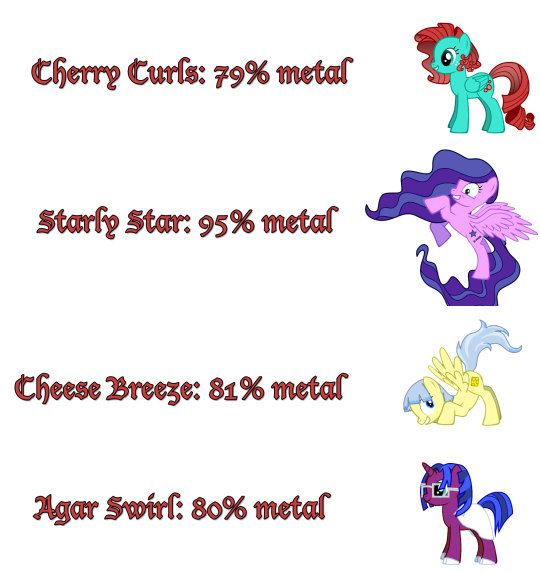
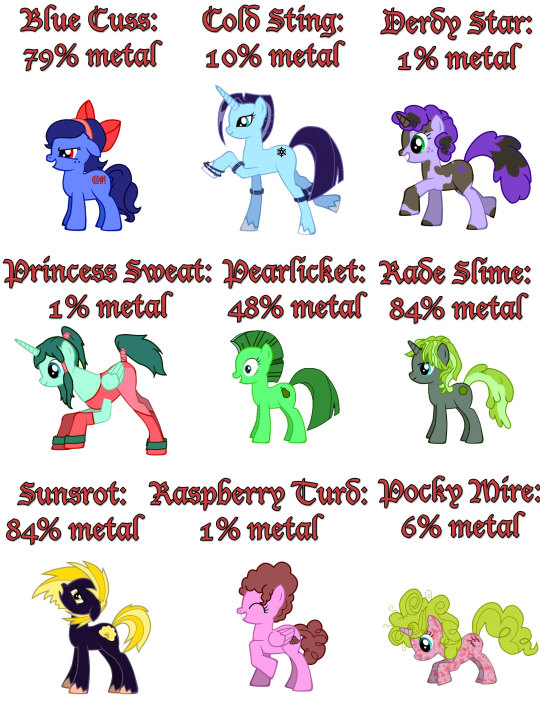
When I fed the classifier names that were generated by a neural network trained on BOTH metal bands and ponies, it was not as confused as I had expected. Instead, it classified them with high confidence as one or the other.
According to this neural network, we may need to rethink Star Wars canon. Leia Organa – 96% metal, 4% pony Luke Skywalker – 31% metal, 69% pony Darth Vader – 19% metal, 81% pony Kylo Ren – 18% metal, 82% pony
I am given a lecture about leaving him alone for one (1) day
Such an angry little storm cloud.
You deserve his scolding!!! How could you??
[video: a black cat lying on a carpet, meowing; halfway through the person taking the video gets down to pet the cat and he gets up and chirps(? like a deep almost-purr with more sass and scolding) a bit while meowing /end ID]
Part of what always gets to me about the “but some autistic people can’t communicate” crowd is what seems to be an implicit assumption that I don’t understand the depth of some people’s communication difficulties because I don’t really know anybody with those kinds of communication challenges, or else I wouldn’t believe what I do?
And I do, you guys. I know them in person, for real.
And I believe in their rights to have their communication in whatever form it does occur taken seriously.
This is not a belief that’s antithetical to people with profound communication disabilities existing.
Yep. Another way this can work is… they decide you’re their teacher. They praise you effusively for being such a valuable teacher. You never consented to that kind of role. But you’ve seen what they say about people who disappoint them. So you “teach” them, which mostly involves them pushing horrifying things in your face and having you explain why they’re horrifying. Except sometimes it involves pushing absolutely innocuous things from mutual colleagues you need to keep a working relationship with in your face and expecting you to treat those as horrifying too. Meanwhile, they’re trying to keep up an appearance of “protecting” you by giving unasked for “trigger warnings” for things that actually are your job to know about.
A hard lesson: some people are intellectual flashers who go out into public spaces and open their mental raincoat and waggle their awful opinions at you without permission. You do not have to engage with these people.




 Urocyon's Jaunts 2.0
You must be logged in to post a comment.