She was a 19th-century pioneer in many fields: business, travel,
mountaineering. But 178 years after her death, Anne Lister is best known
for her string of female lovers, with their erotic encounters
explicitly chronicled in a coded diary stretching to 27 volumes.
Last week, the woman often referred to as the “first modern lesbian”
was honoured with a blue plaque at Holy Trinity church in Goodramgate,
York. The medieval church had sealed Lister’s de facto marriage to a
woman when the couple took communion at its altar.
The plaque, which celebrates a “gender-nonconforming entrepreneur”,
is the first in the UK to be bordered with rainbow colours in
recognition of lesbian, gay and trangender history.
Next year the BBC will screen an eight-part TV drama about Lister’s life and loves, written and directed by Sally Wainwright, whose credits include Happy Valley and Last Tango in Halifax. The series, Gentleman Jack
– Lister’s nickname, a result of her penchant for dark, masculine
clothing – is being filmed in Yorkshire with a cast led by Suranne Jones
and including Sophie Rundle and Timothy West.
“Bringing Anne Lister to life with all her complexity, passion, brilliance and wit is an epic challenge,” Wainwright told the Radio Times last year when the series was announced.
She came from one of the most prominent families in Halifax, whose
estate, Shibden Hall, dating from the 15th century, is now a tourist
attraction. As a result of the deaths of her four brothers, Lister
inherited the family seat in 1826, eventually restoring and renovating
the house and landscaping the grounds.
By
then, Lister had experienced at least four serious lesbian love
affairs. The first, which began when she was 15, set a pattern of
overlapping, passionate relationships. As a teenager she began recording
her love life in diaries which eventually amounted to four million
words.
In 1834, Ann Walker, an heiress to a neighbouring estate in
Yorkshire, moved in to Shibden Hall where she and Lister lived openly as
a couple. But Lister, a Christian, wanted their union blessed by God.
“She never experienced any difficulty in reconciling her lesbian sexuality with her Christianity,”
said Helena Whitbread, who has studied Lister’s diaries for 35 years
and is writing a biography. “Her firm belief was that as God had endowed
her with her sexual nature, it would be wrong to act against it.”
On Easter Sunday, Lister and Walker – who had exchanged vows
and rings – took communion together at Holy Trinity. In Lister’s eyes,
said Whitbread, the sacramental act “sealed the matrimonial pact in
which they had entered”. The church has now become “an icon for what is
interpreted as the site of the first lesbian marriage to be held in
Britain.”
Five years later, the two women set off on a European tour. In
Georgia, Lister developed a fever after being bitten by an insect and
died at 49 in September 1840. Walker had her body embalmed and returned
to Yorkshire.
Her diaries remained hidden for almost 50 years, until a descendant,
John Lister, who had inherited Shibden Hall, found them and broke the
code derived from algebra and the Greek alphabet. The sexually explosive
content so alarmed Lister –who was clandestinely gay – that he returned
the diaries to their hiding place.
They were rediscovered in the following century when Shibden Hall
opened as a museum. The bulk of the journals recorded Lister’s daily
life and network of acquaintances – an extraordinarily detailed social
history giving an intimate glimpse into the Georgian era. Her “depiction
of Halifax resembles a cross between [the 19th century novel] Cranford and Jane Austen,” according to Whitbread.
But when the code – which accounted for about a sixth of the diaries,
and was referred to Lister as “my crypthand” – was rebroken in the
1980s, Lister’s passionate love life was revealed. “It is groundbreaking
stuff, absolutely explicit, every action is described. It’s very saucy
and very riveting,” said Whitbread. “Most of the women Lister seduced
were straight, but they were very happy to get back into bed with her.”
In 2011, Lister’s journals were recognised by Unesco as a “pivotal
document” in British history and added to the Memory of the World
register. The diaries were “a comprehensive and painfully honest account
of lesbian life,” said the UN cultural body.
Kit Heyam, one of the activists who campaigned for the plaque, said
Lister’s story was “enormously significant because she is one of the
first people for whom there is documentary evidence of what she saw as a
queer marriage”.
Heyam added: “She also saw no conflict between her Christian faith
and her sexuality. And an important part of her legacy was her gender
non-conformity. Nowadays we tend to separate sexuality and gender, but
historically, as Anne Lister shows, it was intertwined.”
York Civic Trust, which erected the plaque in partnership with
lesbian, gay and trangender organisations in York and the Churches
Conservation Trust, said there had been “a lot of discussion but no
controversy” about the memorial. “There is no doubt that York has an
LGBT history that should be recognised,” said the chief executive, David
Fraser.
Lister’s “marriage” took place 180 years before same-sex unions
became legal in the UK. Despite the change in the law and shifting
social attitudes, the Church of England does not permit or recognise
such ceremonies, nor allow its clergy to bless same-sex couples who have
undergone a civil marriage.
However, Holy Trinity was declared redundant in 1971 and is now one
of 353 churches in the care of the conservation trust. “We strive to
make our churches as inclusive as possible and we support celebrations
of love,” said Anthony Bennett, its director of development.
Hey. LIVING COSTS MONEY! How about giving more money to the companies that employ me and MAYBE I MIGHT BE OK
This is such a funny thing to me because in Thai culture, it’s completely normal to live with your parents when you’re an adult. In fact, most people live in their family home until they’re married ¯_(ツ)_/¯
Saaaame in Pakistan dude and being abroad for grad school is really fucking me up I am not built to be even slightly independent 😂
In Western culture (including America!) it was completely normal for people to live with their parents in adulthood–sometimes until they married, sometimes longer. In America, that changed (for men) in the 1940s and 50s, when it was really really easy for an 18 year old to get a good job that paid more than enough to live a comfortable life on, or to afford college which would then practically guarantee you an even better-paying job. Women joined the trend of moving out at 18 in the 1960s and 70s.
And now those jobs don’t exist, or are few and far between, and guess what! People are living with their parents again. But that 70-year span was just long enough that it fell out of common memory, and now people are seen as “failures” because the economics have changed.
A very great deal of Western culture, ESPECIALLY America, is actually still based on a memory of the 40′s and 50′s as the baseline of normalcy despite them being a total fluke at the time.
World War II and McCarthyism created a massive shift towards rabid patriotism, Christian fundamentalism and the ideal of the “nuclear family” that resembled nothing before it and we’re still recovering from as the majority of our most powerful politicians are old enough that this period of sudden fanaticism is their “nostalgic good old days” and the way they think things are “supposed to be.”
I love when these posts randomly become tiny history lessons, it soothes me
The exploitation part of Capitalism isn’t just that your boss profits by taking most of the results of your labour (you know, the ‘having to bake a loaf of bread in order to be able to afford a slice of bread’ thing) but also because your boss carries no responsibility for depleting your resources (energy, health, joy, etc).
Your boss can assign you a job that drains you physically and emotionally and how and whether you recover is not his concern. If you need to use your weekend to work a second job to pay the rent, that’s not his concern. If the weekend isn’t actually long enough to overcome the intense stress of your job, that’s not his concern. Even the most basic physical safety rules had to be fought for tooth and nail.
Your boss doesn’t just exploit you by taking what you make and taking time from your life, but also by exhausting and damaging your body and mind and taking no responsibility for it’s recovery.
This last thing is something we often overlook and as a result we reproduce it in our own community and activism. Think about it: how often have you done physically and emotionally draining activist work and not talked at all about the recovery after that action or taken responsibility as a group for the recovery of the bodies and minds that you use?
reminder that the 8 hour day is no longer necessary due to advances in production (most people get a day’s worth of work done in four hours anyway) and a lengthy work day is designed to prevent poor and working people from having the means to fight back, organize, and improve their working and living conditions.
The 8 hour day has never been necessary. It was what unions could achieve at the time and as a huge step forward it was hard won but ‘necessary’ had nothing to do with it.
thinking this also applies nowadays to white collar corporate frontliners working unofficial 60 and 70 hour weeks exempt, who might potentially decide to utilize their strategic and executive skills to push back if they weren’t fed lies about passion and kept in a routinely exhausted and depleted state.
Absolutely. White collar workers, especially in creative jobs, are told a flattering individualist narrative about how lucky they are to be able to ‘do what they love’ no matter how draining it is.
Working 70 hours a week coding video games and have no energy left to do anything? But you’re doing what you love! Organising your whole life around working for that NGO and still can’t make rent? But you’re doing what you love! Accept that unpaid overtime, skip lunch to meet that deadline, cancel dinner plans, abandon all quality of life, you’re the lucky few who do what they love! And nothing else matters.
This is of course bullshit. The ‘do what you love’ workers are not lucky, they’re just exploited through a different narrative.
As someone who works for a nonprofit, this is 10000000% true and accurate and no matter how “radical” your nonprofit is, none of them actually want to talk about labor. Ever.
TRUUUUUUUUUUUUUEEEEEEEEEEEEE.
Non-profits are some of the worst in the “do what you love sacrifice your whole life and yhour mental health to us for shit pay and still answer to a boss like every other worker” game.
There do exist jobs that require full time sacrifice of oneself to the job, but those are raising children or livestock. Working too hard damages your ability to work in future, reducing net work ability. Don’t. Do not
You’re making some thinking errors here:
–
‘jobs that require full time sacrifice’
can be separated into smaller work loads with shared responsibilities
– while it is true that working too hard
damages your ability to work in future, it is far more important to note that
working too hard
damages your ability to have a life that is worth living, now and in the future. We don’t live to work. Our quality of life is far more important.
– telling workers ‘Do not’ give their all to the job isn’t worth much, because the reality is that workers have no control over how much they work. ‘Know that this is exploitation even if you work in a creative field’ and ‘unite with other workers to collectively resist this’ would be better advice by far.
Telling employers that they are damaging future assets is an effective way to reduce their damaging behaviour. Change their thinking and they will change their behaviour. Examples of jobs that require full time sacrifice and cannot be further subdivided reasonably includes running a family farm in a community of similar farms. You will potentially be called on by or calling on a neighbour at three in the morning because your cattle are having calving troubles or something is on fire. Once hay season starts, you don’t stop working each day until you have no light, and you pray to any gods that are in the neighbourhood that the rain doesn’t come in. In winter you have to check the animals, clean the pens and yard, and feed the animals. And gardening is a perpetual war against weeds and vermin. Could you hire help? Sure! Then all of you work that hard anyway.
Telling employers that they are damaging future assets is a useful thing to do if you are talking only to an employer and want to change nothing about his worldview except for the immediate effect of shorter working hours for employees.
In every other context, you are reinforcing the incredibly damaging idea that workers are ‘assets’ defined by their productivity instead of human beings forced to sell most of their lives, physical and mental health to survive under capitalism and employers are making money of our stolen lives.
The idea that a family farm is a life of full time sacrifice is true only in the context of capitalism, where farmers are extremely underpaid for their product and are forced to work themselves to their limits to get by. The family that works themselves close to collapse every harvest is a family that has been forced by capitalism to work far beyond their capacity.
Popular images of the past tell us that we used to work much harder but this is a lie. Before the pressures of capitalism, farmers had an abundance of leisure. Medieval farm work was interrupted by meals, naps and rest breaks even at the height of harvest seasons and holidays were plentiful. The medieval worker worked less than 8 hours a day and had a lot of resting days and holidays, having far less working days in total than workers today. http://queeranarchism.tumblr.com/post/171513139023/one-of-capitalisms-most-durable-myths-is-that-it
If we got rid of capitalism, no one would have to sacrifice their life to a job. We need to call this what it is: exploitation, the theft of our very lives for profit.
Yes! Stretch your imagination! Imagine a hundred people who all turn up and get the harvest in, not for the pay, but because everyone depends on the harvest getting in. And these hundred people who show up, they are willing and able to do so because their needs are getting met-they are eating, thier emotions are being held, they are connected deeply to community and know that when they have the equivalent problem the community will show up. People say it’s not possible but it’s actually the way humans have organized themselves in many ways, through many different mechanisms throughout time. (Sources? Debt: The first 5000 years. Also, Fragments of an Anarchist Anthropology, same author).
Break out of the box! We could do it differently. Really we could. We can, maybe. Maybe just in little clusters at first. That’s why it’s so vital to educate yourself and keep passing it on.
Yes.There are so many other ways too in which we would have to work so much less if we shared our resources, our tools, our time. The ‘self-sustaining farm’ existing on the edges of capitalism does not provide a good model at all for how our lives would be outside capitalism.
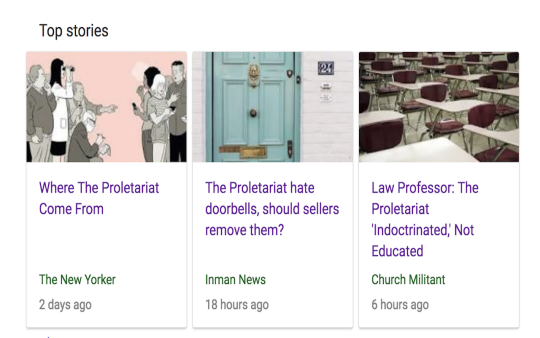
Someone should make a browser extension that changes every instance of “baby boomers” into “bourgeoisie” and every instance of “millennials” into “proletariat”
To clarify for anyone who needs clarification:
I’m saying a lot of y’all misattribute values, political leanings, behavior, and status to age cohorts instead of rightfully attributing it to class.
The problem isn’t a divide between young and old, it’s a divide between the ruling class and the working poor. And a lot of the statements made about boomers and millennials are just inaccurate euphemistic distractions from what could be oppprtunities in developing class consciousness.
So I went ahead and made the addon, you can download it for Chrome here




 Urocyon's Jaunts 2.0
You must be logged in to post a comment.