My friend Lar needs some help to get a new place before they’re kicked to the curb. Sharing is easy and free, but if you can also donate, that would be greatly appreciated.
If yall could boost this and consider throwing down even a dollar that would be ameezeeng.
Hey everyone, thank you all for boosting the signal on this and helping my friend.
the people in grenfell died because they were poor.
the people in grenfell died because their landlord chose to spend money on flammable cladding because rich tenants in nearby penthouses didn’t like the ugly council building ruining their view.
the people in grenfell died because their landlord chose not to spend money on a centralised fire system or sprinklers or an additional fire escape.
the people in grenfell died because the tories voted against a law that would force landlords to make their buildings inhabitable and safe for their tenants.
the people in grenfell died because of the privatisation of social housing.
the people in grenfell burnt to death with their children in their arms because they were poor.
more than a year has passed, the tory government has done basically nothing, we haven’t forgotten
HOLY SH*T. THEY FOUND NITROGEN-FIXING CORN BRED BY INDIGENOUS PEOPLE IN MEXICO. @botanyshitposts
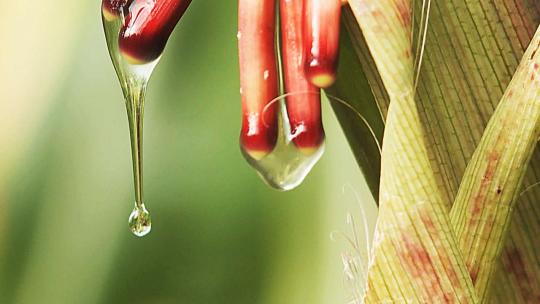
“The study found the Sierra Mixe corn obtains 28 to 82 percent of its nitrogen from the atmosphere. To do this, the corn grows a series of aerial roots. Unlike conventional corn, which has one or two groups of aerial roots near its base, the nitrogen-fixing corn develops eight to ten thick aerial roots that never touch the ground.
During certain times of the year, these roots secrete a gel-like substance, or mucilage. The mucilage provides the low-oxygen and sugar-rich environment required to attract bacteria that can transform nitrogen from the air into a form the corn can use.
“Our research has demonstrated that the mucilage found in this Sierra Mixe corn forms a key component of its nitrogen fixation,“ said co-author Jean-Michel Ané, professor of agronomy and bacteriology in the College of Agricultural and Life Sciences at UW–Madison. “We have shown this through growth of the plant both in Mexico and Wisconsin.”
…
“
Researchers are a long way from developing a similar nitrogen-fixing trait for commercial corn, but this is a first step to guide further research on that application. The discovery could lead to a reduction of fertilizer use for corn, one of the world’s major cereal crops. It takes 1 to 2 percent of the total global energy supply to produce fertilizer. The energy-intensive process is also responsible for 1 to 2 percent of global greenhouse gas emissions.
“
I’ve written about this before, this is one of those ‘saving the planet’ levels of discovery. No joke.
Corn’s heavy need for nitrogen is also why it’s traditionally been grown together with nitrogen-fixing beans. Often as part of something like a Three Sisters plan, which further helps prevent erosion among other benefits.
That gets trickier with modern commercial monocropping (with its number of other environmental drawbacks). But, it’s possible to get some of the same benefits just from using a nitrogen-fixing cover crop between corn seasons. That can apparently provide about half the nitrogen the corn requires, along with other nutrients.
(For that matter, how much might fertilizer requirements be reduced by combining strategies, and growing a variety like this along with other nitrogen-fixing crops?)
But, there are already other ways to approach this problem. Many of those also starting with paying attention to the folks who really know corn, with a history of growing it extensively in more sustainable ways.
And have not tended to grow it as a monocrop, I have to say again. I’m really not that optimistic about the overall results from using the same large-scale commercial growing techniques, but with nifty “new” varieties in hopes of environmental harm reduction.
ok but why is ‘potato’ always used negatively in phrases? ‘couch potato’ and ‘he looks like a potato’……… what the hell have potatoes ever done to you? potatos are the mvps of the food world, the backbone of many dishes. they never let u down. potatoes are the real winners here and we should feel honoured to be described as one
I can think of at least one time potatoes have let down a very large group of people.
That was not the potatoes’ faults! That, like most things, was on the British.
It turns out that Border Collies are an ideal breed for this specific type of job. Bounding through miles of forest terrain requires not only speed, intelligence, and endurance, but also a willingness to stay focused and not get distracted by wildlife. Border Collies were bred to herd sheep, so they’re not as likely to run after or hurt other animals in the forest.
This system is also more efficient than having people spread the seeds manually. These speedy canines can race through a forest and cover up to 18 miles a day. Humans, on the other hand, can only cover a few miles each day. These pups can scatter over 20 pounds of seeds, depending on the terrain. While robots or drones might be able to disperse seeds too, dogs aren’t as pricey to handle. Most importantly, they leave a lighter carbon footprint.
Francisca and Constanza put special backpacks on the dogs, fill them with native seeds and then it’s off to the races. Once the dogs have emptied out their bags, Francisca and Constanza give them plenty of treats, refill their bags, and release them again to dash around the destroyed forest, sprinkling more seeds in their wake. The end goal of all this, of course, is to restore the damaged ecosystem and have the wildlife return to the forests.
Patty Stonefish, of Arming Sisters, asked me to create flyers for the #WeWontForgetMMIW*, a campaign that brings a timeless ritualized gesture into today’s social media. I have had the privilege of working with her for almost two years now and her commitment to the rights of indigenous North American women is a permanent source of inspiration.
A while back a ton of people saw a video of a turtle with a straw stuck up its nose. I was one of them. It was very sad.
So when places started proposing we ban plastic straws, I was like…
“Yeah! Fuck straws!”
But then the disabled community spoke up and tried to inform everyone that plastic bendy straws are essential for people with various health issues. Without them, people might end up having to make the choice of whether or not they can consume liquids in public. And that really sucks.
This community put a lot of thought and research into this and was unable to find another material that could be a suitable replacement in every circumstance.
They proposed a system where you could just ask for straws rather than places giving them out all willy-nilly. This would still reduce the use of plastic straws significantly without screwing disabled folks.
I assessed this new information and…
I CHANGED MY DAMN MIND.
*gasp* “The Frogman is a flip-flopper!”
Naively, I figured most people who consumed this new information would do the same.
But it ended up being a mixed bag of mostly sullen disappointment.
As I read the comments on various articles I noticed a weird phenomenon where people magically transformed into materials scientists.
Disabled groups thought long and hard about this. These groups did some great in-depth research. And all these groups pretty much came to a unanimous consensus that there are currently no satisfactory alternative solutions. They also found that plastic straws are actually a drop in the bucket of our waste issues. Furthermore, the “straws on demand” solution would make that drop pretty frickin’ tiny. The overall risk to turtle noses would go way down.
Despite seeing these conclusions thoroughly presented to them, people would think about the issue for about 30 seconds and be like…
“Okay, but what about paper straws? What about reusable straws? What about this? What about that? I have a metal straw that works great! Surely that will do!”
These internet dunderheads actually believed their 30-second brainstorm would come up with a sufficient solution that has not been thought of yet.
As if the entire disabled community is going to be like, “We did all of this research, spent all of this time looking for alternatives, committed all of these resources to spread our conclusions, BUT WE NEVER KNEW ABOUT PAPER STRAWS! Thank you, kind stranger! You have single-handedly solved this dilemma!”
I just have trouble wrapping my head around the kind of ego one must have to think they could solve an issue like this with an internet comment.
What makes it worse is some of these “what about” comments would be replies to actual disabled people. These sudden experts in the science of materials would start suggesting straw alternatives. And these disabled folks, who are probably exhausted and at their wit’s end, must decide if they should give these individuals explanations of why these genius suggestions won’t work for them.
“I know you aren’t feeling well, but can you do all of the research for me so I don’t have to spend 2 minutes googling shit?”
And when you try to tell these people they are being ableist and kinda shitty, they act like a wounded animal. Suddenly they are the victim. THEY WERE JUST TRYING TO HELP! Not trusting people who live with these problems is the height of privilege. And forcing them to make their experiences relateable while remaining calm and polite is exhausting.
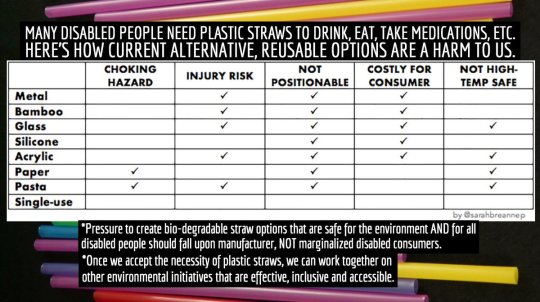
Then someone made this amazing chart that couldn’t possibly make it any easier to comprehend.
And people were still responding to it with…
“OKAY, BUT WHAT ABOUT…?”
In conclusion…
IT’S OKAY TO CHANGE YOUR DAMN MIND.
Also…
YOU’RE NOT AS SMART AS YOU THINK YOU ARE.
(Unless you actually are a materials scientist and you are developing an alternative as we speak.)







 Urocyon's Jaunts 2.0
You must be logged in to post a comment.