When I was nine, possibly ten, an author came to our school to talk about writing. His name was Hugh Scott, and I doubt he’s known outside of Scotland. And even then I haven’t seen him on many shelves in recent years in Scotland either. But he wrote wonderfully creepy children’s stories, where the supernatural was scary, but it was the mundane that was truly terrifying. At least to little ten year old me. It was Scooby Doo meets Paranormal Activity with a bonny braw Scottish-ness to it that I’d never experienced before.
I remember him as a gangling man with a wiry beard that made him look older than he probably was, and he carried a leather bag filled with paper. He had a pen too that was shaped like a carrot, and he used it to scribble down notes between answering our (frankly disinterested) questions. We had no idea who he was you see, no one had made an effort to introduce us to his books. We were simply told one morning, ‘class 1b, there is an author here to talk to you about writing’, and this you see was our introduction to creative writing. We’d surpassed finger painting and macaroni collages. It was time to attempt Words That Were Untrue.
You could tell from the look on Mrs M’s face she thought it was a waste of time. I remember her sitting off to one side marking papers while this tall man sat down on our ridiculously short chairs, and tried to talk to us about what it meant to tell a story. She wasn’t big on telling stories, Mrs M. She was also one of the teachers who used to take my books away from me because they were “too complicated” for me, despite the fact that I was reading them with both interest and ease. When dad found out he hit the roof. It’s the one and only time he ever showed up to the school when it wasn’t parents night or the school play. After that she just left me alone, but she made it clear to my parents that she resented the fact that a ten year old used words like ‘ubiquitous’ in their essays. Presumably because she had to look it up.
Anyway, Mr Scott, was doing his best to talk to us while Mrs M made scoffing noises from her corner every so often, and you could just tell he was deflating faster than a bouncy castle at a knife sharpening party, so when he asked if any of us had any further questions and no one put their hand up I felt awful. I knew this was not only insulting but also humiliating, even if we were only little children. So I did the only thing I could think of, put my hand up and said “Why do you write?”
I’d always read about characters blinking owlishly, but I’d never actually seen it before. But that’s what he did, peering down at me from behind his wire rim spectacles and dragging tired fingers through his curly beard. I don’t think he expected anyone to ask why he wrote stories. What he wrote about, and where he got his ideas from maybe, and certainly why he wrote about ghosts and other creepy things, but probably not why do you write. And I think he thought perhaps he could have got away with “because it’s fun, and learning is fun, right kids?!”, but part of me will always remember the way the world shifted ever so slightly as it does when something important is about to happen, and this tall streak of a man looked down at me, narrowed his eyes in an assessing manner and said, “Because people told me not to, and words are important.”
I nodded, very seriously in the way children do, and knew this to be a truth. In my limited experience at that point, I knew certain people (with a sidelong glance to Mrs M who was in turn looking at me as though she’d just known it’d be me that type of question) didn’t like fiction. At least certain types of fiction. I knew for instance that Mrs M liked to read Pride and Prejudice on her lunch break but only because it was sensible fiction, about people that could conceivably be real. The idea that one could not relate to a character simply because they had pointy ears or a jet pack had never occurred to me, and the fact that it’s now twenty years later and people are still arguing about the validity of genre fiction is beyond me, but right there in that little moment, I knew something important had just transpired, with my teacher glaring at me, and this man who told stories to live beginning to smile. After that the audience turned into a two person conversation, with gradually more and more of my classmates joining in because suddenly it was fun. Mrs M was pissed and this bedraggled looking man who might have been Santa after some serious dieting, was starting to enjoy himself. As it turned out we had all of his books in our tiny corner library, and in the words of my friend Andrew “hey there’s a giant spider fighting a ghost on this cover! neat!” and the presentation devolved into chaos as we all began reading different books at once and asking questions about each one. “Does she live?”— “What about the talking trees” —“is the ghost evil?” —“can I go to the bathroom, Miss?” —“Wow neat, more spiders!”
After that we were supposed to sit down, quietly (glare glare) and write a short story to show what we had learned from listening to Mr Scott. I wont pretend I wrote anything remotely good, I was ten and all I could come up with was a story about a magic carrot that made you see words in the dark, but Mr Scott seemed to like it. In fact he seemed to like all of them, probably because they were done with such vibrant enthusiasm in defiance of the people who didn’t want us to.
The following year, when I’d moved into Mrs H’s class—the kind of woman that didn’t take away books from children who loved to read and let them write nonsense in the back of their journals provided they got all their work done—a letter arrived to the school, carefully wedged between several copies of a book which was unheard of at the time, by a new author known as J.K. Rowling. Mrs H remarked that it was strange that an author would send copies of books that weren’t even his to a school, but I knew why he’d done it. I knew before Mrs H even read the letter.
Because words are important. Words are magical. They’re powerful. And that power ought to be shared. There’s no petty rivalry between story tellers, although there’s plenty who try to insinuate it. There’s plenty who try to say some words are more valuable than others, that somehow their meaning is more important because of when it was written and by whom. Those are the same people who laud Shakespeare from the heavens but refuse to acknowledge that the quote “Some are born great, some achieve greatness, and some have greatness thrust upon them“ is a dick joke.
And although Mr Scott seems to have faded from public literary consumption, I still think about him. I think about his stories, I think about how he recommended another author and sent copies of her books because he knew our school was a puritan shithole that fought against the Wrong Type of Wordes and would never buy them into the library otherwise. But mostly I think about how he looked at a ten year old like an equal and told her words and important, and people will try to keep you from writing them—so write them anyway.
*sobs for like the umpteenth time this day and reblogs the fuck out of this*
Reblog, Facebook, and sending it to myself so I can always find it…
This brings back so many memories of my childhood stories that I may just weep.
“I wont pretend I wrote anything remotely good, I was ten and all I could come up with was a story about a magic carrot that made you see words in the dark, but Mr Scott seemed to like it.” Are you KIDDING me, that is the most beautiful metaphor about writing and you used the man’s own PEN as the central symbol I’m crying and I can’t even imagine how he felt sdlfkajsdf GOD.
I am not a writer. No, as I have yet to learn the skill of sorting ten-thousand disjointed and fragmented ideas into coherent narrative without growing frustrated and impatient and quitting before I can barely begin…
…but this gives me a flicker of hope that such a thing may change someday.
“But mostly I think about how he looked at a ten year old like an equal and told her words are important, and people will try to keep you from writing them—so write them anyway.”
This isn’t because Burger King is nicer in Denmark. It’s the law, and the US is actually the only so-called “developed” country that doesn’t mandate jobs provide a minimum amount of paid vacation, sick leave, or both.
kinda debunks that claim that they can’t afford to pay their workers those sort of wages and still make a profit
Its corporate greed, plain and simple.
It is the same in Sweden. It is so funny every time an american company opens up offices here and then tries to do it the american way and all the unions go “I don’t think so”.
They refused to sign on to the union deals that govern such things as pay/pension and vacation in Sweden. Most of our rights are not mandated by law (we don’t have a minimum wage for example) but are made in voluntary agreements between the unions and the companies.
But they refused, saying that they had never negotiated with any unions anywhere else in the world and weren’t planning to do it in Sweden either.
Of course a lot of people thought it was useless fighting against an international giant, but Handels (the store worker’s union) said that they could not budge, because that might mean that the whole Swedish model might crumble. So they went on strike in the three stores that the company had opened so far.
Cue a shitstorm from the press, and from right wing politicians. But the members were all for it, and other unions started doing sympathy actions. The teamsters refused to deliver goods to their stores, the financial unions blockaded all economical transactions regarding Toys ‘r Us and the strike got strong international support as well, especially in the US.
In the end, Toys ‘r Us caved in, signed the union deal, and thus their employees got the same treatment as Swedish store workers everywhere.
The right to be treated as bloody human beings and not disposable cogs in a machine.
and that story right there? is exactly why Republicans in the US work so hard to bust unions. it’s because unionizing WORKS and they’re terrified of workers actually having some power.
I’d be more surprised if a comment from the 80s wasn’t racially insensitive…
Wtf. I double checked the story, because it’s pretty extreme and the link above is to Fox News, but it’s in a large number of other news sources as well, including left leaning news sources like the New York Times, so the story is legit: a race car driver lost a sponsorship because his dad said the n-word literally before he was born, in the early 1980s, and supposedly he only used it at all because he was a recent immigrant from Ireland and unaware of how offensive the word was in the United States.
This is more of a bit outrageous, and extremely troubling; literally punishing someone for the misdeeds of their father.
I didn’t want to respond to this thread on my main, but I was tagged elsewhere, so I feel that I should. Springboarding off isaacsapphire’s reply here due to checking the NYT to verify, but actually elaborating on what @poipoipoi-2016 attributed to me.
Suppose you have a country where the population is 60% white and 40% black, and the number of douchebags per capita of each group is equal. So one group is not superior to the other.
Statistically, there will be people whose entire experience with the other race is chronically negative or acutely negative, because douchebags are not that rare. This contributes to the natural rate of background racism radiation.
However, with prudence and not wanting to stomp on faces with one’s oppression boots, this can be managed. Showing people that actually the other group are normal people too in a direct experience way (as that musician did) can shift them away from it. Enforcing against racism in an equal way (nobody gets to be racist, not even against the majority) creates a pressure that won’t generate collective action because it is solely against individuals for individual acts, which individuals can control.
The failure to totally abolish groups such as white nationalists or white supremacists does not indicate that it is necessary to get out the oppression boots.
As long as they remain marginal, driven only by racism background radiation, people for whom race is the only thing going for them, and people who are naturally way out there on emotional connection to race, they cannot significantly grow through their own actions. The people who value racial identity above all others are out of touch with the general population. The people who only have race going for them are often incompetent, ugly, and socially maladept. The background radiationers don’t match up with the typical person’s experience.
That’s your base pool of white nationalists. Notice how profoundly outnumbered they are at the marches. It’s not because they’re special cowards; it’s because there just aren’t that many of them.
Among this group you generally won’t have competent, charismatic great leaders because they just don’t have a good sample population to start with.
Now, suppose we punish people collectively for the actions of others that they can’t control. If the number is low enough, they’ll never get enough power to overcome it, and most people will just hope it doesn’t happen to them. However, as the number climbs, then regular people start worrying about it happening to them – after all, they can’t control it – and so they will eventually give up on inaction (cheap) and resort to action (costly).
A white man (we’ll call him Fred) who wants to make sure no white nascar drivers are fired for racist remarks made decades ago by other people entirely must remove the people that do so from power over nascar. After this, he has four options:
1. Someone who restores uniform individual punishment.
2. An implicit subconscious racist in his favor.
3. An implicit conscious racist in his favor.
4. An explicit racist in his favor.
#1 is the best option. Fred blames this on nutty college professors and picks someone who likes nascar and doesn’t like unnecessary ethnic conflict. This could easily be a black man from West Virginia. (Yes, there are black men in West Virginia.)
Maybe someone would avoid picking #1 somewhere else, because they believe it’s impossible. But this is nascar, not the cops.
And because this is nascar and not the cops, the primary reason to avoid #1 is believing in collective intergenerational ethnic moral liability, or expecting to be attacked by others who believe the same. (Regular intergenerational moral liability would allow our nascar driver to make a public apology for the statements of his father, and regular intergenerational moral liability is already questionable.)
The primary reason to believe that is to press collective intergenerational ethnic justice* claims.
And so it slides down the ladder. If people conclude that they’re going to be judged as a collective, they’ll probably decide they might as well act as one. If they think they can’t get #1, they’ll pick #2-4. These are more expensive because they require greater levels of coordination and risk greater levels of retaliation. However, none of these people would fire a white nascar driver for a racist remark made by his father. As the perception of threat increases, #2 will be ruled impossible, and then #3.
Past #2, the consequences falling the other direction will open up risk for retaliation as other groups choose their own #3 and #4, increasing the estimate of threat cyclically.
You want them to pick #1. It is important that they pick #1. (And if you can’t get #1, try your hardest for #2.) Collective intergenerational justice is the path of feud, collective intergenerational ethnic justice is the path of conflict and famine.
* This term is a mouthful on purpose. One, it names something that hitherto has hidden behind euphemisms, and two, it should be more difficult to twist the meaning this way.
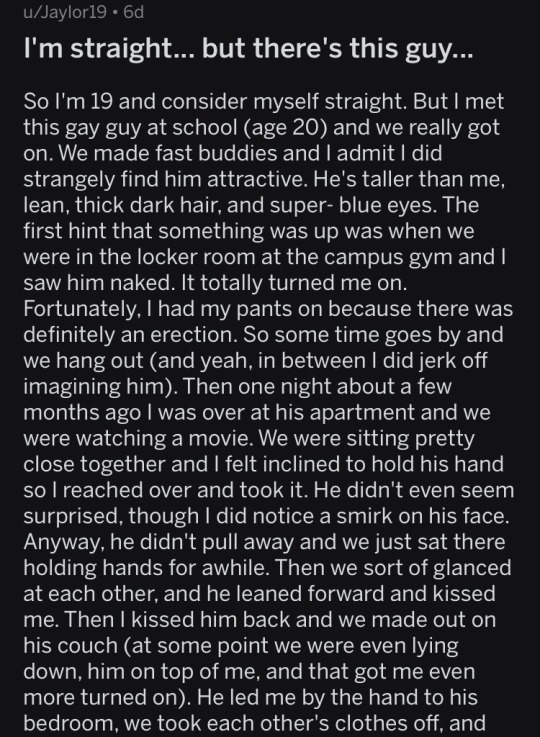
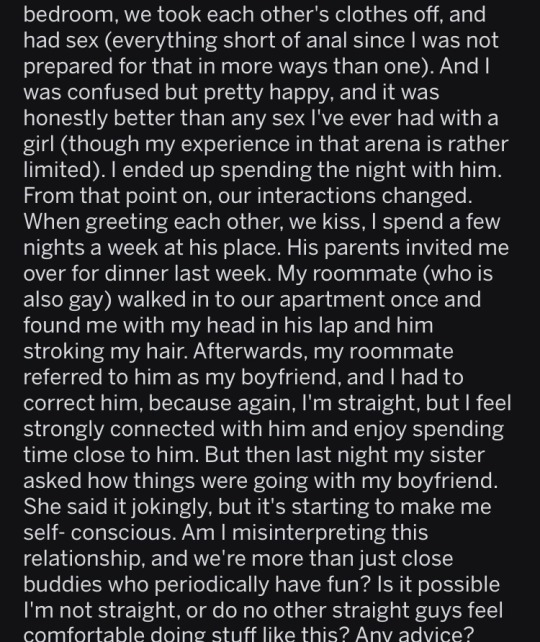
Okay, so I’ve seen some of the tags on this, and a lot of it is making fun of this dude for thinking he was straight when it was so clear he wasn’t.
But ya’ll don’t get it. This is EXACTLY what it’s like to be bi. If you grew up in any sort of environment where LGBT was Not Accepted, and you had any inclination toward the opposite sex, you just ran with that, because that’s all you were ever taught to look towards. And because for the longest time even the media was all ‘you’re either gay or straight’, forgetting that the B in LGBT has been there for quite a fucking while, you had no outside stories or icons you could turn to for guidance.
No one teaches you what being in a same sex relationship is supposed to be like or feel like, and what’s worse, most likely all you know is a caricature of what a homosexual relationship and/or person is, so your own experiences really won’t match up. So none of what’s happening to you makes sense with what you know.
So I can 100% fully believe my dude here thought he was straight. Until society teaches what it also means to be bi, this will neither be the last nor weirdest story you ever hear about a bisexual awakening.
Give the dude a chance.
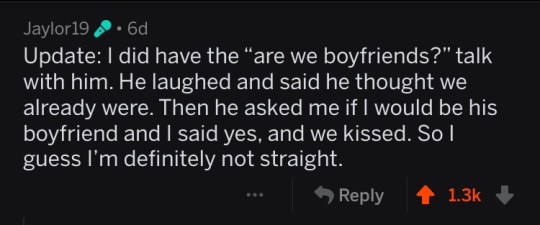
I liked this story the first time I saw it come around, but I like it even more with this addendum.
I just want to know how people could read this and not immediately jump to “bisexual disaster”.
do men have resting bitch faces as well or do they not have negative characteristics ascribed to them for putting on a neutral rather than a deliriously happy facial expression
Yes, Black men in majority white spaces do. If I don’t smile every single second of the day my coworkers become in intimidated and start asking me what’s wrong, telling me to smile, make jokes about how I’m trying to be a thug/act hard, why am I angry, etc. And it’s not just white men at my job God FORBID I my large Black ass makes a white girl feel threaten because I’m sitting down with a neutral expression.
I’m not trying to take this post away from women and make it about Black men but I want to point out that wether it’s patriarchy or white supremacy; those who feel as if they have power over you HATE to see you not smile. They are so used to people like you smiling to gain their approval that when you don’t there’s a cognitive dissonance that makes them extremely uncomfortable.
That’s why “angry Black women” is a thing. They have to put on a smile for everyone (yes even feminist white women) or we all get uncomfortable.
The idea that being born with a penis/testicles means that you’re biologically programmed to be an aggressive, domineering, violent, selfish asshole and there’s simply no way to avoid it is patriarchal propaganda meant to excuse men’s violence (especially against women), and to convince women to blame themselves when men are violent against them, and any feminist who tries to repackage this view in their analysis of “biological sex” is what 11/10 experts call a sucker
Not to mention that numerous anthropological accounts have already disproven any kind of ‘natural’ relationship between ‘biological sex’ and cultural behavior. Thinking that ‘biological sex’ has a universal set of behaviors cross-culturally is not only ethnocentric but complicit in reproducing colonialist and imperialist discourses that work to impose a EuroAmericanist worldview, by force, onto others.




 Urocyon's Jaunts 2.0
You must be logged in to post a comment.