So you are saying 0% of the world should be billionaires?
Yes.
Why shouldn’t their be billionaires? That makes no sense.
Because the existence of billionaires is predicated on the exploitation of human labor and unsustainable environmental harm. That level of wealth hoarding is harmful to economies, as it reduces the amount of money in circulation. No one person, no family, could ever conceivably even SPEND a billion dollars anyway, and it is inherently immoral to accumulate wealth so narrowly while so much of the world lives in abject poverty.
Better then to create a wealth ceiling, a point at which all wealth over a certain point is taxed at or very near 100% to incentivize people to actually spend their money rather than hoard it, stimulating the economy and bettering the lives of far more people. Better even still to create and regulate economic systems that protect workers and the environment in a way that such extreme levels of wealth accumulation aren’t even feasible.
The problem with this is that it reduces the incentive to actually do fiscally well. What’s the point of starting a business if you can’t become wealthy?
There is a very real difference between “reasonably wealthy” and A BILLIONAIRE
No one is saying you shouldn’t have a nice house, we are saying that having multiple really, really ridiculously nice houses while your employees are either homeless or at serious risk of becoming homeless is immoral.
I’ll never understand why this concept is hard for people. I think it’s because they can’t actually fathom how much $1 Billion is.
Seriously.
Let’s say you have a badass job. A great job. You make $100 AN HOUR. You work 10 hours a day ($1000 A DAY), 5 days a week ($5000 a week!!!), every week ($20,000 A MONTH), thats $240,000 Every Year.
It would take you 4,167 years to make a billion dollars.
>The problem with this is that it reduces the incentive to actually do fiscally well. What’s the point of starting a business if you can’t become wealthy?
Uh-huh.
Take away billionaires and you just put millions or possibly billions of people out of work.
Glad to know you hate the working class.
That’s literally the opposite of how reality works but keep going
Do you know how many people work for Walmart?
Get rid of Walmart and you have millions of students and the elderly who needed that paycheque suddenly out of the job.
What about construction workers? Who depend on rich businessmen a lot to get good contracts with good pay.
People have the right to accumulate money and the moment you say they can’t or that there’s a limit that is an issue. The idea that billionaires are exploiting the people they give money to. Is a completely idiotic idea.
The vast majority of the working class is indirectly working for and paid by person or people richer than them. Because you kind of need to be rich to hire thousands of workers.
The rich are an important part of how the economy works. Don’t beleive me? As the Soviets they figured that out the hard way.
Ooooooor maybe Walmart should pay all those students and elderly people a fair wage, and their CEOs can just be fabulously wealthy and not disgustingly wealthy.
Like, this isnt a question of “should ANY amount of wealth inequality exist.” Its specifically about BILLIONAIRES. Not even millionaires. BILLIONAIRES.
Presumably Walmart employees agreed on their terms of payment or they wouldn’t be working there.
Sounds like a fair wage to me.
Not if it forces them onto food stamps to avoid starvation. Without the ability to negotiate for wages on equal footing (through collective action) and without a strong social safety net that ensures temporary unemployment won’t lead to homelessness, then no. Just agreeing to a wage doesnt inherently make it fair.
You act as if people are incapable of collective action. Bad companies lose employees, good companies keep them. A company can ignore this if they like but they’ll suffer for it.
The employee is free to go to another company or become independent if they so choose. they may not get the wages that they want but just because I’m not able to sell something for astronomically more than it’s worth doesn’t make my agreement to the sale price any less legitimate.
The free market is what assures fairness not government action.
I think reality has proven that an unregulated or poorly regulated free market does NOT guarantee fairness in the absence of collective bargaining and strong social safety nets.
If employees can only choose between starvation level wages or potential homelessness then they aren’t REALLY free to quit in search of greener pastures.
As I have said, you premise that there is no collective bargaining is flawed collective action is taken all the time without even mentioning unions.
As a matter of fact collective bargaining, both formal and informal is a part of the free market.
Likewise your premise that people’s only choices are homelessness and starvation wages is also flawed; it’s actually an either or fallacy.
People have potentially limitless option in a market economy and they also have the option of becoming independent. And if people really can’t survive in a situation with so many options they can still leave whichever free market economy that they’re a part of and go to a country with your preferred system.
Your argument is that if a person is worried that quitting their minimum wage job will leave them homeless due to a lack of social safety nets during unemployment, they should MOVE TO A DIFFERENT COUNTRY?
Because emigrating is sooooooooooo cheap and easy, right?
Hello, real world calling.
That’s oversimplification to the point of childishness but yes.
I will remind you that you’re saying that if a person is doesn’t like their pay they should wait for a revolution to steal money from other people instead of improving themselves or just finding a different job.
At least my extreme option gives people agency which you seem to forget that they have.
But that’s the point isn’t it? If people were really on starvation wages then it would be cheaper in the long run to emigrate with their meager possessions now rather than wait and hope someone will give you stollen money.
Even if you’re right and the poor are in oppressive system that’s keeping them poor if they’re not willing to do something as simple as leave, then they may be beyond help.
People can’t emigrate to Sweden if they are living paycheck to paycheck working at Walmart. “If people arent willing and able to flee the country, they deserve to starve” is a bold take.
And no one is saying ~wait for the revolution ~ I’m saying we need legal reforms to the entire system, rather than expect individuals to try and parlay with mega corporations one on one.
Funnily enough this is exactly the way the US worked in the 1950′s. And you can say a lot of terrible things about the 50′s and the conformity and the way anyone who wasn’t a straight white man was treated, but you can’t say American business wasn’t prosperous, and you can’t say American employees weren’t either.
These guys talk like this is a pie in the sky ideal that no one has ever tried, rather than business as usual between the 1940′s and the 1970′s. Even the terrible recession of the 1970′s didn’t leave people in as dire straits as they’re in routinely nowadays.
Those who don’t study history are not only doomed to repeat it, sometimes they’re doomed to believing it wasn’t possible.
1. The cat hopped out of the box and wandered off to look for its food bowl, which it knew was around here somewhere. It had no idea how lucky it was. Meanwhile, a single pale ghost peeled of its sheaf of lives and went mewling up until it joined the clouds. It was not until ten years later, and on its last life, that the cat had cause to remember the incident.
2. The younger twin returned from space, grizzled and radiation-burned, still disorientated from the final burst of deceleration. By now the older twin was near death; it had been a long journey. Nevertheless, deep space is not a healthy environment. Thw twins entered the hospice together, and told each other stories of their years apart as far as they were able. It was the twin who had been to space who died first.
3. The accident was widely reported and led to a number of high-profile resignations. Seven people who had been responsible for maintaining the trolley failsafe systems and track security were found guilty of neglecting their duty. They recieved a mixture of fines and prison sentences. The man who had pulled the lever was eventually judged to be innocent, although some held his decision to be politically motivated, and the families of the deceased refused to accept the verdict.
4. The tortoise’s victory was widely reported, and it even signed a small sponsorship deal with a shell polishing company. However, opponents became increasingly reluctant to allow it a head start in subsequent races. Without its crucial advantage, it began losing. The sponsorship deal was not renewed and eventually the tortoise was largely deserted, even by its supporters. It took to performing stunts to try and win back fame, but ended its career in ignominy after a failed dismount killed a passing playwright.
5. Unfortunately, the hotel with infinitely many rooms was found to contain infinitely many cockroaches. It was shut down on public health grounds. The issues involved in evacuating an infinite number of guests were found to be severe, eventually leading to the formation of a tourist singularity which consumed most of the hotel’s host planet and permanently disrupted the orbits in its home system. Fortunately, infinitely many guests also escaped. Their subsequent search for accommodation led to an unusual period of economic growth and hotel-centric culture in that part of the galaxy.
6. The ladder continued through the garage at relativistic speed and slammed into the warehouse behind, converting its considerable kinetic energy into a large explosion. At the inquest, nobody could quite recall why just making the garage slightly bigger had not been considered as a viable option for ladder storage. It seemed that they had all been overcome by a sort of delirium of scientific enthusiasm.
7. They were very nice jars. After the brain-in-a-jar operation had been shut down by horrified authorities, the custodians charged with winding up operations took a few of them home, where they were repurposed as fish tanks, terrariums and fancy dress astronaut helmets.
8. Having finally produced the complete works of Shakespeare, the monkeys were out of a job. Nobody was interested in what they might produce next. They came to the conclusion that they had accidentally typed some morally unacceptable combination of syllables. Subsequently, they used this insight to develop a language and a culture based on being as far distant from that used by Shakespeare as possible. With one exception; the worst insults and most taboo curses were, of course, wholly Shakespearian. Fortunately, Shakespeare had provided a fine selection to choose from.
When I was nine, possibly ten, an author came to our school to talk about writing. His name was Hugh Scott, and I doubt he’s known outside of Scotland. And even then I haven’t seen him on many shelves in recent years in Scotland either. But he wrote wonderfully creepy children’s stories, where the supernatural was scary, but it was the mundane that was truly terrifying. At least to little ten year old me. It was Scooby Doo meets Paranormal Activity with a bonny braw Scottish-ness to it that I’d never experienced before.
I remember him as a gangling man with a wiry beard that made him look older than he probably was, and he carried a leather bag filled with paper. He had a pen too that was shaped like a carrot, and he used it to scribble down notes between answering our (frankly disinterested) questions. We had no idea who he was you see, no one had made an effort to introduce us to his books. We were simply told one morning, ‘class 1b, there is an author here to talk to you about writing’, and this you see was our introduction to creative writing. We’d surpassed finger painting and macaroni collages. It was time to attempt Words That Were Untrue.
You could tell from the look on Mrs M’s face she thought it was a waste of time. I remember her sitting off to one side marking papers while this tall man sat down on our ridiculously short chairs, and tried to talk to us about what it meant to tell a story. She wasn’t big on telling stories, Mrs M. She was also one of the teachers who used to take my books away from me because they were “too complicated” for me, despite the fact that I was reading them with both interest and ease. When dad found out he hit the roof. It’s the one and only time he ever showed up to the school when it wasn’t parents night or the school play. After that she just left me alone, but she made it clear to my parents that she resented the fact that a ten year old used words like ‘ubiquitous’ in their essays. Presumably because she had to look it up.
Anyway, Mr Scott, was doing his best to talk to us while Mrs M made scoffing noises from her corner every so often, and you could just tell he was deflating faster than a bouncy castle at a knife sharpening party, so when he asked if any of us had any further questions and no one put their hand up I felt awful. I knew this was not only insulting but also humiliating, even if we were only little children. So I did the only thing I could think of, put my hand up and said “Why do you write?”
I’d always read about characters blinking owlishly, but I’d never actually seen it before. But that’s what he did, peering down at me from behind his wire rim spectacles and dragging tired fingers through his curly beard. I don’t think he expected anyone to ask why he wrote stories. What he wrote about, and where he got his ideas from maybe, and certainly why he wrote about ghosts and other creepy things, but probably not why do you write. And I think he thought perhaps he could have got away with “because it’s fun, and learning is fun, right kids?!”, but part of me will always remember the way the world shifted ever so slightly as it does when something important is about to happen, and this tall streak of a man looked down at me, narrowed his eyes in an assessing manner and said, “Because people told me not to, and words are important.”
I nodded, very seriously in the way children do, and knew this to be a truth. In my limited experience at that point, I knew certain people (with a sidelong glance to Mrs M who was in turn looking at me as though she’d just known it’d be me that type of question) didn’t like fiction. At least certain types of fiction. I knew for instance that Mrs M liked to read Pride and Prejudice on her lunch break but only because it was sensible fiction, about people that could conceivably be real. The idea that one could not relate to a character simply because they had pointy ears or a jet pack had never occurred to me, and the fact that it’s now twenty years later and people are still arguing about the validity of genre fiction is beyond me, but right there in that little moment, I knew something important had just transpired, with my teacher glaring at me, and this man who told stories to live beginning to smile. After that the audience turned into a two person conversation, with gradually more and more of my classmates joining in because suddenly it was fun. Mrs M was pissed and this bedraggled looking man who might have been Santa after some serious dieting, was starting to enjoy himself. As it turned out we had all of his books in our tiny corner library, and in the words of my friend Andrew “hey there’s a giant spider fighting a ghost on this cover! neat!” and the presentation devolved into chaos as we all began reading different books at once and asking questions about each one. “Does she live?”— “What about the talking trees” —“is the ghost evil?” —“can I go to the bathroom, Miss?” —“Wow neat, more spiders!”
After that we were supposed to sit down, quietly (glare glare) and write a short story to show what we had learned from listening to Mr Scott. I wont pretend I wrote anything remotely good, I was ten and all I could come up with was a story about a magic carrot that made you see words in the dark, but Mr Scott seemed to like it. In fact he seemed to like all of them, probably because they were done with such vibrant enthusiasm in defiance of the people who didn’t want us to.
The following year, when I’d moved into Mrs H’s class—the kind of woman that didn’t take away books from children who loved to read and let them write nonsense in the back of their journals provided they got all their work done—a letter arrived to the school, carefully wedged between several copies of a book which was unheard of at the time, by a new author known as J.K. Rowling. Mrs H remarked that it was strange that an author would send copies of books that weren’t even his to a school, but I knew why he’d done it. I knew before Mrs H even read the letter.
Because words are important. Words are magical. They’re powerful. And that power ought to be shared. There’s no petty rivalry between story tellers, although there’s plenty who try to insinuate it. There’s plenty who try to say some words are more valuable than others, that somehow their meaning is more important because of when it was written and by whom. Those are the same people who laud Shakespeare from the heavens but refuse to acknowledge that the quote “Some are born great, some achieve greatness, and some have greatness thrust upon them“ is a dick joke.
And although Mr Scott seems to have faded from public literary consumption, I still think about him. I think about his stories, I think about how he recommended another author and sent copies of her books because he knew our school was a puritan shithole that fought against the Wrong Type of Wordes and would never buy them into the library otherwise. But mostly I think about how he looked at a ten year old like an equal and told her words and important, and people will try to keep you from writing them—so write them anyway.
*sobs for like the umpteenth time this day and reblogs the fuck out of this*
Reblog, Facebook, and sending it to myself so I can always find it…
This brings back so many memories of my childhood stories that I may just weep.
“I wont pretend I wrote anything remotely good, I was ten and all I could come up with was a story about a magic carrot that made you see words in the dark, but Mr Scott seemed to like it.” Are you KIDDING me, that is the most beautiful metaphor about writing and you used the man’s own PEN as the central symbol I’m crying and I can’t even imagine how he felt sdlfkajsdf GOD.
I am not a writer. No, as I have yet to learn the skill of sorting ten-thousand disjointed and fragmented ideas into coherent narrative without growing frustrated and impatient and quitting before I can barely begin…
…but this gives me a flicker of hope that such a thing may change someday.
“But mostly I think about how he looked at a ten year old like an equal and told her words are important, and people will try to keep you from writing them—so write them anyway.”
This isn’t because Burger King is nicer in Denmark. It’s the law, and the US is actually the only so-called “developed” country that doesn’t mandate jobs provide a minimum amount of paid vacation, sick leave, or both.
kinda debunks that claim that they can’t afford to pay their workers those sort of wages and still make a profit
Its corporate greed, plain and simple.
It is the same in Sweden. It is so funny every time an american company opens up offices here and then tries to do it the american way and all the unions go “I don’t think so”.
They refused to sign on to the union deals that govern such things as pay/pension and vacation in Sweden. Most of our rights are not mandated by law (we don’t have a minimum wage for example) but are made in voluntary agreements between the unions and the companies.
But they refused, saying that they had never negotiated with any unions anywhere else in the world and weren’t planning to do it in Sweden either.
Of course a lot of people thought it was useless fighting against an international giant, but Handels (the store worker’s union) said that they could not budge, because that might mean that the whole Swedish model might crumble. So they went on strike in the three stores that the company had opened so far.
Cue a shitstorm from the press, and from right wing politicians. But the members were all for it, and other unions started doing sympathy actions. The teamsters refused to deliver goods to their stores, the financial unions blockaded all economical transactions regarding Toys ‘r Us and the strike got strong international support as well, especially in the US.
In the end, Toys ‘r Us caved in, signed the union deal, and thus their employees got the same treatment as Swedish store workers everywhere.
The right to be treated as bloody human beings and not disposable cogs in a machine.
and that story right there? is exactly why Republicans in the US work so hard to bust unions. it’s because unionizing WORKS and they’re terrified of workers actually having some power.
I’d be more surprised if a comment from the 80s wasn’t racially insensitive…
Wtf. I double checked the story, because it’s pretty extreme and the link above is to Fox News, but it’s in a large number of other news sources as well, including left leaning news sources like the New York Times, so the story is legit: a race car driver lost a sponsorship because his dad said the n-word literally before he was born, in the early 1980s, and supposedly he only used it at all because he was a recent immigrant from Ireland and unaware of how offensive the word was in the United States.
This is more of a bit outrageous, and extremely troubling; literally punishing someone for the misdeeds of their father.
I didn’t want to respond to this thread on my main, but I was tagged elsewhere, so I feel that I should. Springboarding off isaacsapphire’s reply here due to checking the NYT to verify, but actually elaborating on what @poipoipoi-2016 attributed to me.
Suppose you have a country where the population is 60% white and 40% black, and the number of douchebags per capita of each group is equal. So one group is not superior to the other.
Statistically, there will be people whose entire experience with the other race is chronically negative or acutely negative, because douchebags are not that rare. This contributes to the natural rate of background racism radiation.
However, with prudence and not wanting to stomp on faces with one’s oppression boots, this can be managed. Showing people that actually the other group are normal people too in a direct experience way (as that musician did) can shift them away from it. Enforcing against racism in an equal way (nobody gets to be racist, not even against the majority) creates a pressure that won’t generate collective action because it is solely against individuals for individual acts, which individuals can control.
The failure to totally abolish groups such as white nationalists or white supremacists does not indicate that it is necessary to get out the oppression boots.
As long as they remain marginal, driven only by racism background radiation, people for whom race is the only thing going for them, and people who are naturally way out there on emotional connection to race, they cannot significantly grow through their own actions. The people who value racial identity above all others are out of touch with the general population. The people who only have race going for them are often incompetent, ugly, and socially maladept. The background radiationers don’t match up with the typical person’s experience.
That’s your base pool of white nationalists. Notice how profoundly outnumbered they are at the marches. It’s not because they’re special cowards; it’s because there just aren’t that many of them.
Among this group you generally won’t have competent, charismatic great leaders because they just don’t have a good sample population to start with.
Now, suppose we punish people collectively for the actions of others that they can’t control. If the number is low enough, they’ll never get enough power to overcome it, and most people will just hope it doesn’t happen to them. However, as the number climbs, then regular people start worrying about it happening to them – after all, they can’t control it – and so they will eventually give up on inaction (cheap) and resort to action (costly).
A white man (we’ll call him Fred) who wants to make sure no white nascar drivers are fired for racist remarks made decades ago by other people entirely must remove the people that do so from power over nascar. After this, he has four options:
1. Someone who restores uniform individual punishment.
2. An implicit subconscious racist in his favor.
3. An implicit conscious racist in his favor.
4. An explicit racist in his favor.
#1 is the best option. Fred blames this on nutty college professors and picks someone who likes nascar and doesn’t like unnecessary ethnic conflict. This could easily be a black man from West Virginia. (Yes, there are black men in West Virginia.)
Maybe someone would avoid picking #1 somewhere else, because they believe it’s impossible. But this is nascar, not the cops.
And because this is nascar and not the cops, the primary reason to avoid #1 is believing in collective intergenerational ethnic moral liability, or expecting to be attacked by others who believe the same. (Regular intergenerational moral liability would allow our nascar driver to make a public apology for the statements of his father, and regular intergenerational moral liability is already questionable.)
The primary reason to believe that is to press collective intergenerational ethnic justice* claims.
And so it slides down the ladder. If people conclude that they’re going to be judged as a collective, they’ll probably decide they might as well act as one. If they think they can’t get #1, they’ll pick #2-4. These are more expensive because they require greater levels of coordination and risk greater levels of retaliation. However, none of these people would fire a white nascar driver for a racist remark made by his father. As the perception of threat increases, #2 will be ruled impossible, and then #3.
Past #2, the consequences falling the other direction will open up risk for retaliation as other groups choose their own #3 and #4, increasing the estimate of threat cyclically.
You want them to pick #1. It is important that they pick #1. (And if you can’t get #1, try your hardest for #2.) Collective intergenerational justice is the path of feud, collective intergenerational ethnic justice is the path of conflict and famine.
* This term is a mouthful on purpose. One, it names something that hitherto has hidden behind euphemisms, and two, it should be more difficult to twist the meaning this way.
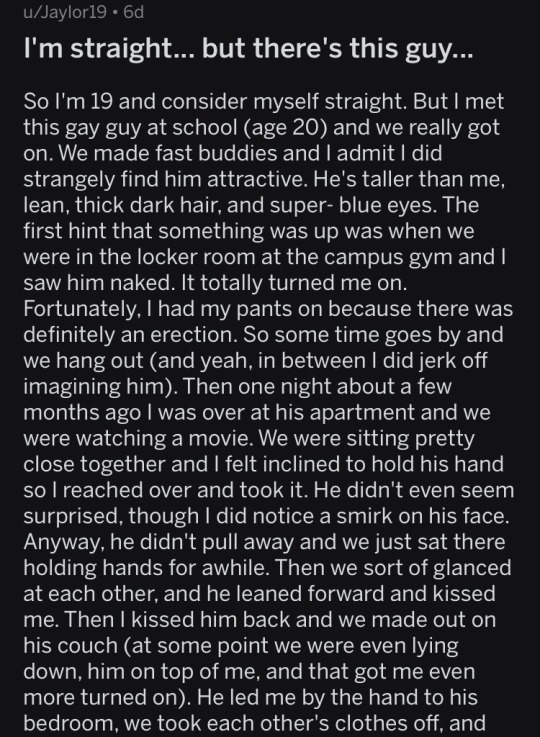
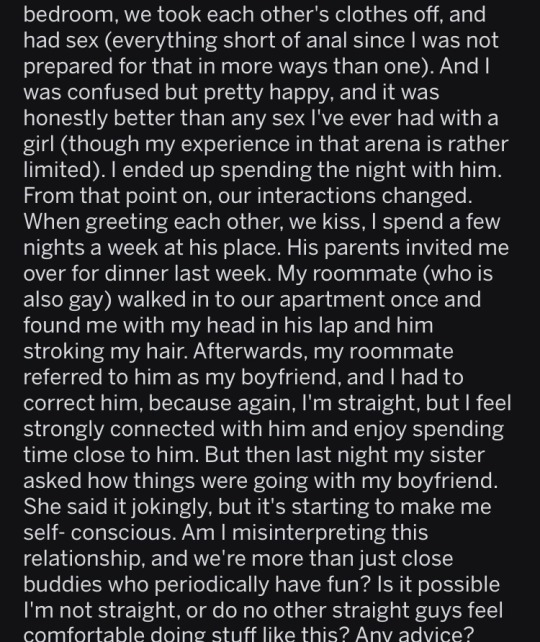
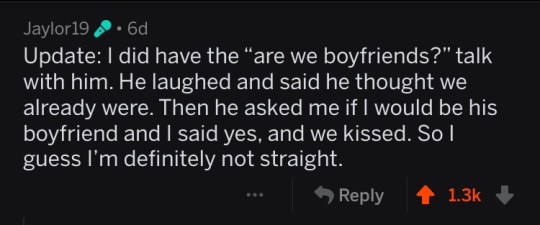
Okay, so I’ve seen some of the tags on this, and a lot of it is making fun of this dude for thinking he was straight when it was so clear he wasn’t.
But ya’ll don’t get it. This is EXACTLY what it’s like to be bi. If you grew up in any sort of environment where LGBT was Not Accepted, and you had any inclination toward the opposite sex, you just ran with that, because that’s all you were ever taught to look towards. And because for the longest time even the media was all ‘you’re either gay or straight’, forgetting that the B in LGBT has been there for quite a fucking while, you had no outside stories or icons you could turn to for guidance.
No one teaches you what being in a same sex relationship is supposed to be like or feel like, and what’s worse, most likely all you know is a caricature of what a homosexual relationship and/or person is, so your own experiences really won’t match up. So none of what’s happening to you makes sense with what you know.
So I can 100% fully believe my dude here thought he was straight. Until society teaches what it also means to be bi, this will neither be the last nor weirdest story you ever hear about a bisexual awakening.
Give the dude a chance.
I liked this story the first time I saw it come around, but I like it even more with this addendum.
I just want to know how people could read this and not immediately jump to “bisexual disaster”.




 Urocyon's Jaunts 2.0
You must be logged in to post a comment.